Best Mission Toilets (2026)
Toilets4.6
Mission-style toilets favor honest, simple lines and strong proportions over ornamentation, pairing naturally with Arts and Crafts bathrooms, and the strongest ones…
Read the guideEvery major EPA WaterSense certified toilet on the market today, with MaP flush scores, GPF ratings, and honest analysis to help you choose the right model for your home.
Research updated June 2026.
EPA WaterSense certification requires toilets to flush at 1.28 GPF or less while passing a 350-gram MaP minimum. Top performers like the TOTO Drake II and Kohler Cimarron hit 1.28 GPF with MaP scores at or above 800 grams, saving roughly 20 percent over standard 1.6 GPF models without sacrificing flush strength.
EPA WaterSense is a voluntary labeling program that certifies toilets using 1.28 gallons per flush (GPF) or less, while independently verifying they clear at least 350 grams of solid waste in third-party testing. The program was launched by the Environmental Protection Agency in 2006 and has since helped American households save over 5.5 trillion gallons of water cumulatively. A WaterSense-labeled toilet is guaranteed to meet both efficiency and performance thresholds, meaning you do not have to sacrifice flush power to save water.
The WaterSense standard sits well below the federally mandated 1.6 GPF maximum set by the Energy Policy Act of 1992. Yet it is not the same as ultra-high-efficiency (UHE) territory, which starts at 1.0 GPF or below. The 1.28 GPF sweet spot is where most premium brands now concentrate their lineups because the flush mechanics work reliably at that volume.
To earn the label, a manufacturer must submit products for independent certification by an EPA-recognized third-party certifier. These organizations run the MaP (Maximum Performance) protocol, which measures how many grams of simulated waste a toilet flushes completely in a single attempt. WaterSense requires a minimum MaP score of 350 grams, though competitive models regularly score 600 to 1,000 grams at 1.28 GPF.
The MaP protocol uses a standardized soybean-paste medium that simulates real household waste. A toilet scoring 800 grams at 1.28 GPF is, in practical terms, a stronger flusher than most older 1.6 GPF toilets that score below 600 grams. MaP score is the single most predictive metric for clog resistance -- GPF tells you water use, MaP tells you whether the bowl will clear reliably.
From a financial standpoint, a WaterSense toilet saves the average household approximately 13,000 gallons of water per year compared to a pre-1994 toilet using 3.5 GPF or more. Versus a standard 1.6 GPF toilet, the savings are around 4,000 gallons annually per household. At national average water rates, that translates to roughly $50 to $90 saved per year per toilet for a family of four.
WaterSense certification requires a minimum MaP score of 350 grams at 1.28 GPF or less, along with third-party verification by an EPA-recognized certifier such as IAPMO or NSF International. Standard MaP testing, conducted independently by Veritec Consulting, measures performance at whatever GPF the manufacturer specifies and publishes scores publicly without any EPA involvement. The key difference is that WaterSense is a certification with ongoing compliance requirements, while MaP testing is a voluntary benchmark that any toilet can undergo at any GPF rating.
MaP testing has been available since 2003 and covers thousands of toilet models. The published database at map-testing.com shows results across multiple flush volumes, including 1.6 GPF, 1.28 GPF, and even 1.0 GPF. A toilet can appear in the MaP database without being WaterSense certified if the manufacturer only tests it at 1.6 GPF, or if the certifier approval step was never completed.
WaterSense adds four compliance requirements beyond MaP performance: the toilet must flush at or under 1.28 GPF, it must carry the WaterSense label on packaging and product literature, it must be tested by a licensed certifier, and the manufacturer must maintain ongoing compliance audits. This makes WaterSense more stringent from a regulatory standpoint, even if both programs ultimately rely on the same MaP flush protocol for performance verification.
When shopping, look for both the WaterSense label (efficiency guarantee) and the published MaP score above 600 grams (performance guarantee). A toilet can be WaterSense certified with a MaP score of only 350 grams, which passes the threshold but represents below-average clog resistance. The best models carry certification and score 800 grams or higher.
Every major U.S. toilet brand offers WaterSense certified models in 2026, including TOTO, Kohler, American Standard, Gerber, Woodbridge, Swiss Madison, and Glacier Bay. TOTO and American Standard have the deepest certified lineups, with dozens of SKUs carrying the label. Gerber and Kohler focus their WaterSense offerings on flagship series like the Viper and Cimarron respectively, while budget brands like Woodbridge and Swiss Madison certify most of their 1.28 GPF models.
Here is a breakdown of WaterSense certified offerings by brand based on published manufacturer data and the EPA WaterSense product search database as of June 2026:
| Brand | Key WaterSense Series | GPF | MaP Score (Top Model) | Trapway Size | Price Tier |
|---|---|---|---|---|---|
| TOTO | Drake II, UltraMax II, Aquia IV | 1.28 / 0.9 | 1,000g | 2-1/8 in. | Mid-Premium |
| Kohler | Cimarron, Highline, Santa Rosa | 1.28 | 1,000g | 2-1/8 in. | Mid |
| American Standard | Champion 4, Cadet 3, VorMax | 1.28 | 1,000g | 4 in. (Ch4) | Mid |
| Gerber | Viper, Maxwell, Ultra Flush | 1.28 | 900g | 2-1/8 in. | Mid |
| Woodbridge | T-0001, T-0019, B-0750 | 1.28 / 0.8 | 800g | 2-1/8 in. | Budget-Mid |
| Swiss Madison | Ivy, Clarence, St. Tropez | 1.28 / 0.8 | 750g | 2-1/8 in. | Budget-Mid |
| Glacier Bay | Elongated series | 1.28 | 600g | 2 in. | Budget |
Note: MaP scores listed are for best-performing models within each brand's WaterSense lineup, not averages across all SKUs. Always verify the specific model number against the MaP database and the EPA WaterSense product search before purchasing.
The following models are all EPA WaterSense certified at 1.28 GPF or less, carry published MaP scores, and have substantial aggregated owner review data. Analysis is based on manufacturer specifications, MaP results, and aggregated buyer feedback across major retail platforms.
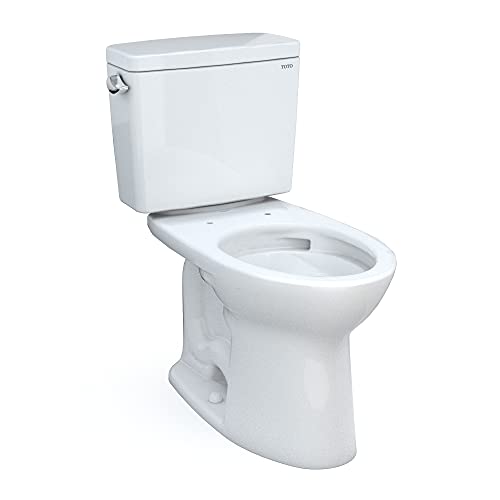
The TOTO Drake II is the benchmark WaterSense toilet, achieving a MaP score of 1,000 grams at 1.28 GPF through TOTO's Double Cyclone flush system, which uses two nozzles to create a powerful centrifugal flow across the entire bowl surface.
The Drake II uses TOTO's Double Cyclone technology, which replaced the older G-Max system starting around 2011. Instead of a single large siphon jet, it routes water through two rim nozzles that work in concert to produce a wide, spiraling wash. This design reduces water use while dramatically increasing bowl coverage compared to older 1.6 GPF siphonic designs.
Aggregated owner feedback consistently praises the Drake II for not requiring double flushing, even in high-use households. The CeFiONtect glaze is a meaningful differentiator: TOTO's proprietary ionic barrier layer makes the vitreous china surface measurably smoother than standard glazing, reducing the adhesion of waste and mineral deposits. Owners report the bowl stays cleaner between scrubbing sessions.
The Drake II is the toilet plumbers and bathroom contractors most frequently install when customers want WaterSense performance without troubleshooting risk. The Double Cyclone system is mature, well-documented, and the parts ecosystem for repair is deep. If you want to pick one model from this list and never think about it again, this is that model.
The TOTO UltraMax II brings the same Double Cyclone technology and 1,000-gram MaP score as the Drake II into a seamless one-piece form factor, eliminating the tank-to-bowl junction that accumulates grime in two-piece designs.
The UltraMax II is essentially the Drake II engine packaged in a streamlined, skirted housing. The flush performance is identical: 1.28 GPF, Double Cyclone system, CeFiONtect glaze, and WaterSense certification. The meaningful difference is the one-piece configuration, which eliminates the seam between tank and bowl where moisture, mildew, and mineral deposits commonly collect in two-piece designs.
For households where bathroom aesthetics matter -- master baths, renovated powder rooms, rental properties targeting higher-end tenants -- the UltraMax II's cleaner silhouette justifies the price premium over the Drake II. Aggregated owner reviews rate it very highly for ease of cleaning, with many noting the absence of crevices makes weekly maintenance significantly faster.
If you want the proven TOTO flush system and a bathroom that photographs cleanly, the UltraMax II is the answer. The performance is indistinguishable from the Drake II in day-to-day use. The decision comes down to whether the sleeker profile and easier cleaning are worth the additional cost over the two-piece configuration.
The TOTO Aquia IV adds a 0.9 GPF liquid-waste flush option to a WaterSense certified platform, making it the most water-efficient option in TOTO's mainstream lineup while maintaining a 1,000-gram MaP score on the full flush.
The Aquia IV uses a top-mounted dual-flush actuator -- a rectangular button on the tank lid -- that many users find less intuitive initially than a traditional side handle. However, the mechanism is reliable and the split-flush logic is straightforward: partial press for liquid waste at 0.9 GPF, full press for solid waste at 1.28 GPF. In a household where the 0.9 GPF option is used consistently for appropriate flushes, annual water consumption per toilet drops significantly below even a standard 1.28 GPF WaterSense model.
TOTO's WASHLET compatibility is a notable selling point for the Aquia IV platform. Several Aquia IV models are designed to accept TOTO's WASHLET bidet seat integration, allowing owners to add a bidet seat later without compatibility concerns. The CEFIONTECT glaze and the ceramic quality are identical to the Drake II series.
For households focused on minimizing water bills or located in drought-restricted areas of California, Arizona, or Colorado, the Aquia IV dual-flush system is worth the adjustment to the top-mount actuator. The long-term water savings over a single-flush 1.28 GPF model can be meaningful for large families.
Kohler's Cimarron consistently earns 1,000-gram MaP scores at 1.28 GPF while carrying the WaterSense label, making it the strongest value proposition in a mid-market price range for households that want proven performance without paying a TOTO premium.
Kohler's Cimarron uses a Class Five flush system with a 3-1/4 inch canister flush valve that opens completely on each flush, maximizing water flow. The 2-1/8 inch trapway is comparable to TOTO's specs, and aggregated MaP data confirms the Cimarron achieves the 1,000-gram maximum score at 1.28 GPF, which is exceptional at its price point.
The Comfort Height seat position at approximately 16.5 inches from floor to seat puts it in ADA-compliant territory, making it easier for taller adults and users with mobility limitations. For best flushing toilets recommendations at the mid-market price tier, the Cimarron is the default recommendation because it balances flush power, brand support infrastructure, and broad availability better than any comparable model.
The Kohler Cimarron's canister valve design does eventually wear and may require replacement after five to ten years of heavy use. However, the canister is a standard Kohler part available at virtually any hardware store. The excellent MaP score and the brand's parts availability make the Cimarron a reliable long-term choice at its price tier.
The American Standard Champion 4 features a massive 4-inch flush valve and 2-3/8 inch trapway -- the widest trapway among mainstream WaterSense certified toilets -- producing the largest water pathway and some of the strongest clog resistance available at 1.28 GPF.
American Standard's Champion 4 platform was originally engineered to solve chronic clogging in high-traffic residential settings. The 4-inch flush valve is nearly 60 percent wider than the 2.5-inch valves used in most competing models, creating a significantly faster water rush through the bowl. Combined with the 2-3/8 inch trapway, the Champion 4 produces a water column that physically cannot clog on typical household waste.
The WaterSense 1.28 GPF version maintains the same core engineering as the original 1.6 GPF Champion 4, with internal tank adjustments to reduce fill volume. The flush remains authoritative and owners across aggregated review data consistently report that the Champion 4 is the most reliable toilet they have owned for households with children, older adults, or other frequent plunging issues. See also our guide on best toilets for frequent clogs for more context.
The Champion 4's proprietary 4-inch flapper is the one ownership caveat worth knowing: when it needs replacement (typically every 3 to 5 years), you must use an American Standard OEM flapper, not a generic. The generic replacements do not seat correctly on the oversize valve. Keep a spare on hand or order directly from American Standard.
The American Standard Cadet 3 FloWise in round-front configuration is one of the most space-efficient WaterSense certified toilets available, with a round bowl that reduces the overall footprint while maintaining a MaP score above 600 grams at 1.28 GPF.
For powder rooms, half-baths, and bathrooms under 40 square feet, the round-front Cadet 3 FloWise is the most practical WaterSense choice. The bowl depth savings of roughly 2 inches over an elongated equivalent can be the difference between comfortable door clearance and a space that feels cramped.
The Cadet 3's EverClean antimicrobial surface is an American Standard proprietary treatment that inhibits bacterial and mold growth on the bowl surface, similar in concept to TOTO's CeFiONtect but applied as a chemical treatment rather than a glaze modification. Owners report it works adequately in practice, though not quite as impressively as TOTO's approach. For small bathroom toilet guidance, the Cadet 3 round-front FloWise remains the default recommendation.
The Cadet 3 FloWise MaP score varies by SKU. The elongated versions score higher (up to 800g or above) while some round-front versions score closer to 600g. If clog resistance is a priority even in a small bathroom, opt for the elongated Cadet 3 FloWise if the space permits it.
The Woodbridge T-0001 delivers a skirted, contemporary one-piece profile with dual-flush WaterSense certification at a price point significantly below TOTO and Kohler competitors, with a published MaP score above 800 grams on the full 1.28 GPF flush.
Woodbridge has built a strong reputation for delivering premium-looking toilets at accessible price points. The T-0001's fully skirted exterior eliminates the exposed trapway, giving it the clean silhouette of toilets that cost two to three times as much. The dual-flush top-mount button functions correctly in the vast majority of owner-reported experiences, though a small percentage of users report fill-valve adjustment needs during the first few months.
At the 800-gram MaP score, the T-0001 performs meaningfully better than the 350-gram WaterSense minimum and handles typical household waste reliably. It is not in the same tier as the Champion 4 or Drake II for extreme load scenarios, but for a typical household without chronic clogging history, the performance gap is rarely noticed in practice. For more on this brand, see our detailed Woodbridge T-0001 review.
The Woodbridge T-0001 occupies a genuine gap in the market: a modern, skirted, dual-flush one-piece toilet at a price that competes with traditional two-piece models from major brands. If aesthetics are a priority and the budget is limited, this is the most visually sophisticated WaterSense option at the accessible price tier.
Gerber's Viper is a contractor-favorite WaterSense certified toilet that achieves a MaP score around 900 grams at 1.28 GPF with a straightforward siphonic action and durable tank components, making it a reliable workhorse at a mid-range price point.
Gerber is less well-known among consumers than TOTO or Kohler, but it has a strong reputation in the plumbing trade. The Viper's internal components are deliberately simple: a standard 3-inch tower-style flush valve and a reliable fill valve that plumbers can replace with common parts from any supply house. This simplicity translates to lower long-term maintenance costs compared to proprietary systems.
For landlords and property managers who want a reliable WaterSense toilet that any plumber can service without brand-specific parts, the Gerber Viper is a practical choice that the TOTO and Kohler options, despite their superior flush technology, cannot fully match in serviceability terms. Our overview of best Gerber toilets covers the full lineup for further reference.
Plumbers favor the Gerber Viper because the internals are conventional and fixable with parts from any wholesale plumbing distributor. For rental properties where the next service call might happen in five years with a different plumber, the Viper's standardized internals are a genuine practical advantage over proprietary systems from premium brands.
For most households, 1.28 GPF is the optimal WaterSense choice because it balances meaningful water savings with strong flush performance and broad model availability. Dual-flush models offering 0.8 or 0.9 GPF on the light cycle add water savings for liquid waste but require user behavior change and come with slightly more complex internals. Ultra-high-efficiency models at 0.8 GPF single-flush are available but have less MaP data and can require double-flushing in some configurations, which negates the water savings.
The 1.28 GPF standard exists because testing has shown that, at this volume, a well-engineered siphonic toilet can reliably evacuate 350 to 1,000 grams of solid waste per flush. This makes the volume sufficient for full household use without the need for double-flushing in typical scenarios.
Here is how different GPF levels compare for WaterSense certified toilets:
Some California and Colorado municipalities now require 1.28 GPF or below for all new toilet installations, while others in extreme drought zones push toward 1.0 GPF. Always check local plumbing code requirements before purchasing -- a toilet that exceeds the local GPF limit cannot be legally installed even if it carries the WaterSense label for national purposes.
For a detailed look at how these numbers translate across the full range of residential toilets, see our guide on toilet GPF ratings explained.
Yes. EPA WaterSense certified toilets are eligible for toilet rebate programs offered by thousands of water utilities across the United States, with rebates typically ranging from $50 to $200 per toilet depending on the utility and geographic region. Many California, Texas, and Florida water districts offer the highest rebate values; the EPA maintains a rebate finder tool at epa.gov/watersense/rebate-finder that allows users to search by ZIP code for available programs. Some utilities also offer free toilet replacement programs for low-income households.
Rebate availability is utility-specific and changes annually based on budget allocation. Common rebate structures include:
To claim a rebate, most utilities require: proof of purchase (receipt), the product name and model number confirming WaterSense certification, and in some cases a completed rebate application or photo of the installed toilet. Always check your local utility's website before purchasing to confirm current program terms and whether pre-approval is required.
In southern California, LADWP and the Metropolitan Water District have historically offered some of the country's most generous toilet rebates, sometimes reaching $200 per unit for dual-flush WaterSense certified models. Stacking a rebate with a sale price can make a premium TOTO or Kohler model competitive in cost with a budget toilet while delivering significantly better long-term performance. Always check before purchasing.
For a broader look at how toilet water usage adds up, see our article on how much water a toilet uses.
WaterSense certified means the toilet has been independently tested and verified to flush at 1.28 gallons per flush or less, while passing a minimum 350-gram MaP flush performance test. The EPA WaterSense program administers the certification and requires third-party testing by accredited certifiers like IAPMO or NSF.
Yes, for well-engineered models. The key variable is MaP score, not GPF alone. A toilet at 1.28 GPF with a 1,000-gram MaP score (like the TOTO Drake II or Kohler Cimarron) flushes solid waste more effectively than many older 1.6 GPF toilets with poor trapway geometry. GPF tells you water volume; MaP tells you actual performance.
Compared to a pre-1994 toilet using 3.5 GPF, a WaterSense toilet at 1.28 GPF saves approximately 13,000 gallons per household annually. Compared to a standard 1.6 GPF toilet, the savings are roughly 4,000 gallons per year per toilet for a typical four-person household, based on EPA estimates using average flush frequency.
The EPA WaterSense program requires a minimum MaP score of 350 grams for certification. However, 350 grams is well below what is considered adequate for most household use. Most plumbers and bathroom specialists recommend looking for a MaP score of at least 600 grams, and preferably 800 grams or above, to ensure reliable performance without double-flushing.
Yes. The EPA maintains a searchable product database at epa.gov/watersense that allows verification by brand, model, and model number. You can also look for the WaterSense label on product packaging and manufacturer specification sheets. If a toilet is listed in the EPA database, certification is current.
No. A dual-flush toilet is only WaterSense certified if it meets the program requirements and has been submitted for third-party certification. The 1.28 GPF full-flush mode must be the maximum volume setting, and the toilet must pass the 350-gram MaP test at that volume. Not all dual-flush toilets on the market carry WaterSense certification; always check the EPA product database.
WaterSense certification is tied to the specific model and requires ongoing compliance by the manufacturer. If a manufacturer changes the internal design of a certified model, recertification may be required. From a consumer standpoint, a certified model in production remains certified, but if you are purchasing an older model from inventory, it is worth verifying current status in the EPA database, particularly for models produced before 2020.
TOTO's primary WaterSense certified models include the Drake II, UltraMax II, Aquia IV, Drake (Eco version), Entrada, Vespin II, Nexus, and Carlyle II series. TOTO has one of the broadest WaterSense certified lineups of any manufacturer, covering two-piece, one-piece, and wall-hung configurations across multiple price points. Verify specific SKUs in the EPA WaterSense product database.
Specific Kohler Highline variants are WaterSense certified when they use the 1.28 GPF flush setting. The Kohler Highline Classic and Highline Arc in 1.28 GPF configurations carry WaterSense certification. The older 1.6 GPF Highline models do not qualify. Always confirm the model number ends in a designation indicating 1.28 GPF when purchasing.
A high-efficiency toilet (HET) is defined by flushing at 1.28 GPF or less -- which is the same volume threshold as WaterSense. However, WaterSense adds the performance verification layer: third-party certification and a minimum 350-gram MaP score. HET is a general industry term, while WaterSense is a specific EPA certification program with enforceable standards.
For dual-flush toilets, WaterSense requires the full flush to be 1.28 GPF or less, and the partial flush to be no more than 0.8 GPF for liquid waste. The MaP performance test is conducted on the full flush at 1.28 GPF. The average flush volume across both modes, assuming typical usage patterns, must also meet the WaterSense efficiency threshold.
Yes. California's CALGreen building standards require 1.28 GPF maximum for toilets in new construction and renovations, which aligns with WaterSense but is a separate regulatory requirement. Some California water districts go further, requiring 1.0 GPF or below in drought-designated areas. WaterSense is a federal voluntary program; CALGreen is a mandatory building code. A WaterSense certified toilet generally meets CALGreen toilet requirements, but always verify local code.
Federal tax credits for WaterSense toilets alone are not currently available under standard residential energy tax credit programs, which focus on heating, cooling, and insulation improvements. However, some state-level tax incentives and utility rebate programs do provide financial benefits. Check with your state energy or water agency for current incentive programs, as these change annually.
WaterSense is an EPA certification program requiring efficiency (1.28 GPF max) and performance (350g MaP min) with third-party verification. MaP testing is an independent performance-only protocol that measures how many grams a toilet flushes at any specified volume, without an efficiency requirement or certification process. A toilet can appear in the MaP database without WaterSense certification, and the two programs serve complementary but different purposes.
No special installation is required. WaterSense certified toilets install identically to standard toilets using the same rough-in dimensions (typically 12 inches), wax ring seal, water supply connection, and toilet bolts. The only consideration is ensuring the home's water supply pressure is within the recommended range (typically 20 to 80 PSI) for the specific model to perform at its rated flush volume.
The dual-flush 1.28/0.8 GPF model saves more water if the low-flush button is consistently used for liquid waste, which accounts for approximately 65 to 70 percent of household flushes according to EPA usage data. In practice, dual-flush models save about 20 percent more water per year than single-flush 1.28 GPF models in households that use the dual-flush function correctly.
Not all American Standard models are WaterSense certified. Models using 1.6 GPF settings do not qualify. American Standard's WaterSense certified lineup includes the Champion 4 (1.28 GPF version), Cadet 3 FloWise, VorMax Plus, and several H2Option dual-flush models. Always confirm the model's GPF rating and check the EPA WaterSense database before purchasing.
Double-flushing in a WaterSense toilet is usually caused by three factors: low home water pressure (below 20 PSI at the toilet supply), an incorrect water level in the tank (below the fill line marked inside the tank), or a MaP score that is too low for the household's typical waste volume. Verifying water pressure, adjusting the fill valve to the correct tank water level, and selecting a model with a MaP score of 600 grams or above typically resolve double-flush issues.
Yes. WaterSense certified toilets are fully compatible with aftermarket bidet toilet seats, provided the seat is sized correctly for the bowl shape (round or elongated) and the rough-in dimensions allow for the seat's power cord or water supply connection. TOTO's Aquia IV and UltraMax II are specifically designed with WASHLET compatibility in mind. Verify bidet seat compatibility with the specific toilet model before purchasing.
EPA WaterSense certification is the most reliable single indicator that a toilet will save water and still flush effectively, but the MaP score tells you by how much. For most households, the TOTO Drake II or Kohler Cimarron at 1.28 GPF with 1,000-gram MaP scores represent the optimal balance of water efficiency, flush power, and long-term reliability. If water savings are a top priority, a dual-flush model like the TOTO Aquia IV or Woodbridge T-0001 can reduce consumption further. In every case, verify WaterSense certification in the EPA database and confirm the MaP score is 600 grams or above before purchasing -- the label alone is not sufficient due diligence.
How we rank & our data sources
We do not run physical lab tests. Rankings are built from published, verifiable data and real owner feedback, never paid placement.
Researched by Marcus Bell · Last updated June 28, 2026 · Our review method
Mission-style toilets favor honest, simple lines and strong proportions over ornamentation, pairing naturally with Arts and Crafts bathrooms, and the strongest ones…
Read the guide
Elaborate high-tank pull-chain designs and ornately scalloped silhouettes that bring genuine period drama without sacrificing a modern, reliable flush.
Read the guide
Refined, softly curved one-piece and skirted silhouettes with a polished, Parisian-elegant profile, paired with verified MaP flush scores rather than a stylist's…
Read the guide