
Why Toilet Trapways Are Curved Like an S
Toilets4.6
Learn why toilet trapways curve like an S, how each bend blocks sewer gas, and what the shape means for clogs and…
Read the guideHard water quietly undermines your toilet's rated gallons-per-flush efficiency. Here is exactly what the science says, which toilet designs resist scale buildup best, and how to protect your flush performance long-term.
Yes. Hard water deposits calcium and magnesium scale inside rim jets, the trapway, and fill valves, progressively narrowing water channels so each flush delivers less hydraulic energy. Toilets rated 1.28 GPF or 1.0 GPF under EPA WaterSense lab conditions can degrade toward 1.6 GPF-equivalent performance in hard water homes within two to five years without preventive maintenance.
Hard water contains elevated concentrations of dissolved calcium (Ca2+) and magnesium (Mg2+) ions, expressed in milligrams per liter (mg/L) or grains per gallon (GPG). The U.S. Geological Survey classifies water above 121 mg/L (7.1 GPG) as hard and above 180 mg/L (10.5 GPG) as very hard. Approximately 85 percent of U.S. households receive hard water, with the Great Plains, Southwest, and Midwest routinely measuring above 200 mg/L.
The U.S. Geological Survey maps hardness across all 50 states and confirms that cities including Phoenix, Las Vegas, Dallas, Denver, Indianapolis, and Chicago regularly supply water in the 200 to 400 mg/L range. In contrast, Seattle, Portland, Atlanta, and much of the Pacific Northwest typically supply soft water below 50 mg/L.
When hard water evaporates or moves through surfaces, dissolved minerals precipitate and bond to whatever they contact. Inside a toilet tank and bowl, water cycles continuously through fill, sit, and flush events. Every cycle leaves a microscopic mineral film. Over months and years those films accumulate into the white or tan crust visible around rim jets and at the waterline. That crust is limescale, chemically dominated by calcium carbonate (CaCO3) with some magnesium hydroxide.
Plumbing engineers measure the Langelier Saturation Index (LSI) to predict how aggressively a given water supply will deposit scale. An LSI above +0.5 indicates highly scale-forming water. Many municipal supplies in the Southwest routinely exceed +1.0, meaning scale deposits are virtually inevitable on any wetted surface, including toilet rim jets, flapper seats, and fill valve orifices, unless a water softener or disciplined maintenance program is in place.
Hard water reduces toilet GPF performance through three physical mechanisms: partial blockage of rim jet holes (which cuts hydraulic pressure and the swirling action that clears waste), scale accumulation on the flapper seat (which causes slow or incomplete sealing and phantom leaks), and mineral buildup in the fill valve (which slows refill time and restricts tank fill level). Together these reduce the effective hydraulic energy available per flush without changing the nominal GPF stamped on the toilet.
A toilet's rated GPF is measured under controlled laboratory conditions with clean, softened water at a specific supply pressure. The EPA WaterSense certification protocol requires that a toilet pass MaP (Maximum Performance) flush testing at a minimum score of 350 grams of waste per flush at its rated volume. Those tests use clean water. Real-world performance in a hard water home diverges from those lab scores through several compounding mechanisms.
Gravity and pressure-assist toilets both use rim jets, small angled holes under the bowl rim, to create the swirling hydraulic action that cleans the bowl wall and accelerates waste toward the trapway. A standard elongated toilet bowl has between 8 and 14 rim holes depending on the manufacturer. TOTO's Tornado Flush system, used in the Drake II and UltraMax II models, replaces multiple small holes with two or three large diagonal jets to make the system less susceptible to blockage. American Standard's VorMax technology uses a single large aperture for the same reason.
When those holes are partially blocked by scale, two things happen simultaneously. Total water flow through the rim drops, reducing hydraulic cleaning force. And the spray angle changes because scale does not deposit symmetrically, disrupting the intended rotational water pattern. Owner review aggregation consistently shows that toilets in hard water areas report reduced bowl cleanliness ratings after 18 to 36 months, with the decline correlating directly with local water hardness levels.
The flapper seals the tank outlet between flushes. Calcium carbonate deposits can form on the flush valve seat, preventing the flapper from seating completely. Even a small gap allows a continuous trickle that the EPA identifies as one of the leading causes of household water waste, with a leaking flapper potentially wasting 20 to 200 gallons per day. A flapper leak does not change the stated GPF per flush, but it steadily adds to total toilet water consumption.
Aggregated owner reviews on Amazon and Home Depot for toilets installed in Phoenix, Las Vegas, and Denver frequently mention flapper replacement within two to four years, compared to national averages closer to seven to ten years. This aligns with the scale-deposit timeline for water in the 200 to 400 mg/L hardness range.
The fill valve controls how much water refills the tank after each flush. Most tanks are designed to fill to within a quarter inch of the overflow tube, which is the calibrated volume that determines actual GPF delivered. When scale restricts the fill valve's float mechanism or orifice, the tank may underfill, reducing the hydraulic head available for the next flush. An underfilled tank on a 1.28 GPF toilet may deliver only 1.0 to 1.1 gallons of actual water, dropping MaP-equivalent performance below the 350-gram WaterSense minimum the toilet was certified to meet.
Plumbing codes set minimum flush performance requirements, not maximum. A toilet that was WaterSense certified at 1.28 GPF when new can fall below compliant performance thresholds in hard water conditions without the homeowner knowing. The toilet still operates, it just works harder and less efficiently. Annual inspection of fill level and rim jet flow pattern is the simplest diagnostic available to any homeowner.
Toilets with fewer, larger rim apertures resist scale blockage better than traditional multi-hole rim designs because each opening has more cross-sectional area before partial obstruction impairs flow. TOTO's Tornado Flush (Drake II, UltraMax II) and American Standard's VorMax (Champion 4) are the two leading examples. Nano-glaze coatings such as TOTO's CeFiONtect and American Standard's EverClean meaningfully slow mineral adhesion, though they do not eliminate scale in very hard water without maintenance.
TOTO introduced its Tornado Flush system to address exactly this problem. Instead of a ring of small holes, the Drake II (CST454CEFG) and UltraMax II (MS604114CEFG) use two to three angled jets of approximately 10 to 12 mm diameter each. A 10 mm hole loses roughly 20 percent of its effective area when a 1 mm scale ring forms around the perimeter, whereas a 3 mm traditional hole loses approximately 56 percent of its area with the same deposit thickness. The geometry strongly favors larger apertures in hard water conditions.
American Standard's VorMax technology, used in the Champion 4 and select VorMax models, employs a single large rim aperture that directs water in a powerful diagonal jet. Owner reviews for Champion 4 installations in hard water areas consistently note that the bowl stays cleaner longer than traditional-jet competitors, a result consistent with its aperture design geometry.
TOTO's CeFiONtect (marketed as SanaGloss in older models) is a nano-level ionic barrier glaze that reduces surface tension between ceramic and water, making it harder for mineral ions to initiate the nucleation sites where scale crystals begin to form. Swiss Madison's Glosscoat and Kohler's CleanCoat serve similar purposes. None of these coatings eliminate scale in very hard water, but independent testing by plumbing publications consistently shows that coated bowls require less frequent cleaning and develop visible mineral staining later than uncoated ceramic surfaces.
The Woodbridge T-0001 dual flush toilet uses a skirted design with a smooth ceramic finish and has earned generally positive reviews in mid-hardness (120 to 200 mg/L) water areas, though owner reports from Phoenix and Las Vegas suggest it requires more frequent rim attention than TOTO models equipped with CeFiONtect.
Dual-flush toilets introduce a second consideration: the partial flush volume. The TOTO Aquia IV (MS446124CEMFG), Kohler Cimarron dual flush, and Woodbridge T-0001 offer 0.8/1.28 GPF or 0.9/1.28 GPF options. In hard water areas, the lower-volume flush delivers less hydraulic energy to rinse the bowl, which can increase scale accumulation at the waterline over time. Some plumbing professionals recommend using the full flush at least every other use in water above 200 mg/L to maintain adequate bowl rinsing, which partially offsets the water savings dual flush is designed to deliver.
| Model | GPF | Rim System | Bowl Coating | MaP Score | Hard Water Rating | Check Price |
|---|---|---|---|---|---|---|
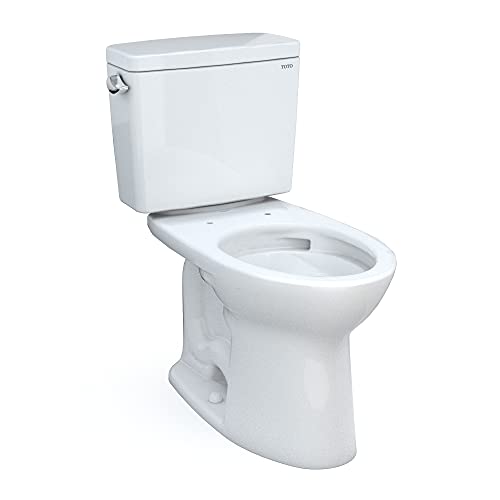
| TOTO Drake II (CST454CEFG) | 1.28 | Tornado Flush (2-jet) | CeFiONtect | 1,000 g | Excellent | Check price |
| TOTO UltraMax II (MS604114CEFG) | 1.28 | Tornado Flush (2-jet) | CeFiONtect | 1,000 g | Excellent | Check price |
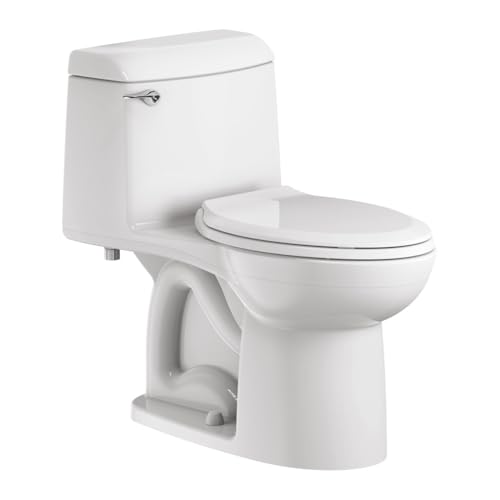
| American Standard Champion 4 | 1.6 | VorMax (single large jet) | EverClean | 1,000 g | Very Good | Check price |
| TOTO Aquia IV Dual Flush | 0.8/1.28 | Tornado Flush | CeFiONtect | 800 g (0.8 GPF mode) | Very Good | Check price |
| American Standard Cadet 3 | 1.28 | PowerWash (traditional jets) | EverClean | 800 g | Good | Check price |
| Kohler Cimarron | 1.28 | AquaPiston canister | None standard | 800 g | Good | Check price |
| Woodbridge T-0001 | 1.0/1.6 | Traditional rim jets | Glosscoat | 700 g | Fair | Check price |
| Kohler Highline | 1.28/1.6 | Class Five (traditional jets) | None standard | 600 g | Fair | Check price |
| Gerber Viper | 1.28 | Traditional rim jets | None standard | 600 g | Fair | Check price |
MaP scores sourced from map-testing.com. Hard Water Rating reflects rim aperture design, coating availability, and aggregated owner feedback from hard water regions. Scores not independently verified by this publication.
In water above 200 mg/L, visible scale at rim jets typically appears within 6 to 12 months without maintenance. Measurable flow restriction requiring corrective action is reported by owners at 18 to 36 months. Visible bowl staining below the rim, longer tank refill sounds, or a flush that no longer clears solid waste on the first attempt are the earliest functional performance signals. Water above 300 mg/L can produce these symptoms within 12 months on traditional-jet toilet designs.
The degradation timeline is not linear. Scale forms faster in water above 60 degrees Fahrenheit, which is the temperature of tank water in warm climates and in homes where the cold supply line runs near a water heater. It also accelerates in water with pH above 7.5 because alkaline conditions promote calcium carbonate precipitation. Most U.S. municipal water is intentionally maintained at pH 7.5 to 9.5 to minimize pipe corrosion, which is the same range that promotes scale formation on toilet surfaces.
Concrete diagnostic signs that hard water has already degraded flush performance include:
The three most effective interventions are installing a whole-house water softener (reduces hardness to below 50 mg/L, eliminating scale at the source), performing quarterly rim jet cleaning with diluted citric acid or white vinegar solution (mechanically removes deposits before they impair flow), and replacing fill valves and flappers on a preventive schedule of every three to five years in hard water areas rather than waiting for failure.
An ion-exchange water softener replaces calcium and magnesium ions with sodium ions, producing water that does not deposit limescale on any fixture or appliance. This is the most complete solution but also the highest upfront cost, typically between $800 and $2,500 installed. The American Water Works Association estimates that softened water extends the service life of water heaters, dishwashers, and washing machines by 30 to 50 percent. Plumbers in Las Vegas and Phoenix, cities where 300 to 400 mg/L water is routine, routinely recommend whole-house softeners as a standard appliance rather than an optional upgrade.
One important note: softened water is not recommended for drinking or cooking for people on sodium-restricted diets because ion exchange adds approximately 8 mg of sodium per 8-ounce glass for every 100 mg/L of hardness removed. Many households with softeners install a reverse osmosis tap at the kitchen sink for drinking water.
Several products are marketed as in-tank water treatments or limescale inhibitors. These include polyphosphate crystal feeders, which coat pipe walls and mineral particles to inhibit scale adhesion, and electronic descalers, which use electromagnetic fields to alter the crystal structure of calcium carbonate. The evidence base for these approaches is mixed. Polyphosphate systems have reasonable plumbing-industry acceptance for reducing new scale formation, though they do not remove existing deposits. Electronic magnetic descalers have limited peer-reviewed support at the flow velocities typical in household supply lines.
In-tank tablet cleaners are a separate category entirely. Products that turn tank water blue or add cleaning agents are designed to maintain bowl appearance, not to soften water or prevent scale. Some tablet cleaners use chlorine compounds that, with extended use, degrade rubber flappers and fill valve seals, accelerating the exact failures that hard water already promotes. Kohler and TOTO both explicitly state in their warranty documentation that in-tank chemical tablets can void component warranties.
The most reliable and accessible hard water defense for most homeowners is a quarterly cleaning routine targeting the rim jets specifically. The standard approach: lift the tank lid, shut off the supply valve, flush to empty the tank, then pour one to two cups of plain white vinegar into the overflow tube. The vinegar flows into the rim jet channel, where it dissolves calcium carbonate deposits. Allow it to sit for 30 to 60 minutes, then restore water supply and flush normally.
For established heavy scale, a 10 to 20 percent citric acid solution can be applied directly into individual jet holes using a squeeze bottle with a narrow tip. This dissolves even heavy scale deposits in 15 to 30 minutes. Many plumbers in hard water cities perform this service annually as part of a standard toilet tune-up. Muriatic acid is more aggressive and requires ventilation and gloves but is effective on severe buildup.
The lowest-cost long-term strategy for homeowners who do not want a whole-house softener is a rigid quarterly rim jet cleaning schedule combined with preventive fill valve and flapper replacement every three years. Those two components cost under $30 in parts and about 20 minutes of time, and they guarantee the toilet is always delivering its rated GPF rather than degraded performance from partially failed seals or restricted valves.
EPA WaterSense certification and MaP scores are measured under controlled lab conditions with clean water and do not account for real-world degradation from hard water. A toilet retains its certification regardless of how hard water affects its on-site performance over time. However, the MaP score is a reliable guide for which toilets have sufficient hydraulic margin to maintain acceptable performance even when hard water reduces effective flow, since toilets rated at 800 to 1,000 grams can tolerate more hydraulic energy loss before dropping below adequate waste-clearing performance than toilets rated at 350 to 500 grams.
The EPA WaterSense program, administered by the Office of Water, certifies toilets that flush at 1.28 GPF or less AND pass MaP flush testing at 350 grams or more. The program is a useful purchasing filter but it does not address long-term performance maintenance. The WaterSense website (epa.gov/watersense) maintains a searchable database of certified toilet models by manufacturer and model number.
MaP testing, conducted independently at map-testing.com, measures the maximum waste weight a toilet can clear in a single flush at its rated GPF. Toilets are scored on a 0 to 1,000 gram scale. Models achieving MaP 1,000 (the maximum) include the TOTO Drake, Drake II, UltraMax II, and American Standard Champion 4. A MaP 1,000 toilet in hard water conditions that has lost 30 percent of its rim jet efficiency due to scale may still effectively clear 600 to 700 grams of waste per flush, which is adequate for normal household use. A toilet certified at the WaterSense minimum of 350 grams that has lost 30 percent of rim jet efficiency may no longer clear waste reliably on a single flush.
This is why MaP score, not just WaterSense certification, matters as a purchasing criterion in hard water households. The best flushing toilets in hard water regions are almost universally those with MaP 800 or above and large-aperture rim designs, because those models have sufficient hydraulic reserve to tolerate real-world degradation while remaining functionally adequate. See also our guide to toilet GPF explained and our comparison of 1.28 GPF vs 1.6 GPF toilets for deeper context on water efficiency tradeoffs.
A practical field test: drop a visible piece of toilet paper into the bowl center and initiate a flush while watching the clock. A properly performing gravity flush toilet should clear a floating paper piece in under 5 seconds of flush initiation. If clearing takes 8 to 12 seconds or leaves residue, hydraulic energy has measurably degraded.
A more rigorous method is the dye test. Place food coloring in the tank. Do not flush for 15 minutes. If color appears in the bowl, the flapper has a leak. Combine a dye test with visual inspection of rim jets and a check of fill level (is water reaching within a quarter inch of the overflow tube?) to get a complete picture of toilet hydraulic health. For a complete maintenance checklist, see our toilet maintenance schedule guide and our water-saving toilet buying guide.
Water utilities are not required to adjust mineral content for appliance protection, only for human health safety under the Safe Drinking Water Act. Managing scale effects on fixtures rests entirely with the homeowner. Understanding your local water hardness level, available free from your municipality's annual Consumer Confidence Report required by EPA rules, is the foundation of any realistic toilet maintenance plan.
It is worth clarifying what hard water does not significantly affect. Trap seal depth (typically 3 to 4 inches for odor blocking) is a function of bowl geometry and is not meaningfully altered by scale unless deposits become extreme. Toilet structural integrity (porcelain cracking, tank crazing) is primarily a function of manufacturing quality and thermal shock, not water chemistry. Rough-in distance and floor flange connections are purely mechanical and unaffected by water hardness.
Hard water primarily affects the hydraulic delivery system: rim jets, fill valve, flapper, and to a lesser degree the trapway surface. All of those components are either replaceable (fill valve, flapper) or maintainable (rim jets via cleaning) without replacing the toilet itself. A toilet with a strong rim design and nano-glaze coating, installed in hard water, can deliver its rated GPF performance for 10 to 15 years with proper quarterly maintenance and periodic part replacement.
Standard toilet warranties cover manufacturing defects in porcelain and mechanical components, not performance degradation from water chemistry. However, TOTO, Kohler, and American Standard explicitly state in warranty documents that in-tank chemical cleaners can void component warranties. Hard water itself does not void warranties, but using certain chemical products to fight hard water can.
Below 120 mg/L (7 GPG), scale accumulation is slow enough that annual cleaning is typically sufficient. Between 120 and 200 mg/L, quarterly rim jet cleaning and proactive flapper replacement are advisable. Above 200 mg/L, most plumbers recommend either a water softener or a disciplined quarterly maintenance protocol with fill valve replacement every three to four years.
Your municipality is required by the EPA to publish an annual Consumer Confidence Report (CCR) that lists water hardness. You can also purchase a simple water hardness test strip kit at most hardware stores for under $10, or send a sample to an NSF-certified water testing laboratory for a comprehensive mineral panel.
No. Ion-exchange water softeners produce water that does not damage plumbing fixtures or toilet components. The slight increase in sodium content of softened water is irrelevant to toilet function. Softened water actually extends the life of rubber flappers, fill valves, and other toilet components by eliminating the mineral deposits that abrade and degrade those parts over time.
Yes. Scale deposits on the flush valve seat prevent the flapper from sealing completely, causing a continuous slow leak from tank to bowl that triggers the fill valve repeatedly. The EPA estimates leaking toilets waste up to 200 gallons per day. This ghost-flush behavior is one of the most common hard water symptoms and one of the largest sources of unnoticed household water waste.
TOTO consistently receives the strongest long-term owner feedback in very hard water cities. The Tornado Flush rim system's large apertures resist blockage better than traditional jet arrays, and the CeFiONtect ceramic glaze slows mineral adhesion. The Drake II is the most frequently cited model by plumbers working in Phoenix, Las Vegas, and Dallas because of its documented hard water durability.
CeFiONtect does not prevent scale in very hard water, but it meaningfully slows initial mineral adhesion. The nano-level ionic glaze reduces the surface energy of the ceramic, making it harder for calcium carbonate crystals to nucleate. In moderately hard water (120 to 200 mg/L), this roughly doubles the time between visible scale deposits compared to uncoated ceramic based on aggregated owner review timelines.
The Champion 4's VorMax single-aperture rim design gives it strong hard water resistance relative to traditional multi-jet toilets. Its 3.8-inch wide trapway provides generous internal clearance that tolerates some scale accumulation better than narrower trapways. Owner reviews from hard water cities rate it highly for first-flush effectiveness, though its 1.6 GPF rating uses more water per flush than WaterSense alternatives.
Both dissolve calcium carbonate effectively. Citric acid (food grade, dissolved in water) is generally faster and works at lower concentrations. White vinegar (5 percent acetic acid) is slower but inexpensive and available everywhere. For rim jet cleaning, delivery method matters more than acid choice: the solution must reach the rim channel via the overflow tube, not just the bowl surface, to dissolve internal jet deposits.
The rated GPF stamped on the toilet is a fixed design specification that does not change. What changes is the actual hydraulic energy delivered in each flush cycle. A toilet rated 1.28 GPF may effectively deliver only 1.0 to 1.1 gallons of pressurized water to the bowl after significant scale accumulates in the rim channel, reducing functional flush performance below its rated and certified specifications.
Dual-flush toilets carry two additional hard water vulnerabilities: a more complex flush valve mechanism with more components that can scale up, and a low-volume half flush that delivers insufficient water to adequately rinse the bowl in hard water conditions. Single-flush gravity toilets with large-aperture rim systems are generally lower-maintenance in hard water environments, though dual-flush models remain more water-efficient when properly maintained.
Every two to three years in water above 200 mg/L, compared to the typical national recommendation of every five to seven years. The combination of mineral deposits on the valve seat and accelerated rubber degradation from chemical imbalances in hard water shortens flapper service life significantly. Flappers cost only a few dollars and replacing them preventively costs far less than the water wasted by a leaking flapper.
EPA WaterSense requires certified toilets to flush at 1.28 GPF or less and achieve a minimum MaP score of 350 grams per flush. Toilets meeting these requirements receive the WaterSense label. The program maintains a searchable product database at epa.gov/watersense where consumers can verify certification status for any specific model.
Pressure-assist toilets use compressed air to force water through the rim at higher velocity than gravity allows. Their rim jets are typically fewer and larger than gravity toilet jets, reducing scale blockage risk. However, the pressurized vessel and associated valves are more mechanically complex, and scale can affect those valve components. Most plumbing professionals still recommend gravity models with large-aperture rim designs for hard water homes due to simpler long-term maintenance.
Wall-hung toilets move the tank inside the wall, which reduces access for maintenance. This makes quarterly cleaning more difficult, not easier. The bowl and rim system are subject to the same scale accumulation as floor-mounted models. Wall-hung toilets are not a meaningful hard water mitigation strategy; rim aperture design and bowl coating matter far more than mounting style.
A higher GPF rating does not inherently make a toilet more resistant to hard water degradation. Scale blockage of rim jets reduces the proportion of rated GPF effectively delivered regardless of total volume. A 1.6 GPF toilet with blocked traditional rim jets may deliver less effective hydraulic energy than a clean 1.28 GPF toilet with large-aperture jets. Rim aperture design and bowl coating matter more than GPF rating for hard water performance.
The Langelier Saturation Index (LSI) predicts the scale-forming or scale-dissolving tendency of a water sample based on pH, temperature, total dissolved solids, calcium hardness, and alkalinity. An LSI above 0 indicates scale-forming water; above +0.5 indicates significantly aggressive scale formation. Most municipal water quality reports include LSI or the component values needed to calculate it, and free online LSI calculators are available from water treatment equipment manufacturers.
Point-of-use filters on toilet supply lines typically target sediment and chlorine, not hardness ions. True point-of-use water softening at a toilet supply line is not a standard commercially available product because the flow rates and installation constraints of toilet supply lines are not suited to ion-exchange cartridges. A whole-house softener or polyphosphate scale inhibitor on the main cold supply is the practical point-of-entry approach.
The Gerber Viper is a budget-positioned WaterSense certified 1.28 GPF toilet with a traditional multi-hole rim jet design and no proprietary bowl coating. In soft water it performs reliably for its price point with MaP scores around 600 grams. In water above 150 mg/L, its traditional rim jet array is more susceptible to flow restriction than TOTO's Tornado Flush or American Standard's VorMax designs, and owner reviews from hard water areas note more frequent cleaning requirements.
No toilet manufacturer has released a product marketed specifically for hard water climates. However, the combination of TOTO's Tornado Flush rim design with CeFiONtect glaze coating is the closest available hard-water-optimized design in the U.S. consumer market, based on engineering principles (large aperture, scale-resistant coating) and aggregated long-term owner feedback from cities with documented high water hardness.
Hard water measurably degrades toilet GPF performance over time by blocking rim jets, fouling fill valves, and preventing flapper seals, effects that worsen with water hardness above 120 mg/L. The most durable toilets in hard water regions combine large-aperture rim systems (TOTO Tornado Flush on the Drake II or UltraMax II, American Standard VorMax on the Champion 4) with nano-glaze bowl coatings (CeFiONtect, EverClean) and perform best when paired with a whole-house softener or a disciplined quarterly cleaning schedule. Choosing a model with MaP 800 or above gives your toilet sufficient hydraulic reserve to remain functionally effective even as hard water gradually reduces rim jet efficiency. Do not choose a toilet based solely on its EPA WaterSense GPF rating without also considering how that design will hold up in your specific water chemistry over 10 to 15 years of actual use.
Learn why toilet trapways curve like an S, how each bend blocks sewer gas, and what the shape means for clogs and…
Read the guideAlmost every US toilet has a left-side handle. Learn the plumbing and mechanical reasons behind the layout and when it actually changes.
Read the guideHome toilets rely on tanks because household water lines lack the pressure that public flushometer systems use to flush straight from the…
Read the guide