
Why Toilet Trapways Are Curved Like an S
Toilets4.6
Learn why toilet trapways curve like an S, how each bend blocks sewer gas, and what the shape means for clogs and…
Read the guideGPF, MaP score, trapway diameter, rough-in distance, comfort height, siphonic vs. washdown, WaterSense -- decoded clearly so you can compare models with confidence before you buy.
The most important toilet specs are GPF (water per flush), MaP score (waste removal up to 1,000g), trapway diameter (larger means fewer clogs), rough-in distance (12 inches fits most homes), and bowl height. Matching all four to your bathroom avoids costly returns and plumbing surprises.
Toilet spec sheets mix plumbing measurements with efficiency certifications and comfort standards, each developed by different organizations over different decades. Once you know what each term governs -- water use, waste removal, physical fit, or ergonomics -- the list becomes a simple checklist rather than a wall of jargon.
Walk into any home improvement store and you will find toilet boxes covered in numbers: 1.28 GPF, MaP 1000g, 12" rough-in, 16.5" rim height, 2.125" trapway. Each of those figures answers a specific question about whether that toilet will work in your bathroom, conserve water, resist clogs, and feel comfortable to use.
This guide works through every major spec category in the order you should evaluate them. Start with fit (rough-in), move to flush performance (GPF and MaP), then consider design (one-piece vs. two-piece, trapway style), and finally ergonomics (bowl shape, rim height). Getting the sequence right means you only evaluate toilets that physically fit your space before comparing anything else.
Real models from TOTO, Kohler, American Standard, Woodbridge, Swiss Madison, and Gerber are referenced throughout because their published specs and third-party test results give clear, reliable benchmarks.
GPF stands for gallons per flush -- the volume of water released in a single flush cycle. Federal law caps residential toilets at 1.6 GPF, while EPA WaterSense-certified models use 1.28 GPF or less. High-efficiency 1.0 GPF and ultra-high-efficiency 0.8 GPF toilets exist, though they require strong flush engineering to compensate for reduced water volume.
The Energy Policy Act of 1992 established the current 1.6 GPF federal maximum after older toilets routinely used 3.5 GPF or even 5 GPF. That single change cut residential toilet water consumption roughly in half across the country. The next milestone came in 2007 when the EPA launched the WaterSense program, setting a 1.28 GPF ceiling for certified toilets -- a 20% reduction from the federal maximum.
Today most households replacing an old toilet upgrade from 3.5 GPF to 1.28 GPF, cutting toilet water use by about 63%. The TOTO Drake II (CST454CUFG) and TOTO UltraMax II (MS604114CEFG) both carry WaterSense certification at 1.28 GPF. Kohler's Cimarron and Highline lines also offer 1.28 GPF WaterSense-certified configurations. American Standard's Cadet 3 and Champion 4 are available in 1.28 GPF versions, and Gerber's Viper reaches 1.0 GPF.
Lower GPF alone does not guarantee water savings if the toilet clogs and requires double flushing. That is why MaP score (covered in the next section) matters as much as GPF -- you want the minimum water per successful single flush.
| GPF Tier | Gallons per Flush | Standard / Certification | Example Models | Check Price |
|---|---|---|---|---|
| Standard (max legal) | 1.6 GPF | Federal law (1992) | American Standard Champion 4 (original), Kohler Highline Classic | Check price |
| High Efficiency (HET) | 1.28 GPF | EPA WaterSense certified | TOTO Drake II, TOTO UltraMax II, Kohler Cimarron, American Standard Cadet 3 FloWise | Check price |
| Ultra High Efficiency | 1.0 GPF | State-level programs (CA, TX) | Gerber Viper 1.0, Niagara Stealth, TOTO Aquia IV (0.9 / 1.28 dual) | Check price |
| Ultra Low Flush | 0.8 GPF | California Title 20 (commercial) | Niagara 0.8 GPF, select Caroma models | Check price |
| Dual Flush (avg) | 0.9 / 1.28 GPF | EPA WaterSense (combined rate) | TOTO Aquia IV, American Standard H2Option, Woodbridge T-0001 | Check price |
WaterSense certification requires both efficiency (1.28 GPF or less) and performance (passing an independent MaP flush test). A toilet bearing the WaterSense label has been verified to remove at least 350 grams of waste in a single flush -- the minimum threshold set in the certification protocol. Most certified models exceed 600g, and the best reach 1,000g. Never assume a low GPF number means poor flushing; the best low-flow toilets outperform many older 1.6 GPF designs.
MaP (Maximum Performance) testing is an independent third-party protocol that measures how many grams of soybean paste -- a material that closely mimics human waste density -- a toilet removes in a single flush. Scores range from 0 to 1,000 grams; a score of 800g or higher is considered excellent for residential use, and 1,000g (MaP Premium) is the top rating. MaP data is published at map-testing.com and is far more reliable than manufacturer flush demonstrations.
MaP testing was developed in 2003 by a consortium of Canadian water utilities frustrated by the poor flush performance of early 1.6 GPF toilets. The test uses pre-weighed soybean paste media and counts successful single-flush removal at increasing load sizes. The highest load a toilet clears in a single flush becomes its MaP score.
Published MaP results reveal stark differences between models that look similar on a spec sheet. The TOTO Drake (CST744SL) earns a MaP score of 1,000g. The TOTO UltraMax II (MS604114CEFG) also scores 1,000g at only 1.28 GPF. Kohler's Cimarron (K-6418) reaches 1,000g. American Standard's Champion 4 was designed with a 4-inch accelerator flush valve specifically to boost MaP performance and consistently scores 1,000g.
By contrast, some budget toilets score as low as 500-600g, meaning they may struggle with a heavy solid-waste load and require double flushing -- which defeats the purpose of a low-GPF rating. When evaluating any toilet for a household with heavy use or frequent clogging history, a MaP score of 800g minimum is a reasonable cutoff. For problem-free confidence, aim for 1,000g.
See the full breakdown in our MaP score explained guide and our curated list of best flushing toilets.
MaP scores are available for free at map-testing.com and are searchable by manufacturer and model number. Before buying any toilet, entering the model number there takes about 30 seconds and eliminates the guesswork around flush strength. A toilet scoring below 600g at its rated GPF should be approached with caution for any household with more than two regular users.
Rough-in distance is the measurement from the finished wall behind the toilet to the center of the floor drain (closet flange). Standard rough-in in North American homes is 12 inches, though 10-inch and 14-inch rough-ins exist in older or custom construction. Buying a toilet with the wrong rough-in dimension means it will not fit against the wall or will leave a gap at the base.
Rough-in is the single most important measurement before purchasing a replacement toilet. An error here means the toilet physically cannot be installed without moving the floor drain -- a costly plumbing job. Measuring is straightforward: with the old toilet in place, measure from the wall (not baseboard) to the center of one of the bolt caps on either side of the toilet base. Those caps sit directly over the closet flange bolts, which mark the drain center.
Most post-1970 American homes use 12-inch rough-in. Homes built in the 1950s and 1960s, and some manufactured homes, may use 10-inch rough-in. Some larger, older bathrooms have 14-inch rough-in. Manufacturers typically publish which rough-in each model supports. The TOTO Drake is available in 10-inch, 12-inch, and 14-inch rough-in versions under different model numbers -- always verify the suffix code when ordering.
Kohler Highline and Cimarron are available in 12-inch and 14-inch configurations. American Standard Cadet 3 offers 12-inch standard. If you have a 10-inch rough-in and cannot find the exact model you want, a 12-inch toilet can sometimes be positioned with a larger gap at the rear, though this is not ideal. A toilet designed for 12-inch rough-in cannot be pushed far enough back to work in a 10-inch rough-in space.
Our toilet rough-in measurement guide covers all three standard sizes with diagrams.
The trapway is the S-shaped or P-shaped channel inside the toilet base through which waste exits to the drain. A wider trapway -- typically 2.125 inches to 2.375 inches in diameter -- allows more solid material to pass without obstruction. Toilets with a fully glazed trapway (a smooth porcelain coating on the interior channel walls) further reduce friction and residue buildup that leads to partial blockages.
Federal plumbing code sets 1.5 inches as the absolute minimum trapway diameter, but virtually no residential toilet sold today uses anything that narrow. Most modern toilets use a 2-inch to 2.375-inch trapway. The American Standard Champion 4 uses a 4-inch flush valve and a 2.375-inch trapway -- both wider than most competitors -- and markets itself specifically on clog resistance. The TOTO Drake II uses a 2.125-inch fully glazed trapway. Woodbridge T-0001 uses a 2.375-inch glazed trapway.
Glazing is often as important as raw diameter. An unglazed trapway surface is microscopically rough, allowing waste material to catch and accumulate over time. A fully glazed trapway presents a smooth ceramic surface that resists buildup. TOTO's SanaGloss/CeFiONtect finish extends this glaze to the entire bowl surface, including the rim jets and trapway channel.
For households that have experienced frequent clogs with standard toilets, prioritizing a 2.125-inch-or-larger fully glazed trapway eliminates the most common physical cause of blockages. Pair this with a high MaP score and you have a combination that addresses both the flush power and the physical channel dimensions. Our trapway size guide goes into further detail on skirted vs. exposed trapway styles.
| Model | Trapway Diameter | Glazed Trapway | MaP Score | GPF | Check Price |
|---|---|---|---|---|---|
| American Standard Champion 4 | 2.375 in | Yes (EverClean) | 1,000g | 1.6 / 1.28 | Check price |
| TOTO Drake II (CST454CUFG) | 2.125 in | Yes (CeFiONtect) | 1,000g | 1.28 | Check price |
| Kohler Cimarron (K-6418) | 2.125 in | No | 1,000g | 1.28 | Check price |
| Woodbridge T-0001 | 2.375 in | Yes | 800g | 1.28 | Check price |
| American Standard Cadet 3 | 2.125 in | Yes (EverClean) | 800-1,000g (varies by config) | 1.28 | Check price |
| Gerber Viper | 2.0 in | No | 1000g | 1.0 | Check price |
| Swiss Madison Ivy (SM-1T257) | 2.125 in | Yes | 600-800g (independent est.) | 1.28 | Check price |
Standard toilet rim height is 14 to 15 inches from the floor. Comfort height (also called chair height or ADA height) is 16 to 18 inches. The taller dimension matches the seat height of a standard chair and is easier to sit on and stand up from, particularly for taller individuals, seniors, or anyone with limited knee or hip mobility. ADA-compliant toilets must fall within 17 to 19 inches including the seat.
Height labeling is not consistent across brands. Kohler calls it "Comfort Height," TOTO uses "Universal Height," American Standard calls it "Right Height," and some manufacturers simply list the rim height in the specifications. Always check the numeric rim height in the product dimensions rather than relying on the marketing label.
For households with adults over 5'9", seniors, or users recovering from hip or knee surgery, comfort height reduces joint stress when transitioning between sitting and standing. Conversely, comfort height may be less ergonomically suitable for children or adults under 5'3" because it places the feet off the floor, which can affect the angle of the colon during use.
The TOTO Drake (comfort height version: CST744SL) measures 16.125 inches to the rim. The TOTO UltraMax II measures 15.5 inches. Kohler Cimarron Comfort Height (K-6418) measures 16.5 inches. American Standard Champion 4 Right Height measures 16.5 inches. If you are replacing a toilet for a primary bathroom serving adults, comfort height is generally the better default. For a children's bathroom, standard height may be more practical.
See our dedicated comfort height vs. standard height comparison for a full breakdown including ADA code requirements.
The ADA (Americans with Disabilities Act) requires a seat height of 17 to 19 inches measured to the top of the seat, not the rim. Most comfort-height toilets with a seat installed land between 17 and 18 inches, meeting that threshold. If ADA compliance is a legal requirement for your project, verify seat height (rim plus seat thickness) rather than rim height alone, since thick molded seats can add 0.75 to 1 inch.
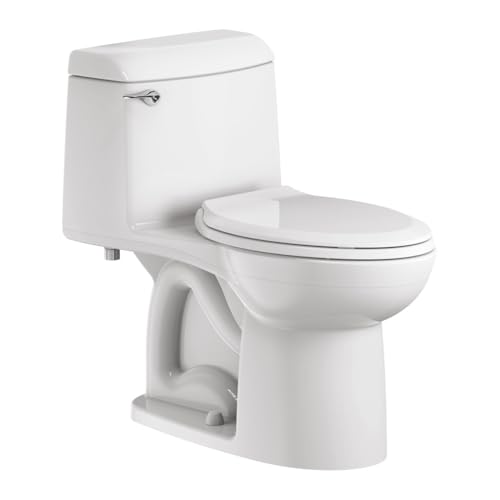
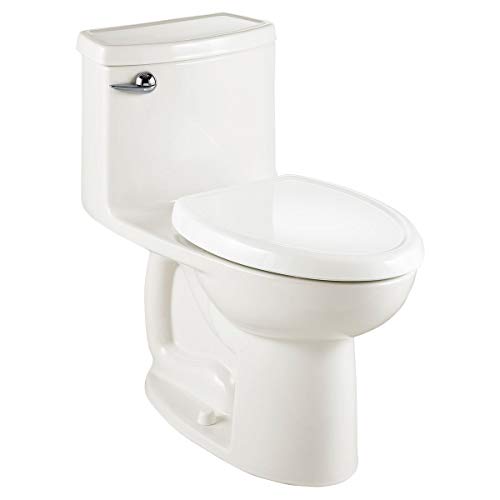
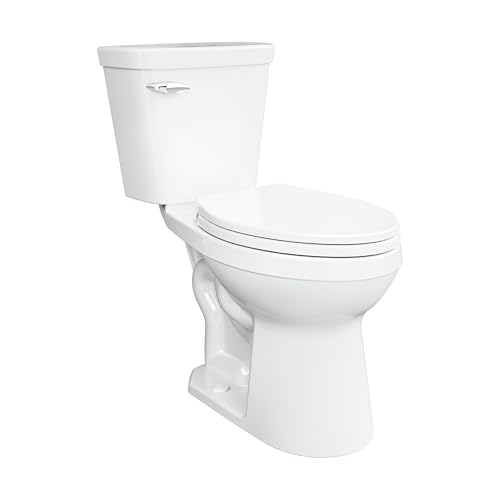
Two-piece toilets have a separate tank and bowl that bolt together during installation; they are more common and typically lower in price. One-piece toilets have a tank and bowl molded as a single unit, making them easier to clean (no seam between tank and bowl), lower in profile, and heavier to handle. Neither design inherently flushes better -- flush performance depends on the internal mechanics, not the number of pieces.
Two-piece toilets dominate the market because they cost less to manufacture and ship -- the tank and bowl arrive in separate boxes, reducing breakage risk. Installation is slightly more involved (you bolt the tank to the bowl), but it is the configuration most plumbers work with daily. Replacement parts are typically interchangeable with a wider range of third-party components.
One-piece toilets simplify cleaning because there is no crevice between tank and bowl where mold and mineral deposits can accumulate. The lower, sleeker profile suits modern bathroom aesthetics. The Woodbridge T-0001 is a widely sold one-piece example with a 1.28 GPF dual-flush system. TOTO's UltraMax II is a one-piece with a Double Cyclone flush. Swiss Madison's St. Tropez (SM-1T258) and Ivy (SM-1T257) are one-piece skirted designs.
Weight is the main practical disadvantage of one-piece toilets -- they typically weigh 80 to 120 pounds compared to 50 to 80 pounds for a two-piece. Getting a one-piece up stairs or into a tight bathroom requires help. If you are installing solo or in a difficult-access location, a two-piece is more manageable.
Our one-piece vs. two-piece toilets guide covers cost differences, cleaning implications, and popular models in each category.
Siphonic toilets, which dominate North American plumbing, use water flowing rapidly through a narrow S-trap to create a vacuum siphon that pulls waste down and out of the bowl. Washdown toilets, common in Europe and parts of Asia, push waste out through a steeper, wider trapway using water pressure and gravity. Siphonic flush leaves a larger water surface in the bowl and is quieter; washdown is faster and uses less water per flush but has a smaller water footprint in the bowl.
Virtually every toilet sold by TOTO, Kohler, American Standard, and Gerber for the North American market uses a siphonic design. The large water surface area that characterizes siphonic bowls -- typically 10 by 7 inches or larger -- keeps the bowl cleaner between uses because waste is less likely to contact the dry porcelain above the waterline.
Washdown toilets are uncommon in North American homes and require specific drain configurations. They flush faster and more forcefully, which is why they are standard in commercial European installations. If you are importing a European toilet brand or buying a specialty "rimless" washdown model, confirm compatibility with your existing drain configuration before purchase.
TOTO's Tornado Flush (used in models like the Nexus and Carlyle II) is technically siphonic but uses two nozzle jets rather than a traditional rim to spin water in a cyclonic pattern for more even bowl coverage. This reduces cleaning requirements without switching to a washdown design.
EPA WaterSense certification guarantees two things: that a toilet uses 1.28 GPF or less, and that it has passed an independent third-party flush performance test demonstrating it can remove at least 350 grams of simulated waste in a single flush. Certification is voluntary but is required to qualify for most U.S. water utility rebate programs, which can offset 20 to 100% of purchase price in some states.
The WaterSense label, governed by the EPA under the Safe Drinking Water Act framework, was modeled after the Energy Star program for appliances. Manufacturers submit toilets to EPA-recognized labs for testing; products that pass can display the WaterSense logo and are listed in the EPA's online product database.
From a consumer perspective, WaterSense certification serves as a floor, not a ceiling. The 350g flush threshold is the minimum -- many certified toilets score 600g to 1,000g on MaP tests. Always check the MaP database in addition to confirming WaterSense certification. A toilet can be WaterSense certified at 350g MaP and still be a poor performer for a family of four; a 1,000g MaP WaterSense toilet like the TOTO Drake II is a much stronger real-world choice.
Water utility rebates vary significantly. In California under the SoCalWater$mart and Bay Area regional programs, rebates for WaterSense toilets have reached $100 to $175 per unit. Texas has offered similar incentives through local water districts. The EPA maintains a searchable rebate finder at epa.gov/watersense. Our EPA WaterSense explained article covers the rebate landscape in detail.
Elongated bowl fronts extend about 2 inches farther from the bowl mounting holes than round bowls -- typically 18.5 inches vs. 16.5 inches front-to-back. Most adults find elongated bowls more comfortable for extended sitting because the larger seating area supports the thighs better. However, that extra 2 inches of depth matters in bathrooms where the door swings toward the toilet or where toilet-to-vanity clearance is tight.
Round bowls are the practical choice for small bathrooms, powder rooms, and any space where front clearance is under 24 inches. They are typically slightly less expensive and easier to find in compact one-piece configurations. Children's bathrooms often benefit from round bowls because the smaller footprint aligns better with shorter leg lengths.
Both shapes are available across all major brands and GPF ratings. The TOTO Drake comes in both elongated (CST744SL) and round (CST743S) versions. Kohler Cimarron is available in elongated only. American Standard Cadet 3 offers both. If your bathroom allows the extra 2 inches, elongated is generally the more comfortable choice for adults.
The flush valve is the component inside the tank that releases water into the bowl when the handle is activated. A larger valve diameter allows water to exit the tank faster, generating a more forceful rush through the bowl. Standard two-piece toilets historically used 2-inch flappers. Three-inch flush valves became common with the 1.6 GPF generation. American Standard's Champion 4 uses a 4-inch flush valve paired with a 2.375-inch trapway -- the larger opening accelerates water release to compensate for lower water volume.
When evaluating flush valves for replacement or repair, matching the valve diameter to the tank's opening is critical. A 3-inch replacement flapper will not seal on a 2-inch seat, and vice versa. American Standard's 4-inch AccuFlush flappers are proprietary to Champion 4 and Titan series tanks and are not interchangeable with standard Fluidmaster or Korky flappers.
One-piece toilets and skirted designs often use tower-style flush valves (a vertical plastic tower rather than a flap) that open the entire base of the tower for water release. These are common in TOTO, Woodbridge, and Swiss Madison models and offer consistent water volume delivery without relying on a rubber flap seal.
The fill valve (also called a ballcock) refills the tank after each flush. Modern fill valves use a float cup that rides up and down on the valve body rather than the older ball-float arm design. When the float reaches the preset water level, it shuts off the water supply. Adjusting the water level inside the tank -- typically marked by a fill line on the tank interior -- directly affects flush volume and power.
A tank water level set too low reduces flush power and can cause the toilet to struggle with solid waste even if it has a high MaP rating. A water level set too high causes water to enter the overflow tube and run continuously into the bowl -- the "running toilet" that wastes 30 to 200 gallons per day according to the EPA. Most fill valves include an adjustment screw or clip that raises or lowers the float position without tools.
Fluidmaster's 400A is the dominant aftermarket fill valve in North America and fits most two-piece toilets. For American Standard ProFlush systems and TOTO tower-style mechanisms, OEM replacement valves are recommended to maintain performance consistency.
Ghost flushing -- when a toilet randomly refills without anyone using it -- is almost always caused by a worn flapper that allows water to seep from the tank into the bowl slowly until the fill valve activates to restore level. A simple dye test (drop a dye tablet in the tank and wait 20 minutes without flushing; color in the bowl confirms a flapper leak) diagnoses this in minutes. A replacement flapper costs under $10 and resolves the issue in most cases.
A skirted toilet has a smooth, flat side panel that hides the trapway channel running along the outside of the bowl. An exposed trapway toilet shows the S-curve of the trapway on the outside of the base. Skirted designs are easier to clean -- no ridges, curves, or crevices along the outside of the bowl where dust, pet hair, and mold accumulate. They also present a cleaner, more modern visual profile.
The tradeoff is installation complexity. Standard two-piece skirted toilets often cannot be anchored using traditional floor bolt-and-cap methods because the skirt covers the mounting bolts. Many skirted models require specialty anchoring hardware or side-mount brackets included in the box. This adds installation time but is manageable with basic DIY skills. Swiss Madison's Ivy, Clarence, and St. Tropez lines are popular skirted designs. TOTO's Vespin II offers a skirted profile in a two-piece configuration.
If cleaning ease is a priority -- particularly in a master bathroom or for someone with limited mobility who cannot easily reach around the base of a toilet -- a skirted design eliminates the most difficult-to-reach surfaces on the toilet exterior.
Gravity-flush toilets -- the standard in almost all residential settings -- use the weight of water falling from the tank into the bowl to generate flush power. Pressure-assist toilets add a sealed plastic pressure vessel inside the tank that uses incoming water pressure (20 to 80 PSI from the supply line) to compress air, then releases both water and compressed air simultaneously into the bowl for a significantly more forceful flush.
Pressure-assist is louder -- noticeably so, roughly equivalent to a commercial building toilet flush. It is also more expensive to purchase and service, as the pressure vessel is a proprietary component. However, in basements with marginal drain slopes, commercial settings with heavy use, or homes with chronic clogging problems that persist even with high-MaP gravity toilets, pressure-assist delivers meaningfully better waste removal per flush cycle.
Brands offering residential pressure-assist include American Standard (Flushometer series) and Kohler (pressure-assist Highline). Sloan's Flushmate vessel is used by several manufacturers including American Standard and Gerber in specific models. For most residential applications with municipal water pressure above 25 PSI, a high-MaP gravity toilet like the TOTO Drake or American Standard Champion 4 performs comparably to pressure-assist without the noise penalty.
Several major brands apply proprietary surface coatings to toilet bowls that reduce the microscopic surface roughness of standard vitreous china, making it harder for bacteria, mold, and mineral deposits to adhere.
TOTO's CeFiONtect (formerly SanaGloss) is an ion-barrier glaze that creates an extremely smooth surface. Independent testing cited by TOTO shows reduced bacteria adhesion compared to uncoated vitreous china. American Standard's EverClean surface adds an antimicrobial agent (silver-based) directly into the glaze that inhibits the growth of stain- and odor-causing bacteria, mold, and mildew. The EverClean surface is backed by a limited lifetime warranty against bacterial growth effects.
Both coatings are applied during the manufacturing process and are not something that can be replicated by aftermarket toilet bowl treatments. They do not make toilets self-cleaning -- regular cleaning is still required -- but they reduce the frequency and intensity of scrubbing needed to keep the bowl visibly clean. For households prioritizing low maintenance, specifically requesting a model with one of these coatings is worthwhile.
Dual-flush toilets provide two flush volumes: a reduced-volume flush for liquid waste and a full-volume flush for solid waste. Most use a two-button actuator plate on the top of the tank rather than a traditional side handle. The half-flush button typically releases 0.8 to 1.0 GPF; the full-flush button releases 1.28 GPF. This allows a household to dramatically reduce daily water use if liquid-only flushes are used consistently for liquid waste.
The TOTO Aquia IV uses 0.9 GPF / 1.28 GPF and carries both WaterSense certification and a MaP score of 1,000g on the full flush. The American Standard H2Option offers 0.92 GPF / 1.28 GPF dual flush. The Woodbridge T-0001 uses 0.8 GPF / 1.6 GPF and is one of the few dual-flush one-piece models under a moderate price point. Gerber's Avalanche also offers a dual-flush configuration.
The practical limitation of dual flush is user behavior: studies cited by the EPA WaterSense program found that household members default to the full flush even for liquid waste, reducing the water savings benefit. Installation with a clear label on the buttons (half / full) improves compliance. For genuinely water-conscious households, the savings can reach 15,000 to 20,000 gallons per year versus a 1.6 GPF single-flush toilet.
Most toilets are sold without a seat, especially two-piece models in the contractor-grade segment. When selecting a replacement or add-on seat, the critical measurements are the bolt hole spacing (5.5 inches on center for most toilets) and the bowl shape (elongated or round). Seats are not universal -- an elongated seat on a round bowl overhangs the front; a round seat on an elongated bowl leaves the front of the bowl rim exposed.
Soft-close seats use hydraulic dampers on the hinge to prevent the lid and seat from slamming down. They are a significant quality-of-life upgrade in any household with children and add negligible cost relative to the toilet price. Bemis and Mayfair produce widely-available soft-close seats in both elongated and round profiles that fit most major brand bowls.
Quick-release seats clip onto fixed hinge posts and can be removed with one hand for thorough cleaning around and behind the hinge area -- the zone most prone to mold and mineral buildup on the back of the bowl. If bowl hygiene is a priority, a quick-release soft-close seat combines both benefits. TOTO sells seat-integrated models (the SS154 seat fits Drake models); Kohler offers Cachet and Brevia quick-release soft-close seats designed for their bowl footprints.
For most homes, 1.28 GPF with EPA WaterSense certification is the best balance of water savings and flush performance. This is 20% below the federal maximum of 1.6 GPF and qualifies for most utility rebate programs. Only consider going lower (1.0 GPF or 0.8 GPF) if your municipality offers specific incentives and the model you choose has a MaP score of 800g or higher.
Look for the WaterSense label on the product box or in the product listing. You can also search the EPA's online product database at epa.gov/watersense, which lists all certified models by manufacturer and model number. WaterSense certification means the model has passed an independent third-party flush performance test at or below 1.28 GPF.
A MaP score of 600g to 800g is adequate for a one or two person household. For families of three or more, or any household with a history of clogging problems, a score of 800g to 1,000g is recommended. Many of the most popular models -- TOTO Drake, Drake II, UltraMax II, Kohler Cimarron, American Standard Champion 4 -- achieve the maximum MaP score of 1,000g.
Measure from the finished wall (not the baseboard) to the center of one of the decorative bolt caps on the base of the toilet. These caps sit directly over the floor bolts that anchor the toilet to the closet flange, which is centered over the drain. Round to the nearest inch: a measurement of 11.25 to 12.5 inches indicates a 12-inch rough-in.
Comfort height refers to a toilet with a rim height of 16 to 18 inches. ADA height refers to a total seat height (rim plus seat) of 17 to 19 inches, as required by the Americans with Disabilities Act for accessible facilities. Most comfort-height toilets with a standard seat installed fall within ADA range, but always verify seat height, not just rim height, for code compliance.
One-piece toilets weigh 80 to 120 pounds and require two people to maneuver safely into position. The installation process itself is no more mechanically complex than a two-piece -- you set the wax ring, lower the toilet, secure the bolts, and connect the supply line. The weight is the main challenge. In tight bathrooms or upper-floor installations, the extra weight of a one-piece is a practical consideration.
Not necessarily. A larger trapway reduces the chance of solid material physically catching in the channel, but flush power depends on water volume (GPF), flush valve size, and water velocity through the bowl. The American Standard Champion 4 pairs a 2.375-inch trapway with a 4-inch flush valve and achieves 1,000g MaP at 1.6 GPF. The TOTO Drake II achieves 1,000g with a 2.125-inch trapway at 1.28 GPF through superior siphon engineering.
A fully glazed trapway has a smooth porcelain coating on the interior surface of the waste channel, from bowl to exit point. This reduces friction and buildup compared to an unglazed trapway with a rougher surface. TOTO applies CeFiONtect glaze through the trapway channel on many models; American Standard applies EverClean coating. Both reduce the likelihood of material adhering inside the channel over time.
Yes, in the vast majority of cases. The drain configuration (rough-in, flange, drain pipe diameter) does not need to change when switching GPF ratings. The only requirement is that the drain line has adequate slope (the standard 1/4 inch per foot of run) to carry waste at lower water volumes, which is already required for standard plumbing installations.
The siphon jet is a large hole at the bottom of the toilet bowl, directly above the trapway entrance. It directs a concentrated stream of water into the trapway at the start of the flush cycle to initiate the siphon. Mineral deposits from hard water accumulate in this hole over time and reduce flush velocity. Cleaning with a small brush and descaling solution (diluted muriatic acid or white vinegar) restores siphon jet effectiveness.
For most residential bathrooms with standard municipal water pressure (40+ PSI) and a properly sloped drain, a gravity-flush toilet with a 1,000g MaP score performs as well as pressure-assist without the noise and higher purchase cost. Pressure-assist is most worth considering in basements with minimal drain slope, in vacation homes where long periods of non-use can cause drain lines to partially dry, or in high-traffic commercial applications.
TOTO has a consistent reputation for manufacturing quality, particularly the Drake and UltraMax series, which have accumulated large owner review samples over 15+ years of production. Kohler ranks highly in owner surveys. American Standard Champion 4 has a strong track record for clog resistance. Gerber is favored by professional plumbers for parts availability and consistent manufacturing. Woodbridge and Swiss Madison offer newer but well-reviewed value-tier options.
The porcelain bowl and tank will outlast most other components in a home if not cracked. Fill valves and flappers typically need replacement every 5 to 10 years depending on water quality; hard water accelerates mineral buildup on rubber components. Flush handles and trip levers rarely fail. Wax rings should last the life of the toilet unless it is removed and reinstalled. Pressure-assist vessels have a shorter service life, typically 8 to 15 years, and are more expensive to replace.
EPA WaterSense evaluates dual-flush toilets on a combined effective flush volume (CEFV) calculated assuming one full flush for every two reduced flushes, reflecting typical use patterns. The CEFV must be 1.28 GPF or less for certification. The TOTO Aquia IV with 0.9 GPF / 1.28 GPF flushes has a CEFV of 1.0 GPF, well within the certification requirement.
Soft-close seats prevent the repeated hard impacts of a seat or lid dropping -- impacts that loosen the hinge hardware over time and can crack porcelain if the lid drops onto the rim of a toilet bowl. In households with children who do not reliably lower seats gently, or in any situation where the lid dropping is a regular occurrence, a soft-close seat pays for itself in prevented damage and reduced noise.
CeFiONtect (TOTO's current brand name for what was formerly called SanaGloss) is an ion-barrier glaze technology that creates an extremely smooth, non-porous surface to prevent waste and bacterial adherence. EverClean (American Standard) is a glaze infused with a silver-based antimicrobial additive that actively inhibits bacterial growth on the surface. Both reduce cleaning frequency; CeFiONtect addresses physical adhesion while EverClean addresses microbial growth.
A skirted toilet has smooth, flat side panels that conceal the trapway contours and mounting hardware, giving the base a clean, rectangular profile. Installation differs from standard models because the skirt panel covers the bolt cap area. Most skirted models include a side-mount anchor kit or require a different anchoring method than the standard bolt-and-cap. Always read the installation manual before starting -- skirted toilets are not harder to install, just different.
Look for a toilet with a 1,000g MaP score, a trapway diameter of 2.125 inches or larger that is fully glazed, and a flush valve of 3 inches or larger. The American Standard Champion 4, TOTO Drake II, and TOTO UltraMax II consistently top this category. Separately, evaluate whether the clogs are caused by flushing materials (wipes, excessive paper) that no toilet design will handle -- the problem may be behavioral as much as mechanical.
Understanding toilet specs before you shop eliminates the two most common mistakes: buying the wrong rough-in size and choosing a low-GPF toilet with a weak MaP score that still clogs. For most households, a WaterSense-certified 1.28 GPF toilet with a MaP score of 800g or higher, a 2.125-inch fully glazed trapway, and a rim height matching user needs covers every meaningful performance dimension. The TOTO Drake II, Kohler Cimarron, and American Standard Champion 4 (in its 1.28 GPF configuration) all meet that standard at different price points. Read the specs, check the MaP database, measure your rough-in, and the right choice becomes clear.
Learn why toilet trapways curve like an S, how each bend blocks sewer gas, and what the shape means for clogs and…
Read the guideAlmost every US toilet has a left-side handle. Learn the plumbing and mechanical reasons behind the layout and when it actually changes.
Read the guideHome toilets rely on tanks because household water lines lack the pressure that public flushometer systems use to flush straight from the…
Read the guide