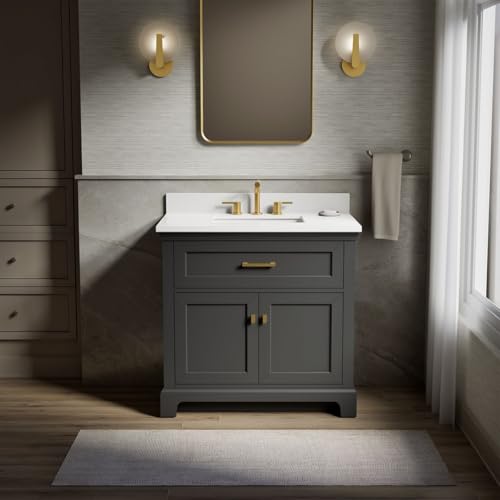
Best Bathroom Vanity Height for Tall People
Bathroom Remodeling4.6
A standard 32 to 34-inch vanity forces anyone over roughly 6 feet tall into a persistent forward bend to brush teeth, wash…
Read the guideRenting a bathroom with a vanity you dislike, or no vanity storage at all, does not mean you are stuck. This guide covers portable and freestanding vanity units that need no permanent wall anchoring, reversible adhesive-mounted organizers that upgrade an existing fixed vanity, and an honest explanation of why most real wall-mounted vanities do require anchoring for basic safety, so any anchored project needs landlord approval first.
Research updated July 2026.
Renters get the most usable storage upgrade from a freestanding rolling vanity cart or an over-toilet storage unit that rests on the floor, requiring no drilling at all. For renters who want to dress up an existing builder-grade vanity, adhesive-backed organizers add function without a single new hole. A wall-anchored vanity, even a light one, is not a true no-drill project and should only be attempted with written landlord approval.
Bathroom storage is one of the most common renter frustrations. Builder-grade apartments often ship with a single small vanity, a pedestal sink with no storage at all, or a vanity that is functional but visually dated. Homeowners solve this by swapping the vanity entirely; renters cannot, and most leases explicitly prohibit removing or replacing fixtures the landlord owns. The gap between "do nothing" and "replace the vanity" is filled with freestanding and adhesive-mounted options that genuinely work.
This guide organizes renter-safe vanity storage by installation type, gives straight answers about what a lease actually allows, and flags the one category where drilling is unavoidable and landlord communication is required. For a full owned-vanity comparison, see the bathroom vanity buying guide.
Renters have three genuinely no-drill categories: freestanding rolling storage carts that sit beside or under an existing pedestal sink, over-the-toilet storage units that use the toilet tank and floor for support rather than the wall, and adhesive-backed organizers (shelves, baskets, hooks) that use rated mounting tape rather than screws. None require modifying the existing fixed vanity, and all move with you at the end of the lease.
Weight capacity is the main tradeoff versus a wall-anchored option: freestanding carts and adhesive shelving hold less than a properly anchored cabinet, so plan storage around lighter, frequently used items rather than heavy stoneware or bulky appliances.
| Option | Install Required | Reversible | Lease Risk | Weight Capacity |
|---|---|---|---|---|
| Rolling Storage Cart | None, freestanding | Yes, instant | None | Moderate (20-40 lbs) |
| Over-Toilet Storage Unit | None, floor-supported | Yes, instant | None | Moderate (25-45 lbs) |
| Adhesive Shelving/Organizers | Rated mounting tape, no screws | Yes, peels off clean | Very Low | Light (2-10 lbs/shelf) |
| Tension-Mount Shelving | Spring pressure, floor to ceiling | Yes, instant | Very Low | Light-Moderate (5-15 lbs/shelf) |
| Wall-Anchored Vanity/Shelf | Drilling into studs or anchors | No, leaves holes | High | Heavy (rated to hardware) |
No, and any product marketed as a "no-drill wall vanity" deserves scrutiny. A fully loaded wall-hung vanity commonly weighs 150 to 350 lbs once you add countertop, sink, water, and stored items. Even a strong adhesive strip is rated for single-digit to low double-digit pounds, nowhere close to what a vanity requires for safe, long-term support. A vanity that pulls away from the wall can crack the sink, break supply lines, and injure whoever is standing nearby.
Adhesive and tension-mount products are legitimate for lightweight accessories, not a substitute for stud-anchored hardware on a load-bearing cabinet. Renters who want an actual wall-mounted vanity are looking at a project that needs drilling, which means it needs landlord approval first.
Drywall anchors without a stud behind them are rated around 10 to 25 lbs per anchor pair for typical toggle-style hardware, assuming correct installation. A loaded vanity or a shelf full of glass bottles exceeds that fast. If a product needs to hold real weight, it needs a stud or blocking behind it, and that is a landlord conversation, not a renter workaround.
Measure the actual floor space next to and beneath the existing sink or vanity, including door swing, since freestanding carts need a functional footprint the same way furniture does. Check the flooring type: adhesive strips and rolling-cart casters can mark unsealed tile grout over long periods, so a felt pad under any freestanding piece protects the floor.
Read the lease's alteration clause for language about "fixtures" versus "furnishings." Freestanding carts and floor-standing storage are furnishings you own and can remove at will; they typically do not require landlord notice. Adhesive-mounted shelving sits in a gray zone depending on tape strength and wall finish, so test on an inconspicuous spot first.
Most renter vanity projects never require asking anyone, because freestanding and adhesive options fall outside standard lease alteration language. The one scenario that does require a conversation is any project involving drilling: a wall-anchored shelf rated for real weight, an actual floating vanity, or replacing the existing vanity outright.
A short, specific email works best: state exactly what you want to install, confirm whether it requires drilling, and if it does, ask directly whether the landlord will allow it and how they want it handled at move-out. Vague requests get vague, cautious answers; specific requests with a move-out plan get real decisions.
Swapping cabinet hardware (knobs and pulls) or adding a removable contact-paper counter overlay is broadly reversible personal customization, as long as the original hardware is kept and reinstalled at move-out. Label the original hardware in a sealed bag from day one.
Refinishing or repainting a vanity cabinet is a bigger step most leases treat as an alteration requiring approval, since restoring the exact original finish at move-out is rarely realistic. Renters who dislike a vanity's finish are almost always better served by adding attractive freestanding storage nearby than by repainting a fixture they do not own.
The following picks are freestanding or adhesive, none require drilling into a wall, and all are fully reversible at move-out.

A three-drawer rolling cart parked beside a pedestal sink or small vanity replaces the drawer storage most rental bathrooms lack, rolls out of the way for cleaning, and requires zero installation.
The rolling cart is the right first purchase for almost any renter missing vanity storage, since it solves the problem completely with zero lease risk and zero tools. Add felt or rubber caster caps if the cart stays in one spot for months to avoid marking grout.

A floor-standing unit straddles the toilet tank on its own legs, adding shelf and cabinet storage in vertical space that would otherwise sit empty, with no anchoring to wall or tank required.
Measure toilet tank height and ceiling clearance first. Prioritize a wide, stable base over a narrow profile; stability prevents tip-over far better than a few extra inches of floor clearance.

Rated adhesive mounting strips, not screws, add small shelves above or beside an existing fixed vanity for daily-use items like soap and skincare, within a light-duty weight limit.
Clean the surface with rubbing alcohol and allow the recommended cure time before hanging weight. Stay well under the stated capacity, since manufacturer numbers reflect ideal lab conditions, not years of humid bathroom use.
Freestanding and adhesive storage solve day-to-day clutter, but renters on longer leases sometimes find it worth proposing an actual vanity upgrade to the landlord rather than working around a disliked fixture indefinitely, especially if they offer to leave the new vanity behind at move-out. This is a case-by-case negotiation, not a default expectation. For most renters, the freestanding and adhesive options above solve the real problem with zero lease risk.
No, not without written landlord permission. The vanity is a fixture the landlord owns, and replacing it without approval is a lease violation in nearly every standard agreement. Freestanding storage next to it solves the functional problem without touching the fixture.
Rated removable strips release cleanly from painted drywall and glazed tile when pulled slowly and parallel to the surface. Damage usually happens when strips are pulled straight outward or left in place for years. Test on a hidden area first.
Most bathroom-sized carts are rated for 15 to 40 lbs total, with individual drawers rated lower, around 5 to 10 lbs each. Distribute heavier items in the bottom drawer for a lower center of gravity.
Yes, with normal precautions: keep chemicals in original labeled containers, avoid stacking heavy bottles above eye level, and use a cart with a door or latch rather than an open shelf if kids or pets have bathroom access.
A fixture is attached to or considered part of the building, like the vanity cabinet and plumbing. A furnishing is a movable item the tenant brings and removes at will, like a rolling cart. Most leases restrict changes to fixtures but say nothing about furnishings.
Not without approval. Painting permanently changes the fixture's finish, and restoring it exactly at move-out is rarely realistic. A removable contact-paper overlay or swapped hardware, with the originals kept, achieves a visual refresh without altering the fixture.
Most fit standard two-piece toilets with a tank height of 27 to 30 inches and enough rear clearance for the unit's legs. One-piece toilets with low-profile tanks may not have adequate clearance. Measure before ordering.
They work well on smooth, consistently wet surfaces like glass shower doors but lose grip over time on painted drywall. Use suction mounts for shower items and adhesive strips for dry vanity-area shelving; the two are not interchangeable.
Clean a small hidden section with rubbing alcohol, apply one strip, and let it cure fully before adding weight. If it holds a light test item for 24 to 48 hours without slipping, the surface is a good candidate for a full installation.
Only with written landlord approval, since a floating vanity requires anchoring into studs or blocking, which is a form of drilling no different from any other fixture alteration. Some landlords approve tenant-funded upgrades left in place at move-out.
Label a sealed bag with the apartment address and a description of what came from where, and store it in a closet for the full lease term. This prevents disputes at move-out when original hardware has to go back on.
For most rentals it is a legitimate long-term solution. Quality rolling carts and over-toilet units, built with powder-coated steel or solid wood, last for years across multiple moves, at the cost of a slightly smaller footprint than a full vanity.
Renters can solve almost every real bathroom storage problem without drilling a single hole. A rolling storage cart or over-toilet unit adds the most storage for the least effort and zero lease risk, while adhesive shelving upgrades an existing fixed vanity with light accessory storage. The one honest limit is a true wall-anchored vanity or shelf built to hold real weight, which requires actual anchoring hardware and, therefore, landlord approval. Be specific when you ask, keep original hardware if you swap anything cosmetic, and your setup will look and function exactly as intended, both during your lease and at move-out.
How we rank & our data sources
We do not run physical lab tests. Rankings are built from published, verifiable data and real owner feedback, never paid placement.
Researched by admin · Last updated July 18, 2026 · Our review method
A standard 32 to 34-inch vanity forces anyone over roughly 6 feet tall into a persistent forward bend to brush teeth, wash…
Read the guide
An honest, spec-by-spec comparison of American Standard's Cadet and Fluent bathtub lines against Kingston Brass's freestanding and alcove tub collections, covering material,…
Read the guideA practical comparison of stock, semi-custom, and fully custom bathroom vanities, covering what typically separates each tier in price, construction quality, and…
Read the guide