Wheelchair-Accessible Bathroom Vanity Guide
Bathroom Remodeling4.6
A wheelchair-accessible vanity is not simply a shorter cabinet. It requires specific knee clearance underneath the sink, a countertop height within reach…
Read the guideA standard 32 to 34-inch vanity forces anyone over roughly 6 feet tall into a persistent forward bend to brush teeth, wash a face, or shave, and that repeated bend adds up to real lower-back strain over years of daily use. This guide covers comfort-height vanities in the 34 to 36-inch range, how to calculate the right height for your specific height and reach, faucet spout clearance considerations that come with a taller counter, and real comfort-height vanity picks from Kohler, American Standard, and Kingston Brass.
Research updated July 2026.
Users taller than roughly 6 feet are consistently more comfortable with a 36-inch comfort-height vanity than the 32 to 34-inch standard height sold as the default on most vanities. A 36-inch countertop reduces the forward bend at the waist and lets a taller user stand closer to upright while brushing teeth, shaving, or washing their face, which measurably reduces lower-back and neck strain accumulated over years of daily use. Kohler, American Standard, and Kingston Brass all sell comfort-height vanities at the 36-inch mark specifically for this reason.
Vanity height is one of the most overlooked dimensions in a bathroom remodel, largely because most people assume "standard" means "correct for everyone." It does not. Standard vanity height, 32 to 34 inches to the countertop, was set decades ago based on average adult height data that skews well below the height of many adults today, particularly taller men and women. A user standing 6 feet 2 inches or taller has to bend forward at the waist by a meaningfully greater angle at a 32-inch counter than at a 36-inch counter, and that bend is repeated multiple times a day, every day, for as long as the vanity is in the home.
This guide explains why comfort-height vanities exist, how to figure out whether 34 or 36 inches is the right target for your specific height, what changes about faucet and mirror selection at a taller counter height, and which comfort-height vanities from established brands are worth buying. For a broader look at vanity dimensions and cabinet sizing, see the bathroom vanity buying guide.
Vanity height determines how far a user has to bend forward at the waist to reach the sink basin, mirror, and faucet at a comfortable working distance. At a standard 32-inch counter, a person who is 6 feet 3 inches tall bends forward substantially more than a person who is 5 feet 6 inches tall, because the vertical distance between their eye and hand height and the counter surface is greater. Repeated forward bending at the waist, done multiple times daily over years, is a well-documented contributor to chronic lower back strain, particularly for anyone who already carries any lower back sensitivity.
Raising the counter height closes that gap. A 36-inch comfort-height vanity keeps a tall user's spine closer to a neutral, upright position while washing hands, brushing teeth, or shaving, which is the same ergonomic logic behind comfort-height toilets and kitchen counters built for taller households. The effect is not purely theoretical; ergonomics research on standing workstations consistently shows that matching work-surface height to user height reduces musculoskeletal strain over repeated use.
The tradeoff is that a 36-inch vanity becomes less comfortable, or even genuinely awkward, for shorter household members or children, which matters in a shared family bathroom. In a primary bathroom used mainly by one or two tall adults, this tradeoff rarely matters.
| User Height | Recommended Vanity Height | Standard 32-34 in. Counter | Comfort-Height 36 in. Counter |
|---|---|---|---|
| Under 5'4" | 30 to 32 in. | Comfortable | Uncomfortable, excessive reach |
| 5'4" to 5'9" | 32 to 34 in. | Comfortable (designed for this range) | Slightly tall but workable |
| 5'10" to 6'1" | 34 to 36 in. | Mild forward bend | Comfortable |
| 6'2" and taller | 36 in. (comfort height) | Noticeable forward bend | Comfortable, reduced strain |
A widely used ergonomic starting point is setting the counter height at roughly 2 to 3 inches below elbow height when standing relaxed with arms at your sides. For most adults over 6 feet tall, that calculation lands at or above the 36-inch comfort-height mark, confirming why comfort-height vanities are specifically marketed toward taller users. For adults in the 5'10" to 6'1" range, the calculation often lands between standard and comfort height, meaning either could work depending on individual torso-to-leg proportions and personal preference.
The most reliable way to check fit before buying is a simple physical test: stand at your kitchen counter (typically 36 inches) and a bathroom counter (typically 32 to 34 inches) and notice which feels more natural for a face-washing or teeth-brushing motion. Most people intuitively feel the difference once they pay attention to it, even without measuring anything.
Households with mixed heights, one tall adult and other shorter family members sharing the same bathroom, should weigh how often each person uses that specific sink and consider a double-vanity layout with two different heights, or split tall-user preference toward the primary bathroom while keeping a standard-height vanity in a shared or kids' bathroom.
The elbow-height rule is a good starting estimate, but the physical test at your own kitchen counter is more reliable in practice, because torso length varies independently of overall height. Two people who are both 6 feet 2 inches tall can have meaningfully different ideal counter heights if one has a longer torso and shorter legs, or the reverse. Test before you commit to a specific vanity height, especially on a custom or built-in project that cannot be easily adjusted later.
Yes, in two specific ways. First, faucet spout height and reach need reconsidering at a 36-inch counter: a faucet designed for a 32-inch counter may sit at a height that still works fine functionally, but taller users sometimes prefer a slightly taller spout profile for a more natural hand-washing angle at the raised counter height. Second, mirror placement should rise along with the counter; a mirror mounted at a fixed height calibrated for a 32-inch vanity will sit lower relative to a taller user's eye line once the counter itself is raised by 2 to 4 inches, requiring the mirror to move up by a similar amount to maintain a comfortable sightline.
Vessel sinks, which sit on top of the counter rather than dropping below it, add another 4 to 6 inches of height on top of the counter surface, pushing total sink rim height to 40 inches or more when combined with an already-raised 36-inch comfort-height counter. This combination suits very tall users well but requires a taller faucet, typically 10 to 14 inches of spout height, to clear the raised basin rim comfortably.
The following picks are all available in a genuine 36-inch comfort-height configuration, confirmed against manufacturer specifications rather than assumed from product photos.
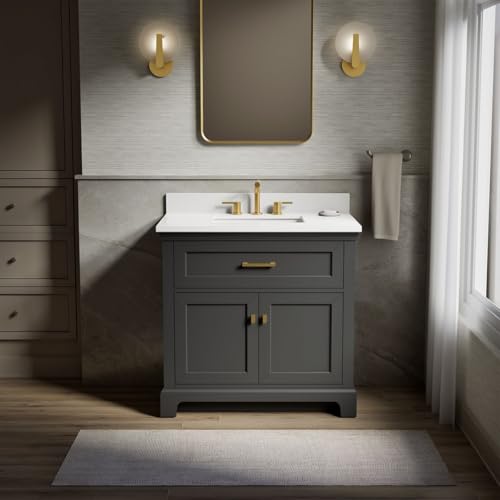
The Kohler Damask ships in a genuine 36-inch comfort-height configuration with a solid furniture-grade cabinet, giving taller users a full 2 to 4 inches of additional counter height over a standard vanity without sacrificing storage or build quality.
Owner reviews consistently note the Damask's cabinet construction as a step above budget comfort-height alternatives, with dovetail drawer joints and a genuinely solid frame rather than a veneer-over-particleboard build. Confirm the 36-inch counter height in the specific listing before ordering, since Kohler also sells a visually similar 32-inch standard-height version of some Damask configurations.
The Damask is the vanity to buy when a tall user wants comfort height without compromising on cabinet quality. The extra 2 to 4 inches of height is invisible in a photo but noticeable every single day at the sink, which is exactly the kind of ergonomic detail that is easy to skip past when shopping by looks alone.

The American Standard 60-inch double vanity is available at a genuine 36-inch comfort height, giving two tall adults sharing a primary bathroom independent sink space at a counter height suited to both, without the compromise of a single-sink layout.
Measure available wall space carefully before ordering a 60-inch double vanity, accounting for door swing, adjacent fixtures, and the NKBA-recommended 30 to 36 inches of clearance in front of the vanity for comfortable use. American Standard's comfort-height double vanities are a more accessible price point than premium solid-wood alternatives while still offering genuine 36-inch height across the full width.
Double vanities at comfort height solve a real problem for tall couples: standard-height double vanities force both partners into the same forward-bend compromise a single tall user would face at a standard-height single vanity. Verify the exact height spec on the specific SKU, since American Standard sells otherwise near-identical double vanities at both standard and comfort heights.

The Kingston Brass 36-inch vanity combo delivers comfort height at a noticeably lower price than premium solid-wood alternatives, bundling a matched top and sink so buyers do not need to source those components separately.
Kingston Brass bundles the vanity, top, and sink as a matched combo, which removes the guesswork of pairing separate components and is typically the most economical path to a genuine 36-inch comfort-height setup. As with any engineered-wood cabinet, good bathroom ventilation extends the cabinet's lifespan meaningfully by limiting sustained humidity exposure.
The Kingston Brass combo is the right pick when comfort height matters more than premium cabinet materials, which is a reasonable priority for a secondary bathroom or a first home. Pair it with a working exhaust fan, since engineered wood cabinets are more moisture-sensitive over the long run than solid wood or plywood construction.
A vessel sink adds 4 to 6 inches of basin height on top of the counter, and combined with a 36-inch comfort-height counter, total sink rim height can reach 40 to 42 inches, which is genuinely comfortable for users at the taller end of the height spectrum, roughly 6 feet 4 inches and above, but starts to feel excessive for users in the 6-foot to 6-foot-2 range who are already well served by a standard undermount sink at 36 inches. Vessel sinks also require a taller faucet, typically 10 to 14 inches of spout height, to clear the raised basin rim without splashing, so the two changes need to be planned together rather than added one at a time.
For most tall users, a 36-inch comfort-height vanity with a standard undermount or drop-in sink solves the ergonomic problem completely without the added height and faucet-matching complexity a vessel sink introduces. Reserve the vessel sink upgrade for households at the very top of the height range or for those who specifically want the vessel aesthetic regardless of the extra height it adds.
A 36-inch comfort-height vanity is the best default for a user at 6 feet 3 inches, since it substantially reduces the forward bend required at a standard 32-inch counter. Individual torso proportions can shift this slightly, so testing against your kitchen counter height (typically 36 inches) before committing to a specific bathroom vanity height is a useful sanity check.
No. Comfort height (36 inches) is designed to reduce bending for taller standing users. ADA height caps the counter at a maximum of 34 inches specifically to keep the sink within reach for a seated wheelchair user. These are different design goals for different users, and a vanity built to one standard does not satisfy the other. See the wheelchair-accessible bathroom vanity guide for the accessibility-specific dimensions.
It can, particularly for household members under about 5 feet 4 inches or for children, who will find a 36-inch counter noticeably harder to reach comfortably. In a shared family bathroom with a wide range of user heights, a standard 32 to 34-inch vanity is usually the more universally workable choice, with a step stool available for shorter users, rather than raising the counter for the tallest user at everyone else's expense.
In some cases, yes, by adding a riser base or platform beneath the existing cabinet, though this changes the toe-kick proportions and can look visually awkward if not done carefully. For a plumbed-in vanity, raising the cabinet height also requires adjusting the drain and supply line rough-in heights, which is a real plumbing project, not a simple furniture modification. Replacing the vanity with a genuine comfort-height unit is usually cleaner than retrofitting height onto an existing cabinet.
Yes. Raising the counter height by 2 to 4 inches without also raising the mirror shifts the mirror lower relative to a tall user's eye line than it was designed for, so mirror height should move up along with the counter. As a rule of thumb, raise the mirror's bottom edge by roughly the same amount the counter height increased to maintain the original sightline proportions.
Not inherently. Comfort-height and standard-height vanities from the same manufacturer and product line are typically priced similarly, since the difference is primarily cabinet height, not additional materials or complexity. Price differences between vanities usually come down to cabinet material, countertop type, and brand positioning rather than the height configuration itself.
Vanity listings state width, depth, and height separately, and "36-inch vanity" without further context almost always refers to width, not height, since width is the dimension buyers search for most often. Always check the height specification explicitly in the product details, and do not assume comfort height from the word "36" appearing anywhere in the title.
Not directly, but tall users often benefit from pairing a comfort-height vanity with a comfort-height (chair-height) toilet, typically 17 to 19 inches to the seat, for the same forward-bend and knee-strain reasons that apply at the sink. Coordinating both fixtures around the household's actual height range creates a more consistently comfortable bathroom than optimizing the vanity alone.
For users at the very top of the height range, roughly 6 feet 4 inches and taller, a vessel sink combined with a 36-inch comfort-height counter can push total sink height into a genuinely more comfortable zone, but it requires a taller faucet to match and is not necessary for most tall users, who are well served by comfort height alone with a standard undermount sink.
Within the same product line, the price difference between standard and comfort-height configurations is usually minor, often reflecting only a slightly taller cabinet panel and, in some cases, a proportionally adjusted drawer front. Buyers should compare the specific SKU prices directly rather than assuming a fixed percentage difference, since pricing strategy varies by manufacturer.
Many users report reduced discomfort after switching from a standard to a comfort-height vanity if their existing back strain was linked to repeated forward bending at the sink, which is a plausible ergonomic mechanism supported by general standing-workstation research. It is not a guaranteed fix for back pain generally, since back pain has many potential causes, but it addresses one specific, well-understood contributing factor for tall users at a standard-height counter.
Only if the household's guests are predominantly tall or if the guest bathroom doubles as a secondary bathroom for a tall household member. For a bathroom used by a wide range of guest heights, standard height remains the safer universal choice, since it accommodates the broadest range of users reasonably well, whereas comfort height specifically favors taller users at the expense of shorter ones.
Users taller than roughly 6 feet consistently benefit from a genuine 36-inch comfort-height vanity over the 32 to 34-inch standard, and the ergonomic reasoning, less forward bend at the waist repeated daily over years, holds up under basic standing-workstation logic. The Kohler Damask, American Standard 60-inch double vanity, and Kingston Brass combo all deliver real comfort height at different price points and configurations. Confirm the exact height specification on any listing before buying, coordinate mirror and faucet height with the raised counter, and remember that comfort height is a tradeoff, not a universal upgrade, in bathrooms shared with shorter users or children.
How we rank & our data sources
We do not run physical lab tests. Rankings are built from published, verifiable data and real owner feedback, never paid placement.
Researched by admin · Last updated July 18, 2026 · Our review method
A wheelchair-accessible vanity is not simply a shorter cabinet. It requires specific knee clearance underneath the sink, a countertop height within reach…
Read the guide
An honest, spec-by-spec comparison of American Standard's Cadet and Fluent bathtub lines against Kingston Brass's freestanding and alcove tub collections, covering material,…
Read the guide
Renting a bathroom with a vanity you dislike, or no vanity storage at all, does not mean you are stuck. This guide…
Read the guide