Why Toilet Trapways Are Curved Like an S
Toilets4.6
Learn why toilet trapways curve like an S, how each bend blocks sewer gas, and what the shape means for clogs and…
Read the guideReplacing a toilet in a manufactured or mobile home is not the same project as replacing one in a site-built house. The rough-in distance can be 10 inches instead of the standard 12 inches, the floor material is thinner and softer, the supply line connections are often non-standard, and many older units have narrower bathroom footprints that rule out full-size elongated bowls. We ranked the top toilets for manufactured and mobile homes using published MaP flush-test scores, gallons-per-flush ratings, rough-in compatibility, bowl dimensions, EPA WaterSense certification, trapway design, and aggregated owner reviews from mobile home installations specifically.
The TOTO Drake in its 10-inch rough-in configuration is the best toilet for most manufactured homes: a 1000 gram MaP score at 1.28 GPF, a fully glazed 2-1/8-inch trapway, and availability in the 10-inch rough-in dimension that many mobile homes require. For compact bathrooms where space is tight, the American Standard Cadet 3 with its space-saving footprint and 1000 gram MaP at 1.28 GPF is an excellent runner-up.
Manufactured and mobile homes present a specific set of toilet replacement challenges that standard buying guides do not address. The most common issue is rough-in distance: while nearly all site-built homes use a 12-inch rough-in (measured from the finished wall to the center of the floor drain), manufactured homes from the 1970s through the 1990s frequently used a 10-inch rough-in, and some pre-HUD models have non-standard drain placements that require measurement before any toilet purchase. Installing a 12-inch rough-in toilet into a 10-inch rough-in space leaves the toilet sitting too far from the wall and creates an installation problem no amount of re-caulking will solve.
Beyond rough-in, the bathroom floor in a manufactured home is typically a thinner wood subfloor layered over a chassis frame, which means the flange sits closer to the surface and the floor has less rigidity than a concrete slab or thick plywood subfloor in site-built construction. This makes proper wax ring sealing more important and makes floor-wobble from an incorrectly installed toilet harder to dismiss. Many older mobile home bathrooms also have narrower widths, making an elongated bowl impractical, and some have supply connections that do not match the standard shut-off valve thread size common in site-built plumbing.
The toilets below were selected with all of these constraints in mind. Every pick has been evaluated for rough-in availability (especially 10-inch options), bowl footprint suitability for tight bathrooms, flush power relative to GPF, and the consistent installation and performance patterns reported by owners in manufactured housing communities. For context on raw flush-power rankings across every toilet category, see the complete guide to the best flushing toilets.
Every toilet on this list met a specific set of criteria tailored to manufactured and mobile home installations. First, rough-in availability: preference was given to models with published 10-inch rough-in variants, which are required in many older manufactured homes. Second, bowl length: compact or standard elongated models that fit in narrower bathroom footprints scored higher than full-size elongated designs. Third, a MaP score of 800 grams or higher at 1.28 GPF or below was required, with preference for 1000 gram scores. Fourth, weight: lighter two-piece models are generally easier to install over a thin manufactured home subfloor without causing stress on the floor structure. Fifth, owner-review patterns specific to manufactured and mobile home installations were given significant weight over general reviews that may reflect site-built house conditions.
| Toilet | Best For | MaP | GPF | 10" Rough-In | WaterSense | Check Price |
|---|---|---|---|---|---|---|
| TOTO Drake (10" RI) | Overall best pick | 1000 g | 1.28 | Yes | Yes | Check price |
| American Standard Cadet 3 | Compact spaces | 1000 g | 1.28 | Yes | Yes | Check price |
| Kohler Highline | Budget + reliability | 600 g | 1.28 | Yes | Yes | Check price |
| TOTO Aquia IV | Water savings / septic | 800 g | 0.8/1.28 | 12" only | Yes | Check price |
| Kohler Cimarron | Mid-range comfort | 800 g | 1.28 | Yes | Yes | Check price |
| American Standard Champion 4 | Clog prevention | 1000 g | 1.6 | Yes | No | Check price |
| Gerber Maxwell | Budget round bowl | 800 g | 1.28 | Yes | Yes | Check price |
| Swiss Madison Ivy | Modern look, tight space | 800 g | 1.28 | 12" only | Yes | Check price |
| Woodbridge T-0001 | One-piece modern | 800 g | 1.28 | 12" only | Yes | Check price |

The TOTO Drake in its 10-inch rough-in variant is the single best toilet choice for manufactured homes that need a non-standard rough-in dimension: it delivers TOTO's proven 1000 gram MaP score and 1.28 GPF G-Max flush in a form factor that fits where most full-size toilets cannot.
The Drake's G-Max flush system uses a wide 3-inch flush valve and a fully glazed 2-1/8-inch trapway to generate a fast, high-volume siphon that clears the bowl completely in a single flush. That is why it earns the maximum 1000 gram MaP score at just 1.28 GPF. The 10-inch rough-in variant adjusts the tank depth to accommodate the shorter distance from wall to drain flange, while keeping the same bowl dimensions and flush mechanism as the standard 12-inch version.
Owner reviews from manufactured home installations specifically note the improvement over mobile-home-grade builder toilets, which often flush at 1.6 GPF or more while still requiring double-flushing due to weak flush valve designs. The Drake eliminates that problem. EPA WaterSense certification confirms independent verification of both water efficiency and minimum flush performance. TOTO replacement parts are widely available online and at plumbing supply stores, which matters for manufactured home owners in areas with limited local plumbing retail.
The 10-inch rough-in Drake is the answer to one of the most common manufactured home toilet questions: "what do we replace our old mobile home toilet with when the rough-in is not standard?" TOTO's decision to offer the Drake platform in a 10-inch rough-in configuration is the single feature that puts it at the top of this list. The flush performance is the same as the 12-inch version, and the 1000 gram MaP score means you will not be double-flushing on a floor that cannot tolerate repeated heavy traffic from multiple plunging events.

The American Standard Cadet 3 delivers 1000 gram MaP performance at 1.28 GPF in a two-piece package that is available in 10-inch rough-in, features American Standard's EverClean antimicrobial bowl surface, and has one of the more compact footprints among elongated comfort-height models.
The Cadet 3 is notable for being one of the few toilets that offers three rough-in options -- 10, 12, and 14 inches -- which gives it exceptional versatility across manufactured homes built in different eras. The EverClean surface is an antimicrobial glaze baked into the porcelain that inhibits mold, mildew and bacteria on the bowl surface without requiring aggressive chemical cleaners, which is a practical advantage in a manufactured home where bathroom ventilation may be limited.
At 1000 grams on the MaP test and EPA WaterSense certified at 1.28 GPF, the Cadet 3 matches the Drake's core flush credentials at a price point that makes multi-bathroom upgrades in a manufactured home more financially realistic. American Standard's parts are stocked at most large hardware retailers, which is a meaningful advantage for homeowners in manufactured home communities where local plumbing suppliers may not carry specialty brands.
The Cadet 3's three rough-in options make it the most installation-flexible toilet on this list, which is exactly what you need when replacing a toilet in an older manufactured home where the rough-in may not match modern standards. The 1000 gram MaP score and EverClean surface together give you strong flush performance and a cleaner bowl with fewer chemicals, both of which matter in a tighter bathroom footprint.

The Kohler Highline is one of the most widely installed toilets in North America and offers a 10-inch rough-in option, a 600 gram MaP score at 1.28 GPF, EPA WaterSense certification, and Kohler's extensive parts and service network, making it the most practical budget replacement for a manufactured home.
The Highline's 600 gram MaP score is lower than the Drake and Cadet 3, which means it handles typical household solid-waste loads reliably but may require a second flush in heavier scenarios. For a manufactured home where the household consists of one or two adults with moderate daily use, the Highline performs consistently. Kohler's canister flush mechanism, which opens the full valve diameter rather than lifting a flapper, produces a faster water release than traditional flapper designs and helps compensate for the lower flush volume.
Kohler parts are stocked at nearly every hardware store in North America, which is the most practical advantage of the Highline for rural manufactured home owners far from plumbing supply specialists. The Highline is also one of the easier toilets to self-install, with a straightforward two-piece design, standard bolt pattern and detailed installation documentation. For a manufactured home owner on a fixed budget replacing a non-functional original toilet, it is the most sensible entry point.
The Highline is not the strongest flusher on this list, but it is the most reliably repairable. For a manufactured home in a remote area where ordering specialty parts takes time, owning a toilet whose fill valve, flapper and flush handle are available at the nearest hardware store is a real operational advantage. If your usage is moderate, the 600 gram MaP is sufficient; if you regularly flush heavier loads, move up to the Cadet 3 or Drake.

The TOTO Aquia IV's 0.8/1.28 GPF dual-flush system delivers the lowest average daily water use of any toilet on this list, making it the top choice for manufactured homes on private septic systems or in areas with metered well water where every gallon saved has a direct cost or maintenance benefit.
Many manufactured homes are sited on rural parcels with private well and septic systems rather than municipal utilities. In those situations, the TOTO Aquia IV's dual-flush design provides a measurable benefit: the 0.8 GPF partial flush handles liquid waste at barely half the water volume of a standard 1.28 GPF flush, and the 1.28 GPF full flush handles solid waste at a MaP-confirmed 800 grams without double-flushing. Over a year of use in a four-person household, that can mean thousands fewer gallons entering the septic tank.
The DYNAMAX TORNADO flush uses two directional nozzles to generate a centrifugal water flow inside the bowl rather than relying on rim holes, producing thorough bowl coverage at both flush volumes. The absence of rim holes also eliminates the mineral buildup channels that develop under the rim in hard-water areas, making the Aquia IV easier to keep clean with milder cleaning products -- a consideration for septic homes where harsh chemicals can disrupt tank bacteria. Note that the Aquia IV is currently available in 12-inch rough-in only, so confirm your rough-in before purchasing.
If your manufactured home is on a septic system or a private well with limited yield, the Aquia IV is the highest-impact toilet upgrade you can make. The 0.8 GPF partial flush is the lowest available in a gravity-feed design with a confirmed MaP score, and the TORNADO flush keeps the bowl clean enough that you will not compensate by using chemical cleaners that would harm septic bacteria. The 12-inch rough-in limitation is the only reason it ranks behind the Drake and Cadet 3 for manufactured homes generally.

The Kohler Cimarron brings Kohler's Class Five flush to a comfort-height elongated bowl with an 800 gram MaP score at 1.28 GPF, 10-inch rough-in availability, and EPA WaterSense certification, making it a dependable mid-range choice for manufactured home upgrades.
The Cimarron sits between the budget Highline and the premium TOTO Drake in both price and flush power. Kohler's Class Five flush is named for a five-ball test that confirms it handles solid waste reliably, and the 800 gram MaP score aligns with typical family household loads without requiring a second flush. The fully glazed 2-1/8-inch trapway keeps the passage smooth over years of use, reducing the buildup that causes slow drains and eventually clogs in older manufactured home drain lines.
For manufactured home owners upgrading from an original builder toilet -- often a 3.5 GPF or 1.6 GPF low-quality fixture -- the Cimarron represents a meaningful improvement in both water efficiency and flush reliability at a price point accessible without a large renovation budget. Kohler's parts availability at major hardware retailers is a practical post-purchase advantage. The 10-inch rough-in variant is confirmed for the Cimarron, making it a realistic option for older mobile homes with non-standard drain placement.
The Cimarron is the right middle-ground choice when the Highline feels too basic but the Drake's price is outside budget. The step up from 600 gram to 800 gram MaP is meaningful: it means fewer double-flush events for moderately heavy users, which matters in a manufactured home where the floor is thinner and frequent plunging can eventually compromise the wax ring seal.
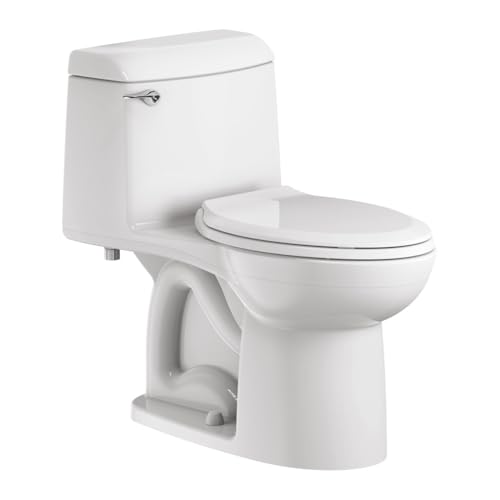
The American Standard Champion 4 has the widest fully glazed trapway (2-3/8 inches) and the largest flush valve (4 inches) of any gravity-feed residential toilet, making it the best choice for manufactured homes with a history of drain clogs, even though its 1.6 GPF puts it above the EPA WaterSense threshold.
Older manufactured homes frequently have ABS or PVC drain lines running at shallower slopes than site-built homes, partly because the floor structure is thinner and partly because the original installation may not have been done to code. Shallower drain slopes mean waste moves more slowly through the line, increasing the risk of accumulation and eventual clogging. The Champion 4's 4-inch flush valve sends a fast, high-volume surge of water that pushes waste through even a slow-draining line without leaving material behind.
The 10-year limited warranty from American Standard is the longest on this list and reflects the Champion 4's reputation for longevity. The 2-3/8-inch fully glazed trapway is wider than any other toilet on this list, which means accumulated paper or waste that would catch on a narrower passage passes through without resistance. For manufactured home owners who have owned the same toilet for years and have been plunging it monthly, the Champion 4 typically ends that cycle completely.
The Champion 4 is the only toilet on this list where the clog-prevention case is strong enough to justify the 1.6 GPF figure. If your manufactured home drains slowly, has an older ABS drain line at a shallow pitch, and you have been plunging regularly, the extra 0.32 GPF per flush is less costly than continuing to deal with clogs that risk pushing waste into the line or damaging the floor around the base from repeated plunging stress. Buy it for that specific scenario; choose a 1.28 GPF model for everything else.

The Gerber Maxwell is a professional-grade round-bowl toilet with a 10-inch rough-in option, 800 gram MaP score at 1.28 GPF, EPA WaterSense certification, and a shorter footprint that makes it the best choice for manufactured home bathrooms too narrow to accommodate an elongated bowl comfortably.
Round bowls are approximately 2 inches shorter from front to back than elongated bowls, and in a manufactured home bathroom where the toilet sits close to a wall or door, that difference can be the deciding factor in whether the fixture fits at all. The Gerber Maxwell provides 800 gram MaP performance and EPA WaterSense certification in a round configuration that works in bathrooms where elongated models physically cannot. Gerber is a professional plumbing brand more familiar to contractors than consumers, which is why it delivers solid specifications without the brand-recognition markup.
The Maxwell's siphon jet flush mechanism uses a glazed trapway and a properly sized flush valve to move waste cleanly without relying on a wide-rim flood. Owner reviews confirm reliable single-flush performance for typical household loads, and the 10-inch rough-in variant makes it one of very few round bowls confirmed to work in older manufactured home drain configurations. Parts are available online; physical retail stocking is limited compared to Kohler or American Standard.
The Maxwell fills a specific gap: it is the best option when a round bowl is required and both budget and rough-in dimension are constrained. If your manufactured home bathroom measures less than 30 inches in front-clearance from the finished wall to the front of the bowl, or the door swing conflicts with an elongated toilet, the Maxwell resolves the fit problem while still delivering adequate flush performance. It is not the most powerful option, but it is the right-sized option for the tightest installations.
The Swiss Madison Ivy is a one-piece elongated toilet with a slim, contemporary profile that works well in updated manufactured home bathrooms where modern aesthetics are a priority, offering 800 gram MaP performance at 1.28 GPF with EPA WaterSense certification.
Swiss Madison has built a following among renovation buyers who want a clean-lined contemporary toilet without paying for TOTO or Kohler premium pricing. The Ivy's one-piece construction eliminates the tank-to-bowl seam that collects grime and can eventually leak in a vibrating manufactured home. The dual-flush button top-mount adds the same liquid-waste water-saving function as the Aquia IV, though at a lower MaP score. For a bathroom being renovated in a newer manufactured home with a 12-inch rough-in, the Ivy provides a modern focal point that many higher-performing but traditionally styled toilets cannot match visually.
The 800 gram MaP score is adequate for typical household solid-waste loads and will not require double-flushing under normal conditions. Owner reviews note that the one-piece design significantly reduces cleaning time compared to the original two-piece toilets found in most manufactured homes, and the low-profile tank does not obstruct bathroom mirror or shelf arrangements the way a taller traditional tank might. Swiss Madison parts and warranty service are available but less broadly distributed than major brands; verify replacement part availability before purchasing if you are in a remote location.
The Ivy makes the list because it provides a modern upgrade option for manufactured home owners who are doing a bathroom renovation and want the result to look intentional rather than utilitarian. The one-piece design, dual-flush function and slim profile together produce a bathroom that reads as a deliberate design choice rather than a functional replacement. If the rough-in is 12 inches and the goal is a contemporary look alongside adequate performance, the Ivy delivers it.

The Woodbridge T-0001 is a skirted one-piece toilet with a concealed trapway, 800 gram MaP score, dual-flush 1.0/1.6 GPF operation, EPA WaterSense certification, and a clean contemporary silhouette that suits manufactured homes undergoing a full bathroom upgrade.
The Woodbridge T-0001's skirted design eliminates the exterior curves and crevices of a traditional two-piece toilet, replacing them with a smooth, flat surface that wipes clean in seconds. In a manufactured home bathroom where space is limited and cleaning access around the base may be restricted, this is a genuine functional improvement over a standard exposed-trapway two-piece. The concealed trapway also removes the most frequently grimy surface on a traditional toilet from visible reach.
Note that the T-0001's full flush at 1.6 GPF is higher than the other dual-flush options on this list, which makes it less ideal for manufactured homes on septic systems where keeping GPF below 1.28 is a priority. For homes on municipal water or with adequate septic capacity, the 1.0 GPF partial flush provides meaningful water savings on liquid-only flushes. The 800 gram MaP score on the 1.6 GPF full flush is adequate for typical household waste. Woodbridge is a newer brand with growing parts availability online but limited local retail stocking.
The T-0001 is the easiest-to-clean toilet on this list, and in a manufactured home bathroom where cleaning frequency tends to be high due to space constraints and shared use, that is a real advantage. The skirted design, soft-close seat and one-piece construction together make it the most renovation-ready option for a homeowner who wants their manufactured home bathroom to look like a site-built remodel. Confirm the 12-inch rough-in before ordering.
The most important thing a manufactured home owner can do before purchasing any toilet is measure the rough-in. A 10-inch rough-in toilet installed in a 12-inch rough-in space will sit 2 inches closer to the wall than intended, and a 12-inch toilet in a 10-inch rough-in space will not sit flush against the wall at all. Take the measurement from the finished wall surface (not the baseboard or quarter-round trim) to the center of the floor bolt cap holes on either side of the existing toilet base. Do this before looking at any product. If the measurement is 10 inches, your options are the Drake, Cadet 3, Highline, Cimarron, Champion 4, or Gerber Maxwell in their 10-inch configurations. If it is 12 inches, the full list applies.
The consequence of choosing the wrong rough-in is significant: a 12-inch toilet in a 10-inch rough-in space will not sit flush against the wall, leaving an unsightly and structurally unstable gap behind the tank. A 10-inch toilet in a 12-inch rough-in space will sit a full 2 inches closer to the wall than intended, which is visible but generally functional. Most manufacturers recommend matching exactly rather than substituting in either direction.
Some older manufactured homes have 14-inch rough-in dimensions, which is less common but real. The American Standard Cadet 3 is one of the only toilets on this list confirmed to offer a 14-inch rough-in option, which makes it the safest choice if measurements come in at 14 inches rather than 10 or 12. For guidance on how to take this measurement accurately, see our detailed guide on how to measure toilet rough-in.
The floor condition is the more common obstacle. A manufactured home subfloor is typically 5/8-inch to 3/4-inch tongue-and-groove particleboard or plywood over a chassis frame, which is thinner and more susceptible to water damage than a concrete slab. If the subfloor around the existing toilet shows any signs of softness, discoloration, or give when pressed, that area needs to be repaired before a new toilet is installed. Installing a new toilet on a damaged subfloor will result in a rocking base that breaks the wax ring seal within months, causing a slow leak that progressively damages more of the subfloor.
Width clearance from the center of the toilet to each side wall should be at least 15 inches per side, per standard plumbing codes. In older mobile homes where the toilet is positioned in a tight corner configuration, measuring both the front clearance and the side-to-side distance before ordering a toilet prevents the frustrating experience of receiving a fixture that physically cannot be installed. For advice on maximizing a tight bathroom layout, see our guide to best toilets for small bathrooms.
Some manufactured homes, particularly older pre-HUD units from the 1960s and early 1970s, used proprietary toilet systems with non-standard connection dimensions. In those cases, a professional plumber familiar with manufactured home plumbing should assess the existing installation before any replacement is ordered. For standard manufactured homes built under HUD code (post-1976), off-the-shelf residential toilets with the correct rough-in dimension are the appropriate replacement.
The following checklist covers every specification that matters specifically for a manufactured home toilet replacement, in priority order.
With the existing toilet still in place, measure from the finished wall surface (not the baseboard) to the center of the floor bolt caps on either side of the base. This is your rough-in distance. Write it down. The most common options are 10 inches, 12 inches, and (rarely) 14 inches. Order a toilet with exactly that rough-in dimension; do not substitute unless the manufacturer explicitly states compatibility.
Measure from the wall behind the toilet location to the nearest obstruction in front (door, vanity, opposite wall). A standard elongated bowl adds approximately 28 to 30 inches from the finished wall to the front of the bowl. A round bowl adds approximately 25 to 27 inches. If your clearance is under 30 inches, measure carefully against the specific toilet you are considering. If it is under 27 inches, a round bowl is likely the only option.
Before purchasing a toilet, press firmly on the floor around the existing toilet base. If it feels soft, spongy or gives noticeably under pressure, the subfloor has moisture damage and needs repair before any new toilet is installed. The floor flange should sit at or slightly above finished floor level; a sunken flange requires an extension ring for proper wax ring sealing. These repairs are inexpensive but critical; skipping them will result in a wax ring leak within months of installation on a damaged substrate.
Choose a toilet with 1.28 GPF or below to qualify for EPA WaterSense certification and to keep water usage as low as possible, which matters both for water bills and for septic system loading on homes with private systems. Confirm a MaP score of at least 800 grams, preferably 1000 grams, to eliminate double-flushing. Scores can be verified at map-testing.com before purchasing.
Every toilet on this list has a fully glazed trapway, but verify this for any model not on the list. An unglazed trapway will accumulate waste and mineral buildup that narrows the passage over years of use, eventually causing clogs regardless of how powerful the flush is. A glazed trapway rated 2 inches or wider in diameter is the standard for reliable long-term performance.
Older manufactured homes sometimes have non-standard supply line fittings or angled shut-off valve positions that require an adapter or flexible supply line rather than a rigid direct connection. Measure the supply line length from the shut-off valve to the fill valve connection on the new toilet before purchase, and verify that your shut-off valve uses a standard 3/8-inch compression fitting that matches modern supply lines. If not, replacing the shut-off valve at the same time as the toilet is the cleanest solution. For additional guidance, see our complete guide to how to install a toilet.
The single most common mistake manufactured home owners make when replacing a toilet is ordering before measuring the rough-in. The second most common mistake is installing a new toilet on a water-damaged subfloor without repairing it first. Both errors result in a toilet that either does not fit or fails within a year. Measure first, repair the floor if needed, then order the toilet with the confirmed rough-in dimension. Every other specification -- GPF, MaP score, bowl shape, brand -- matters less than getting those two fundamentals right.
Most manufactured homes built before the mid-1990s use a 10-inch rough-in. Homes built after approximately 1995 increasingly used 12-inch rough-in plumbing. Some older pre-HUD units may have 14-inch or non-standard rough-in dimensions. Always measure directly from the finished wall to the center of the floor bolt caps before purchasing any replacement toilet.
Yes. Replacing a toilet in a manufactured home is a standard DIY plumbing task provided the subfloor is in good condition and the rough-in has been measured correctly. The process is the same as in a site-built home: shut off the water supply, empty the tank and bowl, disconnect the supply line, remove the floor bolts, lift out the old toilet, replace the wax ring, set the new toilet and reconnect. If the subfloor is soft or the flange is damaged, hire a plumber for that portion of the work before attempting the toilet swap.
For a manufactured home on a private septic system, the TOTO Drake at 1.28 GPF with 1000 gram MaP score is the best option with a 10-inch rough-in. For homes with a 12-inch rough-in where maximum water conservation is the priority, the TOTO Aquia IV at 0.8/1.28 GPF dual-flush is the most septic-efficient choice. Both are EPA WaterSense certified.
No. Manufactured homes use standard residential toilets. The key requirement is that the toilet matches the rough-in distance (commonly 10 inches in older units) and fits within the bathroom footprint. Any toilet from TOTO, Kohler, American Standard, Gerber or other major brands offered in a 10-inch rough-in configuration is appropriate, provided the floor and flange are in adequate condition.
A MaP score of 800 grams or higher at 1.28 GPF is the minimum for reliable single-flush performance. A 1000 gram score is the gold standard and eliminates double-flushing in virtually all household scenarios. For manufactured homes where the floor subfloor is sensitive to repeated plunging stress, a 1000 gram MaP score at 1.28 GPF provides the best protection against clog-related floor damage over time.
Use an elongated bowl if front clearance allows (at least 28 to 30 inches from the finished wall to the nearest obstruction). Elongated bowls are more comfortable for most adults. If front clearance is under 27 inches, a round bowl is the practical choice, as it is approximately 2 inches shorter. The Gerber Maxwell round-bowl with 10-inch rough-in availability is the best compact option on this list for tight mobile home bathrooms.
With the existing toilet in place, measure from the finished wall surface (not the baseboard or quarter-round) to the center of the floor bolt cap holes visible at the base of the toilet on both sides. Do not measure to the bolt itself; measure to the cap center. The number will typically be 10, 12, or 14 inches. Take this measurement before purchasing any replacement toilet.
Yes. TOTO offers the Drake platform in a 10-inch rough-in configuration (look for the model code suffix indicating the rough-in dimension on the product page or packaging). The flush mechanism, MaP score, and GPF are identical to the 12-inch version; the 10-inch variant adjusts the tank depth to accommodate the shorter wall-to-drain distance found in many older manufactured homes.
The most common causes of frequent clogs in manufactured homes are a weak original toilet with a low MaP score, ABS or PVC drain lines installed at a shallower slope than recommended, and partial blockages that have built up over years in older drain lines. Replacing the toilet with a high-MaP model (1000 grams) typically resolves the toilet-related causes. If clogging continues after replacing the toilet, the issue is likely in the drain line slope or a downstream partial blockage.
Toilet replacement in a manufactured home costs the same as in a site-built home when the subfloor and flange are in good condition: the toilet fixture cost plus a wax ring (a few dollars) and a new supply line (under $15 for a braided stainless flex line). Professional installation typically adds $100 to $200 in labor. If the subfloor needs repair or the flange needs to be reset or extended, total costs can rise significantly depending on the extent of damage.
No. "Flushable" wipes should not be used in any residential toilet, including those in manufactured homes. Wipes do not disintegrate the way toilet paper does and are a leading cause of drain line clogs. In manufactured homes with older ABS drain lines at shallower slopes, wipes accumulate faster and cause blockages that are difficult to clear. Use only standard toilet paper, preferably single-ply or septic-safe brands in homes on private septic systems.
EPA WaterSense is a voluntary certification requiring toilets to flush at 1.28 GPF maximum and to pass an independent minimum flush performance test. For manufactured homes, WaterSense certification provides two benefits: it confirms water efficiency that reduces utility costs (or septic loading for homes on private systems), and it confirms a minimum flush standard that reduces double-flushing. It is the fastest single criterion for identifying a toilet that is both water-efficient and reliably functional.
The standard wax ring used for site-built home toilet installation is appropriate for most manufactured home installations. However, if the floor flange sits below the finished floor level -- which is more common in manufactured homes where the floor has been overlaid with additional material -- a wax ring with an extension horn or a foam wax-free seal with a built-in extension may provide a better seal. Inspect the flange height relative to the floor surface before selecting the wax ring style.
Two-piece toilets are generally easier to install in manufactured homes because the tank and bowl can be carried separately, reducing the weight of each piece moved through a potentially narrow hallway or doorway. One-piece toilets are easier to clean once installed. For a manufactured home where the bathroom door or hall width is a constraint during installation, a two-piece model like the TOTO Drake or American Standard Cadet 3 is the more practical choice.
TOTO, Kohler, American Standard, and Gerber all offer 10-inch rough-in variants of several of their most popular toilet models. Swiss Madison and Woodbridge currently offer their main models in 12-inch rough-in only. When ordering, confirm the specific model code corresponds to the 10-inch rough-in version, as the same product name may be offered in multiple rough-in configurations under slightly different model codes.
A rocking toilet in a manufactured home is almost always caused by one of three issues: floor bolts (Johnny bolts) that have come loose or corroded, a failed or misaligned wax ring that allowed the toilet to shift, or a soft or damaged subfloor that no longer supports the toilet base firmly. A rocking toilet must be stabilized immediately: continued rocking breaks the wax ring seal and causes slow water leaks that damage the subfloor. Tighten the floor bolts first; if that does not resolve the rocking, pull the toilet and inspect the subfloor and flange.
Yes. MaP testing measures toilet flush performance independent of the installation context. A 1000 gram MaP score means the toilet clears 1000 grams of simulated solid waste per flush whether it is installed in a manufactured home or a site-built house. The drain line slope and diameter downstream of the toilet affect whether flushed waste reaches the septic tank or municipal connection without stalling, but the MaP score reflects the toilet's own performance only.
A quality toilet installed correctly in a manufactured home should last 20 to 30 years or more, assuming the wax ring and internal components (fill valve, flapper, flush handle) are replaced as needed every 5 to 10 years. The ceramic bowl and tank are effectively permanent. Toilet lifespan in manufactured homes is most commonly shortened by subfloor water damage from a failed wax ring seal, which is why proper floor and flange inspection at installation time is critical.
For most manufactured homes, the TOTO Drake in 10-inch rough-in is the strongest single recommendation: 1000 gram MaP at 1.28 GPF, EPA WaterSense certified, and available in the non-standard rough-in dimension that most older manufactured homes require. If the rough-in measures 10, 12, or 14 inches and you want three-configuration flexibility with 1000 gram MaP performance at a lower price than TOTO, the American Standard Cadet 3 is the best alternative. For manufactured homes with narrow bathrooms where a round bowl is required, the Gerber Maxwell with a 10-inch rough-in option is the most practical choice. For homes on private septic systems with a 12-inch rough-in, the TOTO Aquia IV dual-flush at 0.8/1.28 GPF reduces daily water volume into the tank more than any other model on this list. Regardless of which model you choose, measure the rough-in before ordering and inspect the subfloor before installing: those two steps determine whether the new toilet performs correctly from day one.
Learn why toilet trapways curve like an S, how each bend blocks sewer gas, and what the shape means for clogs and…
Read the guideAlmost every US toilet has a left-side handle. Learn the plumbing and mechanical reasons behind the layout and when it actually changes.
Read the guideHome toilets rely on tanks because household water lines lack the pressure that public flushometer systems use to flush straight from the…
Read the guide