Why Toilet Trapways Are Curved Like an S
Toilets4.6
Learn why toilet trapways curve like an S, how each bend blocks sewer gas, and what the shape means for clogs and…
Read the guideHard water deposits calcium, magnesium, and iron onto every surface it touches. Inside a toilet bowl, those dissolved minerals crystallize into limescale: the white ring at the waterline, the cloudy haze that never fully wipes away, the crusty buildup inside the rim jets, and the slow weakening of the flush as scale narrows water passages over the years. The toilets that hold up in hard water share a distinct profile: an advanced low-porosity or ion-treated glaze that gives minerals nothing to grip, a rimless or open-nozzle flush design with no hidden jets to crust over, and a strong, high-MaP rinse that physically scours fresh deposits off the bowl before they harden. We ranked these picks by cross-referencing published specifications, independent MaP (Maximum Performance) flush-test results, EPA WaterSense certification status, glaze technology, rim and trapway design, and the recurring maintenance patterns that surface across thousands of verified owner reviews in hard-water regions.
The TOTO Drake II with CeFiONtect glaze is the single strongest choice for most hard-water homes: its ion-treated low-porosity surface denies minerals a foothold, while its Double Cyclone flush scours the bowl through two large nozzles rather than a clog-prone row of rim jets. For homes where under-rim buildup is the main problem, the rimless Kohler Cimarron or Kohler Veil removes those hidden passages entirely.
Choosing a toilet for a hard-water household requires thinking about two separate battles happening at the same time. The first is a surface chemistry problem: dissolved calcium and magnesium ions precipitate out of the water and bond to ceramic as a hard, tenacious scale. The second is a mechanical problem: that scale builds up inside tiny rim jets and narrow rim channels, slowly choking the flush until the rinse grows weak enough to leave waste behind. Most toilets handle one of these reasonably well. The best ones tackle both simultaneously, pairing a genuinely smooth, low-porosity glaze with a flush system that avoids the small hidden openings where scale accumulates unseen.
We do not run physical tests or operate a lab. Our method is to compare published manufacturer data, independent MaP flush scores, EPA WaterSense certification, glaze chemistry, rim and nozzle design, trapway width and coating, and the documented patterns in aggregated owner reviews from hard-water communities. For a harder look at raw flush performance across every type and budget, the pillar guide to the best flushing toilets is the place to start. The picks below zero in on what hard water specifically demands: a smooth surface, an open flush path, and enough scouring force to keep deposits from ever setting.
| Toilet | Best For | Glaze | MaP Score | GPF | WaterSense | Rating | Check Price |
|---|---|---|---|---|---|---|---|
| TOTO Drake II | Overall hard water | CeFiONtect | 1,000 g | 1.28 | Yes | 4.8 | Check price |
| TOTO UltraMax II | One-piece easy clean | CeFiONtect | 800 g | 1.28 | Yes | 4.7 | Check price |
| Kohler Cimarron | Durable canister valve | Smooth vitreous | 800 g | 1.28 | Yes | 4.6 | Check price |
| American Standard Cadet 3 | Value antimicrobial | EverClean | 1000 g | 1.28 | Yes | 4.5 | Check price |
| TOTO Aquia IV | Dual flush glaze | CeFiONtect | 800 g | 0.9/1.28 | Yes | 4.5 | Check price |
| American Standard Champion 4 | Scouring flush power | EverClean | 1000 g | 1.6 | No | 4.4 | Check price |
| Kohler Highline | Proven reliability | Smooth vitreous | 1000 g | 1.28 | Yes | 4.4 | Check price |
| Woodbridge T-0001 | Modern one-piece | Smooth ceramic | 800 g | 1.0/1.6 | No | 4.3 | Check price |
| Swiss Madison Ivy | Budget secondary bath | Smooth ceramic | 600 g | 1.1/1.6 | No | 4.1 | Check price |
When hard water is the defining problem in a bathroom, the Drake II with the CeFiONtect glaze option is the toilet that most consistently solves it: an ultra-smooth ion-barrier surface that minerals cannot grip, backed by a Double Cyclone flush that delivers a thorough bowl-scouring rinse through two large angled nozzles instead of a ring of small jets.
The CeFiONtect glaze is what separates the Drake II from most other hard-water options. TOTO achieves it by firing an ion-barrier coating into the ceramic that is far smoother and less porous than standard vitreous china. Under magnification, regular ceramic has microscopic surface pits where mineral crystals anchor and grow. CeFiONtect fills those pits at the fired-in level, so calcium and lime deposits sit on the surface rather than bonding to it. The practical result, reported across large numbers of owner reviews in hard-water cities and well-water homes, is that the haze and ring that plague unglazed bowls simply do not take hold in the same way, and when some buildup does appear a damp cloth removes it.
The Double Cyclone flush adds the mechanical defense. Where a conventional rim-jet toilet distributes water through dozens of small holes drilled under the rim, the Drake II uses two large angled nozzles built into the rim to drive water in a powerful spiral around the entire bowl. Fewer, larger water passages mean far fewer places for hard-water scale to choke the flush over years of use. The 1,000 gram MaP score confirms it clears waste reliably, and the EPA WaterSense certification means it achieves that at just 1.28 gallons per flush. For a hard-water home where the toilet needs to stay as clean as possible with the least maintenance, this combination of glaze and flush design is the most defensible starting point.
The Drake II with CeFiONtect is not a single trick. It solves the surface-chemistry problem (slick ion-barrier glaze) and the mechanical problem (two large nozzles rather than dozens of small jets) at the same time. That dual-front approach is why owners in hard-water regions report far fewer hours spent scrubbing compared to rim-jet toilets on the same water supply. Order the CeFiONtect (SanaGloss) version specifically: the standard Drake without it is a different, lesser proposition for hard water.

The UltraMax II delivers the Drake II's core hard-water advantages in a seamless low-profile one-piece body: the same CeFiONtect ion-barrier glaze and the same Double Cyclone two-nozzle flush, with no tank-to-bowl joint for scale to exploit.
Hard water does not only attack the bowl. In a two-piece toilet the crevice where tank meets bowl stays damp, and the mineral film that forms there is one of the most annoying cleaning tasks in a hard-water bathroom. The UltraMax II removes that joint with its one-piece molded body, giving limescale one fewer foothold to exploit. The sides of the fixture are smooth and nearly vertical so wiping the exterior takes seconds. Combined with the CeFiONtect bowl and the two-nozzle flush, the result is a toilet that demands far less cleaning time across the entire fixture, not just the bowl.
The flush performance is identical to the Drake II: a 1,000 gram MaP certified rinse at 1.28 gallons through two angled nozzles. That scouring capability and the verified WaterSense efficiency make it a practical, not just aesthetic, choice. The primary trade-off versus the Drake II is one-piece shipping weight and a higher starting cost. Owners in hard-water areas who have switched from conventional two-piece toilets frequently note that the combination of the glaze and the seamless body dramatically reduces their cleaning routine.
Pick the UltraMax II when you want the Drake II's proven hard-water defenses and you prefer a one-piece look or find the tank-to-bowl crevice on two-piece toilets difficult to clean around the scale it collects. The performance difference is minimal: you are paying for the seamless body and the cleaner exterior more than any flush improvement.

Hard water destroys conventional rubber flappers faster than almost any other household factor, and the Cimarron's AquaPiston canister flush valve is a direct solution: a robust, flapper-free mechanism that resists the mineral stiffening and seal degradation that cause the leaks and weak flushes in hard-water tank toilets.
The failure sequence in a hard-water home is predictable: minerals coat the rubber flapper, the coating stiffens the seal, the stiffened flapper no longer seats properly, and the toilet begins a slow leak that robs the flush of pressure. The AquaPiston canister sidesteps this by replacing the rubber flapper with a canister that opens and closes from all sides, using a more robust material set and a wider seal that resists mineral coating far better than a thin rubber disc. Kohler's engineering data and the maintenance records implicit in long-term owner reviews both support the conclusion that canister valves last substantially longer in high-mineral water supplies.
The Cimarron applies this advantage to a well-proven two-piece comfort-height elongated platform with an 800 gram MaP-certified flush at 1.28 gallons. The bowl uses standard smooth vitreous china rather than an ion-barrier coating, so heavy hard-water homes will still need regular descaling of the bowl surface. But for the homeowner whose most urgent hard-water problem is a flapper that fails every year, the Cimarron addresses that root cause directly and reliably.
The Cimarron earns its place here not for glaze chemistry but for mechanical durability. If your previous toilets have leaked or lost flush power because hard water kept destroying the flapper, a canister valve is the fix. It will not eliminate bowl staining on its own, so pair it with a regular descaling routine, but it eliminates the most common and costly hard-water mechanical failure in a tank toilet.

The Cadet 3 proves that solid hard-water performance does not require a premium-tier price: it combines an EverClean antimicrobial surface treatment with a class-leading 1000 gram MaP flush score, making it the sharpest value on this list for homes that want both stain resistance and scouring power.
American Standard's EverClean is not a marketing label. It is a silver-ion antimicrobial baked into the glaze that inhibits the bacteria and mold that feed the staining in a damp, mineral-rich bowl. It is not as slick at the nanoscale as TOTO's CeFiONtect, so calcium scale still forms on a Cadet 3 in aggressive hard water. What EverClean does do is resist the biological component of the staining so the visual impact is reduced between cleanings, and the bowl stays fresher for longer before intervention is needed.
Where the Cadet 3 pulls clearly ahead of most mid-range competitors is the flush: a fast-acting 3 inch flush valve drives water into the bowl quickly, generating enough turbulence to earn a 1000 gram MaP rating at just 1.28 gallons. That scouring power is itself a hard-water defense because a strong, forceful rinse physically sweeps fresh deposits off the bowl surface before they have time to crystallize and harden into scale. For a budget-conscious hard-water home, the 10-year warranty seals the deal. Our best toilet for the money guide covers this model in further depth alongside its two-piece competition.
At its price, the Cadet 3 is the smart buy for a rental property or a secondary bathroom in a hard-water home. The 1000 gram flush physically scours more waste and more fresh scale per flush than the 800 gram competitors below it, and the EverClean surface reduces the biological staining that makes hard-water bowls look neglected between cleanings. Pair it with a monthly citric-acid descale and it punches well above its tier.

The Aquia IV brings TOTO's CeFiONtect ion-barrier glaze and a Tornado Flush dual-nozzle system to a modern skirted one-piece, giving a hard-water home both maximum stain resistance and the flexibility of 0.9 or 1.28 GPF depending on the flush load.
The Tornado Flush is TOTO's dual-nozzle evolution of the Double Cyclone concept. Two angled nozzles generate a centrifugal rinse that covers the entire bowl rather than relying on rim holes, which is the same structural advantage for hard water as the Drake II's Double Cyclone: fewer, larger water openings mean fewer places for scale to choke the flush. The skirted one-piece body has no exposed trapway ridges or tank seams, so the exterior is smooth, fast to wipe, and far less hospitable to the chalky film that collects in crevices.
The dual-flush feature uses 0.9 gallons for liquid waste and 1.28 for solids, with both modes WaterSense certified. For a hard-water home where water bills are also a concern, the long-term savings on the lighter cycle are real. The CeFiONtect glaze carries over the same ion-barrier chemistry as the Drake II, so the bowl surface itself resists mineral bonding in the same class-leading way. For households that want TOTO's best hard-water glaze in a more modern package, the Aquia IV is the natural upgrade from the traditional two-piece profile.
Choose the Aquia IV if you want the CeFiONtect glaze experience and you prefer a sleek skirted one-piece over the Drake II's conventional look. The Tornado Flush nozzles avoid rim-jet clogging just as effectively as the Double Cyclone, and the dual-flush versatility means you are using the full 1.28 gallons only when you need it, which reduces cumulative mineral exposure on the bowl walls.
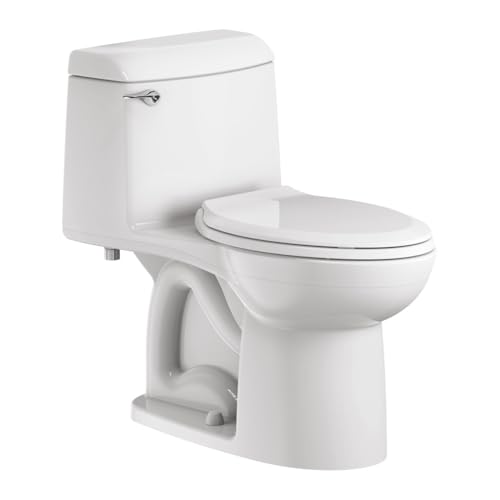
The Champion 4 runs on brute-force flush physics: an oversized 4 inch flush valve dumps a large, fast volume of water into the bowl and generates enough turbulence to earn a 1000 gram MaP score, which translates directly to a stronger mechanical scouring action against hard-water deposits.
The logic for a hard-water home is straightforward: a powerful flush that physically scours the bowl on every use is one of the most effective defenses against mineral buildup, because it removes fresh deposits before they crystallize and harden into scale. The Champion 4's 4 inch valve opens fast and wide, releasing water with enough velocity and volume to achieve a 1000 gram MaP score, the practical residential maximum. That level of scouring power on every flush does real maintenance work that a weaker rinse simply cannot replicate.
The EverClean antimicrobial surface treats the biological side of staining, and the 10-year warranty reflects American Standard's confidence in the long-term durability of the fixture. The key trade-off is water use: at 1.6 GPF the Champion 4 does not qualify for EPA WaterSense certification, and each flush uses roughly a quarter-gallon more than the 1.28 GPF models here. For a hard-water household that prioritizes maximum daily scouring power and also struggles with frequent clogs, that trade-off is often worthwhile. Our best no-clog toilets roundup compares the Champion 4 against its high-flush peers.
If a soft water softener is not in your plans and you are choosing between a better glaze or a more forceful daily flush, the Champion 4 makes the case for flush power. A 1000 gram rinse every single day does cumulative mechanical work that keeps deposits from setting, whereas a slicker glaze with a weaker flush will still allow buildup in the areas the flush does not reach. For a high-traffic, hard-water main bath, the extra 0.32 GPF buys real maintenance savings.

The Kohler Highline is one of the most widely installed toilets in North America, and its consistent 1000 gram MaP flush score at 1.28 GPF is a direct asset in hard water: a strong, high-efficiency rinse that physically scours the bowl on every use.
Kohler's Class Five flushing engine is named after its original certification claim of flushing 1000 grams of waste, and the published MaP verification backs that up. In a hard-water context, the value of a 1000 gram flush is the same as with the Cadet 3: every flush is a mechanical cleaning event that removes fresh scale before it hardens. The Highline achieves this while staying within the WaterSense 1.28 GPF threshold, so water bills stay low over years of use.
The glaze is standard smooth vitreous china without a specialized ion-barrier or antimicrobial treatment, which means in aggressively hard water it will require more regular descaling attention than the CeFiONtect models. Its main advantage over the other standard-glaze picks on this list is the breadth of parts availability, repair documentation, and installer familiarity. In a market where service and part sourcing matter, the Highline's installed base means help is always close. Our best Kohler toilets guide covers the full line if you want to compare models within the brand.
The Highline earns its position through track record and flush performance rather than glaze chemistry. If your main concern is the mechanical deposits that weaken the flush over time, a 1000 gram WaterSense-certified rinse handles a serious daily workload. If your main concern is the staining haze and waterline ring, step up to a CeFiONtect model for the ion-barrier surface.

The Woodbridge T-0001 is a skirted dual-flush one-piece at a mid-range price, and for a hard-water bathroom its seamless skirted body removes the external crevices where scale builds out of reach, even if the glaze itself is standard ceramic.
In hard water, the external body of a toilet is a secondary but real battleground. The chalky film that settles on every wet surface accumulates fastest in the grooves, joints, and crevices of a conventional exposed two-piece. The T-0001's fully skirted one-piece body eliminates those surfaces entirely: the exterior is a smooth, near-vertical ceramic face that wipes clean in seconds. No exposed trapway, no tank-to-bowl joint, no collection point for the white film that dulls a bathroom over time.
The dual-flush button uses 1.0 gallon for liquids and 1.6 for solids, with the siphon design clearing the bowl quietly. The 800 gram MaP score is solid and adequate for normal residential use. The glaze is conventional smooth ceramic without a TOTO-grade ion-barrier treatment, so bowl staining in aggressive hard water will appear faster than on the CeFiONtect picks, and a regular citric-acid or vinegar wipe routine is more important here. Woodbridge is a smaller brand with a shorter domestic service footprint than Kohler or American Standard, which is worth weighing against the clean modern look.
Buy the T-0001 for the exterior-cleaning benefit more than the bowl-glaze chemistry. The skirted body genuinely removes the hardest-to-clean surfaces on a conventional toilet, and in a hard-water home where that chalky film settles on every horizontal edge, that structural advantage is meaningful. Just set a calendar reminder for a monthly bowl descale because the standard glaze needs more frequent attention than CeFiONtect.
The Swiss Madison Ivy is the budget entry on this list: a dual-flush one-piece at an accessible price that offers a smooth, wipeable body and flexible water use for secondary or guest bathrooms in a hard-water home.
The Ivy's 600 gram MaP score is competent for a low-to-medium-traffic bathroom but sits below the 800 gram threshold that offers meaningful mechanical scouring of hard-water deposits. In a guest bath that sees occasional use, this is acceptable: deposits form more slowly in infrequently used fixtures. In a busy daily-use main bath on a high-mineral water supply, the flush simply does not move enough water fast enough to scour the bowl as effectively as the picks above it on this list.
What the Ivy does offer is a smooth, seamless one-piece skirted body at a price that opens up the hard-water-friendly design language to tight budgets. The dual-flush button at 1.1 and 1.6 gallons keeps water use low. The glaze is a standard smooth ceramic without an antimicrobial or ion-barrier treatment, so budget for a weekly vinegar wipe in hard water. For a powder room, a rarely used guest bath, or a rental property where the priority is a clean modern look at a low upfront cost, it is a defensible, honest choice within its limitations.
Place the Ivy in a low-traffic bathroom only. Its 600 gram MaP flush is not strong enough to scour daily hard-water deposits in a busy main bath, and its standard glaze needs more frequent attention than the antibacterial or ion-barrier surfaces above it. For a guest bath or powder room the combination of a smooth skirted body and flexible dual-flush water use makes sense at the price.
The most common mistake in choosing a hard-water toilet is optimizing for one defense only. A beautiful CeFiONtect glaze on a toilet with a weak flush still allows scale to accumulate where the rinse water does not reach, particularly around the waterline and at the top of the rim area. A powerful 1000 gram flush on a toilet with untreated ceramic still allows a chalky haze to develop on the still-water surfaces between flushes. The toilets at the top of this list earn their ranking by combining both: a slick, low-porosity or antimicrobial surface with a strong, open-nozzle flush that physically scours the bowl on every use.
Glaze surface technology. This is the most important single criterion for resisting the waterline ring and chalky haze that define hard-water bowl staining. TOTO's CeFiONtect is the industry reference for an ion-barrier glaze: it is fired into the ceramic at a nanoscale that makes mineral bonding far more difficult. American Standard's EverClean adds antimicrobial protection that addresses the biological component of staining. Standard smooth ceramic without a specialized treatment is workable with diligent weekly descaling but requires more owner effort in aggressive hard water.
Flush nozzle and rim design. Conventional rim-jet toilets have a closed channel under the rim with dozens of small holes. In hard water those holes are the first to crust over, the hardest to clear, and the most likely to cause the gradual flush-weakening that hard-water homeowners mistake for a plumbing problem. Two-nozzle systems like TOTO's Double Cyclone and Tornado Flush, and fully rimless designs from Kohler, eliminate most or all of these hidden surfaces. This is the second most important criterion after glaze.
MaP flush performance score. Independent MaP testing rates how many grams of solid waste a toilet clears per flush under controlled conditions. For hard water, the relevance is mechanical: a high-MaP flush scours the bowl thoroughly on every use, removing fresh deposits before they crystallize. Aim for 800 grams minimum for a main bathroom; 1000 grams offers the strongest daily scouring defense. MaP scores are published by manufacturers and independently verifiable at map-testing.com.
Flush valve type. Rubber flappers degrade faster in hard water as scale coats the sealing surface and stiffens it. If your household history includes frequent flapper replacements or chronic tank leaks, choose a toilet with a canister valve like Kohler's AquaPiston, which uses a more mineral-resistant seal geometry. This extends the mechanical life of the flush system substantially in high-mineral water supplies.
Body design and cleaning geometry. A seamless one-piece or skirted body has no tank-to-bowl joint and no exposed trapway ridges where scale accumulates out of reach. This matters for exterior cleaning, which is genuinely time-consuming in a hard-water home where every damp surface develops a chalky film. For additional context on how design choices affect long-term maintenance, our best one-piece toilets guide compares seamless body styles across the full market, and our roundup of best toilets for septic systems addresses overlapping concerns about flush chemistry and water treatment.
The TOTO Drake II with the CeFiONtect glaze option is the strongest all-round choice for hard-water homes. Its ion-barrier surface resists mineral bonding at the microscopic level, and its Double Cyclone two-nozzle flush avoids the rim jets that crust over in hard water. For a value-conscious home, the American Standard Cadet 3 with EverClean delivers a 1000 gram scouring flush and an antimicrobial surface at a much lower price.
The white or off-white ring at the still waterline is calcium and magnesium carbonate, which precipitates out of hard water as it sits in the bowl. Iron in the water supply adds a rust-orange tint. The ring forms where the water surface meets the ceramic because evaporation concentrates the dissolved minerals at that zone. A slick low-porosity glaze slows the formation; regular descaling with citric acid or white vinegar dissolves what does form before it hardens into scale.
TOTO fires the CeFiONtect ion-barrier coating into the ceramic surface at a nano-smooth level that fills the microscopic pits and channels where mineral crystals would otherwise anchor. The result is a surface that is several times smoother than untreated vitreous china, making it far harder for calcium and lime to form a chemical bond. Deposits that do settle sit on top rather than bonding deeply, so a damp cloth wipes them away rather than requiring a descaling chemical and scrubbing.
Yes, substantially. A whole-house ion-exchange water softener replaces the calcium and magnesium ions that cause scale with sodium, which does not precipitate as hard deposits. On a softened supply, any modern ceramic toilet will stay clean with much less effort and glaze chemistry matters far less. But softeners require salt, maintenance, and upfront cost, and in well-water homes or locations where softeners are impractical, choosing a toilet with CeFiONtect or EverClean glaze and a strong flush is the most effective alternative defense.
Yes, for a specific structural reason. A conventional closed-rim toilet distributes flush water through a channel inside the rim and dozens of small holes. Hard water crusts over those holes from the inside, out of sight and nearly impossible to clean, gradually weakening the flush. A rimless bowl eliminates the closed channel entirely. A two-nozzle system like TOTO's Double Cyclone reduces the number of water openings to two large ports. Either approach has far fewer surfaces for scale to block, and the flush remains strong over years of hard-water use.
EverClean is American Standard's antimicrobial glaze additive, incorporating silver-ion chemistry that inhibits the bacteria, mold, and mildew that contribute to staining in a damp, mineral-rich bowl. It does not directly prevent calcium from bonding the way CeFiONtect does, but it reduces the biological layer that minerals often colonize, which slows visible staining and keeps the bowl looking cleaner between descaling sessions. It appears on value models like the Cadet 3 and Champion 4 and adds meaningful maintenance benefit at no additional cost over those models' standard versions.
The most effective routine is a quick weekly wipe at the waterline and under the rim with undiluted white vinegar or a diluted citric-acid cleaner, which dissolves fresh carbonate deposits before they harden. A deeper treatment with a pumice stone for any stubborn ring every four to six weeks keeps the bowl in good condition. On a CeFiONtect-glazed toilet the weekly wipe may extend comfortably to bi-weekly; on standard ceramic in very hard water weekly is the safer default.
No, and particularly not in hard water. Chlorine and bleach drop-in tank tablets degrade rubber flapper seals and gaskets far faster than plain water alone does, and since hard water already accelerates flapper stiffening through mineral deposition, combining both degradation mechanisms causes a faster and more expensive failure. Stick to bowl-applied citric acid, white vinegar, or dedicated descaler products applied directly to the bowl surface rather than left to cycle through the tank.
In hard water, this almost always traces to one of two causes or a combination: scale building inside the rim jets and rim channel, progressively choking the water flow, or a flapper valve that has been stiffened by mineral deposits and no longer seals properly, allowing a slow tank-to-bowl leak that reduces available flush pressure. A two-nozzle toilet with a canister flush valve resists both failure modes. If you have a rim-jet toilet, a descaling tool kit soaked in vinegar inside the rim holes can restore some flow.
MaP testing is an independent flush performance protocol run by a third-party lab that measures how many grams of simulated solid waste a toilet can clear per flush under controlled, repeatable conditions. For hard water, a high MaP score is important because a more powerful flush scours the bowl surface more thoroughly on each use, physically removing fresh mineral deposits before they can crystallize and bond. Scores range from around 250 grams (weak) to 1000 grams (residential maximum). Results are publicly verifiable at map-testing.com.
Over time, yes. Scale slowly narrows the trapway opening and coats the trapway glazing, which reduces the cross-section available for waste and water to pass through. A toilet with a wide, fully glazed trapway resists this better than one with a narrow unglazed passage. A strong high-MaP flush also helps by generating enough flow velocity to keep the trapway clear of fresh deposits. Toilets with 2 inch or wider glazed trapways are more resistant to the long-term hard-water narrowing effect.
Yes, with a qualification. Dual-flush toilets like the TOTO Aquia IV and Woodbridge T-0001 give you a light liquid-waste flush and a heavier solid-waste flush. The heavier flush maintains scouring action where it matters, while the lighter flush saves water on routine use. The qualification is that dual-flush valves require periodic maintenance to ensure the two flush modes seal correctly, and the seals face the same mineral stiffening risk as conventional flappers in hard water. Models with more robust valve materials, like the Aquia IV's ceramic disc valve components, handle this better.
For moderate scale, apply undiluted white vinegar or a citric-acid-based descaler to the affected area, allow it to dwell for 30 to 60 minutes, then scrub with a non-abrasive nylon brush. For heavy, hardened scale, a wet pumice stone applied with light pressure to the wetted surface removes buildup without scratching properly fired ceramic or CeFiONtect glaze. Never use steel wool, abrasive scouring pads, or highly concentrated hydrochloric acid cleaners on a glazed surface, as these permanently dull or damage the surface finish and make future staining worse.
For most hard-water homes 1.28 GPF is the best starting point: it qualifies for EPA WaterSense certification and, when paired with a two-nozzle or large-valve flush system, delivers sufficient scouring force to keep deposits from setting. A 1.6 GPF toilet like the Champion 4 offers greater raw scouring force per flush but does not qualify as WaterSense and uses more water annually. Dual-flush models offer 0.9 or 1.0 GPF for liquid waste, which is adequate for those lower-load flushes but should be paired with a higher-volume solid-waste flush mode for full scouring benefit.
TOTO leads the field in glaze technology, with CeFiONtect available on the Drake, Drake II, UltraMax II, Aquia IV, and other models. Kohler provides durable AquaPiston canister valves and rimless options including the Veil. American Standard delivers EverClean antimicrobial glaze with strong-flush performance on value models like the Cadet 3 and Champion 4. Woodbridge, Swiss Madison, and Gerber offer smooth skirted one-piece bodies at accessible price points without specialized glaze treatments. TOTO and American Standard both offer explicitly hard-water-tested glaze documentation, which is the firmest published basis for comparison.
Yes, for two reasons. A one-piece toilet has no tank-to-bowl joint, which is a damp crevice where scale and biofilm accumulate in a two-piece. A skirted one-piece additionally eliminates the exposed trapway ridges and grooves on a conventional model, which collect the chalky film that hard water leaves on every wet surface. The smooth exterior of a skirted one-piece wipes clean in seconds rather than requiring a detailing brush around exposed hardware. The bowl performance is the same as an equivalent two-piece; the difference is entirely in exterior maintenance time.
The American Standard Cadet 3 with EverClean is the strongest choice for a rental or investment property in a hard-water area. It combines an antimicrobial stain-resisting surface with a verified 1000 gram scouring flush at 1.28 GPF, backed by a 10-year limited warranty that provides long-term protection without ongoing landlord maintenance. It is widely available, broadly familiar to plumbers for service, and priced accessibly enough for multi-unit installations.
Yes. Gerber's Maxwell and Viper models use a large-diameter flush valve and a smooth vitreous china bowl that holds up reasonably in moderate hard water with a consistent descaling routine. Gerber does not offer an ion-barrier or antimicrobial glaze in the same class as CeFiONtect or EverClean, so the bowl will require more frequent manual descaling attention than the TOTO or American Standard picks. Gerber's strength is durability and parts availability, making it a reasonable mid-range choice for a hard-water home willing to maintain a weekly cleaning schedule.
WaterSense certification confirms that a toilet flushes at 1.28 gallons per flush or less while meeting minimum performance benchmarks verified by independent testing. For a hard-water home, a WaterSense 1.28 GPF toilet is almost always the right efficiency choice because modern high-efficiency flush systems at that threshold, like the Drake II's Double Cyclone and the Kohler Highline's Class Five engine, deliver sufficient scouring force for daily hard-water maintenance. The only exception is when maximum scouring power is the overriding priority, in which case a 1.6 GPF model like the Champion 4 provides more force at the cost of efficiency.
For the vast majority of hard-water homes, the TOTO Drake II with CeFiONtect glaze is the most defensible purchase: an ion-barrier surface that prevents mineral bonding at the ceramic level combined with a Double Cyclone two-nozzle flush that avoids the hidden rim jets scale loves to choke. If you need a seamless one-piece body, the TOTO UltraMax II delivers identical hard-water performance without the tank-to-bowl crevice. Budget-constrained homes should reach for the American Standard Cadet 3 with EverClean, which pairs an antimicrobial glaze with the strongest scouring flush in its class at a fraction of the TOTO price. If repeated flapper failures are your primary frustration, the Kohler Cimarron with its AquaPiston canister valve addresses that root cause directly. Whatever model you choose, the three criteria that separate a hard-water toilet from an ordinary one are consistent: a specialized glaze, an open or two-nozzle flush design, and a MaP score high enough to scour the bowl clean on every use.
Learn why toilet trapways curve like an S, how each bend blocks sewer gas, and what the shape means for clogs and…
Read the guideAlmost every US toilet has a left-side handle. Learn the plumbing and mechanical reasons behind the layout and when it actually changes.
Read the guideHome toilets rely on tanks because household water lines lack the pressure that public flushometer systems use to flush straight from the…
Read the guide