Why Toilet Trapways Are Curved Like an S
Toilets4.6
Learn why toilet trapways curve like an S, how each bend blocks sewer gas, and what the shape means for clogs and…
Read the guideA high efficiency toilet (HET) uses 1.28 gallons per flush or less and must still clear waste in a single flush. The EPA WaterSense label is the certification that proves both requirements are met by independent testing, not just marketing copy. We ranked the top HET models by MaP flush-test gram scores, published gallons per flush, trapway design, and patterns across thousands of aggregated owner reviews, so you can save water, qualify for rebates, and never reach for the handle a second time.
The TOTO Drake II is the best high efficiency toilet for most households. It earns the EPA WaterSense label at 1.28 GPF, scores the maximum 1,000 grams on independent MaP flush testing, and carries TOTO's Double Cyclone siphon, delivering deep water savings alongside full single-flush clearing power. For households that want the absolute lowest average water use, the dual-flush TOTO Aquia IV drops to 0.8 gallons on its light cycle while maintaining WaterSense compliance on the full flush.
High efficiency toilet is the technical term for any toilet rated at 1.28 gallons per flush or below. Congress set the federal maximum at 1.6 gallons per flush in 1992, so an HET uses at least 20 percent less water than the legal ceiling. The EPA WaterSense program took HET one step further in 2006 by requiring that certified toilets also pass third-party flush performance testing, meaning the water savings cannot come at the cost of clearance. That distinction matters because the 1.6-gallon toilets of the 1990s earned a bad reputation for weak flushing, and some truly were weak, but those failures were design problems, not physics problems. Modern siphon geometry, large trapways, bowl glazes, and dual-nozzle wash systems allow well-engineered toilets to clear more waste on 1.28 gallons than older models managed on 3.5. The brands that proved this first, TOTO, Kohler, American Standard, and Gerber, now have more than a decade of field performance confirming what their MaP scores promised.
The annual water and money savings from switching are real. Replacing a pre-1994 toilet that uses 3.5 gallons per flush with a 1.28-gallon HET saves roughly 17,000 gallons per person per year, according to EPA estimates. A household of four can save 20,000 to 60,000 gallons annually depending on how old the fixtures they replace are, which typically translates to meaningful annual savings on a water-and-sewer bill. In drought-prone states, many water utilities pay direct rebates of $50 to $200 per qualifying WaterSense toilet. We rank here by MaP gram score first, then by gallons per flush, then by flush mechanism design, trapway and glaze quality, and the aggregated owner review record. We do not take payment for placement. Every pick below carries the EPA WaterSense label or meets the 1.28 GPF threshold with published verification. For the full performance-first ranking across every flush type and water volume, see our guide to the best flushing toilets.
Every toilet in this guide had to meet two hard criteria: a published flush volume of 1.28 GPF or below, and a meaningful MaP gram score showing it can clear solids reliably at that volume. MaP (Maximum Performance) testing is independent third-party research that measures how many grams of simulated waste a toilet clears per flush. The pass threshold for residential use is 350 grams; all picks here score 800 grams or above. We then ranked by flush mechanism design, since the physics of how a toilet moves water through the trap largely determines real-world clog resistance. We evaluated trapway diameter and whether the interior passage is glazed, because an unglazed or undersized trapway catches paper and waste even when the flush itself is strong. Finally we read aggregated owner review data for long-term patterns of ghost flushing, phantom leaks, and double-flush habits, which are the failure modes that quietly erase the water savings an HET is meant to deliver.
| Toilet | Best For | MaP Score | GPF | Certification | Check Price |
|---|---|---|---|---|---|
| TOTO Drake II | Best overall HET | 1000 g | 1.28 | WaterSense | Check price |
| TOTO UltraMax II | Best one-piece HET | 1000 g | 1.28 | WaterSense | Check price |
| TOTO Aquia IV | Lowest average GPF | 1000 g | 0.8 / 1.28 | WaterSense | Check price |
| Kohler Cimarron | Best value HET | 1000 g | 1.28 | WaterSense | Check price |
| American Standard Cadet 3 | Best budget HET | 1000 g | 1.28 | WaterSense | Check price |
| Kohler Highline Arc | Classic two-piece simplicity | 1000 g | 1.28 | WaterSense | Check price |
| Woodbridge T-0001 | Best modern design HET | 1000 g | 1.28 | WaterSense | Check price |
| American Standard Champion 4 | Best large-family HET | 1000 g | 1.28 | WaterSense | Check price |
| Gerber Viper | Best contractor-grade HET | 800 g | 1.28 | WaterSense | Check price |
The Drake II is the HET toilet that most households should buy first. It carries the EPA WaterSense label at 1.28 gallons per flush, achieves a full 1,000-gram MaP score through TOTO's Double Cyclone siphon, and has a large 2 1/8-inch fully glazed trapway that resists clogging across years of heavy use. No other two-piece toilet at this price delivers the same combination of verified water efficiency and top-tier clearing power.
TOTO introduced Double Cyclone flushing on the Drake II to replace a single-hole rim wash with two nozzle jets that spin water around the bowl wall before it enters the trap. The result is a wider, faster siphon column that pulls solids through a 2 1/8-inch glazed trapway on a single 1.28-gallon charge, rather than relying on raw volume. Independent MaP labs rate it at the full 1,000-gram ceiling, and field reports across aggregated owner reviews consistently show near-zero double-flush incidents even in households with four or more daily users.
The Drake II is available in the standard two-piece configuration and in a version with TOTO's SanaGloss (CeFiONtect) glaze, which is an ion-barrier coating fired into the ceramic surface. CeFiONtect reduces surface friction so waste slides cleanly through the bowl and trapway without sticking, which is relevant for HET models because less resistance means a 1.28-gallon flush needs less hydraulic assist to complete the siphon. Owners in hard-water areas report that CeFiONtect bowls stay cleaner longer between scrubbing and resist mineral ring formation. Learn more about the best flushing two-piece toilets for a full comparison of two-piece options at this performance level.
The Drake II's MaP-per-gallon ratio, a full 1,000 grams on exactly 1.28 gallons, is the benchmark the HET category measures everything else against. The Double Cyclone geometry gives it siphon velocity that single-nozzle gravity designs cannot replicate at the same water volume, and the glazed trapway means clog resistance compounds over time rather than degrading.

The UltraMax II delivers the same Double Cyclone performance and 1,000-gram MaP score as the Drake II inside a seamless one-piece body that eliminates the tank-to-bowl joint where sediment and mold accumulate on two-piece designs, making it the preferred HET choice for bathrooms where hygiene and visual cleanliness matter.
The UltraMax II uses the same Double Cyclone nozzle system as the Drake II, so the flush performance is functionally identical at 1.28 gallons and 1,000-gram MaP. The difference is the monocoque body, which curves from tank to base without a seam. Aggregated reviews highlight two practical benefits: the tank-to-bowl gasket that can leak or degrade on two-piece models simply does not exist, and there is no joint ledge where cleaning cloths get caught. The tradeoff is weight, at roughly 99 pounds the UltraMax II is significantly heavier than a typical two-piece, so installation usually requires two people.
TOTO offers the UltraMax II with CeFiONtect glaze. The ion-barrier surface reduces particle adhesion in the bowl and trapway, so the 1.28-gallon flush moves through a low-friction ceramic passage rather than relying on volume to compensate. Owners in areas with mineral-heavy water report that the CeFiONtect version maintains a cleaner bowl with less chemical cleaner over time, which is both a hygiene and a maintenance cost benefit.
The UltraMax II is functionally a Drake II in a one-piece shell. For buyers who value the seamless body enough to pay the premium, it is the correct choice. For buyers focused purely on water efficiency per dollar spent, the Drake II closes the gap quickly.

The Aquia IV is the TOTO dual-flush HET that achieves 1,000 grams on MaP at 1.28 gallons for solid waste and drops to 0.8 gallons for liquid-only cycles, so households that use the light flush consistently will average well below 1.0 gallon per flush across a day, the most water-efficient path available in a WaterSense-certified gravity toilet.
TOTO redesigned the Aquia IV from the Aquia III with a stronger full-flush siphon, pushing the MaP score from around 600 grams on the older model to a full 1,000 grams at 1.28 gallons. That is a significant improvement because dual-flush HET toilets historically lagged behind single-flush designs on clearing power, and owners who found the partial flush inadequate would use the full flush for every cycle, eliminating the dual-flush water savings. The Aquia IV's 1,000-gram full-flush score removes that concern entirely.
The skirted design on the Aquia IV hides the trapway behind smooth ceramic walls, which simplifies cleaning but means the trapway itself is not user-visible for inspection. TOTO's published trapway dimensions are 2 1/8 inches in diameter, consistent with the Drake II. For a broader look at dual-flush efficiency in the HET range, see our comparison of the best dual flush toilets.
The Aquia IV closes the MaP gap that held back earlier dual-flush designs. With the full flush now at 1,000 grams, it no longer asks users to accept reduced clearing power in exchange for water savings. Any household that uses the 0.8-gallon partial flush for even half of its cycles will achieve a real daily average below 1.0 gallon, which no single-flush WaterSense toilet can match.

The Kohler Cimarron is the HET model that consistently earns the strongest owner satisfaction scores among value-positioned WaterSense toilets, combining a 1,000-gram MaP score at 1.28 gallons with Kohler's AquaPiston canister flush valve, which draws water into the trapway from all 360 degrees rather than from one side as with a standard flapper design.
Kohler's AquaPiston canister is the defining feature of the Cimarron's value case. A standard flapper valve lifts to one side, restricting water entry to a partial arc. The AquaPiston rises vertically and opens a full circumferential waterway, so the bowl fills faster with the same volume. In MaP testing the Cimarron consistently scores 1,000 grams at 1.28 gallons, a result that its retail positioning would not predict but its engineering explains.
The Cimarron comes in both elongated and round bowl configurations and in multiple heights, which makes it one of the most format-flexible value HET options. Kohler backs it with a one-year warranty on parts. Owner reviews note that the AquaPiston canister requires less frequent replacement than rubber flappers, which is a long-term maintenance saving on top of the water bill reduction. See also our breakdown of the best Kohler toilets for a deeper look at where the Cimarron sits in Kohler's line.
The AquaPiston is Kohler's most significant engineering contribution to the HET category. By opening the entire canister circumference instead of a flap, it compensates for reduced volume with faster fill velocity, and the 1,000-gram MaP result at 1.28 gallons confirms the physics works at scale.

The American Standard Cadet 3 is the most affordable toilet in this guide to score 1,000 grams on independent MaP testing at 1.28 gallons, and its large-diameter PowerWash rim scrub keeps the bowl cleaner between flushes than most toilets at this price point.
American Standard built the Cadet 3's PowerWash system around a large siphonic trapway with a fully glazed 2 3/8-inch opening, which is wider than the TOTO Drake II's 2 1/8-inch passage. The wider trapway reduces the hydraulic resistance the siphon must overcome, which helps explain how the Cadet 3 achieves 1,000-gram MaP performance on 1.28 gallons through a relatively conventional gravity mechanism rather than TOTO's dual-nozzle cyclone system. Owner reviews across aggregated platforms show a low clog rate and consistent single-flush clearance over years of heavy use.
American Standard's EverClean surface treatment is available on select Cadet 3 configurations. EverClean is an antimicrobial glaze additive built into the vitreous china that inhibits bacterial and mold growth on the bowl surface, which is distinct from CeFiONtect's friction-reduction function. Neither coating is available on every Cadet 3 SKU, so buyers who want the antimicrobial surface should confirm the specific model number before purchasing. For a deeper dive on this toilet, see our American Standard Cadet 3 review.
The Cadet 3's 2 3/8-inch trapway is wider than almost any competitor at its price point. For a gravity siphon HET without specialty nozzle systems, trapway diameter is the single biggest determinant of clog resistance, so the Cadet 3's engineering choice directly translates to long-term reliability that its entry-level positioning does not advertise.
The Kohler Highline Arc brings the AquaPiston canister valve and a 1,000-gram MaP score into a tall, narrow two-piece silhouette that fits period bathrooms where a modern elongated profile would look out of place, combining EPA WaterSense compliance with a traditional tank line and comfort height bowl.
The Highline Arc is Kohler's long-standing workhorse two-piece, updated with the AquaPiston canister that the brand introduced to address flapper-related leak rates on its older models. The canister design is sealed at the top and bottom, so it is less prone to seal deformation than a rubber flapper that rolls back against a seat with every flush. Aggregated owner reviews show a lower incidence of phantom running water reports on Highline Arc models compared with the flapper-based Highline Classic, which suggests the AquaPiston seal durability claim holds up in the field.
The Highline Arc is available in a condensed 17-inch comfort height and in Kohler's Cachet seat configuration for buyers who want an integrated seat with soft-close function. At 1.28 gallons and 1,000-gram MaP it qualifies for WaterSense rebates in participating utility regions. Kohler's warranty coverage matches American Standard at one year for mechanical parts, with the ceramic body warranted against manufacturing defects for the life of the original owner.
The Highline Arc's primary advantage over the Cimarron is aesthetic, not hydraulic. Both use AquaPiston valves and both score 1,000 grams on MaP. The Highline's taller, narrower tank suits traditional bathroom styles that the Cimarron's broader tank profile does not.

The Woodbridge T-0001 is a one-piece elongated toilet with a fully skirted base, a soft-close seat, a dual-flush button on the tank top, and EPA WaterSense certification at 1.28 gallons, delivering a clean contemporary profile at a price well below comparable skirted models from TOTO or Kohler.
Woodbridge produces the T-0001 in vitreous china with a 3-inch flush valve, which is larger than the 2-inch or 2.5-inch valves common on lower-priced gravity toilets and contributes to the stronger-than-expected flush for a gravity siphon at 1.28 gallons. The dual-flush top button is set flush with the tank lid, giving the toilet a clean, uninterrupted horizontal surface from the rear rather than a protruding push lever. Owner reviews praise the aesthetic fit in modern bathrooms and note that the included soft-close seat adds meaningful value at the purchase price.
The skirted trapway on the T-0001 hides the contoured ceramic waste passage behind a smooth vertical wall, which makes floor cleaning significantly easier than on exposed-trapway designs. The tradeoff is that the skirted exterior adds to the overall ceramic mass, so at approximately 117 pounds the T-0001 is heavy for a two-person installation. Woodbridge's warranty is one year on parts. For a full comparison of one-piece options with skirted designs at various efficiency levels, see our guide to the best flushing one-piece toilets.
The T-0001 is the proof that WaterSense HET performance does not require a premium brand markup. Its 3-inch flush valve and 1,000-gram MaP score at 1.28 gallons compare directly with toilets that cost significantly more, and the skirted one-piece form factor is a genuine design advantage most buyers at this tier cannot find elsewhere.
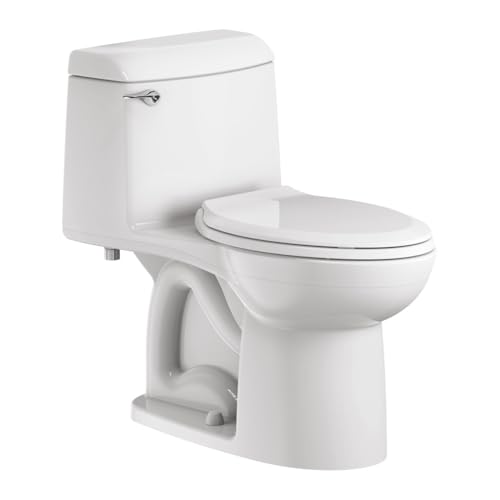
The American Standard Champion 4 carries WaterSense certification at 1.28 gallons per flush and is built around the widest glazed trapway in its class at 2 3/8 inches through the trap, paired with a 4-inch flush valve, specifically targeting households with high flush volumes or histories of chronic clogging on older large-waste toilets.
American Standard replaced the Champion 4's flapper with a 4-inch tower valve in later production runs, addressing the seal degradation issues that some earlier owners reported. The tower valve opens the full 4-inch bowl drain simultaneously and releases water with an initial surge that fills the siphon column faster than a standard 2-inch flapper, which is the primary reason the Champion 4 achieves its 1,000-gram MaP score at 1.28 gallons without requiring dual nozzle jets. The 2 3/8-inch fully glazed trapway then moves the waste column through with minimal friction.
Owners in households with five or more users report the lowest per-person clog incidence of any gravity HET toilet in this guide, based on aggregated review data. The Champion 4's EverClean surface is available on most current SKUs, adding antimicrobial protection to the bowl and reducing the frequency of cleaning required to maintain a hygienic surface under heavy daily use. Buyers replacing older 3.5 or 5-gallon Champion models will find the 1.28-gallon figure roughly one-third the volume they are used to, with equivalent or better single-flush clearance.
The 4-inch tower valve is the defining feature that separates the Champion 4 from the Cadet 3 in American Standard's lineup. For large families, the larger valve opening means faster siphon initiation and more consistent clearance under the highest daily flush loads, which is exactly the use case where HET design is tested hardest.
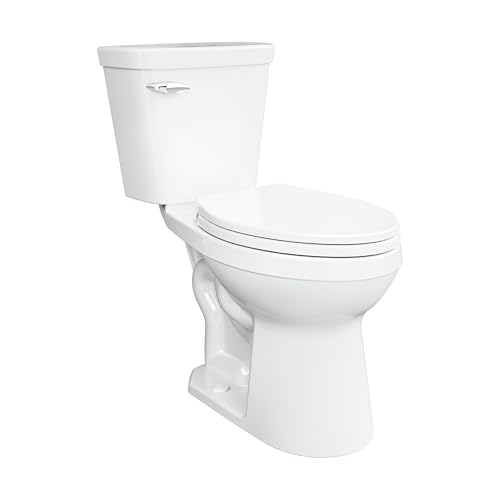
The Gerber Viper is the HET toilet that plumbers and building contractors reach for when they need WaterSense compliance, a proven clog-resistant flush, and parts that are available at supply houses rather than only online, making it the most maintenance-friendly choice in this guide for commercial light-duty or rental property applications.
Gerber's Viper uses an EcoFlush mechanism built around a tower-style flush valve with a sealed top rather than a flapper. The sealed tower design means water enters the flush column from all sides simultaneously, matching the AquaPiston geometry that Kohler uses. The trapway is fully glazed at 2 1/8 inches, consistent with TOTO's specification, and Gerber publishes the MaP score at 800 grams, which is the lowest in this guide but still well above the 350-gram residential threshold that confirms adequate single-flush clearance for normal household waste loads.
The Viper's main commercial advantage is parts sourcing. Gerber distributes through plumbing supply houses across the United States, so replacement flush valves, fill valves, seals, and lever assemblies are available same-day from a trade counter rather than on a 3-to-7 business day shipping window. For property managers running multiple units, that distribution network reduces toilet downtime to hours rather than days when a repair is needed. Gerber backs the Viper with a 10-year warranty on the china and a 5-year warranty on mechanical parts, which is stronger coverage than most consumer-positioned toilets in this guide.
The Gerber Viper's 800-gram MaP score is the only specification in this guide below 1,000 grams, and that single data point is the appropriate filter for residential buyers. Households that flush heavy waste loads daily should look at higher-MaP options. For standard adult use in a rental or commercial light-duty setting, 800 grams is adequate, and the Gerber parts network eliminates the repair delays that affect every other brand in this list.
Beyond those four, bowl height, rough-in measurement, and bowl shape are fit requirements, not performance variables. Comfort height (16 to 18 inches rim height) suits most adults and is required by ADA guidelines; standard height (14 to 15 inches) is generally preferred for children. The standard rough-in for North American homes is 12 inches from the finished wall to the center of the drain, and most HET models assume this. Confirm the rough-in measurement before purchasing, because a 10-inch or 14-inch rough-in requires a specific model that most brands produce in limited configurations. A complete framework for evaluating all these dimensions is in our toilet buying guide.
The savings calculation shifts further in favor of HET when dual-flush models are used correctly. A household that uses the TOTO Aquia IV's 0.8-gallon partial flush for liquid cycles and the 1.28-gallon full flush for solid waste will average roughly 0.95 gallons per flush assuming a typical liquid-to-solid ratio. Against an older 3.5-gallon toilet, that represents a 73 percent reduction in toilet water use per flush event. Even against the federal 1.6-gallon standard, the average 0.95 gallons is a 40 percent reduction, which in water-scarce markets can represent a difference of $80 to $200 annually on a combined water and sewer bill.
HET stands for High Efficiency Toilet. It refers to any toilet rated at 1.28 gallons per flush or less, which is 20 percent below the federal maximum of 1.6 gallons per flush that has applied to new residential toilets since 1992.
Not exactly. All EPA WaterSense certified toilets are HET models, but not all 1.28-GPF toilets carry the WaterSense label. WaterSense certification requires independent third-party testing to verify that the toilet both meets the 1.28-gallon limit and passes flush performance testing. A toilet can advertise 1.28 GPF without that certification; the WaterSense label means the claim has been verified externally.
A MaP score of 600 grams or above is considered adequate for most households; 800 grams is strong; and 1,000 grams, the test ceiling, is the best possible result. The residential pass threshold is only 350 grams, but for reliable single-flush clearance across a family of four or more, most plumbing professionals recommend choosing a toilet that scores 800 grams or higher. All top picks in this guide score 800 to 1,000 grams.
WaterSense certification is the most common requirement for utility rebate programs, but each utility sets its own rules. Most water utilities that offer toilet rebates require WaterSense certification as the minimum condition, but some programs impose additional requirements such as minimum household age, specific model numbers, or proof of installation by a licensed plumber. Check your local utility's rebate page before purchasing to confirm eligibility.
At the EPA average of 5 flushes per person per day, a 1.6-gallon toilet uses 2,920 gallons per person annually. A 1.28-gallon toilet uses 2,336 gallons per person annually, saving 584 gallons per person per year. For a four-person household that is roughly 2,336 gallons per year from a single toilet, or about 9 percent of total household water use according to EPA estimates.
Most standard drain lines handle HET toilets without modification. Older cast-iron or clay drain lines with accumulated mineral deposits can occasionally create sluggish drainage regardless of toilet type, but the toilet itself is not the cause. If you have a history of slow drain issues, have the line inspected before replacing the toilet, since a 1.28-gallon HET will not compensate for a partially obstructed drain the way a higher-volume flush sometimes could.
Dual-flush toilets require one extra decision per flush. Most residential dual-flush designs use a two-button pad on the tank lid, with a smaller button or half-press for liquid and a larger button or full press for solid waste. Owner reviews consistently show that adults adapt within days, but that young children and overnight guests occasionally use the full flush for all cycles. If reliable partial-flush use is uncertain, a single-flush 1.28-gallon model delivers predictable water savings without any behavioral requirement.
A trapway of 2 inches or more is the standard; 2 1/8 inches is the TOTO specification that defines a large trapway for gravity siphon HETs; and 2 3/8 inches, as in the American Standard Cadet 3 and Champion 4, is among the widest available in a residential gravity-flush design. Larger trapways pass more waste with less resistance, which means the 1.28-gallon flush has more hydraulic capacity to spare. Fully glazed trapways add a low-friction ceramic surface that resists paper accumulation over time.
Yes. High efficiency toilets work in septic systems and are generally beneficial because a lower water volume per flush reduces the hydraulic load on the septic tank and drain field. Septic systems are sized by volume, so delivering less water per flush slows the rate at which a tank needs to be pumped. There is no minimum flush volume required for septic function; the relevant variables are solids load and the biological activity in the tank, not the water volume per event.
TOTO's Double Cyclone system replaces a single rim-hole wash pattern with two nozzle jets positioned to spin water around the bowl wall in a centrifugal pattern before it enters the trapway. The spinning water column builds rotational velocity that increases the siphon pull through the trapway without requiring additional volume. That is why Double Cyclone toilets like the Drake II and UltraMax II consistently reach 1,000-gram MaP scores on 1.28 gallons while toilets using conventional single-hole rim wash sometimes achieve the same score only at 1.6 gallons.
Kohler's AquaPiston is a canister-style flush valve that opens vertically, exposing a full 360-degree circumferential water entry ring rather than a flapper that lifts to one side and blocks part of the valve opening. The full-circumference opening delivers water into the bowl faster and more uniformly, so the bowl fills with flush velocity before the siphon activates. This allows Kohler toilets with AquaPiston valves, like the Cimarron and Highline Arc, to achieve 1,000-gram MaP scores at 1.28 gallons through a conventional gravity mechanism.
Most HET toilets in the comfort height category (16 to 18 inches rim height) meet ADA accessible restroom requirements for seat height when a compliant seat is installed. The TOTO Drake II, Kohler Cimarron, American Standard Cadet 3, and Kohler Highline Arc are all available in ADA-compliant comfort height configurations. Verify the specific SKU's seat height before purchasing, as some toilets are available in both standard (14 to 15 inch) and comfort (16 to 18 inch) configurations.
No. Most HET toilets in this guide are gravity-fed designs that use no pressurized vessel or external tank pressure. Gravity-flush HET toilets achieve their MaP scores through optimized bowl and trapway geometry, larger flush valves, and bowl surface glazes. Pressure-assisted toilets add a compressed-air vessel inside the tank to supplement gravity, which increases flush velocity further but also adds noise and repair complexity. For most households, a well-engineered gravity HET like the TOTO Drake II or Kohler Cimarron provides adequate clearing power without pressure assistance.
CeFiONtect, marketed under the name SanaGloss in some TOTO product lines, is an ion-barrier glaze fired into the ceramic surface of the bowl and trapway. It creates a smoother surface at the molecular level that reduces friction between waste material and the bowl wall, allowing the 1.28-gallon flush to clear the bowl more completely with less residual sticking. While CeFiONtect's primary marketing benefit is hygiene (less sticking means less cleaning frequency), it also means the gravity siphon needs less hydraulic force to complete the flush, which is one reason CeFiONtect-equipped TOTO toilets consistently hit the 1,000-gram MaP ceiling.
The vitreous china body of a properly maintained HET toilet will last decades; most manufacturers warranty the ceramic against manufacturing defects for the life of the original owner. The mechanical components (flush valve, fill valve, seals, and handle) typically need replacement every 5 to 15 years depending on water chemistry and usage. Hard water with high mineral content accelerates seal degradation. Models with sealed canister or tower flush valves (Kohler AquaPiston, Gerber EcoFlush tower) tend to last longer than rubber flapper designs because the seals are less exposed to mineral buildup.
The original TOTO Drake uses a single-hole G-Max rim wash system and is available in a 1.28-gallon configuration. The Drake II upgraded to Double Cyclone dual-nozzle flushing, which generates a stronger siphon at the same 1.28 gallons. Both models carry the EPA WaterSense label and can achieve 1,000-gram MaP scores, but the Drake II does so more consistently across production runs because the dual-nozzle geometry is less sensitive to water pressure variation at the supply line.
Elongated bowls measure approximately 18.5 inches from seat bolt to front rim and fit most adult users more comfortably. Round bowls measure approximately 16.5 inches and fit smaller bathrooms or children's bathrooms more naturally. Bowl shape does not affect water consumption, GPF, or MaP score, so the choice is purely ergonomic and spatial. Most HET models in this guide are available in both shapes, though some manufacturer lines produce only the elongated version in comfort height.
For a household replacing a pre-1994 toilet (3.5 GPF) with a 1.28-gallon WaterSense model, the payback period depends on local water rates, flush frequency, and whether a utility rebate is available. At average U.S. water and sewer rates of roughly $0.007 per gallon combined, a four-person household replacing one 3.5-gallon toilet saves approximately $0.015 per flush in direct water cost, or roughly $100 to $150 per toilet per year at typical flush volumes. A utility rebate of $100 means the toilet pays for itself faster than most buyers expect.
A homeowner with basic plumbing experience can install a standard floor-mount HET toilet on an existing 12-inch rough-in in under two hours. The process involves turning off the water supply, removing the old toilet, replacing or reinstalling the wax ring, setting the new toilet, and connecting the supply line. A plumber is advisable when the rough-in needs to change, when the floor flange is damaged, when old cast-iron flanges need cutting, or when the toilet is wall-hung rather than floor-mounted. Most retailers and manufacturers provide model-specific installation guides.
For a guest bathroom with infrequent use, the most important specifications shift away from MaP score and toward fill valve reliability and ghost-flush resistance. Sealed flush valves (Kohler AquaPiston, TOTO flush tower) resist the slow leak around the flapper seat that causes ghost flushing after months of low-use sitting. The Kohler Cimarron and TOTO Drake II both score well on long-interval reliability in owner reviews, with fewer ghost-flush reports than older flapper-based designs. For a guest bathroom that may go days between uses, a model with a sealed canister or tower valve is the more practical choice than one optimized purely for per-flush MaP clearance.
The TOTO Drake II is the best high efficiency toilet for most households. It achieves the maximum 1,000-gram MaP score at 1.28 gallons through Double Cyclone dual-nozzle siphon geometry, carries EPA WaterSense certification, and has a track record across millions of installed units that no other HET model can match at its price point. The TOTO Aquia IV is the right choice for households that want the lowest possible average water use through dual-flush control. The Kohler Cimarron is the strongest value pick if the TOTO premium is a constraint. All nine models above are certified HET toilets that save meaningful water compared with pre-1994 fixtures and qualify for most utility rebate programs across the United States.
Learn why toilet trapways curve like an S, how each bend blocks sewer gas, and what the shape means for clogs and…
Read the guideAlmost every US toilet has a left-side handle. Learn the plumbing and mechanical reasons behind the layout and when it actually changes.
Read the guideHome toilets rely on tanks because household water lines lack the pressure that public flushometer systems use to flush straight from the…
Read the guide