How to Replace a Bathroom Vanity: Complete Guide
Bathroom Remodeling4.6
Everything involved in swapping an old bathroom vanity for a new one, from planning and demolition through disposal, wall repair, and reinstalling…
Read the guideClassic pedestal, console, and oval drop-in basins in vitreous china, sized and shaped for bathrooms built around a timeless silhouette.
Research updated June 2026.
The Kohler Devonshire Pedestal Sink is the strongest traditional bathroom sink for most buyers: a vitreous china basin with a fluted pedestal base, a classic oval bowl shape, and Kohler's proven durability across decades of production.
Traditional bathroom sinks favor oval or rounded basin shapes, pedestal or console legs with decorative detailing, and vitreous china construction over the squared-off vessel and trough basins common in modern bathroom design. The goal is a sink that reads as classic furniture rather than a minimalist fixture.
This guide covers traditional-style pedestal, console, and drop-in bathroom sinks from Kohler, American Standard, and Kingston Brass. Every pick uses vitreous china, the traditional standard material for bathroom sinks, prized for its glass-like glazed surface and long-term stain resistance. If you are renovating a full bathroom, see our best flushing toilets guide for a matching traditional-style toilet.
A traditional bathroom sink uses an oval or gently rounded basin, a pedestal or console leg base with decorative fluting or turned-leg detailing, and vitreous china construction. The overall profile references early-to-mid 20th century bathroom fixtures, favoring curved silhouettes and a furniture-like presence over the flat-sided vessel or trough basins common in contemporary design.
Vitreous china is fired at extremely high temperatures until the clay body becomes glass-like and non-porous, making it the traditional standard for bathroom sinks and toilets alike. It resists staining, scratching, and chemical damage better than cultured marble or acrylic alternatives, and its glossy glazed finish is the material most associated with classic bathroom fixture design. Kohler, American Standard, and most premium sink manufacturers use vitreous china for their traditional pedestal and console lines.
A pedestal sink combines the basin and a single decorative leg into one connected unit, concealing the plumbing while occupying minimal floor space, making it a longstanding favorite for smaller traditional powder rooms. A console sink uses two or four decorative legs (often metal) with the basin resting on top, exposing more of the plumbing as a design feature and typically offering more counter space around the basin than a pedestal. A drop-in (self-rimming) sink sits inside a cutout in a traditional-style vanity countertop, which is the most practical configuration when storage beneath the sink is a priority.
Traditional pedestal basins typically range from 18 to 24 inches wide and 15 to 20 inches deep. Console sinks tend to run slightly larger, 24 to 30 inches wide, to fill the visual space between their legs. Drop-in oval basins for traditional vanities commonly measure 16 to 20 inches wide and 12 to 16 inches deep, sized to fit standard 31 to 37 inch vanity cabinet widths with adequate counter space remaining.
Traditional sinks are most commonly drilled for a widespread faucet (8-inch spread) or a centerset faucet (4-inch spread), matching the cross-handle and lever faucet styles typical of traditional bathroom design. Single-hole traditional sinks exist but are less common, since the wider hole spread better accommodates the visual weight of traditional faucet bodies.
| Model | Style Fit | Key Spec | Best For | Check Price |
|---|---|---|---|---|
| Kohler Devonshire Pedestal Sink | Traditional pedestal, fluted base | Vitreous china, oval basin | Best overall traditional sink | Check price |
| American Standard Ovalyn Drop-In Sink | Traditional oval drop-in | Vitreous china, 20-inch oval | Traditional vanity countertop pairing | Check price |
| Kohler Bancroft Pedestal Sink | Traditional pedestal | Vitreous china, oval basin | Coordinated Bancroft collection | Check price |
| Kingston Brass Fauceture Console Sink | Traditional console, metal legs | Vitreous china, 4-leg console | Console styling with exposed legs | Check price |
| American Standard Colony Pedestal Sink | Traditional value-tier pedestal | Vitreous china, oval basin | Budget-friendly traditional pedestal | Check price |
| Kohler Caxton Undermount Sink | Traditional undermount oval | Vitreous china, 20-inch oval | Traditional stone-top vanity pairing | Check price |

The Devonshire pairs a gently curved oval vitreous china basin with a fluted pedestal column, one of Kohler's longest-running traditional sink designs, offering widespread faucet drilling and a glossy glazed finish that resists staining for decades.
The Devonshire line has been a Kohler catalog staple for years, meaning replacement parts and matching faucets remain broadly available even as design trends shift. Its fluted pedestal is a hallmark traditional detail, echoing classical column styling that pairs naturally with wainscoting and traditional tile work.
Pedestal sinks generally offer less counter space than console or vanity sinks, a real trade-off for households that need surface area for toiletries. Owner reviews consistently note that the Devonshire's glaze finish holds up well against toothpaste and hard water staining over multi-year ownership.
A pedestal sink's structural integrity depends heavily on correct wall-anchor installation, since the pedestal itself provides only partial support in most designs. Confirming stud or blocking placement before mounting is the single most important installation step for long-term stability.

The Ovalyn is American Standard's benchmark oval drop-in sink, a vitreous china basin that self-rims into a cutout on a traditional vanity countertop, one of the most widely installed traditional sink shapes in the American residential market.
The Ovalyn's self-rimming lip sits above the counter surface, which simplifies installation and sealing compared to undermount alternatives, making it a practical choice for DIY vanity top replacements as well as full renovations.
Because the Ovalyn has been in continuous production for decades, replacement units and matching drain assemblies remain simple to source even years after the original installation, an underrated advantage for long-term bathroom maintenance.
The Ovalyn's ubiquity in the American market is itself a durability signal: a fixture that has remained in continuous production this long has demonstrated reliable manufacturing consistency across millions of units, not just a single production run.

The Bancroft pedestal sink matches Kohler's Bancroft bathroom faucet line, letting renovators coordinate the sink basin, pedestal detailing, and faucet handle style for a fully unified traditional bathroom design.
Choosing a matched sink and faucet collection like Bancroft removes the guesswork of coordinating handle style and finish tone across two separate fixture lines, a detail that noticeably affects the finished look of a traditional bathroom renovation.
The Bancroft basin's slightly larger footprint compared to the Devonshire gives marginally more usable basin space, useful for households doing more than quick hand-washing at this sink.
Matched fixture collections reduce the single most common complaint in aggregated bathroom remodel reviews: mismatched handle styles and finish tones between the sink faucet and other bathroom hardware.

Kingston Brass's Fauceture console sink rests on four decorative metal legs, exposing the plumbing as an intentional design feature and providing more counter space around the basin than a comparable pedestal sink.
Console sinks require more floor space than pedestal designs since the legs sit further apart than a single pedestal column, but they offer a distinct visual advantage: the exposed decorative legs read as furniture, a look increasingly favored in higher-end traditional bathroom renovations.
Because plumbing remains visible beneath a console sink, matching the supply line and trap finish to the faucet and leg finish is an additional but worthwhile detail for a polished final look.
Console sinks have seen renewed interest in higher-end traditional renovations precisely because their exposed structure reads as intentional furniture design rather than utilitarian plumbing, a distinction that matters in bathrooms aiming for an heirloom aesthetic.
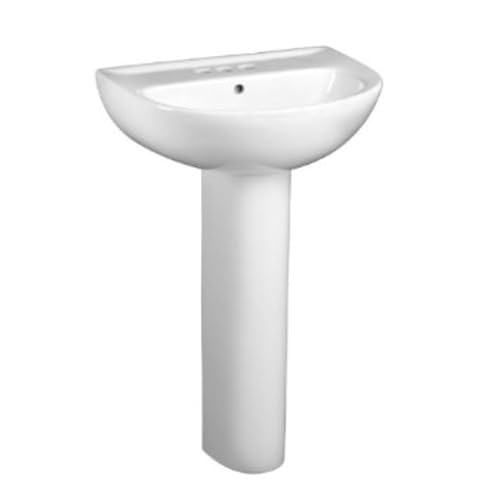
American Standard's Colony pedestal sink brings the brand's proven vitreous china construction to a simpler, more accessible price point than the Devonshire or Bancroft, with a clean oval basin and straightforward pedestal styling.
American Standard built its reputation partly on its toilet line, and applies similar manufacturing consistency to its sink production. The Colony pedestal uses the same vitreous china firing process as its premium lines, keeping quality reasonable at this accessible price point.
For rental properties or secondary bathrooms where budget discipline is a real constraint, the Colony pedestal is a low-risk pick with a long production history and simple replacement part availability.
Vitreous china quality is largely determined by the firing process and glaze formulation rather than decorative detailing, meaning a simpler-styled pedestal like the Colony delivers comparable long-term durability to more ornate, higher-priced options.

The Caxton is Kohler's traditional oval undermount sink, designed to mount beneath a stone or solid-surface vanity countertop for a seamless edge, delivering the classic oval basin shape without a visible rim to trap debris.
Undermount installation requires a countertop material that can be finished with a polished edge at the cutout, typically granite, quartz, or marble, making this pairing most common in higher-end traditional vanity renovations rather than laminate or budget countertop projects.
The absence of a visible basin rim is a genuine practical advantage: water and debris can be wiped directly from the countertop into the basin without catching on a raised lip, a meaningful cleaning improvement over drop-in designs.
Undermount sinks require professional countertop fabrication for the cutout and edge finishing, which adds cost but delivers a more refined and easier-to-clean result than a self-rimming drop-in basin. For a premium traditional vanity build, the Caxton is a worthwhile upgrade.
Vitreous china is the traditional standard material for bathroom sinks, fired at high temperatures until the clay body becomes glass-like and non-porous. It resists staining, scratching, and chemical damage better than cultured marble or acrylic alternatives and is the material most associated with classic bathroom fixture design.
A pedestal sink combines the basin and a single decorative leg into one connected unit that conceals the plumbing. A console sink rests on two or four separate decorative legs, typically metal, exposing more of the plumbing as an intentional design feature and generally offering more counter space around the basin.
Pedestal sinks typically offer minimal counter space, often just a narrow ledge around the basin rim itself. This is the primary functional trade-off for a pedestal sink's smaller floor footprint and classic silhouette compared to a vanity or console sink.
Traditional sinks are most commonly drilled for either an 8-inch widespread faucet or a 4-inch centerset faucet, matching the cross-handle and lever faucet styles typical of traditional bathroom design. Always confirm hole spread compatibility between your chosen sink and faucet before purchasing.
Pedestal sink installation is more involved than a standard vanity sink because the basin must be securely anchored to the wall, typically requiring a mounting bracket fastened into wall studs or blocking. Many homeowners handle the plumbing connections themselves but hire a professional for the wall-anchoring step to ensure long-term stability.
An undermount sink mounts beneath the countertop cutout rather than resting on top, creating a seamless edge with no visible rim. It pairs well with traditional vanities that use stone or solid-surface countertops, since laminate countertops cannot be finished cleanly for undermount installation.
Most stains on vitreous china respond well to a mild non-abrasive cleaner and a soft cloth or sponge. For mineral deposits from hard water, a diluted white vinegar solution left to sit for a few minutes before rinsing is effective. Avoid abrasive scouring pads, which can dull the glaze over many years of repeated use.
Traditional oval drop-in sinks measuring 16 to 20 inches wide typically fit standard vanity cabinets ranging from 24 to 37 inches wide, with room remaining for counter space on either side of the basin. Always confirm the exact cutout dimensions specified for your chosen sink against your vanity's countertop template.
Cast iron is more commonly used for traditional bathtubs than bathroom sinks, though a small number of console and drop-in sink lines use enameled cast iron for its weight and durability. Vitreous china remains the dominant material for pedestal, console, and drop-in bathroom sinks.
Yes, generally. Console sinks rest on legs positioned at the outer edges of a wider basin, requiring more floor clearance than a single pedestal column. Console sinks are best suited to bathrooms with adequate floor space around the fixture.
Most pedestal and console bathroom sinks sit at a standard height of 31 to 32 inches from the floor to the basin rim, consistent with historical bathroom fixture proportions. This is slightly lower than the 34 to 36 inch comfort height common in some modern vanity designs.
For most traditional bathrooms, the Kohler Devonshire pedestal sink delivers the best combination of classic fluted detailing, proven vitreous china durability, and a manageable footprint for smaller spaces. Buyers renovating a full vanity should look to the American Standard Ovalyn drop-in for practical counter storage, while stone-countertop vanities are best served by the Kohler Caxton undermount. In every case, confirm faucet hole spread compatibility and basin dimensions against your specific bathroom layout before finalizing a purchase.
How we rank & our data sources
We do not run physical lab tests. Rankings are built from published, verifiable data and real owner feedback, never paid placement.
Researched by admin · Last updated July 3, 2026 · Our review method
Everything involved in swapping an old bathroom vanity for a new one, from planning and demolition through disposal, wall repair, and reinstalling…
Read the guide
Freestanding soaking tubs in light, natural finishes built to feel like the centerpiece of a sunlit, plant-filled bathroom rather than a purely…
Read the guideA complete walkthrough covering water shutoff, old vanity removal, leveling and anchoring, countertop and sink setting, and reconnecting the P-trap and supply…
Read the guide