
Why Toilet Trapways Are Curved Like an S
Toilets4.6
Learn why toilet trapways curve like an S, how each bend blocks sewer gas, and what the shape means for clogs and…
Read the guideToilet seats come in far more varieties than most people realize. Shape, height, material, hinge style, and special features all determine whether a seat fits your toilet, suits your household, and lasts for years. This guide covers every toilet seat type with real specs, so you can choose correctly the first time.
For most households, a standard elongated closed-front seat in polypropylene from TOTO or Kohler is the safest pick. Elongated bowls seat most adults comfortably and the closed-front design suits any bathroom. If you own a round bowl, match it precisely. Measure your bowl before ordering -- a 1/2-inch mismatch means the seat will not close correctly.
A toilet seat has two basic jobs: it must fit the bowl exactly, and it must be comfortable enough that the person using it does not think about it. Both jobs are harder than they sound, because seat specifications vary by bowl shape, bowl material, hinge spacing, and mounting hole placement. Every major choice -- shape, material, height, hinge type -- affects fit and daily comfort. Getting even one of them wrong means returning the seat.
The industry divides toilet seats into categories by bowl shape first, then by construction material, then by feature set. Understanding each layer lets you narrow a field of hundreds of options down to the three or four that actually fit your toilet.
Round seats measure approximately 16.5 inches from the front of the bowl to the hinge bolt holes. They fit round bowls found on TOTO Entrada, Kohler Highline round edition, American Standard Cadet 3 round, and many compact or older toilets. Round seats use less space front-to-back, which makes them a practical choice for a bathroom under 50 square feet where every inch matters. The seated surface is smaller, so some adults find them less comfortable for extended use.
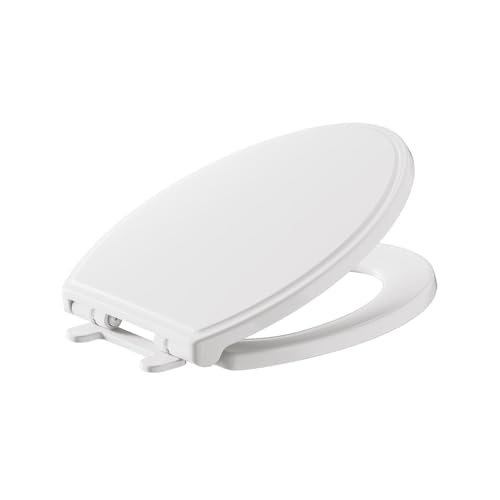
Elongated seats measure approximately 18.5 inches from front to hinge bolt holes, giving two extra inches of seated surface. They fit elongated bowls found on TOTO Drake, TOTO Drake II, TOTO UltraMax II, TOTO Vespin II, Kohler Cimarron, Kohler Santa Rosa, American Standard Champion 4, Woodbridge T-0001, Woodbridge T-0019, Swiss Madison St. Tropez, and Gerber Viper. Elongated seats are more comfortable for most adults and are the default choice for new toilet installations in the US.
D-shape and square seats fit modern rimless or wall-hung toilets with a flat front edge. Swiss Madison St. Tropez, Woodbridge T-0019, and several Gerber Avalanche models use a D-shaped bowl profile. These seats are not interchangeable with round or elongated seats and almost always must be ordered from the same brand as the toilet. Measuring the exact bowl dimensions is mandatory before purchasing a D-shape seat.
Polypropylene is the most common toilet seat material sold in the US. It is lightweight, easy to clean, resistant to most household cleaners, and cheaper to manufacture than alternatives. Polypropylene seats are sold by every major brand including TOTO, Kohler, American Standard, and Woodbridge. The main limitation is that thinner polypropylene seats can crack under heavy or repeated stress over several years, so look for seats with a wall thickness above 3 mm or a stated weight capacity.
Duroplast is a harder, denser molded plastic that resists scratching and staining better than standard polypropylene. It does not flex under weight, so it feels more substantial when you sit down. Gerber and several Swiss Madison models use duroplast on their premium seat lines. Duroplast seats are heavier and cost more, but they hold their appearance longer in high-traffic bathrooms and resist the yellowing that affects some polypropylene seats over time.
Solid wood seats, often made from medium-density fiberboard (MDF) with an enamel or lacquer finish, offer a warmer feel and a heavier, more traditional look. Kohler Memoirs, some Kohler Santa Rosa, and specialty seat lines from Bemis use enameled wood. Wood seats are sensitive to moisture: prolonged exposure near leaks or high-humidity bathrooms can cause the finish to crack or the core to swell. They are best suited for low-traffic guest bathrooms where aesthetics matter more than durability.
Cushioned toilet seats have a vinyl outer shell over foam padding. They were common in the 1970s through the 1990s and are still sold as a replacement option, but most plumbing professionals advise against them in modern bathrooms. The vinyl surface is difficult to disinfect properly around seams, and the foam core can harbor mold if the vinyl cracks. For households with older adults who need padding for comfort, a raised seat with firm padding is a safer alternative.
A standard height toilet places the seat rim between 15 and 17 inches from the floor. Standard seats suit children and shorter adults who find that their feet rest flat on the floor in this position. Most round toilet installations in older homes use standard height, and the round seat options from TOTO Entrada and American Standard Cadet 3 round configuration fall in this range.
Comfort height toilets sit between 17 and 19 inches from floor to seat rim, comparable to a standard chair. TOTO Drake, TOTO UltraMax II, TOTO Vespin II, Kohler Cimarron, Kohler Highline, and most modern two-piece toilets ship as comfort height. The ADA (Americans with Disabilities Act) standard for accessible bathrooms requires a seat height of 17 to 19 inches. For adults over 5 feet 8 inches, and for anyone with knee or hip issues, comfort height reduces the effort of sitting down and standing up significantly.
Raised seats are add-on units that clamp onto an existing toilet bowl and add 2 to 6 inches of height. They are primarily intended for temporary use during recovery from orthopedic surgery, or for permanent use by individuals with limited mobility. Raised seats are not cosmetically integrated with the toilet bowl and require careful selection to match the bowl shape. Some models include locking armrests, which provide additional stability. TOTO and Kohler both offer raised seat accessories for their respective bowl lines.
Standard plastic or metal bolt hinges use a nut-and-bolt system that passes through the two mounting holes at the rear of the bowl. They are inexpensive, universally available, and straightforward to install with a wrench. The main downside is that the hinge can loosen over time from daily use, causing the seat to shift sideways. Retightening is usually a 5-minute task, but it recurs every year or two.
Quick-release hinges allow the seat to pop off the hinge posts for cleaning without any tools. Kohler, TOTO, and American Standard all offer quick-release hinges on mid-range and premium seat lines. The ability to lift the seat completely off the bowl makes deep cleaning the back of the bowl and around the hinge area far easier. This feature is especially valuable in households with children who miss the bowl or in bathrooms that develop mineral deposits around the hinge zone.
Soft-close hinges use a built-in damper mechanism that slows the lid and seat as they fall, preventing the sharp bang that wakes household members at night. TOTO, Woodbridge T-0001 and T-0019, and Swiss Madison St. Tropez all include soft-close hinges as standard on their integrated seat models. Soft-close hinges add a small cost premium but dramatically reduce hinge wear and the noise complaints that accompany standard toilet use in shared living spaces.
Top-mount hinges secure from above the bowl, which simplifies installation but can create a small gap where bacteria collect. Bottom-mount hinges are secured from underneath the bowl rim for a cleaner appearance and tighter fit. Most modern premium seats use top-mount quick-release hinges as a compromise: easy installation, easy removal for cleaning, and a low profile.
The open-front seat has a gap cut out at the front of the seat ring. Closed-front seats form a complete oval or circle. Open-front seats are required by ADA standards for commercial public restrooms because the gap allows cleaning without contact between the user and the seat. For residential use, the choice is entirely personal. Closed-front seats are more common in homes because they look cleaner, provide more surface area, and prevent objects from falling into the bowl gap. Open-front seats see more use in offices, hospitals, and schools.
The most common toilet seat mistake is buying by price alone. A seat that looks identical to a premium model may use thinner polypropylene that starts cracking within 18 months. If you are replacing a seat on a toilet you plan to keep for 10 or more years, spending more on a duroplast or name-brand polypropylene seat with a quick-release hinge saves you a replacement cycle. Kohler's PureWick and TOTO's SoftClose lines both hit this durability-to-value target well.
Electronic washlet seats attach to an existing toilet bowl and add rear wash, front wash, heated seat, and air-dry functions. TOTO pioneered the category with the Washlet line, and the TOTO S550e and C5 are among the most purchased units based on owner review volume. American Standard and Kohler have released their own bidet seat lines under the Aquawash and C3 brands respectively. Washlet seats require a nearby GFCI outlet and must match the bowl shape of the installed toilet.
For a dedicated look at electronic seat options, the best bidet toilet seats guide compares the top units by wash pressure, seat temperature range, and owner satisfaction.
Heated seats without bidet functionality are a smaller category. They use a thin heating element embedded in the seat material and typically offer two to three temperature settings. TOTO and Brondell both offer heated-only seats. These are most valued in cold climates or in bathrooms that lack in-floor heating. Owner feedback consistently notes that the heating element draws about 25 to 40 watts during active use, adding a negligible amount to electricity costs.
Raised seats add 2 to 6 inches of height above the existing toilet rim. They clamp to the bowl with a locking mechanism and are available in round and elongated configurations. Some models include hinged arms for stability. These are categorized as durable medical equipment (DME) in the US and are sometimes covered by Medicare or insurance for users with qualifying conditions. Matching the seat to the correct bowl shape is essential: raised seats designed for elongated bowls will rock on a round bowl and pose a safety risk.
Family seat configurations include a built-in smaller seat that folds down for toddler use, eliminating the need for a separate training seat. Kohler and Ginsey both make family seat models in elongated and round configurations. The integrated smaller seat has a hinge of its own and can be folded up out of the way when not in use. The overall seat dimension is the same as a standard seat, so it fits the same bowl shapes.
Getting the right measurement takes under two minutes and prevents a return trip. Here is the correct method.
Measure from the center of the hinge bolt holes (at the very back of the bowl) to the front edge of the bowl. Do not measure the tank. If the result is 16 to 17 inches, you have a round bowl. If it is 18 to 19 inches, you have an elongated bowl. A flat front indicates a D-shape or square bowl.
Measure the distance between the centers of the two hinge bolt holes. Most toilets use 5.5 to 6.5 inch spacing. Some compact toilets and wall-hung toilets use different spacing. Note this number -- some seat models only fit standard 5.5 inch spacing and will not mount correctly on non-standard hole patterns.
Measure the widest point of the bowl (usually just in front of the hinge holes). Most standard bowls measure 14 to 14.5 inches wide. Very wide or skirted bowls, like the Woodbridge T-0019, may require brand-specific seats.
Look under the existing hinge for a model number. TOTO, Kohler, and American Standard stamp their seat model numbers on the hinge underside. This makes finding an exact factory replacement much simpler than measuring alone. For TOTO toilets, replacement seats follow a naming convention: the Drake's SS113 seat, the UltraMax II's SS204, the Aquia IV's SS234, and the Vespin II's SS234.
These are the seat types and configurations that fit the most popular toilet models reviewed on best flushing toilets.
Factory-spec seat for the Drake and Drake II. Soft-close lid, quick-release hinge, polypropylene shell.
Check on AmazonFits the Kohler Highline and Cimarron elongated bowls. Quiet-close lid, grip-tight bumpers, quick-release hinge.
Check on AmazonFactory match for the Champion 4 and Cadet 3 elongated bowls. Slow-close hinge standard, easy-clean surface.
Check on AmazonWhite and bone (also called biscuit or almond) are the two dominant toilet seat colors. A white seat matches TOTO's Cotton White (01) and Colonial White (11) bowl finishes. A bone or biscuit seat matches Kohler's Almond (96) and American Standard's Linen and Bone offerings. Mixing a white seat on a bone bowl creates a visible color mismatch that is more obvious in bright lighting.
Swiss Madison and Woodbridge have popularized matte black and matte white finishes on integrated toilet seat and bowl combinations. These are not interchangeable with standard seats from other brands. If you have a Woodbridge T-0001 or T-0019, the seat must come from Woodbridge's own accessory line to match the gloss level and color exactly. The same applies to Swiss Madison St. Tropez models, which use a proprietary D-shape bowl that is not compatible with standard elongated seats.
For guidance on choosing the overall toilet form that your seat needs to match, the one-piece vs two-piece toilets guide covers how the seat-to-bowl interface differs between these two construction styles.
Standard toilet seat installation requires only a wrench and 10 to 15 minutes. The mounting bolts pass through the hinge ears and through the two holes in the bowl rim, then secure with plastic or metal nuts from underneath. Most modern seats include plastic bolts to avoid corroding in the humid environment inside the bowl.
The most common installation problem is over-tightening. Ceramic porcelain cracks under excessive torque. The hinge nuts should be snug -- the seat should not move laterally when you push it sideways -- but they should not be cranked down with force. Finger-tight plus a quarter-turn with a wrench is generally sufficient for standard bolt sizes.
For quick-release seats, the hinge posts snap into a base that is bolted to the bowl. The base gets installed once and stays permanently. The seat itself clicks onto the posts and lifts off without tools when you need to clean.
The single most underrated feature on a toilet seat is the quick-release hinge, not soft-close. Soft-close is nice; quick-release is the one that actually changes your cleaning routine. Being able to snap the seat off, wipe the entire back of the bowl and both hinge posts, and snap it back in under 90 seconds is the reason high-traffic bathrooms stay consistently clean. If you can only choose one upgrade feature, choose quick-release over soft-close every time.
Choosing the right toilet seat comes down to four decisions made in order. Get any of them wrong and the seat will not fit, will not feel right, or will not last.
Measure from hinge holes to bowl front. Round = 16 to 17 inches. Elongated = 18 to 18.5 inches. D-shape or square = flat front edge with brand-specific dimension. Never guess -- a seat that is half an inch too long will overhang the bowl and rock. Read the round vs elongated toilets guide if you are also deciding which bowl shape to install.
For durability in a family bathroom: duroplast or thick-wall polypropylene. For aesthetics in a guest bath: enameled wood. For maximum hygiene and feature density: electronic bidet seat. Cushioned vinyl: avoid.
Quick-release for easy cleaning. Soft-close for noise reduction. Both features together for shared or family bathrooms. Standard bolt hinges for budget replacements where cleaning access is not a priority.
No features: basic polypropylene replacement, lowest cost. Soft-close only: mid-tier, most common upgrade. Quick-release + soft-close: best everyday family seat. Heated + soft-close: comfort upgrade, requires outlet. Full washlet (TOTO, Kohler C3, American Standard Aquawash): highest cost, highest hygiene and comfort return.
For the broader context of how a toilet seat fits into the complete bathroom decision, the Toilet Buying Guide and the How to Choose a Toilet guide both walk through seat considerations alongside bowl shape, rough-in distance, and flush type.
Most households are best served by an elongated soft-close seat with a quick-release hinge in duroplast or thick-wall polypropylene. TOTO's SoftClose line and Kohler's Cachet Quiet-Close series both hit this target reliably. If comfort and hygiene are the priority, a TOTO Washlet entry-level electronic seat on an elongated bowl delivers the largest quality-of-life upgrade of any bathroom accessory. Always measure your bowl before purchasing -- shape and bolt hole spacing must match exactly.
No. Toilet seats come in at least three shapes -- round, elongated, and D-shape/square -- plus variations in bolt hole spacing and bowl width. A round seat will not close correctly on an elongated bowl, and vice versa. Always measure before you buy.
Measure from the center of the hinge bolt holes (at the back of the bowl) to the front edge of the bowl. Under 17 inches means round. 17.5 to 18.5 inches means elongated. If the front of the bowl is flat rather than curved, you have a D-shape bowl that requires a brand-specific seat.
Soft-close refers to the damper in the hinge that slows the lid as it falls, preventing slamming. Quick-release refers to the ability to lift the entire seat off the hinge posts without tools for cleaning. Many seats offer both features. They are separate mechanisms on the same hinge assembly.
Not reliably. The hinge post diameter and seat mounting geometry differ between brands. A Kohler seat on a TOTO bowl will often fit loosely or sit unevenly. For best results, use the brand's own replacement seat or a certified universal seat that lists your specific model as compatible.
A quality polypropylene or duroplast seat lasts 5 to 10 years under normal household use. Wood and enameled wood seats last 3 to 7 years, depending on humidity. Electronic washlet seats typically carry 1 to 3 year warranties and are designed for 5 to 10 years of use before electronic components require service.
The phrase "comfort height seat" usually refers to the toilet bowl it sits on, not the seat itself. A comfort height toilet places the seat rim 17 to 19 inches from the floor, matching standard chair height. The seat itself is the same product as a standard seat; the height comes from the taller bowl. If you need a higher seat without replacing the toilet, use a raised seat accessory.
Duroplast resists scratching, staining, and impact better than standard polypropylene and does not flex under weight. In high-traffic bathrooms, duroplast seats maintain their appearance longer. Polypropylene seats cost less and are perfectly adequate for low-to-medium-use bathrooms, especially when wall thickness is above 3 mm.
The TOTO Drake standard two-piece toilet uses TOTO's SS113 SoftClose seat for the elongated bowl configuration. The Drake II, which features Double Cyclone flushing, uses the SS204 seat. Both are elongated, polypropylene, soft-close seats with quick-release hinges. They are available in Cotton White (01) to match the Drake's standard color.
An open-front seat has a gap cut at the front of the ring, leaving an open C-shape rather than a closed oval. ADA standards require open-front seats in commercial public restrooms for hygiene reasons. For residential use they are optional; closed-front seats are more common in homes because they provide more sitting surface and look neater.
In theory, very heavy cast-iron or stone resin seats could stress porcelain mounting holes over time, but this is rare with modern designs. The practical concern with heavy seats is that soft-close dampers on some seats are calibrated for polypropylene weight; a significantly heavier seat may drop faster than the damper can control. Always check the manufacturer's weight rating for seats with soft-close mechanisms.
A seat that slides sideways has loose hinge nuts. Remove the hinge caps, tighten the nuts finger-tight plus a quarter-turn with a wrench, and replace the caps. If the nuts are already tight but the seat still moves, the plastic hinge post stabilizers may be worn or the hinge posts may have developed play inside the mounting holes. In that case, replacing the seat and hinge assembly is the fastest fix.
An intact enameled wood seat is as sanitary as plastic because the enamel creates a non-porous surface. The risk comes from cracks or chips in the enamel, which expose the porous MDF or wood core underneath. That exposed core cannot be fully disinfected and can harbor bacteria. Inspect wood seats regularly and replace them at the first sign of surface damage.
It depends on the model. The Woodbridge T-0001 uses an elongated bowl and can accept aftermarket elongated seats, though Woodbridge's own seat matches the aesthetics best. The Woodbridge T-0019 uses a D-shape bowl with a flat front edge and requires a D-shape seat, which is available from Woodbridge as an accessory. Fitting a standard elongated seat on the T-0019 will not produce a flush close because the front edge geometry is different.
MaP (Maximum Performance) testing measures how many grams of solid waste a toilet can clear in a single flush. MaP scores apply to the toilet bowl and flush system, not the seat. However, the MaP score determines which toilet you buy, and that toilet determines which seat fits it. For reference, a MaP score of 800 g or above is considered strong performance, and a score of 1000 g indicates maximum test performance for EPA WaterSense-listed models.
The Champion 4 uses an elongated bowl and is compatible with American Standard's own slow-close and quick-release seat lines. American Standard's 5321A65CT slow-close elongated seat is the factory-matched option. The Champion 4's bowl width and hinge hole spacing also accept select Bemis and Mayfair universal elongated seats that list American Standard as a compatible brand.
Based on aggregated owner data, bidet seats consistently receive high satisfaction ratings, particularly from households where one or more members have mobility limitations, post-surgical recovery needs, or a preference for reduced toilet paper use. TOTO Washlet models lead the category in owner-reported satisfaction. The main barriers are the upfront cost and the need for a GFCI outlet within reach of the toilet.
Cushioned seats are still sold but are not recommended by most plumbing professionals. The vinyl surface seams are difficult to disinfect completely, and the foam core is vulnerable to mold if the vinyl cracks. If comfort is the goal, a comfort height toilet that places the seat at chair height provides more ergonomic benefit than adding padding to a standard seat.
No. EPA WaterSense certification applies to the toilet flush system and bowl assembly, not the seat. A seat has no impact on water consumption. WaterSense toilets must flush at 1.28 GPF or less and meet MaP performance minimums. The certification belongs to the toilet model, and the seat choice is independent of water efficiency.
The Swiss Madison St. Tropez uses a proprietary D-shape elongated bowl. The factory-supplied seat is included with the toilet and uses a specific bolt pattern that matches Swiss Madison's hinge design. If you need a replacement seat, Swiss Madison sells the seat separately under their accessory line. Generic elongated seats do not fit the St. Tropez because the flat front edge changes the effective seat length and the bolt pattern may differ.
Learn why toilet trapways curve like an S, how each bend blocks sewer gas, and what the shape means for clogs and…
Read the guideAlmost every US toilet has a left-side handle. Learn the plumbing and mechanical reasons behind the layout and when it actually changes.
Read the guideHome toilets rely on tanks because household water lines lack the pressure that public flushometer systems use to flush straight from the…
Read the guide