Why Toilet Trapways Are Curved Like an S
Toilets4.6
Learn why toilet trapways curve like an S, how each bend blocks sewer gas, and what the shape means for clogs and…
Read the guideWhen you read that a toilet has a MaP score of 1000 grams, that number comes from an independent, third-party flushing test that is the most rigorous standardized measure of toilet performance available to consumers. This guide explains what MaP testing is, how scores are graded, which models top the rankings, and how to use the data when buying a new toilet so you stop guessing and start comparing on equal terms.
A MaP score of 600 grams or higher is considered acceptable for a household toilet. The TOTO Drake earns the maximum 1000-gram rating on a 1.28-gallon flush, making it the benchmark for clog-free gravity performance. Any toilet rated 800 g or above will handle the demands of a typical family without repeated clogging or double-flushing.
A toilet manufacturer can print almost anything on a box. "Powerful flush." "Clog-free." "Maximum performance." What those phrases actually mean in practice has historically been impossible to verify without a plumbing background and access to a flow lab. The MaP (Maximum Performance) program was created specifically to cut through that marketing language by putting every toilet through an identical, repeatable flushing test and publishing the results so consumers and plumbers can compare models on a level field.
Understanding what MaP scores mean, how they are measured, what thresholds matter, and how they interact with water use (gallons per flush, or GPF) is the difference between buying a toilet that works reliably for ten years and buying one that you plunge three times a week. This guide walks through all of it, covering the methodology behind the testing, the score ranges and what they predict, how top-rated models from TOTO, Kohler, American Standard, Woodbridge, Swiss Madison and Gerber compare, and how MaP data fits into a complete buying decision. For a broader side-by-side look at the top-performing toilets overall, see our roundup of the best flushing toilets.
MaP (Maximum Performance) is a standardized, third-party flush-performance testing program developed in partnership with water utility agencies in the United States and Canada. Toilets are tested by flushing a precisely measured soybean-paste media (formulated to simulate human waste) and the score is the maximum grams cleared in a single flush, reported in 50-gram increments up to a ceiling of 1000 grams. Every model is subjected to the identical protocol regardless of brand, price or marketing claims.
Testing is conducted at certified labs and results are published at map-testing.com, where consumers can look up any listed model by manufacturer, series or SKU. Because it is third-party and protocol-controlled, a 1000-gram MaP score from TOTO means exactly the same thing as a 1000-gram score from American Standard or Woodbridge. The program was developed with input from major water utilities because the original EPA WaterSense certification (which rewards low water use) did not measure actual flushing power, creating a loophole that allowed water-efficient but poorly performing toilets to pass federal thresholds.
The test media used in MaP testing -- a dense soybean paste of standardized consistency -- was chosen because it closely approximates the density and cohesion of human fecal matter without the biological and safety complications of using the real thing. The paste is shaped into standardized balls of known weight and loaded into the bowl. The flush is triggered once, and engineers observe and measure what is cleared. The test is repeated multiple times per model to account for variation, and the final score represents the maximum the toilet can reliably clear.
It is worth noting that MaP tests bowl clearance, not drain-line performance. A toilet can score 1000 grams and still experience issues downstream if a home has old, undersized or partially blocked drain lines. However, for the bowl-level performance that most clogging problems originate from, MaP scores are the most reliable objective indicator available to consumers.
Any MaP score of 350 grams or higher meets the minimum threshold the program considers adequate for residential use, but in practice a score below 500 grams indicates a toilet that many households will find too weak. A score of 500 to 799 grams is solid for a single-occupancy bathroom or guest bath with light use. A score of 800 to 999 grams is excellent and will handle a full family without frequent clogging. A score of 1000 grams is the maximum the program awards and signals class-leading flush power.
For families with multiple occupants, older drain lines, or anyone who has experienced chronic clogging problems, aiming for a MaP score of 800 grams or higher is the practical recommendation. The performance gap between a 500-gram toilet and a 1000-gram toilet in day-to-day use is significant and noticeable.
| MaP Score Range | Performance Rating | Best For | Risk Level |
|---|---|---|---|
| 350 to 499 g | Minimum passing | Single occupant, infrequent use | High clogging risk in family use |
| 500 to 599 g | Adequate | Guest bathrooms, light use | Moderate risk under heavy use |
| 600 to 799 g | Good | Family of 2 to 3 people | Low to moderate risk |
| 800 to 999 g | Excellent | Busy family bathrooms, rentals | Very low clogging risk |
| 1000 g | Maximum (Best) | All households, heavy-use environments | Lowest possible clogging risk |
MaP scores and gallons-per-flush (GPF) are independent measurements, and the relationship between them is exactly what makes MaP testing valuable. A toilet can use more water (1.6 GPF) and still earn a mediocre MaP score if its bowl and trapway design are inefficient. Conversely, a well-engineered toilet can use only 1.28 GPF and still earn the maximum 1000-gram MaP score because the flush is efficient rather than just voluminous. The EPA WaterSense certification requires 1.28 GPF or less, but WaterSense does not test flush power -- that gap is precisely what MaP fills.
When comparing toilets, look for models that are both EPA WaterSense certified (1.28 GPF or less) AND score 800 grams or higher on MaP testing. That combination means the toilet saves water versus the federal 1.6-gallon standard while still delivering flush power that outperforms most basic 1.6-gallon toilets.
The federal maximum for new residential toilet installations in the United States is 1.6 gallons per flush, established by federal law in 1992. EPA WaterSense certification, which requires 1.28 GPF or lower, sits 20 percent below that threshold. High-efficiency toilets (HETs) typically use 1.28 GPF, while ultra-high-efficiency models can go as low as 0.8 GPF or use a dual-flush system with a 0.8-gallon partial flush and a 1.28-gallon full flush.
Here is the practical consequence for buyers: a toilet from the late 1990s using 3.5 gallons per flush used sheer water volume to move waste. Modern low-flow toilets achieve comparable or better performance by optimizing the shape of the rim wash, the angle of the trapway, the size of the flush valve, and the geometry of the bowl. A TOTO Drake using 1.28 GPF scores 1000 grams on MaP. An older or poorly designed 1.6-gallon toilet might score 500 grams. More water does not guarantee better flushing. The engineering does. To understand more about how water efficiency and flush power intersect, see our guide on everything you need to know when buying a toilet.
The single best use of MaP data is this: before buying any toilet, look up its score on map-testing.com. If a manufacturer does not list its toilet in the MaP database, that itself is a signal. Most reputable brands that are confident in their flush performance submit for testing because a strong score is a genuine marketing asset. If the model you are considering has no MaP listing and the manufacturer only offers vague claims about "powerful flushing," move to a model that has objective data behind it.
The TOTO Drake (G-Max flush, 1.28 GPF) and the American Standard Champion 4 (1.6 GPF) are consistently cited as the toilets with the strongest documented flush performance, with both earning 1000-gram MaP scores. For buyers who want maximum power at the lowest water use, the TOTO Drake is the better engineering achievement since it reaches the MaP ceiling at 1.28 GPF. The American Standard Champion 4 also earns 1000 grams but uses the full 1.6 GPF, making it less water-efficient even though it handles extremely large waste loads.
Other models that routinely earn MaP scores of 800 grams or higher include the Kohler Cimarron, the TOTO Drake II, the TOTO UltraMax II (Tornado Flush), the Gerber Viper, the Gerber Avalanche, and the Woodbridge T-0001 and T-0019. Among the 1.28-gallon WaterSense tier, reaching 1000 grams as the TOTO Drake does is comparatively rare.
The toilet best suited to preventing clogs combines a high MaP score (800 grams or higher), a fully glazed 2-inch or larger trapway, and a flush valve of 3 inches or larger. The TOTO Drake satisfies all three criteria and earns a 1000-gram MaP score on 1.28 GPF, making it the most consistently recommended clog-resistant gravity toilet. The American Standard Champion 4 uses a 4-inch wide flush valve and a 2-3/8-inch trapway and also earns 1000 grams, and its extra valve width helps in households with very large waste volumes.
For buyers who want a one-piece design with strong clog resistance, the TOTO UltraMax II (Tornado Flush) and the Woodbridge T-0001 are well-regarded options with MaP scores above 800 grams. No toilet is immune to clogging if the drain line has issues, but a high MaP score combined with a fully glazed large trapway is the combination that minimizes bowl-level clogs.
The comparison below covers widely available models from major brands. MaP scores are sourced from published manufacturer data and third-party testing records. Scores can vary slightly between SKUs and flush volumes within the same product family, so always confirm the score for the exact model number before purchasing.
| Toilet Model | Best For | MaP Score | GPF | WaterSense | Aggregate Rating | Check Price |
|---|---|---|---|---|---|---|
| TOTO Drake (G-Max) | Clog-free power + efficiency | 1000 g | 1.28 | Yes | 4.8 / 5 | Check price |
| American Standard Champion 4 | Very large waste loads | 1000 g | 1.6 | No | 4.6 / 5 | Check price |
| Kohler Cimarron (AquaPiston) | Balanced style and power | 1000 g | 1.28 | Yes | 4.6 / 5 | Check price |
| TOTO Drake II (Double Cyclone) | Quiet, efficient family use | 1000 g | 1.28 | Yes | 4.7 / 5 | Check price |
| TOTO UltraMax II (Tornado Flush) | Rimless cleaning, one-piece | 1000 g | 1.28 | Yes | 4.7 / 5 | Check price |
| Gerber Viper | Budget + strong MaP | 800 g | 1.28 | Yes | 4.4 / 5 | Check price |
| Gerber Avalanche | ADA height + solid MaP | 800 g | 1.28 | Yes | 4.4 / 5 | Check price |
| Woodbridge T-0001 | Modern design + value | 800 g | 1.28 | Yes | 4.5 / 5 | Check price |
| Woodbridge T-0019 | One-piece minimalist | 800 g | 1.28 | Yes | 4.4 / 5 | Check price |
| American Standard Cadet 3 | Budget family use | 600 to 800 g | 1.28 | Yes | 4.3 / 5 | Check price |
| Kohler Highline | Classic style, reliable | 600 to 800 g | 1.28 | Yes | 4.4 / 5 | Check price |
| Swiss Madison St. Tropez | Wall-hung modern look | Varies by install | 0.8/1.28 dual | Yes | 4.3 / 5 | Check price |
A few patterns emerge from that table. Every model from TOTO in the 1.28-gallon class performs at or above 800 grams, which reflects TOTO's engineering investment in flush dynamics. American Standard's Champion 4 hits 1000 grams but at the higher 1.6-gallon rate, meaning you sacrifice some water savings for that ceiling score. Gerber produces less marketing noise than TOTO or Kohler but consistently earns strong MaP scores relative to price, which is why plumbers frequently recommend Gerber models in budget-conscious renovations. To dig deeper into how to evaluate all of these factors together, read our complete guide on how to choose a toilet.
The MaP database is publicly available at map-testing.com. You can search by manufacturer name, model series, or product catalog number. The database is updated periodically as new models submit for testing, and it shows the MaP score alongside the flush volume tested, so you can confirm you are looking at the 1.28-gallon version of a model rather than the 1.6-gallon variant, which may have a different score.
When searching, use the official model number rather than the marketing name. TOTO lists the Drake under catalog numbers like CST744E (elongated, 1.28 GPF) or CST743E (1.6 GPF version). Kohler lists the Cimarron under K-3609 or K-3887 depending on configuration. American Standard's Champion 4 is catalog number 2034.014 for the round model and 2021.014 for the elongated version. If you cannot find the exact model in the MaP database, that is worth noting before you commit to the purchase.
Some retailers, particularly big-box stores, carry proprietary model numbers that are exclusive to their stores but are manufactured by the same brands under a different SKU. In those cases, searching the MaP database by brand and approximate specifications can sometimes surface the base model. If no data is available, the safest course is to buy a model with a confirmed MaP score rather than relying on retailer claims.
When advising buyers, we consistently find that the MaP database lookup takes under two minutes and eliminates the most common toilet-buying regret: discovering that the toilet flushes weakly after installation. No return policy covers dissatisfaction with flush power for most buyers because the toilet works -- it just works poorly. Two minutes with the MaP database before you order is the most efficient use of your research time in the entire toilet-buying process.
Every major toilet brand uses proprietary flush-system marketing names. TOTO calls its technology G-Max, Double Cyclone, or Tornado Flush depending on the series. Kohler uses AquaPiston and Revolution 360. American Standard uses Champion, ActiClean, and Right Height. Gerber uses CleanCurve and HET. These names describe real engineering differences in how the flush mechanism works, but they are not standardized across brands and do not translate into a score you can compare.
A "Champion" flush and a "G-Max" flush are both proprietary names. A 1000-gram MaP score and an 800-gram MaP score are universal numbers. The proprietary name tells you the engineering approach. The MaP score tells you what that approach actually achieved when tested under objective conditions. Both pieces of information are useful, but when they conflict -- when a toilet has a bold marketing name but a weak or unlisted MaP score -- the MaP data is the one to trust.
It is also worth noting what MaP does not cover. The program tests bulk waste clearance. It does not formally test paper clearance, bowl rim-wash coverage, or how cleanly the bowl is rinsed after flushing. For a toilet with a rimless design, the key advantage is rim hygiene, not necessarily MaP score improvement. The TOTO UltraMax II uses Tornado Flush to deliver a full rim rinse without a rim channel, which reduces bacteria buildup. That is a valuable feature that the MaP number alone does not capture, which is why reading the full specification sheet alongside the MaP score gives a more complete picture.
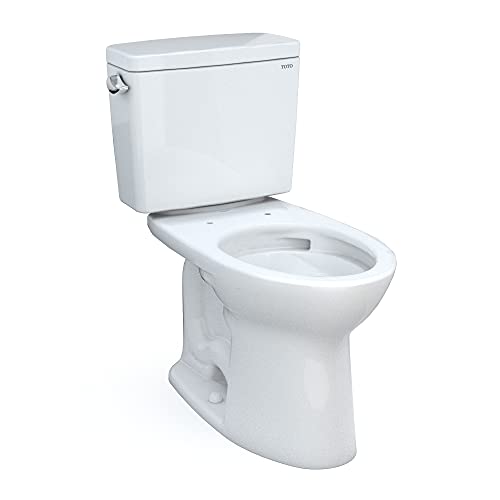
The TOTO Drake earns the maximum 1000-gram MaP score on a 1.28-gallon flush, combining class-leading waste clearance with EPA WaterSense efficiency in a two-piece design that plumbers have recommended for decades.
The Drake's 3-inch flush valve is the mechanical reason for its 1000-gram score. That valve diameter releases tank water into the bowl faster than 2-inch valves found on many competitors, generating a deeper, more aggressive siphon pull. The fully glazed 2-1/8-inch trapway is wide enough that the water jet does not just push waste but actually draws it through via suction.
In aggregated owner feedback, two patterns repeat consistently: the Drake almost never clogs, and it runs louder than quiet-flush alternatives like the Drake II or UltraMax II. The noise is the price of the aggressive G-Max mechanism. Buyers who can accept a pronounced flush sound get one of the most reliable waste-clearance records of any gravity toilet currently sold.
If you have one bathroom, multiple occupants, and a history of reaching for the plunger, the TOTO Drake is the starting point of the conversation. Its 1000-gram MaP score at 1.28 GPF is the most impressive pairing of efficiency and power in its class.
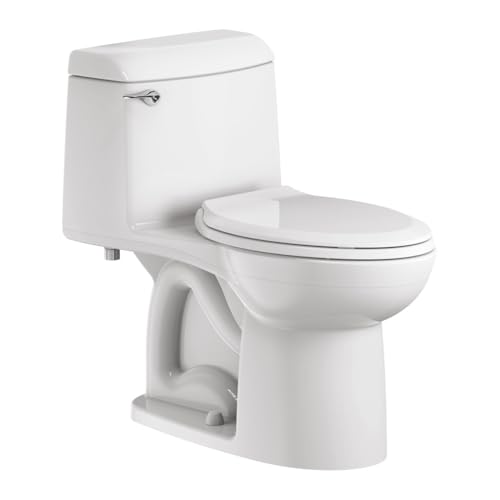
The American Standard Champion 4 uses a 4-inch wide flush valve -- the largest in its class -- to deliver a 1000-gram MaP score at 1.6 GPF, making it the preferred option when sheer volume and valve width matter more than water savings.
American Standard's Champion 4 name refers directly to its 4-inch wide flush valve, which is the largest diameter valve sold in a standard residential toilet. That extra valve width allows the full 1.6 gallons to dump into the bowl almost instantly, generating a powerful siphon. The 2-3/8-inch fully glazed trapway is the widest in the standard two-piece residential class.
The tradeoff is water use. At 1.6 GPF, the Champion 4 does not qualify for WaterSense certification and will use more water over time than 1.28-gallon alternatives. However, in households with very old drain lines, cast iron pipes with partial corrosion, or septic systems that benefit from full water flush, the higher volume is sometimes the right engineering call for the specific situation.
The Champion 4 is the right choice when the household's drain line history suggests that extra water volume genuinely helps move waste down the line. In a home with a modern PVC drain system, the TOTO Drake gets to the same 1000-gram score while saving 20 percent of the water. But in an older home with aging cast iron, the Champion 4's water volume becomes part of the clog-prevention solution.

The TOTO UltraMax II uses Tornado Flush -- two nozzles that generate a centrifugal bowl rinse -- to match the 1000-gram MaP ceiling while delivering superior rim-wash coverage compared to traditional siphon-jet designs, all in a seamless one-piece form.
The UltraMax II's Tornado Flush reaches the same MaP ceiling as the G-Max Drake through a different mechanism. Its two angled inlet nozzles create a vortex that spreads water around the entire interior bowl surface on every flush, which dramatically reduces the mineral deposits and staining that accumulate inside conventional rim-channel bowls. The 1000-gram MaP score means it clears the heaviest test load with room to spare, and buyers choosing between it and the Drake are deciding on form factor and noise, not flush ceiling.
Owner feedback across aggregated reviews highlights the quiet flush as a standout feature -- noticeably quieter than the Drake -- and the one-piece glazed exterior as easier to clean. TOTO's CeFiONtect glaze (on models that include it) is a ceramic ion-barrier coating that reduces waste and mineral adhesion to the bowl surface, which owners in hard-water areas consistently call out as a practical benefit.
The UltraMax II is the right pick when the combination of quiet operation, excellent bowl hygiene, and a clean one-piece exterior matters as much as raw MaP score. At 1000 grams it matches the Drake's ceiling score outright, and the Tornado Flush rim coverage means fewer scrubbing sessions than almost any competitor at any price.
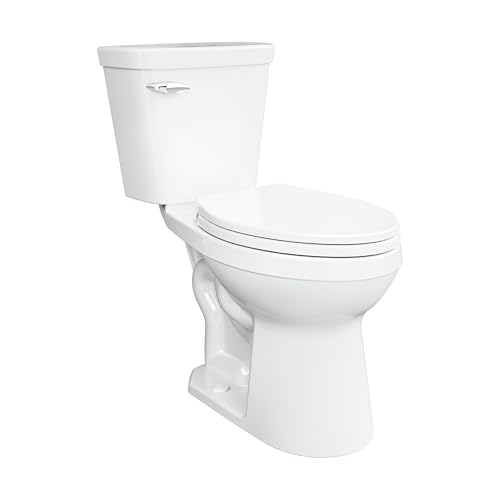
The Gerber Viper earns a consistent 800-gram MaP score with EPA WaterSense certification at 1.28 GPF, representing one of the strongest price-to-performance ratios in the independently tested residential toilet market.
Gerber does not spend heavily on consumer marketing, which is part of why many homebuyers overlook it. But plumbers who install dozens of toilets a year frequently cite Gerber models by name, and the Viper's 800-gram MaP score at 1.28 GPF is solid, verified performance for far less than a comparable TOTO or Kohler purchase. Gerber's CleanCurve rim design reduces the ledge where bacteria tend to accumulate under conventional rim channels.
Aggregated owner feedback on the Viper is quieter in volume than TOTO or Kohler reviews simply because it is a less prominent brand, but the consistent themes are reliable flushing and minimal maintenance. For rental property owners or contractors who need to install multiple toilets with confidence in performance at a lower per-unit spend, the Viper is the model that comes up consistently.
The Gerber Viper is the most underrated toilet on this list. At its price, an independently verified 800-gram MaP score with WaterSense certification is exceptional. If budget is a factor and 1000 grams is not a hard requirement, the Viper is the one to buy without hesitation.

The Woodbridge T-0001 is a skirted one-piece dual-flush toilet with a reported 800-gram MaP rating, WaterSense certification, and a clean modern profile that competes with toilets sold at significantly higher prices from more prominent brands.
Woodbridge has grown its market presence by offering modern, skirted designs at prices substantially below Swiss Madison or TOTO one-piece models. The T-0001 features a concealed trapway behind a smooth skirted base, which eliminates the exterior cleaning difficulty of an exposed S-trap. The dual-flush button mechanism on the tank lid handles liquids at 0.8 GPF and solids at 1.28 GPF, which can reduce household water consumption noticeably in a multi-person bathroom.
The Woodbridge T-0001 and its companion T-0019 carry reported 800-gram MaP scores that place them well above minimum thresholds. Woodbridge is a newer entrant relative to TOTO or American Standard, and some buyers note that replacement parts and dedicated customer service are less established than with the major brands. For understanding how one-piece designs compare generally, our guide on one-piece vs two-piece toilets covers the key tradeoffs.
The Woodbridge T-0001 is the most interesting toilet in the mid-range bracket. It brings the skirted one-piece form factor -- previously a premium-only design -- down to a price where it competes directly with plain two-piece models from Kohler and American Standard. The 800-gram MaP score backs up the flush claim with data.

The Kohler Cimarron combines AquaPiston canister flush technology with a 1000-gram MaP score, WaterSense certification at 1.28 GPF, and cleaner styling than the TOTO Drake, making it the best-rounded toilet in the upper-mainstream market.
Kohler's AquaPiston canister is engineered differently from TOTO's G-Max. Instead of a traditional flapper that lifts to release water, the AquaPiston is a full-diameter canister that opens 360 degrees around its circumference, which Kohler claims delivers 90 percent more water surface contact on the initial burst into the bowl. The result is a flush that spreads water across the bowl interior more evenly on the downstroke, improving bowl rinse quality alongside waste clearance.
The Kohler Cimarron carries a 1000-gram MaP score across its standard configurations, putting it directly competitive with the TOTO Drake at the top of the testing scale. Kohler also offers a limited lifetime warranty on the Cimarron's flush mechanism, which is one of the stronger warranty commitments at this price point among major brands. To compare bowl shape options for the Cimarron and similar models, our guide on round vs elongated toilets covers the measurement and comfort considerations.
The Kohler Cimarron is what we recommend when someone wants TOTO Drake-level performance but objects to the Drake's purely utilitarian look. The AquaPiston mechanism is genuinely different engineering, and the cleaner bowl styling and Kohler's lifetime warranty on the flush canister make it a compelling alternative to both TOTO and American Standard at this price tier.
MaP score is a key data point, but buying a toilet involves several interconnected factors. Here is how to use MaP alongside the other specifications that actually predict whether a toilet will perform well in your specific bathroom.
Before comparing models, decide on a minimum MaP score for your situation. A guest bathroom used only occasionally by adults can function adequately with a 600-gram score. A master bathroom used by a family of four every morning needs 800 grams at a minimum. Any household with a documented history of clogs, or with occupants whose waste volume is high, should target 1000 grams and consider nothing below 800 grams as a fallback.
If your municipality offers rebates for WaterSense-certified toilets, or if you have a septic system with specific volume limits, 1.28 GPF (WaterSense certified) is the bracket to buy within. If your drain line is old or your home has a long horizontal pipe run that requires water volume to carry waste, a 1.6 GPF model may be the practical choice even at the cost of losing WaterSense certification.
Before any other decision, measure the rough-in: the distance from the finished wall behind the toilet to the center of the floor drain. Standard rough-in is 12 inches, but 10-inch and 14-inch rough-in toilets exist. Buying a toilet for a 12-inch rough-in when your bathroom has a 10-inch drain means the toilet will not fit against the wall. Our detailed guide on toilet buying covers this measurement process step by step.
Elongated bowls add roughly 2 inches of front-to-back depth compared to round bowls. In a bathroom with 30 inches or more of clear space in front of the toilet, elongated is the more comfortable choice for adults. In compact bathrooms, round bowls preserve clearance. Comfort height (16 to 18 inches rim height) is easier on knees and hips for most adults and is now the default in many product lines. Standard height (15 inches) is better for shorter occupants and children. See our full breakdown in the guide on round versus elongated toilets for sizing context.
A fully glazed trapway reduces friction as waste moves through, contributing to clog resistance beyond what the MaP score alone captures. Trapway width matters too: 2 inches is the minimum standard, 2-1/8 inches (TOTO Drake) is better, and the American Standard Champion 4's 2-3/8-inch trapway is the widest available in the standard residential class. Skirted toilets conceal the trapway for easier exterior cleaning but use the same internal trapway engineering as exposed designs.
Buyers who do all five of those steps before shopping -- MaP floor, GPF target, rough-in measurement, bowl shape and trapway check -- almost never have buyer's remorse on a toilet purchase. The ones who skip to the MaP score without checking rough-in and bowl shape end up with a toilet that performs well but does not fit their bathroom. Measurement first, then performance specs, then aesthetics.
The Gerber Viper offers the strongest value for its MaP score, delivering an 800-gram rating with WaterSense certification at a price well below similarly scored TOTO and Kohler models. For buyers who need the 1000-gram ceiling score at a price lower than the TOTO Drake, the American Standard Champion 4 is the alternative, though it sacrifices WaterSense certification at 1.6 GPF. Among one-piece designs, the Woodbridge T-0001 delivers an 800-gram score in a skirted modern form at a mid-range price that undercuts comparable TOTO and Swiss Madison one-piece models.
The best value calculation depends on whether water savings factor into the household's budget. Over ten years of average residential use, a 1.28 GPF toilet saves roughly 4,000 to 6,000 gallons of water per year compared to a 1.6 GPF toilet in the same household. In areas where water is priced above $0.005 per gallon, that efficiency gap translates into meaningful annual savings that offset the price premium of a WaterSense-certified model.
MaP stands for Maximum Performance. It is the name of the independent third-party testing program that measures how many grams of solid waste a toilet can clear in a single flush. The program was developed with input from North American water utilities and publishes results publicly at map-testing.com.
A higher MaP score means the toilet is capable of clearing more waste in a single flush, which reduces clogging and eliminates the need for double-flushing. For most households, higher is better. However, a 1000-gram toilet is not necessarily the only viable choice. A family of two adults with no clogging history may find an 800-gram toilet performs perfectly for their needs.
The maximum MaP score awarded by the testing program is 1000 grams. Several widely available residential toilets achieve this ceiling score, including the TOTO Drake, the American Standard Champion 4, and the Kohler Cimarron.
No. EPA WaterSense certification requires that a toilet use 1.28 gallons per flush or less and pass a minimum flush performance standard, but WaterSense does not specifically require a MaP score. A toilet can carry WaterSense certification with a relatively modest MaP score. MaP and WaterSense are separate programs that complement each other.
MaP tests use a standardized soybean-paste media formulated to approximate the density and consistency of human waste. The media is shaped into measured balls of known weight, placed in the toilet bowl, and flushed once. Engineers measure what is cleared. The test is repeated multiple times per model, and the final score represents the maximum grams the toilet can reliably clear in a single flush under identical test conditions.
Yes. The MaP database is publicly available at map-testing.com. You can search by manufacturer name, product series, or model number. The database shows the MaP score alongside the specific flush volume tested, so you can confirm you are looking at the correct configuration of the model you plan to purchase.
The primary MaP protocol tests solid waste clearance using the soybean-paste media. The program has expanded to include optional paper-clearance testing in some of its protocols, but the widely cited MaP score refers specifically to the grams-of-media cleared in the standard solid-waste test. A high MaP score is a strong indicator of overall flush power, but it specifically measures solid waste performance.
For a bathroom used by a family of three or more people, target a MaP score of 800 grams or higher. A score of 1000 grams provides the most clog-resistant performance possible from a gravity toilet and is the recommendation for heavy-use bathrooms or any household with a history of clogging.
Not necessarily. Water volume and MaP score are related but not directly proportional. The TOTO Drake earns 1000 grams at 1.28 GPF, while some 1.6 GPF toilets score well below 800 grams. Bowl geometry, flush valve size, trapway width, and water velocity all influence MaP score more than raw volume alone. Engineering efficiency matters more than gallons.
Manufacturer flush ratings are proprietary and not comparable across brands. A Kohler "AquaPiston" score and a TOTO "G-Max" rating use different methodologies and different media, so they cannot be directly compared. MaP scores are produced by an independent third party using an identical protocol on every model, which makes them comparable across all brands tested.
Yes. Pressure-assist toilets can be submitted for MaP testing and many are. Pressure-assist toilets tend to earn high MaP scores because their compressed-air assisted flush delivers a fast, forceful discharge. However, the MaP testing protocol is the same regardless of flush mechanism, so a pressure-assist 1000-gram score is directly comparable to a gravity 1000-gram score in terms of waste clearance.
The Gerber Viper has been listed in the MaP database with scores at or around 800 grams for the standard 1.28 GPF configuration. As with any model, checking map-testing.com for the specific model number you intend to buy is the best way to confirm the current published score, since scores can vary between production runs and SKU variants.
The TOTO Drake's combination of a 1000-gram MaP score at 1.28 GPF with EPA WaterSense certification is the best documented pairing of flush power and water efficiency in the gravity residential category. The American Standard Champion 4 also scores 1000 grams, but at 1.6 GPF. For buyers who want the ceiling score at the lowest water use, the Drake is the benchmark. For buyers who want the ceiling score regardless of water use, both are equivalent on MaP performance.
Bowl shape can influence MaP results within the same toilet family. Elongated bowls have a longer front projection, which can affect how the flush siphon forms relative to waste position. Manufacturers often publish separate MaP scores for round and elongated versions of the same model. Always look up the MaP score for the specific bowl shape you plan to buy, not just the product family average.
The MaP program considers 350 grams the minimum passing score for residential adequacy, but in practice most plumbing professionals recommend a minimum of 500 grams for a toilet that will be used regularly. Below 500 grams, clogs and double-flushing are likely to occur frequently in typical household use, particularly for a bathroom used by multiple adults.
The Swiss Madison St. Tropez and its related models have been submitted for MaP testing. Results depend on the configuration (wall-hung or floor-mounted, and which tank or in-wall carrier is paired with the bowl). Wall-hung toilet MaP scores can vary more than floor-mount models because the flush pressure is partly determined by the in-wall flush valve system rather than the bowl alone. Check map-testing.com for the current listing of the specific St. Tropez SKU you are considering.
Yes, directly. Double flushing happens when the first flush does not fully clear the bowl, requiring a second flush to remove remaining waste. A toilet with a 1000-gram MaP score is capable of clearing waste in amounts that exceed typical household deposits on a single flush, which is why owner reviews of high-MaP toilets consistently note the absence of double flushing as a frequently cited benefit.
Dual-flush toilets have two flush volumes, typically 0.8 GPF for liquids and 1.28 GPF for solids. MaP testing for dual-flush toilets is conducted on the full-flush setting (1.28 GPF), because that is the flush used for solid waste clearance. The partial flush (0.8 GPF) is not MaP-scored for solid waste since it is intended for liquid waste only. When evaluating a dual-flush toilet for MaP purposes, confirm the score is from the full-flush cycle.
No. MaP testing is voluntary. Major brands including TOTO, Kohler, American Standard and Gerber routinely submit their primary residential models. Some smaller or import brands do not participate, which means no publicly verifiable third-party performance score exists for those models. When a toilet you are considering has no MaP listing, that should be a factor in your decision.
Yes. Although manufacturers pay a submission fee to enter the MaP program, the testing is conducted by independent certified labs using a standardized protocol. The program was developed with water utility input specifically to be impartial, and the results are published publicly whether the score is strong or weak. The protocol does not allow manufacturers to cherry-pick results or influence grading, and the same test is applied to a budget toilet and a premium toilet without modification.
MaP scores are the most reliable objective measure consumers have for comparing toilet flush performance across brands. Target 800 grams or higher for any busy bathroom, and look for models that pair that score with WaterSense certification at 1.28 GPF. The TOTO Drake remains the benchmark -- 1000 grams at 1.28 GPF -- and it earns that position based on independently published data, not marketing language. Use the MaP database before you buy, and stop guessing about flush power.
Learn why toilet trapways curve like an S, how each bend blocks sewer gas, and what the shape means for clogs and…
Read the guideAlmost every US toilet has a left-side handle. Learn the plumbing and mechanical reasons behind the layout and when it actually changes.
Read the guideHome toilets rely on tanks because household water lines lack the pressure that public flushometer systems use to flush straight from the…
Read the guide