
Best 30-Inch Bathroom Vanities (2026)
Bathroom Remodeling4.6
Thirty inches is the sweet spot between a cramped 24-inch vanity and a full 36-inch cabinet, giving a single-sink bathroom real drawer…
Read the guideA practical guide to blending rustic materials, period-correct fixtures, and modern water-efficiency standards in a farmhouse-style bathroom remodel.
A successful farmhouse bathroom pairs shiplap accent walls and a freestanding clawfoot tub with a modern toilet that passes EPA WaterSense certification. TOTO and Kohler both offer period-inspired elongated designs that flush at 1.28 GPF, keeping the look authentic while cutting water use by 20 percent versus older 1.6 GPF toilets.
A farmhouse bathroom is defined by four recurring material signatures: raw or painted shiplap on at least one wall, exposed or painted cast-iron plumbing fixtures (particularly clawfoot tubs), matte-black or brushed-nickel hardware with visible cross handles, and natural-fiber or whitewashed wood accents. The style borrows from American rural vernacular architecture of the late 1800s through the 1930s, prioritizing honest materials and practical durability over decorative excess.
The term "farmhouse bathroom" covers a wide spectrum. At the purer end, you will find claw-foot soaking tubs on unfinished pine floors, bead-board wainscoting painted in antique white, and pedestal sinks with exposed supply lines. At the more contemporary end, the same shiplap boards appear alongside floating vanities, rainfall showerheads, and elongated comfort-height toilets in classic white vitreous china. Both interpretations share the same grounding philosophy: materials that look like they were made to last a generation.
Color palettes lean on whites, creams, sage greens, and muted blues, always anchored by natural wood tones. The restraint is intentional. Farmhouse bathrooms avoid glossy surfaces, chrome that reads as "modern," or ornate carved details more associated with Victorian style. The ceiling treatment is as important as the walls; shiplap ceilings are popular in compact bathrooms because they add height and texture without pattern competition.
Shiplap installed horizontally reads more authentically rustic. Vertical installation works in narrow rooms to add the illusion of height, but it can veer toward a barn-door aesthetic that reads differently than true farmhouse. Choose 1x6 or 1x8 pine boards with a 1/4-inch reveal gap and paint in a flat or eggshell finish to hold the period feel.
Shiplap is a wooden board milled with a rabbet on each edge so boards overlap slightly rather than butting flush, creating a recessed shadow line between courses. In a bathroom, shiplap is typically installed over a moisture-resistant backer board or directly to studs when used on non-wet walls, then sealed and painted with a semi-gloss or satin paint to resist humidity. It is not appropriate directly inside a shower or tub surround without a full waterproofing membrane system.
Authentic shiplap is milled from solid wood, most commonly pine, spruce, or fir. Modern "shiplap-look" alternatives include tongue-and-groove PVC paneling and MDF with routed channels, both of which perform better in high-humidity environments. For a true farmhouse bathroom, solid pine painted in alkyd or 100-percent-acrylic paint remains the most visually convincing option, provided the wall receives adequate ventilation.
Installation follows these principal steps:
Material cost for pine shiplap ranges from roughly $1.20 to $3.50 per square foot depending on grade and region, well below subway tile or large-format porcelain. A 12-by-8-foot accent wall uses approximately 96 board-feet, so material alone is manageable. Labor runs higher because level installation on an out-of-plumb wall requires shimming, adding 30 to 50 percent to the install time versus tile work.
Avoid shiplap inside the tub wet zone entirely. Even sealed and painted boards will eventually wick moisture at cut ends and joints. Use a porcelain subway tile or a large-format limestone slab on the wet surround, then transition to shiplap above the tile line. That hybrid approach is the most durable long-term solution and is aesthetically correct for the farmhouse period, when tile and painted wood coexisted in the same room.
A clawfoot tub is a freestanding cast-iron or acrylic soaking tub supported by four decorative feet, typically in a ball-and-claw or slipper style. Standard sizes run 54 to 72 inches in length, with interior soaking depths of 14 to 24 inches. Cast-iron models weigh 250 to 500 pounds, requiring confirmed floor joist capacity of at least 125 pounds per square foot before installation.
The choice between cast iron and acrylic is the most consequential decision in a clawfoot purchase. Cast iron retains heat better, typically 20 to 30 minutes of sustained soaking temperature versus 10 to 15 minutes for acrylic, but the weight demands verified structural support. Acrylic clawfoot tubs weigh 60 to 100 pounds and suit second-floor installations where floor load is a concern, but they can flex slightly under body weight, a sensation some owners find unsatisfying.
| Specification | Cast Iron Clawfoot | Acrylic Clawfoot | Composite Clawfoot |
|---|---|---|---|
| Heat Retention | 20-30 min | 10-15 min | 15-20 min |
| Weight (avg 60-in tub) | 300-400 lbs | 60-90 lbs | 120-200 lbs |
| Floor Load Required | 125+ psf | 40-60 psf | 60-80 psf |
| Typical Lifespan | 50-100+ years | 10-20 years | 20-40 years |
| Refinishing | Yes, multiple times | Limited, once | Limited |
| Entry price range | Higher | Lower | Mid |
Drain and faucet configuration matters significantly with clawfoot tubs. Most accept deck-mounted faucets through pre-drilled holes in the tub rim, or a freestanding floor-mount faucet that connects to the supply lines through the floor. The freestanding floor-mount option is visually striking in farmhouse bathrooms because the exposed supply pipes reinforce the period aesthetic. Confirm supply stub locations before purchasing: floor-mount faucets typically require supply stubs within 6 inches of the tub drain location.
Clawfoot tub shower conversions use a circular curtain ring suspended from the ceiling, or an oval rod mounted overhead, with a hand-shower on a riser. These ring systems are widely available and install in two ceiling anchors. Confirm ceiling height is at least 7 feet to allow comfortable clearance above the curtain ring.
Two-piece elongated toilets in high-gloss white vitreous china are the most period-appropriate choice for a farmhouse bathroom, as they reference plumbing fixtures of the early-to-mid 20th century. Comfort-height (17 to 19 inches) models from TOTO and Kohler maintain the classic silhouette while meeting modern EPA WaterSense 1.28 GPF efficiency standards, and their fully skirted or exposed trapway designs can be matched to the room's level of formality.
The farmhouse aesthetic does not call for smart toilets, wall-hung toilets, or compact elongated designs more associated with contemporary bathrooms. Exposed tank toilets with a slightly taller tank profile actually read more authentically, since pre-war bathrooms often featured high-tank gravity-flush designs. Modern two-piece toilets capture that verticality without the impracticality of a true high-tank cistern.
For a bathroom that leans toward the cleaner farmhouse-meets-modern interpretation, a one-piece elongated toilet with a streamlined tank profile in cotton white (Kohler's designation) or colonial white (American Standard's equivalent) works well. These finishes have a slight warm tone rather than the stark blue-white of standard gloss, which pairs better with cream shiplap and aged brass hardware.
Key toilets to consider for farmhouse bathrooms include:
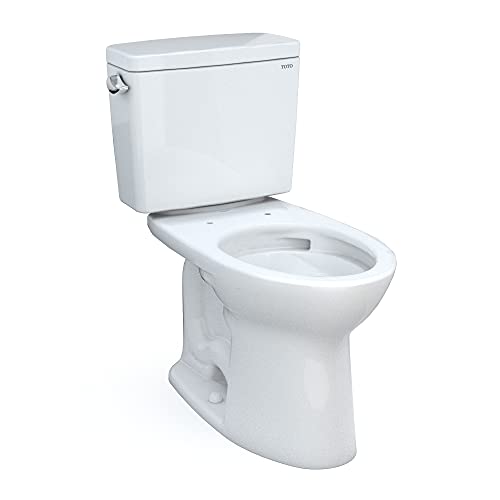
The Drake II delivers a MaP score of 1,000 grams, the highest rating achievable, in a tall two-piece profile that suits traditional farmhouse bathrooms without requiring a modern one-piece silhouette.
TOTO's Double Cyclone flushing system uses two nozzles to create a centrifugal water flow that coats the entire bowl surface while maintaining a 1.28 GPF rate. Aggregated owner reviews across major retailers cite the near-elimination of double-flushing as the most consistent satisfaction driver.
For farmhouse bathrooms specifically, the two-piece tall tank design reads more authentically than the brand's one-piece options, and the white cotton finish option (CST454CEFG#01) provides the warm-toned white that pairs well with painted shiplap and cream tile.
The Drake II is the workhorse recommendation in farmhouse remodels because it delivers reliability data (MaP 1,000 g, WaterSense certified) without the contemporary visual language of a skirted one-piece. For rooms where the toilet is partially visible from an adjoining hallway, the tall tank silhouette actually anchors the period look rather than disrupting it.
Kohler's Cimarron brings AquaPiston flushing to a comfort-height elongated body that suits farmhouse bathrooms needing accessibility-friendly seat height without abandoning the classic aesthetic.
Kohler's AquaPiston canister opens 90 degrees for a full 360-degree water flow, which avoids the side-entry flapper bias that can cause inconsistent flush performance over time. Published MaP testing shows the Cimarron clears a perfect 1000 grams, matching the TOTO Drake II and putting it at the top of the comfort-height segment rather than merely above average.
The Biscuit color option (suffix -96) pairs particularly well with cream-painted shiplap and natural linen tones. Kohler also offers the Cimarron in white cotton and almond, broadening the palette match options for warm farmhouse schemes.
The Cimarron is the right call when comfort height is non-negotiable due to household mobility needs. At 17.5 inches from floor to seat, it meets ADA guidelines while keeping a two-piece silhouette that does not look clinical or contemporary in a farmhouse setting. The Biscuit tone option is underrated for period remodels.
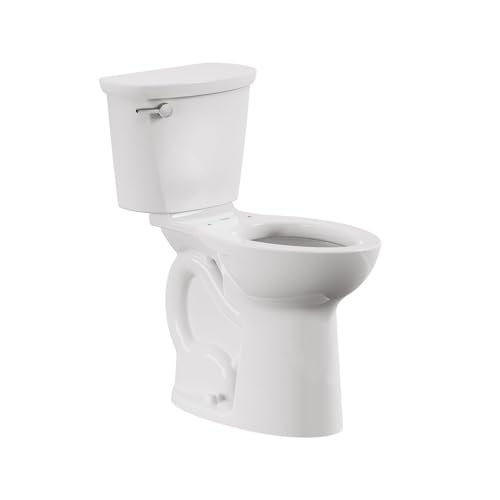
The Cadet 3 from American Standard carries a class-five flushing system that consistently clears 800 grams in MaP testing, making it a dependable choice where budget allocation is directed toward the tub and tile rather than the toilet.
American Standard's EverClean surface inhibits mold, mildew, and bacteria growth on the bowl surface according to published manufacturer data, a practical advantage in farmhouse bathrooms where natural materials and humidity can combine to accelerate surface staining. The Cadet 3 is a consistent MaP performer at 800 grams, verified across multiple independent test cycles.
Color matching deserves attention: American Standard's "colonial white" has a pronounced warm undertone that reads noticeably different from a true white in natural light. If the tile and trim are bright white, specify the "white" option instead.
In remodel budgets where the significant spend is on the clawfoot tub and handmade subway tile, the Cadet 3 is a defensible toilet choice. It performs at a level indistinguishable from mid-range competitors in day-to-day household use, and its parts are available at every hardware chain nationally, simplifying eventual maintenance.
Matte black, oil-rubbed bronze, and brushed nickel are the three finishes most consistent with farmhouse bathroom design. Cross-handle or lever faucets with exposed body plating and ceramic disc cartridges reference the functional hardware of early plumbing without requiring actual antique parts. Unlacquered brass has become popular in farmhouse remodels for its natural patination over time, though it requires periodic cleaning to manage uneven oxidation.
Faucet selection must align with sink type. Farmhouse bathrooms typically feature one of three sink configurations: pedestal sinks with widespread or centerset faucets, undermount or drop-in sinks in a reclaimed-wood vanity, or vessel sinks on a console or slab counter. Each configuration has specific faucet geometry requirements.
| Sink Type | Faucet Style | Best Finish | Notes |
|---|---|---|---|
| Pedestal sink | Widespread 8-in (3-hole) | Oil-rubbed bronze / matte black | Best period accuracy; cross handles preferred |
| Undermount in wood vanity | Widespread or single-hole | Brushed nickel / unlacquered brass | Single-hole suits smaller vanities |
| Vessel sink | Tall single-hole vessel faucet | Matte black | Tall spout clears vessel rim by 4+ in |
| Clawfoot tub | Floor-mount or rim-mount | Oil-rubbed bronze | Exposed supply risers reinforce period look |
Cross-handle faucets merit specific mention. The four-spoke or cross-pattern handle design is directly associated with early 20th-century plumbing hardware, when lever handles had not yet displaced the more mechanically precise cross configuration. Modern cross-handle faucets use ceramic disc cartridges rather than rubber washers, meaning they retain the period look while delivering the drip-free performance of contemporary valve technology.
Finish durability varies by type. Powder-coated matte black is prone to chipping on high-use faucets; physical vapor deposition (PVD) matte black is significantly more durable and worth seeking out for primary bathroom applications. Oil-rubbed bronze is typically a living finish with a lacquer topcoat; check the manufacturer's care instructions before purchase, as some versions tolerate minimal cleaning products while others accept standard bathroom cleaners.
Showerhead selection follows the same finish logic. A rain head or wall-mounted arm in matte black or brushed nickel with a 6-inch to 8-inch face reads as farmhouse-appropriate. Industrial-style exposed thermostatic valves with metal knobs reinforce the aesthetic in bathrooms that incorporate a shower separate from the clawfoot tub. Avoid polished chrome in farmhouse rooms; the high reflectivity reads as 1990s-builder-grade regardless of the surrounding materials.
Commit to one metal finish throughout the bathroom and use it consistently across faucets, towel bars, toilet paper holder, and mirror frame. Mixing two finishes is possible but requires intentionality: matte black hardware with unlacquered brass accents works because both have a warm, non-reflective quality. Matte black plus polished nickel creates a visual tension that reads as unresolved rather than designed.
Farmhouse bathroom layouts prioritize the clawfoot tub as the visual anchor, typically centering it on the longest wall or under a window. The toilet is positioned in a secondary location, ideally in a nook or against a sidewall, where the classic two-piece form integrates without competing with the tub. Minimum clear floor space is 30 inches in front of the toilet per code, and 15 inches from the centerline to any obstruction.
A full farmhouse bathroom conversion in an existing house almost always involves working within existing drain rough-in positions. Moving a drain even 12 inches horizontally typically requires opening the subfloor and is the single largest cost multiplier in a bathroom renovation. The most cost-effective approach places new fixtures over or near existing drain locations while concentrating the aesthetic transformation in surfaces, fixtures, and hardware.
Standard layout considerations for a farmhouse bath:
Permit requirements vary by jurisdiction but typically include mechanical and plumbing permits for any work involving drain relocation or new supply rough-in. Surface-level renovations (tile replacement, shiplap installation, fixture swaps that use existing connections) may qualify for a simpler residential improvement permit or no permit at all depending on local codes. Confirm with the local building department before starting.
For toilet selection in the context of a complete farmhouse bathroom, the broader guide to best flushing toilets covers flush performance benchmarks across every major style including the two-piece elongated models most suited to farmhouse design. Additionally, readers planning for accessibility should review ADA-compliant toilet options, and those evaluating water efficiency in the context of a broader remodel will find the 1.28 GPF versus 1.6 GPF comparison directly relevant. Understanding bathroom color scheme selection helps align toilet, tile, and shiplap choices across the room.
Flooring is the third major surface decision after walls and fixtures. The most popular farmhouse bathroom floors in current remodels, based on builder reports and design publications, are:
Farmhouse bathroom lighting follows the same period-referencing logic as hardware. Exposed-bulb sconces with cage shields or simple drum shades in matte black or oil-rubbed bronze suit the aesthetic. Barn light pendants work over dual vanities or in bathrooms with 9-foot-plus ceilings where pendants do not create a head-strike hazard. Dimmer switches are advisable on all bathroom lighting except night lights, since the combination of white shiplap walls and light-colored tile creates a high-reflectance environment that can read as clinical at full illumination.
Avoid recessed can lighting as the primary source in a farmhouse bathroom. The penetrations into a shiplap or bead-board ceiling disrupt the surface continuity that makes those ceilings appealing, and the harsh downward light conflicts with the warm, diffuse quality of period-appropriate fixtures.
Solid wood shiplap is not inherently waterproof, but it performs well on non-wet bathroom walls when properly primed and painted with a moisture-resistant paint. It should never be used inside a shower or tub enclosure without a full waterproof membrane system. PVC shiplap alternatives offer better moisture resistance but require careful seam sealing.
A standard 60-inch cast iron clawfoot tub typically weighs 250 to 400 pounds empty, and must support an additional 300 to 500 pounds when filled with water and occupant. Before installing any cast iron tub, verify floor joist size, span, and condition. Most residential floors built to code support 40 psf live load; a filled cast iron tub often requires sistered joists or structural assessment.
The TOTO Drake II in a two-piece elongated configuration is the most recommended toilet for farmhouse bathrooms based on its combination of traditional silhouette, maximum MaP flush performance (1,000 grams), and EPA WaterSense certification at 1.28 GPF. The Kohler Cimarron is a strong alternative when comfort height is needed.
Yes, provided you use an acrylic or composite clawfoot tub rather than cast iron, and confirm that floor joists can handle the combined weight of tub plus water plus occupant. A structural engineer can assess load capacity for roughly $300 to $600, which is worthwhile before committing to a heavy fixture on any upper floor.
EPA WaterSense certified toilets flush at 1.28 GPF or less while meeting minimum performance standards set by the EPA's flush performance testing protocol. Certified toilets must clear at least 350 grams in the MaP test (though top performers exceed 800 to 1,000 grams). Replacing a 1990s 3.5 GPF toilet with a WaterSense model saves approximately 13,000 gallons per year for an average household of four.
MaP (Maximum Performance) flush testing measures how many grams of solid waste a toilet clears in a single flush using a standardized test media. Scores run from 0 to 1,000 grams, with 600 grams considered the minimum for a reliable household toilet and 1,000 grams representing maximum performance. The TOTO Drake II, American Standard Champion 4, and Woodbridge T-0001 all achieve 1,000-gram MaP scores.
Oil-rubbed bronze and matte black are the most period-appropriate faucet finishes for farmhouse bathrooms. Unlacquered brass is increasingly popular for its natural patina development but requires more maintenance. Brushed nickel works in bathrooms that lean toward a cleaner, modern farmhouse interpretation. Avoid polished chrome, which reads as contemporary builder-grade regardless of surrounding materials.
The most common shiplap board widths for bathrooms are 1x6 (5.5 inches face) and 1x8 (7.25 inches face). Narrower boards create a more traditional horizontal clapboard feel. Wider boards read more contemporary and suit modern farmhouse interpretations. For standard 8-foot ceiling heights, 1x6 boards produce a more balanced visual rhythm.
Yes. Farmhouse bathrooms translate well to rooms as small as 40 to 50 square feet when the clawfoot tub is replaced by a pedestal tub or walk-in shower. The core aesthetic elements (shiplap, cross-handle hardware, hexagonal tile, matte-black fixtures) scale down without losing coherence. A single strong element such as a shiplap accent wall on one face creates the farmhouse character even in a compact powder room.
Hexagonal white mosaic tile in 1-inch or 2-inch format is the most historically grounded choice, directly referencing domestic and commercial tile patterns from the 1900 to 1940 period that defines farmhouse style. Black-and-white checkerboard in 3-inch to 4-inch squares is equally appropriate and remains widely popular in farmhouse bathroom renovations.
No. Bead board features narrow vertical grooves along its face at regular intervals, creating a textured paneling effect. Shiplap is a flat board with a rabbet cut on each edge for an overlapping horizontal reveal. Both are associated with farmhouse and cottage aesthetics, but they read differently: bead board is more vertical and paneled, while shiplap is more horizontal and plank-like. Both can coexist in the same room (bead board wainscoting below a shiplap upper wall is a common treatment).
A slipper clawfoot tub has one or both ends raised higher than the center, creating a more reclined soaking posture. Single slipper tubs have one raised end for the head or back. Double slipper tubs have both ends raised symmetrically. Standard clawfoot tubs have a flat, rolled rim at a consistent height on all sides. Slipper styles are more ornate and suit larger bathrooms where the tub is a focal centerpiece.
A full farmhouse bathroom remodel covering tub replacement, shiplap installation, new toilet, tile, and fixture updates ranges from $8,000 to $25,000 depending on fixture selection and whether plumbing relocation is involved. Moving drain or supply rough-in adds $1,500 to $5,000 to the budget. Cosmetic-only remodels (shiplap, hardware, toilet swap) can be completed for $2,000 to $6,000.
Shiplap is almost always painted in bathroom applications. Natural-finish wood in a bathroom requires more maintenance (annual oiling or sealing) and is more vulnerable to moisture damage. Standard practice is to prime all surfaces including end grain with a shellac-based or alkyd primer, then apply two coats of bathroom-grade acrylic paint in a satin or semi-gloss sheen. White and soft greens are the most common farmhouse bathroom colors.
Elongated wood toilet seats in white enamel or bisque are the most period-appropriate choice for farmhouse bathrooms. Solid wood seats with a slow-close hinge mechanism balance aesthetics with daily convenience. Avoid plastic seats with visible metal hinges or bidet seats with protruding control panels, both of which conflict with the understated hardware aesthetic of the farmhouse style.
The Woodbridge T-0001 achieves a MaP score of 1,000 grams and carries EPA WaterSense certification at 1.28 GPF, which makes its flush performance on par with top-tier competitors. Its skirted one-piece design leans contemporary, which suits modern farmhouse interpretations. For traditional farmhouse rooms, a two-piece exposed-trapway design is more period-appropriate than the sleek skirted profile.
Comfort height toilets sit 17 to 19 inches from floor to seat top, mirroring standard chair height. They are recommended for adults over 60, users with knee or hip joint issues, and ADA-compliant bathrooms. For farmhouse bathrooms serving households with older adults, the Kohler Cimarron Comfort Height is a natural specification. For households without mobility concerns, standard height (14 to 17 inches) is equally appropriate and does not change the aesthetic meaningfully.
Farmhouse bathrooms with shiplap walls require a bathroom exhaust fan rated for at least 1 CFM per square foot of floor area, with a minimum of 50 CFM for any bathroom under 50 square feet. Higher humidity from clawfoot tub soaking makes a 110 to 150 CFM fan advisable in most farmhouse bathrooms. The fan should duct to the exterior, not to an attic space, to prevent moisture accumulation behind shiplap boards.
Use a 100-percent silicone caulk in a color matching the grout or paint at any junction where shiplap meets a wet surface, tub rim, or floor. Silicone maintains flexibility through the seasonal wood movement that rigid caulk cannot accommodate, reducing the likelihood of cracked seals that allow moisture intrusion. Reapply silicone caulk at the tub/floor line every 1 to 2 years as part of standard bathroom maintenance.
The TOTO Aquia IV is a dual-flush skirted one-piece toilet with a very contemporary minimalist profile. Its aesthetic reads as modern or transitional rather than farmhouse, making it a poor visual fit for traditional farmhouse rooms. It is more at home in contemporary or transitional bathrooms. For TOTO models that suit farmhouse aesthetics, the two-piece Drake and Drake II are the better references.
A farmhouse bathroom remodel succeeds when materials, hardware finishes, and fixtures share a consistent period reference without requiring antique plumbing or unmanageable maintenance. Shiplap walls painted in flat white, a cast iron clawfoot tub centered on the primary wall, and a two-piece elongated toilet in the TOTO Drake II or Kohler Cimarron deliver the full aesthetic while meeting current water efficiency standards. Commit to one metal finish across all hardware, specify cross-handle faucets in oil-rubbed bronze or matte black, and use hexagonal mosaic tile or black-and-white checkerboard on the floor. Those choices produce a bathroom that reads as genuinely designed rather than trend-chasing, and that holds its visual integrity for decades.
Thirty inches is the sweet spot between a cramped 24-inch vanity and a full 36-inch cabinet, giving a single-sink bathroom real drawer…
Read the guide
Cast iron is the material homeowners choose when heat retention and permanence matter more than installation weight, and Kohler remains the brand…
Read the guideStep-by-step fixes for the bathroom vanity problems that show up most often, from misaligned drawers and doors to water damage at the…
Read the guide