
How Much Water Does an Old Toilet Use?
Buying Guides4.6
Find out how many gallons per flush an old toilet really uses, how to check your own tank, and how much water…
Read the guideBrown rust, yellow mineral haze, pink biofilm -- each color signals a different root cause. This guide explains exactly what each tint means, which fixes actually work, and when to call a plumber.
Research updated June 2026.
Brown toilet water almost always means corroded iron pipes or high iron in your supply. Yellow tints point to hard-water minerals or an aging wax ring. Pink or reddish rings are Serratia marcescens bacteria feeding on soap residue. Each color needs a different fix -- cleaning rarely solves the underlying source.
Brown toilet water is caused by iron or manganese oxidizing in your water supply or corroding from aging galvanized or cast-iron pipes. When water sits in older pipes overnight, dissolved ferrous iron absorbs oxygen and converts to visible ferric iron particles -- the same chemistry that turns a cut apple brown. Municipal supply changes, nearby water-main flushing, or a failing water heater anode rod can also suddenly release rust into your lines.
Iron at concentrations above 0.3 mg/L (the EPA Secondary Maximum Contaminant Level) will stain porcelain, laundry, and fixtures. Manganese stains darker -- closer to black-brown -- and becomes a concern above 0.05 mg/L. Neither mineral poses an acute health risk at typical household levels, but the staining is severe and persistent.
The first diagnostic step is to check whether brown water appears only in the toilet or throughout every faucet in the home. If every tap runs rusty for the first 30 seconds after sitting unused overnight, the problem is in your supply pipes or the city main. If only the toilet bowl shows discoloration, the tank parts -- a corroded flapper, old fill valve, or a galvanized supply line -- are the likely culprits.
A simple home test: fill a clean white bucket from the outside hose bib and let it stand for 24 hours. If sediment settles or a ring forms, your source water has elevated iron or manganese. Send a sample to a state-certified lab (roughly $25 to $40) before buying any treatment equipment -- many homeowners install softeners when an oxidizing filter is the correct tool.
| Symptom | Likely Cause | Scope | Fix Complexity |
|---|---|---|---|
| Brown only in toilet, clears after flush | Corroded tank parts (flapper, fill valve) | Single fixture | DIY -- replace parts ($8-$20) |
| Brown at every tap for 30 sec, then clears | Galvanized supply pipes corroding internally | Whole house | Pipe replacement or filtration |
| Brown water only from hot side | Failing water heater anode rod | Hot-water lines | Anode rod replacement ($20-$50) |
| Sudden brown after years of clear water | City main flushing, nearby construction, pressure change | Neighborhood | Flush your lines; call utility |
| Brown with sulfur smell | Manganese + sulfur-reducing bacteria in well | Well supply | Shock chlorination + oxidizing filter |
Step 1 -- Isolate the tank. Remove the tank lid and inspect the inside. A brown, slimy coating on the overflow tube or flapper indicates the tank is the contamination source. Corroded metal tank components leach rust into every fill cycle.
Step 2 -- Replace old metal tank parts. Flappers, fill valves, and flush valves made before 1980 are often partly metal. Modern plastic replacements from Fluidmaster or Korky cost under $20 and eliminate internal corrosion. TOTO and Kohler sell OEM replacement kits for their specific models.
Step 3 -- Check the supply line. The braided stainless or chrome supply line connecting the shut-off valve to the tank can rust at the fittings. Replace it every 5 to 7 years.
Step 4 -- Test source water. If the brown persists after fixing tank parts, order a certified water test. EPA WaterSense does not cover iron and manganese -- those are addressed under the Safe Drinking Water Act's Secondary Standards, which are non-enforceable guidelines.
Step 5 -- Install appropriate treatment. Oxidizing filters (birm, greensand) remove iron and manganese without salt. Water softeners do not remove iron effectively above 2 mg/L. An iron filter sized to your flow rate (gallons per minute) is the correct tool for persistent whole-house rust.
Yellow or cloudy toilet water is most commonly caused by calcium and magnesium carbonate deposits (hard water scale) reacting with urine residue or chlorine byproducts in the bowl. It can also result from a deteriorating wax ring, high chloramine levels in municipal water, or, less commonly, a slow leak from a wax seal allowing sewage gases to seep into the bowl. Yellow tint that appears only in standing water and disappears after flushing usually points to mineral buildup on the porcelain itself rather than a supply-side problem.
Water hardness is measured in grains per gallon (gpg) or milligrams per liter. Water above 7 gpg (120 mg/L) is classified as hard by the U.S. Geological Survey. Roughly 85 percent of U.S. homes receive hard water. Over time, calcium carbonate coats the bowl interior, trap, and rim jets with a yellowish-white scale that traps stains and accelerates discoloration between cleanings.
Rim jets are the most overlooked source of yellow bowl water. Mineral scale slowly blocks these small holes under the rim, reducing flush velocity and allowing scale-coated water to dribble rather than jet into the bowl. Use a dental mirror and a bent wire coat hanger to clear clogged rim jets before blaming your water supply. TOTO's TORNADO FLUSH design uses only two large nozzles rather than many small rim jets, largely avoiding this problem.
| Hardness (gpg) | Classification | Toilet Bowl Effect | Recommended Action |
|---|---|---|---|
| 0 to 1 | Soft | Minimal staining | Standard cleaning |
| 1 to 3.5 | Slightly hard | Light white residue | Monthly citric acid treatment |
| 3.5 to 7 | Moderately hard | Yellow tint, scale on rim jets | Weekly cleaning + annual descaling |
| 7 to 10.5 | Hard | Heavy scale, persistent yellow | Water softener or whole-house filter |
| 10.5+ | Very hard | Rapid scale, yellow standing water | Softener required; consider ceramic bowl replacement |
Citric acid treatment: Pour one cup of citric acid powder (food-grade, widely available) into the bowl and let it sit for two to four hours. Citric acid dissolves calcium carbonate without damaging vitreous china glaze. This is safer than muriatic acid, which can etch the surface if left too long.
Pumice stone: A wet pumice stone removes heavy scale from porcelain without scratching because pumice is softer than vitreous china (Mohs hardness ~6 vs ~7). Always wet both the pumice and the bowl surface. Never use pumice on colored or enameled bowls.
Toilet tank tablets caution: Blue bleach tablets hung inside the tank keep the bowl visually cleaner but degrade rubber flappers within six to twelve months, according to published data from flapper manufacturers including Fluidmaster. The resulting leaks waste thousands of gallons annually and can cause brown discoloration from degraded rubber particles. Drop-in tablets are not recommended by most toilet manufacturers including TOTO and Kohler.
Toilets with a glazed trapway, such as the best flushing toilets on our main roundup, resist scale adhesion better than unglazed models. American Standard's EverClean glaze and TOTO's CeFiONtect ceramic glaze both carry independent testing data showing meaningful reductions in bacterial and mineral adhesion compared to standard vitreous china.
The pink or reddish ring that forms at the waterline in toilet bowls is caused by Serratia marcescens, an airborne bacterium that thrives on moisture, soap residue, and mineral deposits. Serratia is not a waterborne pathogen in the same category as E. coli, but it is an opportunistic organism that can cause respiratory or urinary tract infections in immunocompromised individuals. Regular cleaning with a disinfectant containing at least 0.1 percent sodium hypochlorite (bleach) eliminates it; the challenge is preventing rapid recolonization from bathroom air.
Serratia marcescens produces a red pigment called prodigiosin that gives the ring its characteristic pink-to-orange-red color. The bacterium does not come from your water supply -- it is ubiquitous in household air, dust, and on surfaces. Bathrooms with high humidity, infrequent use, and residual soap or toothpaste aerosol on surfaces are most susceptible. A toilet that sits unused for several days without flushing is especially prone because the standing water surface acts as a growth medium.
Pink rings should not be confused with pink water from the supply, which is rare and typically caused by potassium permanganate from a municipal treatment error. If the water itself (not just the ring) runs pink, contact your water utility immediately.
The most effective long-term strategy against Serratia is reducing bathroom humidity and eliminating soap aerosol sources near the toilet. Running the exhaust fan during and 20 minutes after showers, keeping the toilet lid closed before flushing to prevent aerosol spread, and switching from bar soap to pump dispensers all measurably reduce recolonization frequency. Disinfectant bowl cleaners maintain activity for approximately 7 days; in high-humidity bathrooms, weekly application is more effective than monthly deep-cleaning.
| Step | Action | Product/Tool | Frequency |
|---|---|---|---|
| 1 | Apply disinfectant cleaner under rim and to waterline | Bleach-based bowl cleaner (0.1%+ NaOCl) | Weekly |
| 2 | Scrub with toilet brush, including under rim | Standard toilet brush | Weekly |
| 3 | Wipe exterior and seat hinge with disinfectant wipe | Quaternary ammonium wipes | Weekly |
| 4 | Run bathroom exhaust fan during and post-shower | Exhaust fan, timer switch | Daily |
| 5 | Close toilet lid before flushing | N/A -- habit change | Every flush |
| 6 | Flush unused toilets to refresh standing water | N/A | Every 2 to 3 days if unused |
Yes. The tank is a direct source of discoloration because every flush empties the tank into the bowl. Corroding metal components -- including older ballcocks, metal flapper chains, or galvanized overflow tubes -- shed iron particles into the water with each fill cycle. Rubber flappers degraded by bleach tablet exposure release black or dark brown particles that tint the bowl water. Replacing corroded or degraded tank parts is often the fastest fix when discoloration is isolated to the toilet and does not appear at other fixtures.
Rubber flappers: Standard rubber flappers last three to five years under normal conditions. Chlorine exposure from in-tank tablets accelerates degradation to six to twelve months. Degraded rubber turns the bowl water dark gray or brown and leaves visible particles on the bowl surface. Replace with a chlorine-resistant flapper (Fluidmaster 502 series, Korky 100BP) if you use tank tablets.
Fill valve assembly: Older ballcock fill valves with brass or metal components corrode from the inside. Water picks up ferric iron as it enters through the valve during each fill. Modern plastic fill valves from Fluidmaster, available for $10 to $15, eliminate this entirely.
Flush valve seat: Mineral buildup on the flush valve seat prevents the flapper from seating fully, allowing a constant slow leak. This trickle of water flowing through the bowl 24 hours a day deposits minerals in a concentrated ring at the waterline and can accelerate discoloration. The dye test (food coloring in the tank, wait 15 minutes without flushing) reveals silent leaks.
Supply line and shutoff valve: Older chrome supply lines develop internal rust at the compression fittings. Ball-type shutoff valves that have not been turned in many years can corrode at the stem and shed particles. Turn shutoff valves fully off and back on annually to prevent internal corrosion from seizing them.
When diagnosing tank-sourced discoloration, fill the tank and add a few drops of blue food coloring, then let it sit for 30 minutes without flushing. Blue bowl water confirms slow seepage through a leaking flapper -- typically causing 200 or more gallons of waste per day. The EPA's WaterSense program estimates that toilet leaks account for roughly 1 trillion gallons of water wasted in U.S. homes annually, much of it from degraded flapper valves.
Toilets with fully glazed trapways, ion-barrier ceramic coatings, and skirted bases resist discoloration better than standard models because smooth, dense surfaces give mineral deposits, bacteria, and iron particles fewer microscopic pores to adhere to. TOTO's CeFiONtect glaze, American Standard's EverClean antimicrobial surface, and Kohler's CleanCoat technology each independently tested for reduced microbial and mineral adhesion. MaP flush testing also confirms that models achieving 1,000-gram flush ratings clear waste in a single flush, minimizing residue that darkens over time.
| Brand / Model | Coating Technology | MaP Score | GPF | EPA WaterSense | Stain Resistance | Check Price |
|---|---|---|---|---|---|---|
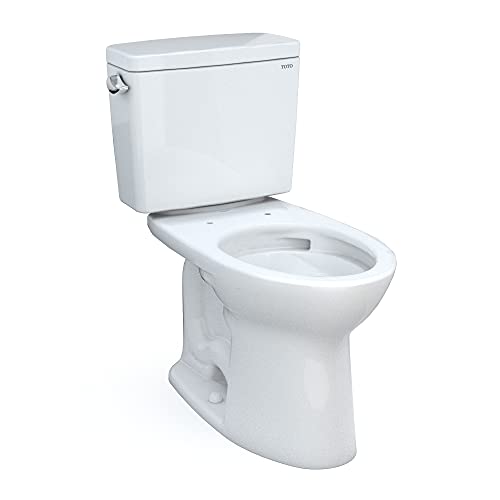
| TOTO Drake II (CST454CEFG) | CeFiONtect | 1,000 g | 1.28 | Yes | Excellent | Check price |
| TOTO UltraMax II (MS604114CEFG) | CeFiONtect | 1,000 g | 1.28 | Yes | Excellent | Check price |
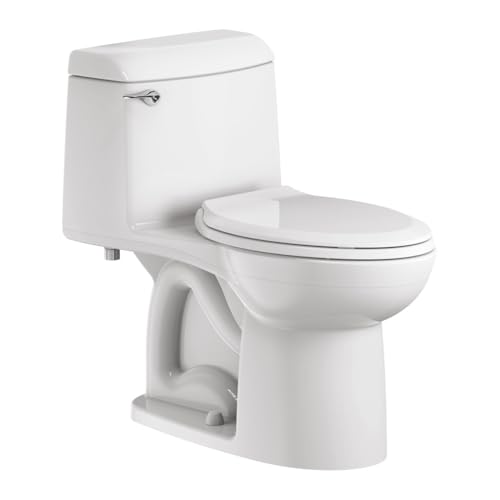
| American Standard Champion 4 | EverClean glaze | 1,000 g | 1.6 | No | Very good | Check price |
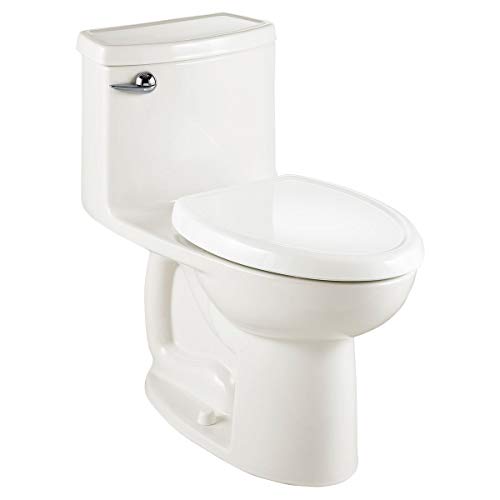
| American Standard Cadet 3 | EverClean glaze | 800 g | 1.28 | Yes | Very good | Check price |
| Kohler Cimarron (K-3609) | CleanCoat | 1,000 g | 1.28 | Yes | Good | Check price |
| Kohler Highline Classic | Standard vitreous china | 800 g | 1.6 | No | Average | Check price |
| Woodbridge T-0001 | Ceramic glaze (no brand coating) | Not independently listed | 1.6 / 1.0 dual | No | Average | Check price |
| Swiss Madison Sublime (SM-1T803) | Standard ceramic glaze | Not listed | 1.28 | No | Average | Check price |
| Gerber Viper (21-312) | Standard vitreous china | 900 g | 1.6 | No | Average | Check price |
MaP (Maximum Performance) testing, conducted by an independent North American consortium, measures how many grams of solid waste a toilet clears in a single flush. Toilets scoring 800 g or above are generally considered adequate; 1,000 g is the maximum rating and indicates the highest confidence in clearing the bowl completely with each flush, leaving the least residue behind to stain or discolor over time. See what MaP flush test scores mean for a deeper explanation of the methodology.
Skirted or concealed trapway designs (like the TOTO Aquia IV and Woodbridge T-0001) eliminate the exposed ridges and crevices on the outside of a traditional two-piece toilet where mineral deposits and biofilm accumulate. The smooth exterior resists the brown streaking that develops on traditional exposed-trapway models in hard water regions. The interior bowl geometry matters more for performance: a fully glazed, smooth-bore trapway reduces the adhesion of waste and mineral particles compared to unglazed trapways common in budget models.
For households with persistent discoloration problems, upgrading to a toilet with a factory antimicrobial glaze is a more durable solution than relying on chemical treatments alone. See our TOTO Drake vs Drake II comparison for a side-by-side look at how the CeFiONtect coating performs against the standard glaze variant, and our guide to toilet bowl coatings compared for all major brands.
| Water Color | Most Likely Cause | Secondary Cause | Urgency | First Action |
|---|---|---|---|---|
| Brown / rust | Iron / corroded pipes | Corroded tank parts | Moderate | Check tank parts; test water |
| Yellow (standing water) | Hard water minerals | Urine residue + scale | Low | Citric acid descale; check rim jets |
| Yellow (all water) | High chloramine / iron | Wax ring failure | Moderate | Compare hot and cold; call utility if whole house |
| Pink / red ring | Serratia marcescens bacteria | Humidity + soap aerosol | Low to moderate | Bleach-based disinfectant weekly |
| Black / dark gray | Manganese or mold | Degraded rubber flapper | Moderate | Inspect tank; test for manganese |
| Blue-green | Copper pipe corrosion | Low pH water (acidic) | High -- pinhole leaks possible | Water pH test; call plumber |
| Milky / cloudy (clears top to bottom) | Dissolved air (harmless) | Pressure change in main | None | Fill glass; observe -- harmless if clears in seconds |
| Orange | Iron + tannins (well water) | Manganese + iron mix | Moderate | Certified lab water test |
Discoloration alone is rarely a reason to replace a functioning toilet. However, there are circumstances where replacement is more cost-effective than continued treatment:
See our complete guide to when to replace a toilet for a detailed cost-benefit comparison across toilet age, repair history, and efficiency tier.
Brown water from iron or manganese is generally safe for flushing and non-potable toilet use. It is not safe to drink. If the source is sewage contamination or pipe failure rather than iron, stop use and call a plumber immediately.
Bleach can lighten organic stains but does not dissolve iron or calcium deposits -- it may temporarily whiten the stain while leaving the mineral substrate intact. Use citric acid or oxalic acid-based cleaners (like Bar Keepers Friend) for mineral-based brown stains. Follow with bleach to kill bacteria.
In hard water areas (above 7 gpg), clean the bowl at least once per week with a descaling agent and perform a deeper citric acid treatment monthly. In soft water areas, bi-weekly cleaning with a standard bowl cleaner is usually sufficient to prevent discoloration rings.
No -- a pink ring in the bowl is almost always caused by Serratia marcescens bacteria from bathroom air, not contaminated water. True pink supply water is extremely rare and would affect all taps simultaneously; contact your water utility if every tap in the house runs pink.
Rapid re-staining usually indicates either very hard water (above 10 gpg) causing fast mineral redeposition, a slow tank leak feeding a constant stream of mineral-laden water through the bowl, or high humidity enabling rapid bacterial regrowth. Address the root cause rather than increasing cleaning frequency.
A failing wax ring does not typically discolor the bowl water directly, but a broken seal allows sewer gases (including hydrogen sulfide) to enter the bathroom, which can contribute to odor and, in rare cases, interact with mineral deposits to produce yellowish residue. The more common sign of a bad wax ring is water on the floor at the toilet base.
Black or very dark gray water typically indicates manganese above 0.05 mg/L, mold growth in the tank or bowl, or a degraded rubber flapper shedding particles. Inspect the tank interior first. If tank parts are intact, request a water test for manganese from a certified lab.
A standard ion-exchange water softener effectively removes iron up to roughly 1 to 2 mg/L but is ineffective above that level. For higher iron concentrations, an oxidizing iron filter (birm or greensand media) is required. Installing a softener when iron exceeds 2 mg/L can foul the resin bed within months.
Toilets fill from the cold supply only, so brown water appearing only from the hot side at sinks and showers indicates a problem inside the water heater -- typically a depleted anode rod or sediment buildup. Replace the anode rod every three to five years to prevent this. The toilet itself is unaffected by hot-water issues.
Milky water that clears from bottom to top within 30 seconds of filling a glass is dissolved air released by pressure changes -- completely harmless. Milky water that remains cloudy after several minutes, or that clears from top to bottom, may indicate suspended sediment or a treatment issue and warrants a water test.
TOTO's independent testing data shows CeFiONtect-coated bowls maintain a smoother surface at the microscopic level compared to standard vitreous china, measurably reducing bacterial and mineral adhesion. Owner reviews aggregated across major retailers consistently note easier cleaning and fewer visible rings between cleanings compared to non-coated competitors.
After a full flush and refill, immediately scoop a cup of water from the toilet bowl before any standing time. If it is clear, the discoloration is building up from minerals in the standing water. If it is already tinted, the discoloration is entering from the supply line or tank components. Also check the inside of the tank -- visible rust or sediment there confirms the tank is the source.
Yes. Bleach-based drop-in tablets corrode rubber flappers, releasing black and brown rubber particles into the flush water. Some tablet formulations also react with iron in the water to form colored compounds. Most major toilet manufacturers including TOTO, Kohler, and American Standard explicitly state that in-tank tablets void the flush valve warranty.
Higher GPF does not automatically mean less staining -- flush mechanics matter more than volume. A 1.28 GPF toilet with a high-velocity siphon jet (MaP score 800 g or above) cleans the bowl more effectively than a 1.6 GPF gravity-feed model with a weak rim wash. MaP testing is the most reliable independent comparison tool for flush-cleaning effectiveness.
The Gerber Viper (21-312) uses standard vitreous china without a proprietary anti-scale coating. In hard water areas above 7 gpg, owners report more frequent yellow ring formation compared to coated competitors. Its 900 g MaP score is adequate, but the lack of a glazed trapway or antimicrobial coating means more frequent cleaning is needed in mineral-rich water regions.
Home test kits (available for $10 to $30 online) can detect iron, hardness, manganese, and pH at basic levels. For accurate, actionable results, use a state-certified water testing laboratory; many state health departments list approved labs. Costs typically range from $25 to $100 depending on the panel. Well owners should test annually; municipal water customers can request the annual Consumer Confidence Report from their utility at no cost.
Both use CeFiONtect glaze and achieve 1,000 g MaP scores. The Aquia IV is a skirted dual-flush model (1.0 / 0.8 GPF) that eliminates exterior ridges where mineral deposits accumulate. For hard water areas where exterior cleaning is as problematic as interior staining, the Aquia IV's smooth skirted design offers a practical maintenance advantage over the Drake II's traditional exposed-trapway design.
The Champion 4 features American Standard's EverClean antimicrobial surface, which is tested to inhibit the growth of stain-causing bacteria and mold on the bowl surface. Its large 2 3/8-inch trapway and PowerWash rim scrub the bowl with each flush. However, at 1.6 GPF it does not carry EPA WaterSense certification, meaning it uses slightly more water per flush than 1.28 GPF alternatives, which can concentrate minerals slightly faster in low-use guest bathrooms.
Brown water means iron or corroded tank parts -- fix the source, not just the stain. Yellow is almost always a hard-water mineral problem best addressed with a citric acid descale and, in severe cases, whole-house softening or filtration. Pink rings are Serratia bacteria from bathroom air, eliminated with weekly bleach-based disinfectant and reduced humidity. Across all discoloration types, toilets with factory antimicrobial ceramic glazes (TOTO CeFiONtect, American Standard EverClean) and high MaP flush scores maintain cleaner bowls between cleanings because their smooth, dense surfaces give deposits fewer anchor points. Treat the water, fix the tank, then choose the right bowl coating -- in that order.
How we rank & our data sources
We do not run physical lab tests. Rankings are built from published, verifiable data and real owner feedback, never paid placement.
Researched by Derek Whitman · Last updated August 14, 2026 · Our review method
Find out how many gallons per flush an old toilet really uses, how to check your own tank, and how much water…
Read the guideA higher MaP score means stronger waste removal, but not always a better toilet. Learn what MaP really measures and when the…
Read the guideModern low-flow toilets can flush as well as older models. Learn why some struggle, how to diagnose weak flushes, and which fixes…
Read the guide