

Where Does Toilet Water Go After You Flush
Buying Guides4.6
When you flush, where does it go? Follow toilet water from the bowl through the trap, drain, and stack to a septic…
Read the guideTwo federal certification labels appear on toilet packaging, but they measure different things. Here is a precise breakdown of what each label means, which one matters more for your wallet, and which real models carry both.
WaterSense is an EPA label for toilets using 1.28 GPF or less with a MaP score of at least 350 grams. Energy Star does not cover standalone toilets. If a toilet says "Energy Star," it is an integrated bidet toilet seat unit, not a standard bowl. For water savings, look for the WaterSense label.
Walk through any plumbing supply store and you will see two blue labels: the familiar Energy Star star-and-checkmark, and the EPA WaterSense drip logo. Both are federally backed programs, but they govern entirely different product categories. Misreading the label can cost you hundreds of dollars in wasted water or lead you to purchase an integrated unit when you only wanted a toilet bowl.
This guide separates the two programs clearly, details the underlying certification standards, names the real toilet models that carry WaterSense certification, and helps you decide what to prioritize when shopping for a best flushing toilets replacement.
| Factor | EPA WaterSense | Energy Star |
|---|---|---|
| Applies to standalone toilet bowls | Yes | No |
| Water use requirement | 1.28 GPF or less | N/A for standalone toilets |
| Flush performance requirement | 350 g MaP minimum | N/A |
| Applies to bidet toilet combos | Partial (water side only) | Yes (electronic seat component) |
| Governing agency | U.S. EPA | U.S. EPA + DOE |
| Annual savings per household | Up to 13,000 gallons per year | Varies by bidet model |
| Rebate availability | Widely available from water utilities | Available for qualifying bidet combos |
| Third-party verification required | Yes (certified lab MaP testing) | Yes (certified testing lab) |
Energy Star does not certify standalone toilet bowls or tanks. The Energy Star program covers electronics, appliances, and HVAC equipment that consume electricity or fuel. The only toilet-related products that carry an Energy Star rating are combination bidet toilet seats and integrated smart toilet units, which consume electricity for seat heating, water warming, and air drying functions. A plain gravity-flush or pressure-assist toilet bowl cannot receive an Energy Star label.
This point causes persistent confusion because Energy Star is a broadly recognized consumer label. Shoppers see it on everything from refrigerators to windows, so it is reasonable to expect it on a major household fixture like a toilet. But the program's mandate requires measurable energy consumption, and a standard toilet uses no electricity at all. The gravity-fed flush mechanism is purely mechanical.
If you see a packaging claim of "Energy Star Certified" on a product described as a toilet, read the fine print. You are almost certainly looking at one of the following:
Products like the TOTO Neorest NX2, the Kohler Veil Intelligent Toilet, and the American Standard SpaLet Advanced Clean carry Energy Star ratings precisely because they include electrical components. The Energy Star rating on those products covers the electronic seat assembly and heating system, not the flush mechanism itself.
Water utility rebate programs almost universally reference WaterSense certification, not Energy Star, because utilities care about water consumption. If you are buying a toilet purely for efficiency and rebate eligibility, WaterSense is the label to verify. Energy Star is relevant only if you are comparing the electricity draw of competing smart toilet models.
EPA WaterSense requires that a toilet use no more than 1.28 gallons per flush (GPF) and achieve a MaP (Maximum Performance) flush test score of at least 350 grams of solid waste per flush, verified by an accredited third-party laboratory. The dual requirement ensures that qualifying toilets are genuinely efficient without sacrificing the flushing power needed to clear the trapway completely.
WaterSense launched in 2006 as a voluntary partnership program modeled conceptually on Energy Star but focused entirely on water use. The toilet specification was one of the first product categories the program addressed, and it has been updated several times as technology improved.
Pillar 1: Water Volume. Standard toilets installed before 1992 used 3.5 to 5 gallons per flush. Federal law (EPACT 1992) set a 1.6 GPF maximum. WaterSense tightens that further to 1.28 GPF, a 20 percent reduction over the current federal baseline. Dual-flush toilets qualify if their full-flush mode does not exceed 1.6 GPF and the average of full and reduced flush does not exceed 1.28 GPF.
Pillar 2: Flush Performance. Early high-efficiency toilets (HETs) gained a poor reputation in the late 1990s and early 2000s because they often required multiple flushes to clear waste, which negated the water savings. The MaP testing protocol, developed independently in Canada and later adopted by the EPA, measures how many grams of simulated solid waste a toilet can flush completely in a single flush. WaterSense requires a minimum of 350 grams. The best-performing models on the MaP scale score 1,000 grams (the MaP Premium designation), clearing a full kilogram in a single flush.
As of 2026, the EPA WaterSense certified toilet list includes hundreds of models across all major brands. Certification is granted at the model number level, so it is important to confirm the specific model you are purchasing is listed, rather than assuming an entire brand's lineup qualifies.
The MaP score floor of 350 grams is a minimum, not a target. When choosing among WaterSense-certified options, look for models that score 600 grams or higher for single-flush tanks, or 1,000 grams (MaP Premium) for the best clog resistance. The TOTO Drake II and American Standard Champion 4 consistently achieve 1,000-gram MaP scores while meeting the 1.28 GPF WaterSense threshold.
According to EPA estimates, replacing an older 3.5 GPF toilet with a WaterSense-certified 1.28 GPF model saves approximately 13,000 gallons of water per year for a family of four, which translates to roughly $110 to $190 in annual utility savings depending on local water and sewer rates. Over the 10 to 20 year life of a toilet, total savings can exceed $2,000.
The EPA's WaterSense program publishes water savings estimates based on average household flush frequency (roughly 5 flushes per person per day). The math is straightforward:
| Toilet Type | GPF | Annual Gallons (4 people) | vs WaterSense (savings) |
|---|---|---|---|
| Pre-1992 standard | 3.5 to 5.0 | 25,550 to 36,500 | Baseline (old) |
| Federal 1.6 GPF standard | 1.6 | 11,680 | Save ~2,920 gal/yr vs 2.0 GPF |
| WaterSense 1.28 GPF | 1.28 | 9,344 | Best in class efficiency |
| WaterSense dual-flush (avg 0.95 GPF) | 0.8 / 1.6 avg ~0.95 | 6,935 | Maximum water savings |
Water and sewer rates vary enormously across the United States. In cities with high utility costs such as San Francisco, Atlanta, and Seattle, the annual savings from switching to a WaterSense toilet can exceed $200 for a household of four. In lower-cost markets, the savings are smaller but still meaningful over a decade of use.
Many municipal water utilities offer rebates of $50 to $200 for purchasing a WaterSense-certified toilet. These rebates can reduce or even eliminate the cost premium a WaterSense model carries over a non-certified toilet. Check the EPA WaterSense rebate finder tool (epa.gov/watersense) to see programs available in your ZIP code before purchasing.
Hundreds of models from all major brands hold WaterSense certification. Notable examples include the TOTO Drake II (1.28 GPF, 1,000g MaP Premium), the TOTO Aquia IV (dual-flush, WaterSense certified), the American Standard Champion 4 (1.28 GPF, 1,000g MaP), the Kohler Cimarron (1.28 GPF), the Gerber Viper (1.28 GPF), and the Woodbridge T-0001 (1.28 GPF). Each is independently tested and listed on the EPA WaterSense certified product database.
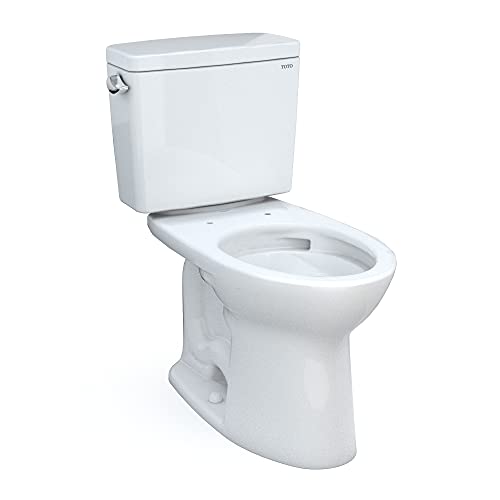
The TOTO Drake II is one of the most widely recognized WaterSense-certified toilets on the market. It uses 1.28 GPF through TOTO's Double Cyclone flushing system, which generates centrifugal rinsing action using two nozzles rather than one. Third-party MaP testing awards it a 1,000-gram score (MaP Premium), meaning it can flush a full kilogram of solid waste in a single pull of the handle. Aggregated owner reviews consistently cite near-zero clogging incidents across years of use. The Drake II is available in elongated and round versions. You can check the TOTO Drake II on Amazon.
The TOTO Aquia IV is a dual-flush WaterSense-certified model offering 0.8 GPF for liquid waste and 1.28 GPF for solid waste. Its CEFIONTECT ceramic glaze reduces particle adhesion on the bowl surface, lowering cleaning frequency and the need for harsh chemicals. It holds both WaterSense certification and a MaP score that meets or exceeds the 350-gram minimum. Learn more about whether dual-flush toilets are worth it in our dedicated guide. You can check the TOTO Aquia IV on Amazon.
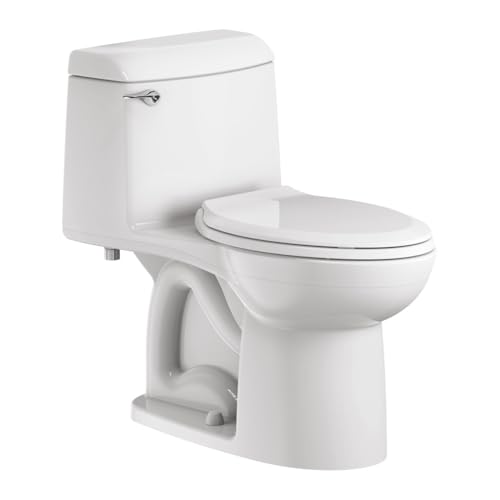
The American Standard Champion 4 uses a 4-inch accelerator flush valve (most toilets use 2-inch or 3-inch valves) combined with a 2-3/8-inch fully glazed trapway. The result is a 1.28 GPF flush with a 1,000-gram MaP Premium score. American Standard publishes the Champion 4 as one of its flagship WaterSense models. The larger valve opening generates more water velocity at a lower volume, which is the engineering principle behind its clog-resistance reputation. See how it compares in our American Standard Champion 4 review. You can check the American Standard Champion 4 on Amazon.
Kohler's Cimarron is WaterSense certified at 1.28 GPF using Kohler's AquaPiston canister flush valve. The AquaPiston allows water to enter the bowl from 360 degrees rather than through a flapper-style opening, which Kohler states produces a more powerful rim wash and trapway evacuation. MaP scores for the Cimarron vary slightly by specific configuration, with elongated versions typically scoring higher than round models. You can check the Kohler Cimarron on Amazon.
The Woodbridge T-0001 is a one-piece skirted toilet that holds WaterSense certification at 1.28 GPF. Its fully concealed trapway (smooth-sided exterior) makes cleaning the outside of the toilet significantly easier than two-piece models with exposed trapway ridges. The T-0001 uses a dual-flush mechanism (0.8 / 1.6 GPF) that averages within WaterSense thresholds. It is a popular mid-range option for bathroom remodels where aesthetics matter alongside efficiency. You can check the Woodbridge T-0001 on Amazon.
The Gerber Viper is a two-piece WaterSense toilet at 1.28 GPF that earns consistently strong MaP scores. Gerber is a professional-grade brand often specified by plumbers in commercial and multi-family residential projects. The Viper's trapway is fully glazed, reducing mineral buildup and maintaining flush performance over years of use. Gerber offers a 10-year warranty on the Viper's vitreous china components. You can check the Gerber Viper on Amazon.
Yes, but only a specific category of product qualifies: integrated bidet toilet units that combine a WaterSense-compliant 1.28 GPF flush system with Energy Star-certified electronic seat components. The TOTO Neorest and Washlet+ series, Kohler Veil Intelligent Toilet, and Swiss Madison Ivy smart toilet are examples. The WaterSense label applies to the water-use portion and the Energy Star label applies to the electrical seat system. A standard bowl and tank toilet cannot hold both labels because it uses no electricity.
Dual-certified smart toilets represent the premium end of the toilet market. They offer benefits beyond both efficiency programs: self-cleaning wand systems, seat warming, heated water bidet spray, air drying, automatic flush on exit, and deodorizer systems. The energy consumption of these electronic systems varies, but most Energy Star-certified bidet toilet combos use between 50 and 100 kWh per year for seat heating, water warming, and drying functions.
At average U.S. electricity rates (roughly $0.13 per kWh in 2026), the annual electricity cost for an Energy Star smart toilet seat runs approximately $6 to $13 per year. Non-Energy Star bidet seats with always-on tank heating can cost $25 to $40 per year to operate, which makes the Energy Star distinction meaningful for this product category even if the savings are modest in absolute dollar terms.
If you are considering a smart toilet and want maximum efficiency, look for a model with both certifications and specifically seek one with an "instant heat" water heating system rather than a tank-style heater. Instant heat systems only activate when the bidet function is triggered, eliminating standby energy waste entirely. Swiss Madison and TOTO both offer instant-heat options in their certified lineup.
The Maximum Performance (MaP) flush test was developed in 2003 by researchers at the Veritec Consulting and Koeller and Company in response to consumer complaints about poor performance from early 1.6 GPF toilets. It provides a standardized, reproducible way to measure how much solid waste a toilet can flush completely in a single pull of the handle, using a soybean paste and tissue paper analog that mimics real waste conditions.
MaP scores range from 0 to 1,000 grams:
Because the EPA requires a minimum MaP score to issue WaterSense certification, the two programs are functionally linked for toilets. You cannot have a WaterSense toilet that flushes poorly. The dual requirement was the key policy innovation that allowed WaterSense toilets to overcome the reputation problems that plagued early high-efficiency toilets.
The MaP database (map-testing.com) is publicly available and searchable by brand, model, and score. Before purchasing any toilet, it is worth spending two minutes to look up the specific model's verified MaP score rather than relying solely on marketing claims. See our related guide on understanding toilet flushing power for a deeper explanation of the test methodology.
Yes. EPA WaterSense includes a specific protocol for dual-flush toilets. To qualify, a dual-flush model must meet these conditions:
In practice, most dual-flush WaterSense models use a 0.8 GPF reduced flush and a 1.28 GPF full flush, which comfortably meets all criteria. The TOTO Aquia IV (0.8/1.28 GPF) and the Woodbridge T-0001 (0.8/1.6 GPF, qualifying on weighted average) are among the most widely sold dual-flush WaterSense models in the U.S. residential market.
Dual-flush toilets offer the highest theoretical water savings among WaterSense-certified options, but only if the household actually uses the reduced-flush button for liquid waste. Studies from Australia and Europe (where dual-flush adoption is higher) suggest that in practice many users default to the full-flush mode for all waste types, which reduces the real-world savings advantage. Positioning clarity on the flush buttons (clearly marked small vs large flush) improves actual usage rates.
The EPA WaterSense program maintains a certified product list on its website (epa.gov/watersense). You can search by brand and model number. For toilets, certification is granted at the model-level, meaning a change in flush valve or rim design can affect whether a specific configuration is certified even within the same product family.
Steps to verify before purchasing:
Do not rely solely on the WaterSense logo appearing on the box. While rare, outdated packaging occasionally circulates in retail channels after a certification lapses or is updated. The EPA database is the authoritative source.
When a sales associate or product listing says "this toilet is Energy Star and WaterSense," ask them to show you the model number in both databases. For a standard bowl-and-tank toilet, Energy Star certification is impossible. If someone shows you an Energy Star logo on a plain two-piece toilet, either the label is being applied loosely (referring to a different product in the packaging) or there is a product description error. Always verify independently.
One of the practical advantages of choosing a WaterSense-certified toilet is rebate eligibility. The EPA coordinates with hundreds of water utilities, municipalities, and state programs to provide financial incentives for WaterSense product purchases. As of 2026, rebates for WaterSense toilets typically range from $25 to $200 per toilet depending on the utility and the specific model.
Common rebate structures include:
The EPA WaterSense website includes a rebate finder tool where you can enter your ZIP code and see available programs. California's utility programs through the Metropolitan Water District and individual municipal utilities are among the most generous, with rebates up to $200 per toilet. Texas, Arizona, and Colorado utilities also run strong programs given their water scarcity challenges.
Some programs require that you purchase from an approved retailer or that the specific model number appear on their pre-approved list. Confirm eligibility before purchasing, not after, to avoid discovering your chosen model does not qualify for the rebate in your service territory.
No. Energy Star does not certify standalone gravity-flush or pressure-assist toilet bowls because they use no electricity. Energy Star only covers integrated bidet toilet units and smart toilet systems that include electronic components like seat heaters, water warmers, and air dryers.
GPF stands for gallons per flush. A 1.28 GPF toilet uses exactly 1.28 gallons of water each time it flushes, which is 20 percent less than the 1.6 GPF federal maximum set in 1992 and far less than older 3.5 to 5 GPF models. 1.28 GPF is the WaterSense program's maximum allowed volume for certification.
For WaterSense-certified models, yes, because certification requires a minimum MaP score of 350 grams. Many 1.28 GPF models score 1,000 grams (MaP Premium), which is actually better than some older 1.6 GPF designs that scored in the 400 to 600 gram range. Lower water volume does not automatically mean weaker flushing when the valve and trapway are designed correctly.
The Maximum Performance (MaP) flush test measures how many grams of simulated solid waste a toilet can flush completely in a single pull of the handle. It uses a standardized soybean paste and tissue paper analog. Scores range from 0 to 1,000 grams. The EPA WaterSense program requires a minimum of 350 grams for certification.
Yes. Dual-flush toilets qualify for WaterSense if the weighted average of their full and reduced flush modes does not exceed 1.28 GPF and both modes independently pass MaP performance testing. Most qualifying dual-flush models use 0.8 GPF for the reduced mode and 1.28 GPF for the full mode.
Likely yes, depending on where you live. The EPA WaterSense program coordinates with hundreds of water utilities to offer rebates ranging from $25 to $200 per toilet. Use the rebate finder at epa.gov/watersense to find programs in your ZIP code before purchasing.
Most TOTO models sold in the U.S. market carry WaterSense certification. The TOTO Drake, Drake II, UltraMax II, and Aquia IV are among the most widely confirmed certified models. TOTO's CEFIONTECT-glazed models pair certification with easy-clean bowl technology. Always verify the specific model number in the EPA database.
Yes. The American Standard Champion 4 MAX is WaterSense certified at 1.28 GPF and holds a MaP score of 1,000 grams. Its 4-inch accelerator flush valve is the largest flush valve in a residential toilet and is the engineering feature behind its clog-resistance reputation.
Check the inside of your toilet tank lid. Most toilets manufactured after 1994 have the GPF stamped into the china. If it reads 1.6 GPF or lower, it meets the federal standard. If it reads 1.28 GPF and you see a WaterSense logo on the tank or bowl, it qualifies for efficiency programs. Toilets with no markings and an older design likely use 3.5 to 5 GPF.
HET stands for High-Efficiency Toilet, which is an industry term for any toilet using 1.28 GPF or less. WaterSense is a specific EPA certification that HETs must earn by also passing MaP performance testing. All WaterSense toilets are HETs, but not all HETs have applied for or received WaterSense certification.
Energy Star covers integrated bidet toilet seats and bidet toilet combo units that include electronic heating, washing, and drying functions. It does not cover passive toilet seats (plain seats without electronics). The certification applies specifically to the energy consumption of the electronic components in qualifying smart bidet products.
WaterSense-certified toilets span a wide price range. Entry-level certified models from American Standard and Gerber compete directly with standard 1.6 GPF toilets. The certification itself does not add a significant cost premium since almost all major manufacturers have shifted their main product lines to 1.28 GPF designs over the past decade. Higher prices on some models reflect brand positioning, smart features, or design, not the certification itself.
Among widely available residential models, dual-flush toilets with a 0.8 GPF reduced mode use the least water for liquid waste. The TOTO Aquia IV at 0.8/1.28 GPF is a commonly cited example. Composting toilets and vacuum-flush systems can use even less, but those require special installation and are not typical residential choices.
The EPA can remove a product from the certified list if it fails retesting or if a manufacturer changes the product's design in a way that affects its performance characteristics. When a model is decertified, it loses rebate eligibility going forward, though purchases made while it was certified typically remain eligible for rebates processed before the decertification date.
Yes. Pressure-assist toilets can receive WaterSense certification if they use 1.28 GPF or less and pass the MaP performance test. Pressure-assist models use compressed air to boost flush velocity and often achieve very high MaP scores. Some commercial-grade pressure-assist models certified for WaterSense use as little as 1.0 GPF.
The Kohler Highline is available in both 1.28 GPF and 1.6 GPF configurations. The 1.28 GPF version is WaterSense certified. When purchasing, confirm you are ordering the 1.28 GPF variant specifically, as the Highline product line includes multiple configurations that differ by flush volume and valve design.
The Swiss Madison Ivy is an integrated smart toilet combining a WaterSense-compliant flush system with an electronic bidet seat featuring instant-heat water and air drying. It is positioned as a dual-certified option (WaterSense for water use, Energy Star for the electronic seat system). It represents the category of products where both certifications are simultaneously applicable and meaningful.
WaterSense is a voluntary EPA partnership program. Participation by manufacturers is optional. However, certain state and local government procurement rules require WaterSense-certified products for public buildings, and many utility rebate programs only apply to certified products. In practice, major manufacturers pursue certification because it increases sales eligibility and consumer trust.
WaterSense certification for a toilet model does not expire on a fixed schedule, but the EPA reserves the right to require periodic retesting, particularly when the program specification is updated. Manufacturers must notify the EPA of any design changes that could affect certified performance characteristics and retest if the change is material.
The Woodbridge T-0001 is listed in the MaP database and holds scores that meet WaterSense certification requirements. The specific gram score varies slightly by bowl configuration (elongated vs round) and flush mode (reduced vs full). The full-flush 1.6 GPF mode on dual-flush models typically produces the higher MaP score. Check the MaP database at map-testing.com for the most current verified scores by model variant.
For a standard toilet purchase, WaterSense is the only label that matters: it confirms 1.28 GPF water use and a minimum 350-gram MaP flush score, verified by a certified lab. Energy Star has no application to conventional toilet bowls and applies only when you are buying an integrated smart bidet toilet unit with electronic seat functions. When comparing models, prioritize WaterSense certification first, then look for a MaP score of 600 grams or higher for reliable performance, and check your local utility's rebate finder before finalizing your choice. The TOTO Drake II, American Standard Champion 4, and Kohler Cimarron represent the strongest combination of certification, performance, and owner-verified reliability in the current market.
When you flush, where does it go? Follow toilet water from the bowl through the trap, drain, and stack to a septic…
Read the guideDo toilets need electricity to flush? Most do not. Learn which toilets use power, how a standard flush works, and how to…
Read the guideFind out how many gallons per flush an old toilet really uses, how to check your own tank, and how much water…
Read the guide