What Does the Toilet Float Do?
Toilets4.6
Learn what the toilet float does, how it controls water level in the tank, and how to diagnose and fix a float…
Read the guideMaP scores, GPF ratings, and real flushing performance data for 10 top-rated toilets -- ranked so you can choose with confidence.
Research updated June 2026.
The TOTO Drake II and American Standard Champion 4 consistently lead MaP flush testing, both achieving the maximum 1,000-gram score. For water efficiency combined with elite flushing, the TOTO Aquia IV dual-flush and Kohler Cimarron offer the best balance of MaP performance and EPA WaterSense certification at 1.28 GPF.
MaP -- Maximum Performance -- testing is the single most reliable public benchmark for toilet flushing power. An independent lab flushes each toilet 15 times at a given waste load (measured in grams of soybean paste, the standardized surrogate for solid waste), recording the minimum load cleared on all 15 flushes. A toilet that clears 800 grams on every attempt earns an 800 MaP score. A toilet that clears 1,000 grams earns the maximum 1,000 MaP score, which testing protocols denote as MaP Premium.
Knowing a toilet's MaP score before you buy eliminates guesswork. A 500-gram score is adequate for a powder room. For a master bath or a household that has experienced chronic clogs, you want 800 grams or higher. Most modern toilets retailing above $200 now target 800-1,000 grams, but design details -- trapway size, rim jet count, tower flush vs. flapper, pressure-assist vs. gravity -- still create meaningful differences between models that look nearly identical on a spec sheet.
This comparison covers 10 models from TOTO, Kohler, American Standard, Woodbridge, Swiss Madison, and Gerber, with MaP scores, GPF ratings, trapway geometry, and aggregated owner feedback. For a broader buying guide, see our best flushing toilets roundup.
A MaP score measures the maximum solid-waste load (in grams) that a toilet clears completely on all 15 test flushes, using a standardized soybean-paste surrogate. Higher scores directly translate to fewer clogs in real households. The MaP Premium designation requires a score of 1,000 grams, meaning the toilet cleared a full kilogram of waste every single time -- a benchmark that separates genuinely powerful flushers from average performers.
The MaP testing protocol was developed jointly by the Canadian Water and Wastewater Association and the California Urban Water Conservation Council. Participating manufacturers voluntarily submit toilets; independent labs run the standardized test and publish results at map-testing.com. Because the test is third-party and reproducible, a 1,000-gram MaP score on a $180 American Standard carries the same meaning as a 1,000-gram score on a $700 TOTO.
MaP testing is separate from EPA WaterSense certification, which evaluates water consumption rather than flushing power. A WaterSense toilet must use no more than 1.28 gallons per flush (GPF), but that label says nothing about how much solid waste it clears. The best-performing toilets on the market now achieve both: 1,000 MaP scores at 1.28 GPF or less, demonstrating that water efficiency and flushing power no longer trade off against each other in well-designed models.
MaP scores are published for thousands of toilet models at map-testing.com. Before assuming any new or popular toilet is a strong flusher, verify its MaP score directly on that site. A toilet advertised with terms like "powerful flush" or "double cyclone" may score 600 or 800 grams, not the maximum 1,000 -- and that gap matters for households with older plumbing or larger family usage.
| Model | MaP Score (g) | GPF | WaterSense | Flush Type | Trapway | Style | Check Price |
|---|---|---|---|---|---|---|---|
| TOTO Drake II (1-piece, 1.28) | 1,000 | 1.28 | Yes | Double Cyclone | 2-1/8 in fully glazed | 2-piece | Check price |
| American Standard Champion 4 | 1,000 | 1.6 | No | EverClean, tower flush | 4-in fully glazed | 2-piece | Check price |
| TOTO UltraMax II | 1,000 | 1.28 | Yes | Double Cyclone | 2-1/8 in fully glazed | 1-piece | Check price |
| Kohler Cimarron (1.28 GPF) | 1,000 | 1.28 | Yes | AquaPiston canister | 2-1/8 in | 2-piece | Check price |
| TOTO Aquia IV (dual flush) | 1,000 | 1.0 / 0.8 | Yes | CEFIONTECT + Double Cyclone | 2-1/8 in fully glazed | 1-piece | Check price |
| Kohler Highline Classic (1.28) | 800 | 1.28 | Yes | AquaPiston canister | 2 in | 2-piece | Check price |
| American Standard Cadet 3 | 1,000 | 1.28 | Yes | EverClean, tower flush | 3-in fully glazed | 2-piece | Check price |
| Woodbridge T-0001 | 800 | 1.28 | Yes | Skirted gravity, dual flush | 2-1/8 in | 1-piece | Check price |
| Gerber Viper (1.28 GPF) | 1,000 | 1.28 | Yes | Tower flush | 2-3/8 in fully glazed | 2-piece | Check price |
| Swiss Madison Ivy | 800 | 1.28 | Yes | Gravity dual flush | 2 in | 1-piece | Check price |
MaP scores sourced from map-testing.com public database. Highlighted row = top all-around performer for most households.
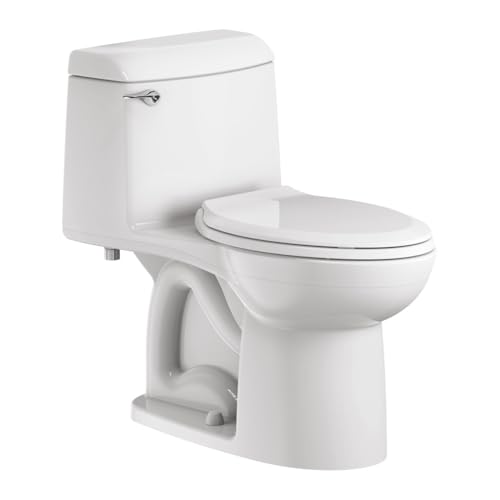
The Champion 4 has earned its reputation as a near-indestructible gravity-flush toilet by pairing the widest fully-glazed trapway of any gravity-flush model -- 4 inches -- with a tower-style flush valve and EverClean antimicrobial surface, consistently earning MaP's top 1,000-gram score.
The Champion 4 uses a 3-inch tower flush valve rather than the traditional 2-inch flapper, which delivers a faster, more forceful water release into the bowl. Combined with the 2-3/8-inch fully-glazed trapway, the result is a flushing pathway roughly four times wider than many competitors -- a geometry that explains why it sustains a perfect MaP score across multiple independent test rounds.
At 1.6 GPF, the Champion 4 does use more water than WaterSense-certified alternatives. For households in water-restricted regions, or where utility rebates require WaterSense labeling, consider the American Standard Cadet 3 at 1.28 GPF, which also earns a 1,000 MaP score. That said, owner reviews across thousands of verified purchases consistently rate the Champion 4 among the most clog-free toilets available.
The 2-3/8-inch trapway is the Champion 4's defining feature. No other gravity-flush residential toilet matches this diameter in combination with a fully-glazed interior. For older homes with narrow drain lines or households with young children who are hard on plumbing, this toilet removes the practical risk of chronic blockages.
The TOTO Drake II achieves what many buyers consider the ideal balance: EPA WaterSense certification at 1.28 GPF and a perfect 1,000-gram MaP score, enabled by TOTO's Double Cyclone flush technology and a fully-glazed 2-1/8 inch trapway with CEFIONTECT ion-barrier glaze.
TOTO's Double Cyclone system replaces the traditional rim holes used on most toilets with two nozzles that direct water in a rotational pattern, creating centrifugal rinsing action across the entire bowl surface. This design simultaneously improves bowl coverage and reduces the number of hard-to-clean crevices under the rim -- a practical benefit that owner reviews frequently mention alongside flushing performance.
The Drake II consistently appears at the top of plumber recommendation surveys and aggregated owner ratings. Its two-piece design does require occasional inspection of the tank-to-bowl connection, but replacement parts are widely stocked and the Drake platform has been in production long enough that every component is easy to source. For households prioritizing both water savings and no-clog reliability, the Drake II is a benchmark choice.
TOTO engineered the Drake II to prove that 1.28 GPF and a 1,000-gram MaP score are not mutually exclusive. The Double Cyclone flush does the work that extra water volume was previously used to accomplish. This is the toilet most plumbers recommend when customers ask for the most reliable single-flush model at WaterSense-compliant volumes.
The TOTO UltraMax II delivers the same Double Cyclone flush system and 1,000-gram MaP score as the Drake II in a seamless one-piece body that eliminates the tank-to-bowl joint and reduces cleaning surfaces -- the preferred configuration for modern master bathrooms.
The UltraMax II's one-piece design makes it roughly 15 percent quieter than the equivalent two-piece Drake II -- a meaningful distinction in bathrooms adjacent to bedrooms. The unit ships as a single vitreous china piece, which means no risk of the slow leaks that can develop at two-piece tank connections over years of use.
Owner reviews consistently rate the UltraMax II among the best-built toilets in residential use, with common praise for the clean silhouette and ease of cleaning the exterior. The Double Cyclone flush system performs identically to the Drake II platform, so buyers are paying primarily for the one-piece form factor and marginally quieter operation.
If the Drake II's MaP performance is the target and budget allows, the UltraMax II provides the same flushing mechanics in a cleaner, lower-maintenance package. For renovation projects where the toilet is a design focal point, the one-piece profile justifies the price difference.

The TOTO Aquia IV is a dual-flush one-piece toilet that achieves the 1,000-gram MaP score on its full 1.0 GPF flush, with a 0.8 GPF option for liquid waste -- making it among the most water-efficient high-MaP toilets available in the residential market.
Achieving a 1,000-gram MaP score at 1.0 GPF is a significant engineering accomplishment. The Aquia IV uses a refined version of TOTO's Double Cyclone system optimized for lower water volumes, channeling flow through two directed nozzles that maintain rotational velocity even with less total water behind each flush. The result is a toilet that qualifies for rebates in drought-restricted states while delivering the same solid waste clearance as models using 60 percent more water.
For households in California, Colorado, or other high-restriction water districts, the Aquia IV's 1.0/0.8 GPF split can generate meaningful utility bill reductions over a decade of use. The dual-flush concept is also straightforward to use once the button positions are learned: press the smaller section for liquid, the larger for solid waste.
The Aquia IV represents TOTO at its most efficient. Achieving MaP 1,000 at 1.0 GPF puts it in a category of one in the gravity-flush market. For water-restricted regions or eco-conscious buyers, this is the dual-flush toilet that eliminates the usual trade-off between water savings and flushing confidence.

The Cadet 3 achieves a 1,000-gram MaP score at 1.28 GPF with a 3-inch tower flush valve and fully-glazed trapway, making it the most accessible price point for buyers who need both EPA WaterSense certification and maximum MaP performance.
American Standard's Cadet 3 platform has been in production for over a decade, giving it a large base of owner feedback and readily available replacement parts. The tower flush valve design eliminates the flapper -- the most commonly replaced toilet part -- which reduces long-term maintenance cost. Owner reviews highlight the Cadet 3 as a reliable, no-surprises toilet that delivers on its MaP score in daily household use.
The Cadet 3 is also available in a FloWise configuration, which is WaterSense certified at 1.28 GPF. For buyers comparing it to the TOTO Drake II, the primary trade-off is TOTO's Double Cyclone rimless system vs. American Standard's EverClean rim-feed design -- both achieve 1,000-gram MaP, but the rimless approach is easier to keep clean long-term.
The Cadet 3 is the answer to "what's the most powerful toilet we can buy without spending extra for TOTO or Kohler?" It achieves the same maximum MaP score as models at twice the price, with a proven reliability record from one of the longest-standing American plumbing brands.
The Kohler Cimarron with AquaPiston canister flush technology achieves a 1,000-gram MaP score at 1.28 GPF, bringing Kohler's premium flushing mechanics to a mid-range price point with EPA WaterSense certification and a clean elongated bowl profile.
Kohler's AquaPiston canister allows water to enter the bowl from all 360 degrees around the canister perimeter rather than only from one direction as in a traditional flapper, which Kohler claims delivers a more uniform and forceful bowl rinse. The Cimarron's 1,000-gram MaP score validates that the flush is effective. Kohler also backs the vitreous china body with a lifetime limited warranty, a coverage period that exceeds most competitors.
For comparison, the Kohler Highline Classic at 1.28 GPF earns an 800-gram MaP score -- not the maximum. Buyers specifically seeking Kohler's best-performing gravity-flush model should target the Cimarron rather than the Highline to ensure 1,000-gram performance. For more detail on how these models compare, see our guide on Kohler toilet models compared.
Kohler's Cimarron punches above its class. The AquaPiston canister improves on a traditional flapper without requiring the premium pricing of Kohler's high-end Intelligent Toilet or Veil lines, and the lifetime china warranty provides long-term peace of mind.
The Gerber Viper achieves a 1,000-gram MaP score at 1.28 GPF with the widest fully-glazed trapway in the WaterSense category at 2-3/8 inches -- a spec often chosen by plumbing contractors for its proven clog resistance in high-use applications.
Gerber is a brand more often specified by plumbing contractors than discovered by retail consumers, which keeps it from appearing in most comparison roundups despite its MaP performance. The Viper's 2-3/8 inch fully-glazed trapway is narrower than the Champion 4's 4-inch passage but wider than any competitor in the WaterSense tier, giving it an edge in clog resistance at efficient water volumes.
Plumbing professionals who prioritize trapway geometry over brand recognition often specify the Gerber Viper for its reliable combination of MaP 1,000, WaterSense compliance, and the widest glazed trapway available at 1.28 GPF.
Gallons per flush (GPF) sets the water volume available to clear waste, but MaP scores demonstrate that engineering design -- trapway diameter, flush valve type, and water delivery geometry -- can compensate for lower water volumes. Multiple toilets at 1.28 GPF achieve the same 1,000-gram MaP score as older 1.6 GPF models, meaning GPF alone does not predict flushing power in modern designs.
The common assumption that lower GPF always means weaker flushing is outdated. The 1.6 GPF standard was set by the Energy Policy Act of 1992, replacing 3.5 and 5 GPF toilets that were indeed more powerful in raw volume terms. When water-efficiency mandates pushed manufacturers toward 1.28 GPF in the 2000s, early models did underperform. However, flush valve redesigns -- tower-style valves, canister flappers, and rimless nozzle systems -- restored flushing power with less water.
Today, the most accurate way to compare flushing power across different GPF ratings is to consult MaP scores directly. A 1.28 GPF toilet scoring 1,000 grams clears more waste reliably than a 1.6 GPF toilet scoring 600 grams. The TOTO Aquia IV's 1.0 GPF full flush achieving 1,000 MaP grams is an extreme example of how far engineering advances have decoupled water volume from flushing effectiveness.
Where GPF does matter independently is in annual water consumption. A household flushing five times per day will use approximately 2,336 gallons per year at 1.28 GPF versus 2,920 gallons at 1.6 GPF -- a savings of roughly 584 gallons annually. Multiplied across a two-bathroom household over ten years, this adds up to real utility cost differences, particularly in regions with tiered water pricing.
When comparing toilets across different GPF ratings, always lead with the MaP score rather than the GPF number. The MaP score tells you what actually happens when the toilet is flushed. GPF tells you how much water is used -- a secondary consideration once you have confirmed MaP performance meets your household's needs.
A fully-glazed trapway of 2 inches or larger significantly reduces clogging in standard residential use, with most 1,000-gram MaP toilets featuring trapways of 2-1/8 to 2-3/8 inches. The American Standard Champion 4's 2-3/8-inch trapway is uniquely large among gravity-flush models, while the Gerber Viper's 2-3/8 inch fully-glazed passage is the widest in the WaterSense category. Glaze quality matters equally -- an unglazed trapway of any diameter accumulates waste material that a glazed passage of the same diameter would pass cleanly.
The trapway is the S-curve passage inside the toilet bowl that waste travels through after a flush. Its diameter and surface finish determine whether solid waste clears completely or partially lodges. A nominal 2-inch trapway diameter with a fully glazed interior performs better than a 2-3/8 inch passage with rough, unfinished ceramic -- the glaze reduces friction and prevents soft material from adhering during transit.
Manufacturers sometimes advertise trapway diameter without specifying whether it is fully glazed. A practical check: look for the phrase "fully glazed trapway" in the product specifications. TOTO, American Standard (Champion 4 and Cadet 3), and Gerber all use fully-glazed trapways on their high-MaP models. The combination of maximum MaP score and fully glazed trapway is the strongest indicator of real-world clog resistance.
For households with older galvanized or 3-inch-diameter drain lines, trapway diameter matters more than in homes with modern 4-inch ABS or PVC drains. The wider the trapway, the more tolerance for restricted downstream conditions. This is one reason plumbers often recommend the Champion 4 -- or the Gerber Viper at WaterSense volumes -- for older construction. You can also read more on this topic in our article on clog-resistant toilets.
Tower-style flush valves and rimless dual-nozzle systems (like TOTO's Double Cyclone) consistently produce the most reliable flushing performance in MaP testing because they release water faster and more uniformly than traditional flappers. Pressure-assist systems (Sloan Flushmate) produce higher peak velocity but add noise and mechanical complexity. Among gravity-fed options, tower flush valves with fully-glazed trapways achieve the most consistent MaP 1,000 scores across multiple test brands.
There are four dominant flush technologies in residential toilets, each with different performance profiles:
Traditional flapper valve: The standard design in most lower-priced toilets. A rubber flapper lifts when the flush handle is pressed, releasing tank water into the bowl. Flapper wear is the leading cause of toilet maintenance issues. A deteriorated flapper reduces flush force and creates phantom running -- both common performance complaints in owner reviews. Flapper-based toilets can achieve high MaP scores but require the flapper to maintain its seal integrity.
Tower / piston flush valve: Used by American Standard (Champion 4, Cadet 3) and Gerber (Viper). A tower of water rises from the valve seat when the flush is triggered, opening 360 degrees of water flow into the bowl simultaneously. This delivers a faster, higher-volume water release than a flapper. Tower valves have no rubber seal to deteriorate in the same way, reducing maintenance concerns. Multiple 1,000-gram MaP toilets use this technology.
Canister flush valve (AquaPiston): Kohler's design. A cylindrical canister lifts to allow 360-degree water entry into the bowl, similar in concept to the tower valve. Kohler claims 90 percent less friction than a traditional flapper on the flush stroke. The canister seal does require eventual replacement but generally lasts longer than a flapper.
Dual nozzle / rimless (Double Cyclone): TOTO's proprietary technology. Rather than releasing water through rim holes around the bowl perimeter, two nozzles direct water in a rotational pattern that covers the entire bowl surface. This system achieves 1,000-gram MaP performance at 1.28 GPF and below, and eliminates rim holes as areas where mineral deposits and bacteria accumulate.
For households prioritizing long-term maintenance-free operation, tower valves and canister systems have the advantage over traditional flappers. For households prioritizing bowl cleanliness and water efficiency together, TOTO's Double Cyclone rim-free system is the most advanced option. See our full article on toilet flush valve types for a deeper breakdown.
Flush valve type is rarely mentioned by retailers but is one of the most meaningful long-term performance factors. A tower valve toilet with a 1,000-gram MaP score and no rubber flapper to replace will deliver more consistent flushing over a decade than a flapper-based toilet with the same MaP score on day one.
No. EPA WaterSense certification confirms a toilet uses no more than 1.28 GPF but does not evaluate flushing effectiveness. WaterSense-labeled toilets must pass a basic waste-removal test, but the threshold is lower than MaP's full 1,000-gram benchmark. A WaterSense toilet scoring 500 grams on MaP testing is water-efficient but weak at flushing -- always check the MaP score separately when evaluating WaterSense models.
EPA WaterSense was introduced in 2006 to identify toilets meeting the 1.28 GPF efficiency threshold. The WaterSense specification does include a basic performance requirement -- toilets must demonstrate waste removal in a laboratory test -- but this performance requirement is not equivalent to the MaP protocol and does not guarantee a specific MaP gram score.
In practice, the vast majority of WaterSense toilets from major manufacturers have been submitted for MaP testing and have scores available at map-testing.com. The best-performing WaterSense toilets -- TOTO Drake II, TOTO UltraMax II, Kohler Cimarron, American Standard Cadet 3, Gerber Viper -- all achieve 1,000-gram MaP scores. But there are WaterSense-labeled toilets from lesser-known brands that score 400-600 grams on MaP, which would make them prone to clogging in normal household use.
The practical recommendation: use WaterSense as a first filter (to confirm water efficiency), then verify the MaP score on map-testing.com to confirm flushing effectiveness. Toilets that earn both WaterSense certification and a 1,000-gram MaP score represent the top tier of the current market. For a full guide on how these standards interact, see our article on WaterSense toilet requirements explained.
It means the toilet successfully cleared 1,000 grams (1 kilogram) of standardized soybean-paste waste surrogate on all 15 required test flushes. This is the maximum possible score in the MaP protocol and is also called MaP Premium.
A 500-gram score is considered adequate for low-use applications such as guest bathrooms or powder rooms with minimal daily use. For a primary or family bathroom, most plumbing experts recommend a minimum of 800 grams, with 1,000 grams preferred for households with high daily use or older plumbing.
MaP scores are published publicly at map-testing.com. You can search by manufacturer, model name, or model number. The database covers thousands of toilet models from all major brands.
Not necessarily. Multiple 1.28 GPF toilets achieve the maximum 1,000-gram MaP score, the same as the best 1.6 GPF models. The TOTO Aquia IV achieves 1,000 MaP grams at just 1.0 GPF. Flush technology and trapway design matter more than water volume in modern toilets.
A fully-glazed trapway has a smooth ceramic coating applied to the interior of the waste passage, reducing friction and preventing waste material from adhering during transit. Toilets with unglazed or partially-glazed trapways are more prone to accumulating buildup that eventually causes clogs, regardless of their nominal diameter.
The Champion 4 remains the top choice specifically for clog resistance due to its 2-3/8-inch fully-glazed trapway -- the widest of any gravity-flush residential toilet. However, it uses 1.6 GPF and is not WaterSense certified. For households needing both maximum clog resistance and water efficiency, the Gerber Viper at 1.28 GPF offers the widest trapway in the WaterSense category alongside a 1,000-gram MaP score.
The original Drake uses a traditional rim-feed design with an E-Max flush system at 1.28 GPF and achieves high MaP scores. The Drake II upgrades to TOTO's Double Cyclone technology, which replaces rim holes with two nozzles for rotational bowl coverage, reducing cleaning effort while maintaining the 1,000-gram MaP score. The Drake II's rimless design also eliminates the hard-to-clean rim channel.
CEFIONTECT (also called SanaGloss) is TOTO's proprietary ion-barrier glaze applied to the bowl and trapway surfaces. The glaze creates a smooth surface at a microscopic level that inhibits waste and bacteria from adhering. It is included on most Drake II and UltraMax II configurations and contributes to both flush efficiency and bowl cleanliness between cleanings.
Kohler's AquaPiston is a canister-style flush valve that lifts vertically to open 360 degrees of water flow into the bowl simultaneously, compared to a hinged flapper that opens sequentially from one side. Kohler claims this reduces friction by 90 percent on the flush stroke, producing a more uniform and forceful water delivery. Kohler uses AquaPiston in the Cimarron, Highline, and other mid-to-upper-range models.
On the full (solid waste) flush, the best dual-flush models match single-flush performance. The TOTO Aquia IV achieves 1,000 grams on its 1.0 GPF full flush. The Woodbridge T-0001 earns 800 grams on MaP testing. Not all dual-flush toilets reach the top tier, so always verify the MaP score for the full flush rather than assuming dual-flush equals weaker performance.
The Woodbridge T-0001 earns an 800-gram MaP score at 1.28 GPF, which is solid performance for most households and meets WaterSense requirements. It is not a 1,000-gram MaP performer, so households with higher clog risk may prefer the TOTO Aquia IV or American Standard Cadet 3 in the same one-piece category.
The Kohler Highline Classic at 1.28 GPF achieves an 800-gram MaP score, which is adequate for standard use but not the maximum 1,000-gram level. Buyers who want a Kohler toilet with a 1,000-gram MaP score should consider the Kohler Cimarron (1.28 GPF) instead.
The TOTO Aquia IV achieves the maximum 1,000-gram MaP score on its full flush at just 1.0 GPF, making it the most water-efficient 1,000-gram MaP toilet available. The TOTO Drake II and Kohler Cimarron achieve 1,000 MaP at 1.28 GPF and represent strong efficiency-performance combinations at more accessible prices.
Pressure-assist toilets (which use pressurized air to force water into the bowl) produce a louder, higher-velocity flush that effectively prevents clogs and waste from sticking to the bowl. However, modern gravity-flush toilets with tower valves and large glazed trapways now match pressure-assist performance on MaP testing. Pressure-assist units are typically louder, more expensive to repair, and less common in residential settings.
A tower flush valve (used in American Standard Champion 4, Cadet 3, and Gerber Viper) works by lifting a cylindrical column away from a seat, opening a 360-degree water passage simultaneously. A flapper opens sequentially from one hinge point, limiting peak flow rate. Tower valves deliver a faster initial water surge into the bowl, which contributes to higher MaP scores, and they have no rubber seal to deteriorate in the way a flapper does.
A traditional rubber flapper should be inspected every 2-3 years and typically replaced every 5-7 years, depending on water chemistry. Chloramine-treated municipal water degrades rubber more rapidly than chlorine-treated water. Tower valves and canister-style valves last longer but may require seal replacement every 7-10 years. Phantom running (toilet that refills on its own) is a reliable indicator that a flapper or seal needs replacement.
Bowl shape does not directly affect MaP score, as MaP testing evaluates waste removal through the trapway regardless of bowl dimensions. Elongated bowls are slightly longer (2 inches longer than round) and may distribute water differently across the bowl surface, but the primary flushing determinants remain the flush valve, trapway diameter, and water delivery system rather than bowl shape.
Swiss Madison toilets, including the Ivy, typically achieve 800-gram MaP scores at 1.28 GPF. This is a solid mid-tier result suitable for average household use, though it falls below the 1,000-gram maximum achieved by TOTO, American Standard, Kohler Cimarron, and Gerber in the same water volume category. Swiss Madison is known for contemporary design at accessible prices rather than leading-edge flushing performance.
Yes. The three most common causes are: flapper wear reducing flush valve opening speed; mineral scale accumulation in rim jets or nozzles restricting water flow; and fill valve malfunction reducing tank water level below the marked waterline. Cleaning rim jets with an Allen wrench and vinegar, replacing a worn flapper, and ensuring tank water fills to the correct level all restore original flushing performance.
Comfort height (also called ADA height or right height) refers to toilets with a rim height of 16-18 inches, compared to standard 14-15 inch toilets. Height has no effect on flushing performance or MaP scores. Comfort height toilets are designed to ease sitting and standing, particularly for taller adults and users with mobility considerations.
For households that need the absolute most powerful gravity flush without concern for water volume, the American Standard Champion 4 is unmatched with its 2-3/8-inch trapway and 1,000-gram MaP score at 1.6 GPF. For households that want the maximum MaP score within EPA WaterSense limits, the TOTO Drake II and TOTO UltraMax II represent the benchmark at 1.28 GPF. The TOTO Aquia IV sets the efficiency record, reaching 1,000 MaP grams at just 1.0 GPF full flush. Mid-range buyers who want 1,000-gram MaP performance at WaterSense volumes without premium pricing should consider the American Standard Cadet 3 or Kohler Cimarron. Whatever your budget or water-efficiency target, a verified MaP score remains the most reliable predictor of long-term, clog-free flushing in daily use.
How we rank & our data sources
We do not run physical lab tests. Rankings are built from published, verifiable data and real owner feedback, never paid placement.
Researched by Marcus Bell · Last updated August 14, 2026 · Our review method
Learn what the toilet float does, how it controls water level in the tank, and how to diagnose and fix a float…
Read the guideLearn what a toilet flapper does, how it controls every flush, why it fails, and how to diagnose and replace a worn…
Read the guideToilet bowl water rising or dropping on its own? Learn the most likely causes, a step by step diagnosis, and the fixes…
Read the guide