
Why Toilet Trapways Are Curved Like an S
Toilets4.6
Learn why toilet trapways curve like an S, how each bend blocks sewer gas, and what the shape means for clogs and…
Read the guideToilets present two distinct hazards to young children: drowning risk for toddlers who can topple head-first into as little as two inches of standing water, and chronic flushing of objects that cause expensive clogs. This guide covers every practical method to lock down a toilet, from lid locks and slow-close seats to choosing a toilet with a clog-resistant trapway design that handles the inevitable flush of a rubber duck without calling a plumber.
For toddlers under 3, a pinch-release toilet lid lock such as the Safety 1st model is the single most important measure because it prevents drowning in as little as 2 inches of standing water. Pair it with a slow-close seat and a high-MaP toilet rated above 800 grams to survive the inevitable object flush without clogging.
Every year in the United States, the Consumer Product Safety Commission records toilet-related drowning incidents involving children under the age of 5. The risk is not intuitive to most parents because toilets hold only a few gallons of water, but toddlers between 9 and 24 months are top-heavy, have limited neck strength, and cannot push themselves back upright once their head dips below the water surface. The water level does not need to be deep for this to become a life-threatening situation.
Beyond drowning, children 2 to 7 years old create a second category of problem: they flush things. Toy cars, wipes labeled as "flushable," small plastic figurines, washcloths, and large wads of paper routinely go down the bowl and jam the trapway. Depending on which toilet you own, one of these flushes might clear right through or it might cost several hundred dollars to remove via augering or partial disassembly. Knowing the MaP (Maximum Performance) score and trapway diameter of your toilet before an incident helps you understand how worried to be.
This guide addresses both hazard categories in order of priority, from physical locks and barriers to toilet seat selection to the hardware upgrade question of whether your toilet itself is a liability. We also name specific products with verified specifications rather than generic advice. If you are also evaluating which toilet to buy for a home with children, our roundup of best toilets for large families covers high-MaP, clog-resistant models ranked for heavy daily use.
The drowning risk is specific to the developmental window between approximately 9 months and 3 years. During this period children are mobile, curious, and tall enough to lean over the bowl rim, but lack the trunk and arm strength to right themselves from a face-down position in water. By the time a parent or caregiver responds, even a brief submersion can cause injury. The American Academy of Pediatrics classifies toilets as a standing-water drowning hazard alongside buckets and bathtubs.
After age 3, most children are physically capable of pulling themselves back upright, so the drowning risk drops sharply. The hazard profile then shifts to water quality (toilet water is not sterile), accidental flushing of valuables or clog-causing objects, and injury from lid slamming. Each developmental stage calls for slightly different countermeasures, which the sections below address in sequence.
Lid locks divide into two main mechanical types. Pinch-release locks use a plastic bracket that attaches to the side of the lid and hooks over the seat, releasing only when an adult simultaneously compresses two pressure points that a small child cannot coordinate. These work on the vast majority of standard two-piece toilets with a flat or gently curved lid. They install in minutes with no tools and no permanent modification to the toilet.
Adhesive-strap locks stick a flexible strap from the back of the lid to the toilet tank. They are easier to install but the adhesive bond weakens with the humidity and temperature swings in a bathroom, and a determined toddler can sometimes work the strap free after the bond degrades. They also leave an adhesive residue on the porcelain that can be difficult to clean fully. For toilets with unusual lid shapes, such as one-piece designs like the TOTO UltraMax II or the Woodbridge T-0001, verify fitment before purchasing, because the integrated tank-to-lid profile on some one-piece models makes standard strap-style locks easier to apply than pinch-release clamps.
A third option is a toilet seat with a built-in integrated latch, sometimes called a lockable toilet seat. These replace the entire seat and lid assembly and include a keyed or button latch mechanism built into the seat hinge. They cost more than an add-on lock but eliminate the separate accessory, look cleaner, and cannot fall off or be pried loose since the latch is structural. Kohler and American Standard both offer seats with integrated slow-close and soft-seat properties, and several aftermarket manufacturers produce lockable versions compatible with Kohler Highline and American Standard Cadet 3 rough-in dimensions.
For families with children under 2, a pinch-release lid lock on every toilet in the house is non-negotiable and should be installed the day a baby becomes mobile. Do not wait until a near-miss. The cost is under $15 per toilet and the installation takes 3 minutes. If you have a one-piece toilet where the lid curves awkwardly, test-fit the lock in the store or buy from a retailer with free returns, because not every lock fits every lid profile.
Standard toilet seats can drop with enough force to pinch fingers, and this is the most common toilet-related injury in children aged 2 to 6 based on emergency room visit data compiled by the CPSC. Slow-close seats use a dampened stainless-steel hinge mechanism that controls the descent rate of both the seat and lid, preventing the slam entirely. Any slow-close seat eliminates this risk regardless of price point.
For the potty-training stage, family seats with a built-in child ring are a practical design. The inner ring flips up for adult use and down to create a smaller, supported seat opening that keeps a small child from falling into the bowl. This eliminates the separate plastic potty trainer that lives on the floor and creates a tripping hazard. Bemis, Mayfair, and Kohler all manufacture family seats in this style. Kohler's family seats are sized to fit their Cimarron, Highline, and Santa Rosa bowls and are sold with matching slow-close hardware.
Seat stability matters more in family households than it tends to be marketed. A loose toilet seat that shifts under a child creates a fall risk. Seats using STA-TITE or similar bolt-expansion hardware grip the toilet mounting holes from below and do not loosen with repeated use the way standard nuts do. If your current seat wobbles, tightening the bolts is a 2-minute fix, but replacing with a STA-TITE or Quick-Release seat solves the problem permanently.
Layer one in any serious childproofing system is the bathroom door itself. A child who cannot enter the bathroom cannot reach the toilet, and this is always the simplest and most reliable control. A hook-and-eye latch mounted at adult shoulder height on the outside of the bathroom door frame takes about 10 minutes to install and costs under $5. A child under 5 cannot reach it even on tiptoe.
If the bathroom door is also used by older children or guests who need access without going to a parent, a second option is a standard privacy knob with the lock engaged when adults are not present, since the privacy lock on a standard door knob requires a quarter-turn of a small tool to open from the outside, enough to stop a toddler. Sliding door alarms are a lower-friction option that allow free access but sound an alert when a child opens the door unsupervised.
No single barrier should be relied upon alone. A toddler who sees an older sibling operate a door latch will sometimes replicate the motion within days. The value of layering the door latch with the toilet lid lock is that defeating both simultaneously is beyond the capability of a child under 3 even if one layer is breached.
MaP testing, conducted independently by Veritec Consulting and Koeller and Company, measures how many grams of solid waste a toilet can clear in a single flush. The test uses a standardized soybean paste to simulate waste and rates toilets from roughly 250 grams to a maximum of 1,000 grams. A toilet with a MaP score of 1,000 grams has cleared the maximum test load and represents the upper limit of flushing power at a given gallon-per-flush rating. In a household with young children, a 1,000-gram MaP toilet is not a luxury choice; it is a practical safety net because small items that enter the trapway during a flush are far more likely to be carried through than to catch and block.
Trapway design compounds the MaP advantage. A fully glazed trapway has a smooth, ceramic-glazed interior surface that reduces the friction coefficient for objects moving through. An unglazed or partially glazed trapway has a rougher surface that increases the chance of an object catching and forming the anchor point for a clog. TOTO's CeFiONtect glaze extends this concept further, applying an ion barrier coating to the entire bowl and trapway surface so that organic matter and foreign objects slide through with less resistance. The American Standard Champion 4 uses a 2-3/8-inch trapway opening, the widest in the standard gravity-flush category, which physically allows larger objects to pass than a 2-inch trapway design.
None of these features make a toilet childproof in the sense that any object can pass. A child's shoe, a full toy car, or a wipes packet will clog any consumer toilet regardless of MaP score or trapway diameter. The practical benefit of a high-performance trapway is that the small objects that inevitably enter the bowl during the years when children are curious about flushing, a small figurine, a coin, a golf ball, clear more often without incident, reducing the frequency and severity of service calls. For a full comparison of toilets ranked by clog resistance, see our guide to the best flushing toilets.
| Product / Feature | Best For | MaP Score | GPF | Key Child-Safety Spec | Check Price |
|---|---|---|---|---|---|
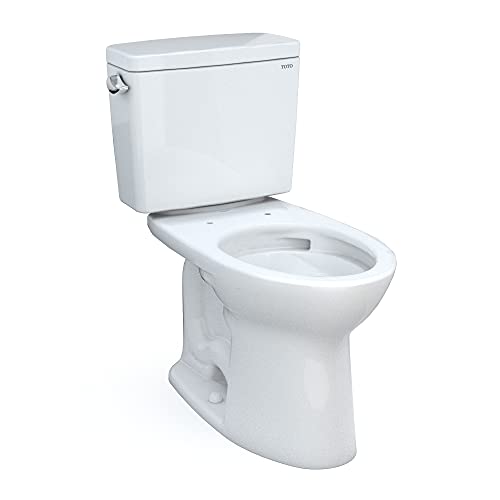
| TOTO Drake (CST744SL) | Clog resistance | 1,000 g | 1.6 | Fully glazed 2-1/8" trapway, CeFiONtect glaze option | Check price |
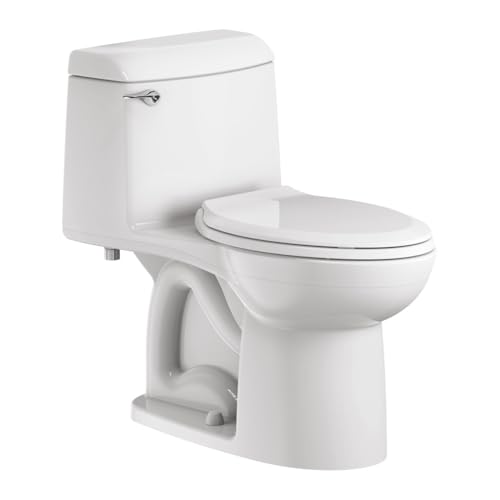
| American Standard Champion 4 | Largest trapway | 1,000 g | 1.6 | 2-3/8" trapway, widest in gravity class | Check price |
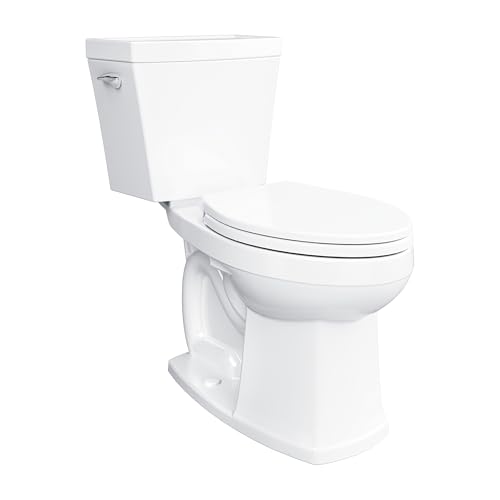
| Kohler Cimarron | Family seat compatibility | 1,000 g | 1.28 | AquaPiston canister flush, EPA WaterSense | Check price |
| Gerber Avalanche | Budget clog-resistant | 1,000 g | 1.28 | Fully glazed 2-1/8" trapway | Check price |
| TOTO Aquia IV | Water savings + power | 1,000 g | 1.0 / 0.8 | Dual flush, TORNADO FLUSH, CeFiONtect available | Check price |
| Woodbridge T-0001 | One-piece ease of cleaning | 800 g | 1.28 / 0.9 | Skirted trapway, slow-close seat included | Check price |
| Safety 1st Lid Lock | Drowning prevention | N/A | N/A | Pinch-release, fits most standard toilet lids | Check price |
| Kohler Family Toilet Seat | Potty training transition | N/A | N/A | Built-in child ring, slow-close, STA-TITE hardware | Check price |
This is the highest-priority step for households with children under 3. Purchase a pinch-release lid lock rated to ASTM F1233 or equivalent child-resistance standards. Attach the bracket to the side of the lid per the manufacturer instructions, typically a snap-on clip with no tools required. Confirm the lid will not open when a child pushes down or pulls on the lid with both hands, but opens immediately when you press the two adult-release points simultaneously. Test every toilet in the house, including guest bathrooms.
If your current seat does not have a slow-close mechanism, replace it. A slow-close seat prevents the lid slam that accounts for the majority of child finger injuries from toilets. If you are in the potty-training window, look for a family seat with a built-in child ring sized for your bowl shape (elongated vs. round). Confirm the new seat uses secure bolt hardware such as STA-TITE or similar expansion-anchor fasteners so it does not shift laterally.
Mount a hook-and-eye latch or similar high-mount latch on the outside of each bathroom door at adult shoulder height. This creates the outer perimeter layer and is especially important for bathrooms that are adjacent to children's play areas or bedrooms. If the layout makes a latch impractical, consider a sliding door alarm as a secondary alert system rather than a physical barrier.
Look up the MaP score for your toilet model at map-testing.com. If your toilet is rated below 600 grams, it is more vulnerable to clogs from flushed objects than higher-rated models. This does not require an immediate replacement, but if you are due for a toilet upgrade in a bathroom used by young children, prioritize a model with a MaP rating of 1,000 grams and a fully glazed trapway. Our guide to best toilets for home includes specifications and MaP scores for the top-ranked models.
Toilet bowl cleaners, tank drop-in tablets, and rim hangers contain chemicals including hydrochloric acid, sodium hypochlorite, and chlorine compounds that are acutely toxic if ingested by a child. Store all cleaning products in a locked cabinet or on a high shelf, and remove in-tank drop-in tablets if a child has access to the tank. A child can lift a toilet tank lid with minimal effort, and the concentrated cleaning solution inside a drop-in tab is far more hazardous than toilet water.
Children frequently pick up toilet brushes and plungers, both of which carry pathogens. Store the brush in a closed holder rather than an open cup, and keep the plunger behind the toilet or in a cabinet rather than on the floor beside it. A flange plunger stored in a drip tray is a lower-spread option than a cup plunger resting directly on the floor.
Families who complete all six steps often report that the toilet stops being a household emergency source entirely. The lid lock and door latch together remove the drowning risk. The slow-close seat eliminates the finger-slam injury. And the clog-resistant toilet absorbs the inevitable object flushes without a $150 service call. The total cost of the non-toilet hardware, lid lock, seat upgrade, and door latch, is typically under $60. That is a modest investment against the alternative outcomes.
If you are selecting a new toilet for a bathroom used by children, the three models below represent the strongest combination of clog resistance, ease of cleaning, and family-friendly features. Each links to the current Amazon listing for price and availability.
The TOTO Drake achieves a MaP score of 1,000 grams with a 1.6 GPF gravity flush and a fully glazed 2-1/8-inch trapway, making it the most field-proven clog-resistant toilet in its price class for family households with young children who flush things they should not.
Check price on AmazonAmerican Standard's 2-3/8-inch EverClean trapway is the widest in the gravity-flush category, and its 1,000-gram MaP score confirms it performs at the top of the scale, a combination that makes it physically harder for a flushed object to catch and block than any comparably priced alternative.
Check price on AmazonKohler's Cimarron reaches 1,000-gram MaP at just 1.28 GPF, qualifies for the EPA WaterSense program, and is designed to accept Kohler's own family seat with built-in child ring, making it the easiest transition toilet for families moving through the potty-training stage.
Check price on AmazonThe toilet bowl and its vicinity is often a storage point for products that carry serious chemical hazards for children. Hydrochloric acid-based cleaners, sold under brand names like The Works and Lysol Power, can cause severe mucosal burns on ingestion even in small quantities. Sodium hypochlorite cleaners (bleach-based products) cause similar injury and release toxic chlorine gas when mixed with any other cleaning product. Enzyme-based cleaners are the safest alternative but still not appropriate for child ingestion.
In-tank drop-in tabs are a specific concern that many parents overlook. A child can lift a toilet tank lid and access the dissolving tablet or the highly concentrated water around it. Removing drop-in tabs from all tanks in a household with young children is a simple and often-overlooked safety measure. If you use a tank additive for cleaning, switch to an under-rim hanger that attaches above the water line rather than dissolving in the tank water.
Organize bathroom cleaning storage around the principle that nothing at or below child shoulder height is accessible to a toddler. Under-sink cabinets should be locked with a two-step child latch unless they contain only items that are not hazardous. The Consumer Product Safety Commission recommends keeping the Poison Control number (1-800-222-1222 in the US) accessible at all times in households with young children.
Toilet height is frequently debated in the context of family bathrooms, and the framing usually centers on whether a comfort-height bowl is appropriate for children. Comfort height toilets, also called chair height or ADA height, measure 17 to 19 inches from floor to seat surface. They are easier for adults, seniors, and taller children to use, and they match the knee angle for adults in a way that standard 14 to 15 inch bowls do not.
For potty training specifically, neither height is ideal without a step stool. A child aged 2 to 4 cannot safely mount a 17-inch comfort bowl without assistance, but also cannot comfortably reach a 14-inch standard bowl without a step stool to keep their feet from dangling uncomfortably during use. A dedicated child-height potty with a separate toddler seat for the adult toilet is the most practical approach during the training period, after which the child grows into the toilet height within a year or two.
If your household spans both young children and seniors or mobility-impaired adults, the comfort height toilet is the stronger choice for the adults in the household, and the children will grow into it. Our guide to best toilets for seniors covers comfort-height models with the accessibility and safety features relevant to that demographic, many of which overlap with family-friendly design.
The first question to answer after a child flushes an object is whether it has cleared the trapway or is caught in it. Flush once (and only once) and watch the drain. If the bowl drains cleanly and the water level drops to its normal resting level, the object has moved through the trapway. It may still be in the branch drain or main drain line where it could eventually cause a clog days later, particularly if it is flat or angular. If nothing happens in the next few days, it has cleared to the sewer and you do not need to take further action.
If the bowl drains slowly or backs up, the object is lodged in the trapway. Do not flush a second time. Turn off the water supply valve behind the toilet and use a closet auger to reach the blockage. A closet auger has a protective sleeve that prevents it from scratching the porcelain as the cable snakes through the trapway. If the auger hooks the object, crank in reverse to pull it back out. If the object is soft (a wad of paper towels, a cloth diaper insert, a bar of soap), the auger often breaks it up enough for a flush to clear. If the object is rigid and the auger cannot hook or move it, a plumber may need to pull the toilet off the flange to retrieve it from below.
Toilets with a 2-3/8-inch trapway opening, such as the American Standard Champion 4, physically allow larger objects to pass than toilets with a 2-inch opening. This does not guarantee object passage but reduces the probability of a catch. If your household experiences repeated foreign-object clogs and your current toilet has a narrow trapway, upgrading to a wider-trapway model eliminates a significant fraction of the service-call risk. See our comparison of best toilets for the full field of MaP-verified options.
The single step that prevents the most foreign-object clogs in family bathrooms is keeping the toilet lid down at all times, enforced by the lid lock during toddler years and by habit afterward. Most objects reach the bowl because they fall in from the counter or vanity, not because a child deliberately places them. A closed lid, always, eliminates that entire category of incident before it starts.
Most child safety experts recommend keeping a toilet lid lock in place until the child is reliably 3 years old and has demonstrated they cannot fall head-first into the bowl. By age 3, most children have the trunk strength and coordination to pull themselves upright. During potty training, the lock is typically removed during supervised training sessions and reinstalled afterward. If a younger sibling will soon enter the mobile toddler stage, keep the lock in place.
Most pinch-release lid locks are designed for standard two-piece toilets with a flat or gently curved lid surface. One-piece toilets, where the tank and lid form a single integrated curve, may not accept the standard bracket-clip style. Test fitment before purchasing, or look for a strap-style lock that adheres to the side of the lid and tank. Manufacturers like Safety 1st and Munchkin publish compatibility lists on their product pages.
Yes. Slow-close seats cost modestly more than standard seats but eliminate lid-slam injury entirely, and they also extend the life of the seat and hinge hardware by preventing the stress of repeated hard closures. Given that slow-close seats are now the norm in mid-range and above toilet seat products, there is no practical reason to own a non-slow-close seat in a household with children.
A family toilet seat includes a full-size adult seat and lid plus a smaller inner ring that flips down to create a reduced opening for children during potty training. This eliminates the separate plastic potty trainer that takes up floor space and is a tripping hazard. If you are actively in the potty training stage, a family seat on the adult toilet simplifies the process and is more hygienic than a floor-level potty. Kohler, Bemis, and Mayfair each offer elongated and round versions in slow-close configurations.
A MaP score of 800 grams is the practical minimum for a bathroom used by children under 10, and 1,000 grams is preferable. A toilet rated at 1,000 grams has cleared the maximum test load in MaP testing and represents the best commercially available performance at its GPF rating. MaP scores for specific models are publicly searchable at map-testing.com and are listed in the product specifications for TOTO, Kohler, American Standard, and Gerber models.
Yes, this is a documented hazard. Toddlers between 9 and 24 months are top-heavy and can fall head-first into the bowl from the rim. Once face-down in water, they lack the trunk and arm strength to right themselves. The water depth does not need to be significant for this to be dangerous; the bowl's standing water is sufficient. A toilet lid lock prevents this risk entirely when a child is under 3 years old.
In-tank cleaning tablets dissolve slowly in the tank water, creating a concentrated cleaning solution. A child can lift a toilet tank lid without adult assistance, and the chemical concentration in the tank water around a dissolving tablet is significantly higher than toilet bowl water. Remove in-tank tablets from all tanks accessible to toddlers and switch to an under-rim hanger, a rim clip, or a bowl cleaner applied during cleaning sessions, then flushed away.
Wipes labeled "flushable" do not break down at the same rate as toilet paper and are a leading cause of toilet and sewer line clogs. Whether a single wipe clogs your toilet depends on your trapway diameter and flush power. On a 1,000-gram MaP toilet with a fully glazed trapway, a single wipe often passes through. On an older low-flush model with a narrow trapway, it is more likely to catch. If the flush runs slow after the wipe, do not flush again; use a closet auger.
Enzyme-based cleaners are the least acutely toxic toilet cleaners available. Products using natural enzyme formulas, citric acid, or oxygen bleach are significantly safer than hydrochloric acid or sodium hypochlorite-based cleaners if accidentally contacted by a child. However, no toilet bowl cleaner is safe for ingestion, and all should be stored locked, well above child reach, regardless of formula.
Both types work equally well from a flushing-performance standpoint given equivalent MaP scores. One-piece toilets are easier to clean because there is no seam between tank and bowl where bacteria can accumulate, which is an advantage in a bathroom used by young children. However, they are heavier and more expensive. Two-piece toilets like the TOTO Drake and Kohler Cimarron offer 1,000-gram MaP performance at lower cost and easier installation.
A step stool for toilet use should be non-slip on both the bottom (to prevent sliding on tile) and the top surface (to prevent slipping feet), and should be tall enough to bring the child's feet to a supported position when seated on the adult toilet. The Squatty Potty and similar platforms also provide a physiologically better elimination posture than feet dangling. Avoid stools that wobble or fold, which create a fall risk on tile or vinyl flooring.
Hard plastic training rings resting on the inside rim of a vitreous china bowl can cause micro-scratches over time, particularly if the ring shifts during use. Choose training rings with foam or rubber edge padding rather than bare plastic edges. If you are using a freestanding potty ring, store it off the toilet between uses rather than leaving it resting inside the bowl.
The pinch-release lid lock is designed so adults and older children over approximately 6 can learn to operate it, while toddlers under 3 cannot. Teach older children to operate the lock during installation and confirm they can do it reliably. The door latch requires more consideration: a high hook-and-eye latch that an 8-year-old can reach will still be out of reach for a 2-year-old. If there is a significant age gap, a latch slightly lower than adult shoulder height may allow older children access while still blocking a toddler.
There are no standard consumer toilets marketed specifically for child-only bathrooms at retail. The closest category is reduced-height or junior-height toilets intended for schools and pediatric settings, which sit at approximately 11 to 14 inches seat height. These are available through commercial plumbing suppliers rather than retail channels. For home use, the practical solution is an adult toilet with a step stool and a family seat with a child ring, which scales from potty training through full adult use.
EPA WaterSense certifies toilets that use 1.28 GPF or less and meet a minimum MaP performance threshold. WaterSense is relevant to childproofing indirectly: WaterSense toilets built by TOTO, Kohler, and American Standard in recent years also tend to have high-performance trapways and glazed surfaces that reduce clog incidence from flushed objects. Choosing a WaterSense-certified toilet does not guarantee a 1,000-gram MaP score, so verify the MaP rating separately at map-testing.com.
Both achieve 1,000-gram MaP and are widely regarded as the two most clog-resistant toilets in the standard gravity-flush category. The American Standard Champion 4 has the wider trapway opening (2-3/8 inches vs. 2-1/8 inches for the Drake), which gives it a slight edge for passing larger objects. The TOTO Drake has the option of CeFiONtect glaze, which keeps the bowl cleaner with less scrubbing. For a child's bathroom, the Champion 4 is the stronger choice strictly on trapway size; for a shared family bath where bowl hygiene is a priority, the TOTO Drake with CeFiONtect is worth the premium. See our full comparison in the best toilets for large families guide.
Dual flush toilets offer a 0.8 to 0.9 GPF half-flush for liquid waste and a 1.28 GPF full flush for solid waste. Children frequently use the wrong button, defaulting to the lower-volume half flush for situations that require the full flush. This results in more frequent incomplete clears. If you opt for a dual flush model, choose one with a MaP rating of 1,000 grams on the full flush like the TOTO Aquia IV, so the full flush is powerful enough to compensate for any misuse.
Skirted toilets, where the trapway is enclosed behind a smooth flat exterior panel, are easier to clean because there are no exposed trapway curves to scrub. Cleaning ease matters more in a child's bathroom because the area around the toilet base requires more frequent disinfecting. The Woodbridge T-0001 and the TOTO Vespin II both feature skirted designs. Skirted toilets are not inherently safer than exposed-trapway models, but the cleaning advantage is real for family households.
The Gerber Avalanche is a two-piece gravity-flush toilet that achieves a MaP score of 1,000 grams at 1.28 GPF with a fully glazed 2-1/8-inch trapway, qualifying it for EPA WaterSense certification. It is one of the most clog-resistant toilets at its price tier and is a strong choice for a children's bathroom when budget is a constraint. It lacks the optional ionic glaze of TOTO's CeFiONtect line but performs at the same MaP level as the Drake at a lower retail price.
Childproofing a toilet is a layered process that starts with a pinch-release lid lock for drowning prevention, adds a slow-close seat with a family child ring for potty training, and extends to a door latch for outer-perimeter control. The toilet itself is the final layer: a TOTO Drake or American Standard Champion 4 with a 1,000-gram MaP score and a fully glazed trapway handles the flushed objects that will inevitably occur in a household with young children far better than an older low-performance model. None of these steps is complex or expensive individually, but applied together they address every meaningful toilet-related hazard in a family bathroom.
Learn why toilet trapways curve like an S, how each bend blocks sewer gas, and what the shape means for clogs and…
Read the guideAlmost every US toilet has a left-side handle. Learn the plumbing and mechanical reasons behind the layout and when it actually changes.
Read the guideHome toilets rely on tanks because household water lines lack the pressure that public flushometer systems use to flush straight from the…
Read the guide