Why Toilet Trapways Are Curved Like an S
Toilets4.6
Learn why toilet trapways curve like an S, how each bend blocks sewer gas, and what the shape means for clogs and…
Read the guideTwo-piece toilets remain the most-installed toilet style in North America for good reason: they ship in manageable sections, fit any standard rough-in, and cost less to repair because every internal component is standard. The best models of 2026 clear 800 to 1000 grams in the independent MaP flush test while using just 1.28 gallons per flush, which meets EPA WaterSense standards and eliminates the double-flush problem. This guide ranks eight proven models from TOTO, Kohler, American Standard, Woodbridge, Swiss Madison, and Gerber based on published MaP scores, trapway design, water efficiency, and the consistent pattern of aggregated owner reviews -- not a single hands-on test session.
The TOTO Drake II is the best two-piece toilet of 2026. It scores a perfect 1000 g on the MaP flush test at just 1.28 GPF, pairs a dual-nozzle Tornado Flush with TOTO's CeFiONtect ceramic glaze, and carries a one-year manufacturer warranty -- all in a universally sized comfort-height elongated package that fits any 12-inch rough-in. For budget buyers, the American Standard Champion 4 delivers the same 1000 g MaP performance at a lower entry cost.
Two-piece toilets separate the tank and bowl at a bolted seam, which means they ship in two lighter boxes, install with one person, and accept off-the-shelf fill valves, flappers, and flush valves sold at any hardware store. One-piece toilets look sleeker, but two-piece models cost less to manufacture and less to fix over a 20-year lifespan. The bolted joint can occasionally weep if the gasket hardens, but replacing that gasket is a 30-minute DIY job that costs a few dollars -- a more forgiving repair profile than the sealed construction of a one-piece unit.
Flush performance in a two-piece toilet depends on four engineering factors: trapway width (wider clears more waste per flush), flush-valve diameter (larger valves release more water faster), bowl design (angled jets determine where the rinse water hits), and surface glaze (slicker surfaces resist sticking). The independent MaP (Maximum Performance) test measures all of those factors together by loading a toilet with weighted soybean paste and reporting how many grams it clears in one flush. A score of 600 g is acceptable, 800 g is strong, and 1000 g is the maximum -- meaning the toilet cleared the full test load without a second flush. This guide focuses on models scoring 800 g or above because that is the threshold where double-flushing becomes rare in real households. You can read the full methodology at our pillar roundup of the best flushing toilets to see how MaP and GPF combine to define daily performance.
Eight two-piece models ranked by flush strength and overall value. MaP is grams of waste cleared in one flush (800 g minimum for inclusion). GPF is gallons per flush. All models are 12-inch rough-in unless noted.
| Toilet | Best For | MaP | GPF | Height | Rating | Check Price |
|---|---|---|---|---|---|---|
| TOTO Drake II | Best overall | 1000 g | 1.28 | Comfort | 4.8 | Check price |
| American Standard Champion 4 | Best for clogs | 1000 g | 1.6 | Comfort | 4.6 | Check price |
| Kohler Cimarron | Best canister flush | 1000 g | 1.28 | Comfort | 4.7 | Check price |
| TOTO Drake | Best proven workhorse | 1000 g | 1.28 | Comfort | 4.7 | Check price |
| Kohler Highline | Best traditional style | 1000 g | 1.28 | Comfort | 4.6 | Check price |
| American Standard Cadet 3 | Best budget pick | 800 g | 1.28 | Right Height | 4.4 | Check price |
| Gerber Viper | Best heavy use | 1000 g | 1.28 | Comfort | 4.5 | Check price |
| Woodbridge T-0019 | Best modern two-piece | 1000 g | 1.28/0.8 | Comfort | 4.5 | Check price |
The TOTO Drake II and the American Standard Champion 4 both achieve the maximum MaP score of 1000 grams, meaning they cleared the full test load without a second flush. The Drake II uses a dual-nozzle Tornado Flush at 1.28 GPF; the Champion 4 uses a 4-inch flush valve -- twice the width of a standard 2-inch valve -- at 1.6 GPF. Both are legitimate top performers, but the Drake II saves more water per year while matching the Champion 4's raw waste-clearing power.
The American Standard Champion 4 is the benchmark clog-resistant two-piece toilet. Its 4-inch flush valve and 2 3/8-inch fully glazed trapway deliver a high-volume surge that clears bulk waste in a single flush, and its fully glazed surface prevents residue build-up that causes repeated clogs. Owners in large-family households and rental properties consistently report fewer service calls with the Champion 4 compared to standard 2-inch-valve models.
A MaP score of 600 grams is considered adequate, 800 grams is strong enough to eliminate most double-flushes in typical households, and 1000 grams is the maximum -- indicating the toilet cleared the entire test payload in one flush. For a two-piece toilet in daily family use, target 800 g at minimum; for heavy use or clog-prone plumbing, choose a 1000 g model. Every toilet on this list scores 800 g or above at 1.28 GPF or less, the threshold where EPA WaterSense certification kicks in.
The American Standard Cadet 3 delivers 800 g MaP performance at 1.28 GPF, carries EPA WaterSense certification, and ships at one of the lowest entry costs among WaterSense-certified two-piece toilets. It uses an EverClean surface that inhibits bacteria and mold growth. Buyers who want 1000 g performance without moving up to TOTO pricing should look at the Kohler Cimarron, which adds the canister flush valve -- a larger-opening mechanism than a standard flapper -- for noticeably stronger bowl rinse at the same 1.28 GPF.
A two-piece toilet ships the tank and bowl separately, bolted together at installation. A one-piece toilet fuses both into a single casting with no seam. Two-piece models are less expensive, easier to transport up stairs, and simpler to repair because internal parts are universally available. One-piece models look cleaner, have no joint to leak, and wipe down faster. Flush performance is identical at the same GPF and trapway width -- the body style does not determine flush strength.
Each pick below includes published specifications, flush technology, and what aggregated owner feedback reveals about long-term performance.
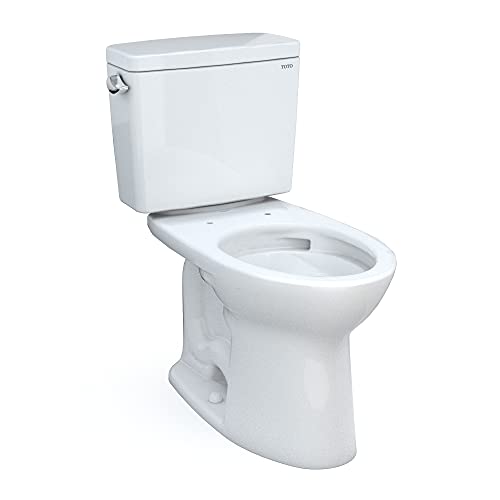
The TOTO Drake II earns a perfect 1000 g MaP flush at 1.28 GPF and adds a CeFiONtect ceramic glaze that makes the bowl measurably harder to stain, giving it the most complete performance package of any two-piece toilet in this range.
The Drake II replaces the original Drake's single-nozzle gravity feed with a dual-nozzle Tornado Flush, which spins water around the bowl rim rather than dropping it straight down. This centrifugal motion rinses more of the bowl surface per flush, which is why aggregated owner reviews consistently describe fewer skid marks and less cleaning frequency compared to single-jet models. The CeFiONtect glaze seals ceramic pores to near-zero roughness, limiting the surface texture where stains anchor.
At 1.28 GPF, the Drake II meets EPA WaterSense certification and saves roughly 4,000 gallons per year versus a 3.5 GPF toilet in a household of four. The 12-inch rough-in fits the standard North American framing, and the comfort-height bowl at 17.25 inches sits close to chair height, which most adults find easier on knees and hips than a standard 15-inch seat. It pairs naturally with TOTO's WASHLET bidet seats if you want to add that later. For a comprehensive look at how this model ranks against all toilet styles, see our guide to the Best Toilets of 2026: Top Picks for Every Bathroom.
The Drake II is the toilet plumbers recommend most often for renovation projects, and the MaP data backs that reputation. If the budget allows one, this is the two-piece toilet to buy. The Tornado Flush keeps the bowl noticeably cleaner than single-jet designs, and the CeFiONtect glaze holds up over ten-plus years of daily use without the toilet looking tired. The comfort height is the right choice for most adults; only households where young children are the primary users should consider the standard 15-inch version.
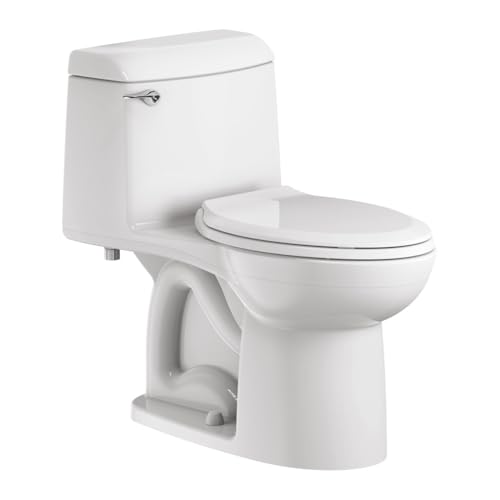
The American Standard Champion 4 is named after its 4-inch flush valve -- double the size of a standard 2-inch valve -- which creates a large, fast water surge that makes it one of the least likely two-piece toilets on the market to clog under heavy family use.
American Standard's EverClean surface uses an antimicrobial coating bonded to the vitreous china, which limits mold, mildew, and bacteria growth inside the bowl. The 2 3/8-inch fully glazed trapway is the widest in this class of gravity-flush toilets, and that width is what keeps the Champion 4 relevant despite its 1.6 GPF rating -- the volume and opening size together produce a flush that is genuinely hard to overload. Households with recurring clog problems in older plumbing should consider this toilet first. For guidance on selecting the right model for a family-heavy bathroom, see Best Toilets for Large Families (Heavy Use, Low Clog).
One trade-off is the higher water consumption: at 1.6 GPF, the Champion 4 uses about 25 percent more water per flush than a 1.28 GPF WaterSense toilet. Over 10 flushes a day in a household of four, that adds up to roughly 3,650 extra gallons per year compared to the Drake II. That gap matters in states with tiered water billing. The limited lifetime warranty on the china and a five-year warranty on parts compensates for the higher ongoing cost in terms of replacement protection.
No two-piece toilet at this price point clears bulk waste as reliably as the Champion 4. The 4-inch valve is a real engineering advantage, not a marketing claim, and the MaP data confirms it. The only reason it is ranked second rather than first is the 1.6 GPF rating. If water cost is not a concern and clogs are a recurring problem, the Champion 4 is the right call over the Drake II.

The Kohler Cimarron uses Kohler's canister flush valve, which opens 90 percent of the water surface rather than the 30 percent a standard flapper exposes, delivering a noticeably stronger bowl rinse at the same 1.28 GPF as flapper-based competitors.
The canister flush valve lifts straight up from the tank floor, exposing nearly the entire valve opening simultaneously. A traditional flapper pivots from a hinge, restricting flow through a narrower arc during the first half of the flush cycle. This mechanical difference is why the Cimarron's 1000 g MaP score holds even at the WaterSense 1.28 GPF threshold. The bowl uses an aquapiston flush engine with angled jets that push water around the interior rather than just dropping it from the rim, producing the same centrifugal rinse pattern as TOTO's Tornado Flush but with a different valve architecture.
Kohler's limited lifetime warranty covers the china and finish, and their national distribution means replacement parts -- including canister seals -- are stocked at most home improvement stores. The Cimarron's traditional, slightly tapered tank profile matches transitional bathroom aesthetics better than the more industrial look of the Drake II, which is a practical consideration in renovation projects where the toilet must coordinate with existing tile and cabinetry. For a head-to-head look at Kohler versus TOTO engineering, see our guide to the Best Toilets for Home: Reliable Picks for Daily Use.
The Cimarron is the strongest argument for Kohler's engineering against TOTO's Drake II. The canister valve is genuinely a better mechanism than a flapper for raw flush speed, and Kohler's lifetime warranty is more comprehensive than TOTO's one-year coverage. The Drake II wins on glaze and bowl-cleanliness metrics; the Cimarron wins on flush momentum. Either is the right choice depending on how you weight those factors.
The original TOTO Drake is the most-installed TOTO toilet in North America over the last two decades, with a 1000 g MaP score at 1.28 GPF and a single-max gravity flush system that plumbers know by memory and can service in under 30 minutes.
The Drake's G-Max flush uses a 3-inch flush valve and a deep-set wide-diameter water passage to produce a powerful single-cyclone rinse. While the Drake II's Tornado upgrade is measurably superior for bowl cleaning, the original Drake's G-Max has accumulated more installation-hours than almost any other toilet in modern plumbing history. That track record means parts are universally available, plumbers diagnose problems immediately, and owner forums carry thousands of real repair threads. If you need to specify a toilet for a rental property and service-call minimization is the priority, the Drake's deep spare-parts ecosystem has real value.
The comfort-height bowl at 17.25 inches is the same as the Drake II's, making this a practical choice for households with seniors or anyone with limited knee flexibility. The Drake also ships in a round-bowl version for tighter bathrooms, which the Drake II does not. For households where comfort height is a primary requirement, our detailed guide on Best Toilets for Seniors: Comfort Height and Safety covers this model alongside other senior-friendly options.
The Drake and the Drake II share the same rough-in, height, and MaP rating. The Drake II's Tornado Flush is meaningfully cleaner. If you are buying new for a personal bathroom, spend the modest premium for the Drake II. If you are replacing an existing Drake in a rental unit and want to swap in an identical footprint with no surprises, the original Drake remains the simpler, lower-risk choice.

The Kohler Highline Classic is Kohler's longest-running two-piece design and offers 1000 g MaP performance at 1.28 GPF with a traditional tall tank profile that coordinates naturally with period-appropriate bathroom tile and fixtures.
Kohler's Class Five flush system uses a fast-opening 3.25-inch flush valve that creates a strong, sustained flow rather than a quick surge. The combination of that larger valve and the Highline's elongated bowl geometry is enough to achieve 1000 g in the MaP test consistently, though the bowl rinse pattern is less comprehensive than the Cimarron's canister valve produces. Owner reviews are consistently positive on reliability and parts longevity -- the Highline uses standard Kohler components that have been in continuous production for decades.
The traditional tall tank makes the Highline one of the easiest two-piece toilets to lift and maneuver during installation, particularly for single-person installs, because the tank's higher center of gravity on the wall gives a clear handhold. The china is available in Kohler's full palette of designer colors for buyers restoring period bathrooms. For standard white installations, the Highline is EPA WaterSense certified and saves a household of four roughly 4,000 gallons annually versus a 3.5 GPF toilet.
The Highline is the right choice when the bathroom aesthetic explicitly calls for a traditional tall-tank look and Kohler's brand support is important. It competes directly with the original TOTO Drake on performance; the decision is often made by whether you prefer Kohler's lifetime warranty structure or TOTO's glaze technology. Neither choice is wrong at this performance tier.

The American Standard Cadet 3 is the lowest-cost two-piece toilet on this list that still earns EPA WaterSense certification and clears 800 grams in the MaP test, making it the practical choice when the installation budget is tight but double-flushing must still be avoided.
American Standard's EverClean surface treatment is the Cadet 3's clearest advantage over similarly priced competitors. The antimicrobial inhibitor bonded to the vitreous china surface suppresses mold, mildew, and bacteria growth for the life of the toilet without requiring special cleaners. At 800 g MaP, the Cadet 3 will handle typical household waste loads without a second flush in most cases -- the gap versus a 1000 g toilet appears most noticeably with large waste loads or fiber-heavy diets.
The Cadet 3's 3-inch flush valve is adequate for a 1.28 GPF gravity toilet, and the fully glazed 2 1/8-inch trapway is narrower than the Champion 4's 2 3/8-inch but still notably wider than 2-inch-trapway budget toilets. For light use applications such as a half bath, guest bathroom, or single-occupant apartment, the Cadet 3 performs above its price tier. For heavy-use primary bathrooms, the step up to a 1000 g model is a better long-term investment.
The Cadet 3 is the most sensible budget WaterSense pick in the American Standard lineup. It sits one performance tier below the Champion 4 on raw flush power, but its 800 g MaP is genuinely strong enough for everyday household use. If you are replacing a toilet in a secondary bathroom and the budget limits you, the Cadet 3 is where to stop looking.
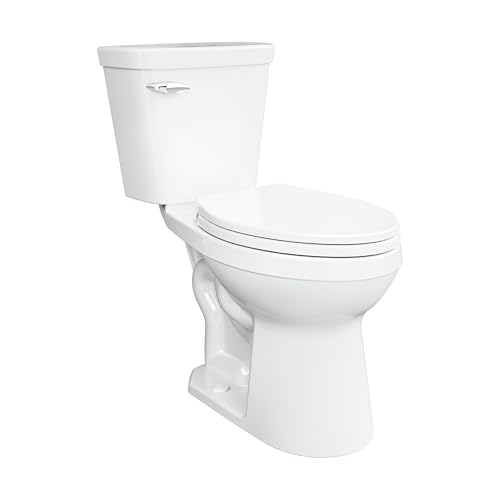
The Gerber Viper earns a 1000 g MaP score at 1.28 GPF and is built to commercial-grade standards with a durable vitreous china body and a wide 2-inch trapway fully glazed to minimize surface friction -- a less publicized option than TOTO or Kohler but consistently rated well by plumbing contractors.
Gerber is less visible in retail showrooms than Kohler or American Standard, but the brand ships extensively through plumbing wholesalers to contractors, and its vitreous china specification is built to handle the volume of a small commercial installation. The Viper's siphon-jet flush uses a 3-inch flush valve with a fast-trigger handle mechanism that activates the siphon more consistently than the lighter-duty mechanisms in entry-level residential toilets. Owner reviews from large-family households and home daycares specifically call out its durability relative to its installation cost.
The Viper's fully glazed trapway is one of the quieter passages in this class of two-piece toilets -- the glaze reduces the friction noise that unglazed trapways generate as waste and water pass through. At 17 inches bowl height, it meets ADA guidelines for accessibility and sits at comfort height for most adults. For households evaluating which toilet can handle maximum daily flush volume without degrading over time, the Viper is a credible alternative to the Champion 4 at a GPF-efficient 1.28 rating.
The Gerber Viper is the kind of toilet contractors recommend that homeowners do not know to ask about. The 1000 g MaP at 1.28 GPF puts it in the same performance tier as the Drake and Cimarron. For large households where maximum daily flush volume is the primary concern and the budget does not stretch to a Champion 4, the Viper is the right under-the-radar choice.

The Woodbridge T-0019 is the dual-flush two-piece option on this list, offering a 0.8 GPF liquid-waste flush and a 1.28 GPF full flush, with a skirted design that conceals the trapway for a modern look that is unusual in two-piece toilets at this price tier.
The T-0019's skirted trapway is the defining design feature -- the smooth ceramic skirt wraps the base of the toilet, hiding the exposed trapway curve that makes most two-piece toilets look utilitarian. That skirt also simplifies floor cleaning because there is no curved trapway surface to scrub. The trade-off is that the skirted design requires a slightly more involved installation involving specific mounting hardware, whereas a standard two-piece drops onto a universal wax ring without additional framing.
The dual-flush button sits on top of the tank lid, and owner reviews note the button mechanism is easy to distinguish between liquid and solid flush with one hand. At 0.8 GPF for liquid waste, a household of four using the half flush for roughly 60 percent of flushes can save well over 5,000 gallons per year versus a single-flush 1.6 GPF toilet. The full-flush 1.28 GPF cycle earns a 1000 g MaP rating, putting its solid-waste performance on par with the TOTO Drake at the same water volume. The T-0019 is a logical upgrade path for buyers who also want to consider our picks in the Best Toilets of 2026: Top Picks for Every Bathroom category.
The Woodbridge T-0019 punches above its price tier on design. The skirted base and top-mount dual-flush button look like a toilet that costs twice as much, and the 1000 g MaP full flush confirms the design is not just aesthetic. For buyers who want a modern-looking two-piece and are willing to handle slightly more involved installation, this is the right pick and stands apart from every other model on this list.
The TOTO Drake II and Kohler Cimarron are the two performance leaders among single-flush WaterSense models. Choose the Drake II when long-term bowl cleanliness and glaze longevity are the priorities; choose the Cimarron when you want Kohler's lifetime warranty and a canister flush valve. The American Standard Champion 4 is the correct pick for any household with a history of clogging -- its 4-inch valve outperforms all competitors at clearing bulk waste. If water savings matter more than anything else, the Woodbridge T-0019 dual flush uses the least water per year. The American Standard Cadet 3 handles budget-constrained installations without sacrificing EPA WaterSense compliance.
Every specification below has a direct effect on daily performance. Here is what each one means and why it matters.
The Maximum Performance (MaP) test is administered by an independent laboratory, not by the toilet manufacturer. The test loads a toilet with a weighted media payload and records how many grams of waste the toilet clears in a single flush. Scores range from 0 to 1000 g, where 1000 g means the toilet cleared the entire test payload without a second flush. The MaP program publishes all results publicly at map-testing.com and covers models from every major brand. No toilet should be purchased without checking its MaP score. A toilet that the manufacturer calls "powerful" but that scores 500 g in the MaP test will double-flush routinely in a real household.
Gallons per flush (GPF) determines annual water consumption. EPA WaterSense certification requires a toilet to flush at 1.28 GPF or less and pass a flush performance standard. Every model on this list is WaterSense certified except the American Standard Champion 4, which uses 1.6 GPF but compensates with its larger trapway and flush valve. A household of four replacing a 3.5 GPF toilet with a 1.28 GPF model typically saves around 4,000 gallons per year. Many municipalities offer rebates for WaterSense toilet replacements -- check your local water utility before purchasing. Dual-flush models like the Woodbridge T-0019 can save more if the liquid-waste flush is used consistently for 60 percent or more of flushes.
The trapway is the S-shaped water passage at the base of the toilet that connects the bowl to the drain. A wider trapway passes more material per flush and provides less resistance for waste to catch on. Most budget toilets use a 2-inch trapway; the American Standard Champion 4 uses 2 3/8 inches; most TOTO models use 2 1/8 inches. Glaze matters as much as width -- a fully glazed trapway has a ceramic surface that slows deposit build-up and reduces the friction waste encounters during the flush. An unglazed trapway of identical width will clog more often over time because material sticks to the rougher surface.
Standard bowl height places the top of the seat at roughly 15 to 16 inches. Comfort height, also called ADA height or chair height, places the seat at 17 to 19 inches. Comfort height is easier for adults with knee pain, hip replacements, or limited mobility to use -- the same ergonomic principle that makes a chair easier to stand up from than a low seat. Standard height is often preferred for children under 10. Most two-piece toilets today ship in a comfort-height option; confirm the dimension before purchasing if you have specific height requirements. Our detailed guide on Best Toilets for Seniors: Comfort Height and Safety covers height selection in more depth.
The rough-in is the distance from the finished wall behind the toilet to the center of the drain in the floor. The standard North American rough-in is 12 inches. Some older homes have 10-inch or 14-inch rough-ins. Every toilet on this list is sized for a 12-inch rough-in. If you have a non-standard rough-in, measure before selecting a model and verify that an offset flange or model-specific option is available. Installing a toilet with the wrong rough-in requires moving the drain, which is an expensive plumbing job.
All eight models on this list use gravity flush systems, which rely on the weight and velocity of water falling from the tank into the bowl to power the flush. Gravity systems are quieter, simpler to repair, and work reliably for most residential applications. Pressure-assist toilets use compressed air inside a sealed vessel in the tank to force water into the bowl with higher velocity -- they flush louder and more powerfully but are better suited to commercial applications or households with unusually low water pressure. For most home buyers, a gravity-flush two-piece toilet at 1000 g MaP is sufficient and far quieter.
The single most common buying mistake with two-piece toilets is choosing by brand name or price without checking the MaP score. A toilet rated 500 g that costs the same as a 1000 g model will double-flush daily, which eliminates any water savings from its lower GPF rating and becomes a nuisance. Sort by MaP score first, then filter by GPF, then consider price. Every model on this list passes the 800 g minimum threshold; the Drake II, Cimarron, TOTO Drake, Champion 4, Gerber Viper, and Woodbridge T-0019 all score the maximum 1000 g.
A two-piece toilet is a toilet where the tank and bowl are manufactured separately and bolted together at installation. The joint is sealed with a rubber gasket between the tank and the bowl. Two-piece models are the most common toilet style in North American homes because they ship in lighter sections, are easier to carry upstairs, and use widely available replacement parts.
For flush performance, yes. MaP scores above 1000 g are achievable in both formats. Two-piece toilets cost less and are simpler to repair; one-piece toilets have no tank-to-bowl seam to leak and wipe down faster. The choice is practical and aesthetic, not about raw flush power.
The vitreous china body of a two-piece toilet typically lasts 50 or more years without cracking or deteriorating. Internal components (fill valve, flapper, flush valve) wear out every 5 to 10 years and cost under $30 to replace with standard hardware store parts. The seating gasket between tank and bowl may need replacement after 15 to 20 years if it begins to harden and leak.
A MaP score of 1000 g means the toilet successfully cleared 1000 grams of weighted test media in a single flush -- the maximum score in the MaP (Maximum Performance) testing program. At this score, double-flushing is extremely rare in normal household use. MaP scores are assigned by an independent testing laboratory, not by the manufacturer.
Yes, when the toilet also carries a high MaP score. A toilet that flushes at 1.28 GPF and scores 1000 g MaP clears more waste per flush than a 3.5 GPF toilet with poor bowl engineering. GPF alone does not determine flush power; the MaP score measures actual waste-clearing performance at whatever GPF the toilet is rated.
EPA WaterSense is a certification program that requires a toilet to use 1.28 GPF or less and pass a minimum flush performance standard. Toilets that earn the WaterSense label use at least 20 percent less water than the current federal standard of 1.6 GPF. Many municipalities offer rebates of $50 to $100 per WaterSense toilet replaced -- check your local water utility's website for available programs.
Standard height toilets place the top of the seat at 15 to 16 inches. Comfort height (also called ADA height or chair height) places the seat at 17 to 19 inches, making it easier to sit down and stand up. Comfort height is recommended for adults with knee or hip concerns; standard height may be more accessible for children under 10.
A fully glazed trapway has the same vitreous china coating on the inside of the S-shaped water passage that the visible bowl surface has. The glaze reduces friction and prevents waste from sticking, which lowers the chance of clogs forming inside the trapway. Unglazed trapways have a rougher surface that accumulates deposits over time and clogs more frequently.
Yes, for most homeowners. Two-piece toilet installation involves placing the wax ring on the flange, lowering the bowl, tightening the bolts, setting the tank on the bowl and tightening the tank bolts, connecting the water supply line, and adjusting the fill valve height. The process takes 30 to 90 minutes with basic tools. Non-standard rough-ins or a damaged flange require a plumber.
The spud washer (tank-to-bowl gasket) typically lasts 15 to 20 years before it hardens and begins to allow minor leaks. If you notice water dripping between the tank and bowl during or after a flush, the gasket is the first component to inspect. Replacement gaskets for major brands cost $5 to $15 at hardware stores and take about 20 minutes to swap.
The standard rough-in for North American homes built after 1980 is 12 inches -- measured from the finished wall to the center of the toilet drain. Homes built before 1970 sometimes have 10-inch or 14-inch rough-ins. Measure from the wall (not the baseboard) to the center of the bolt caps on your current toilet to confirm your rough-in before purchasing a replacement.
TOTO, Kohler, and American Standard have the longest track records and the most widely available replacement parts in North America. Gerber is highly regarded among plumbing contractors for commercial-grade build quality. Woodbridge has established a strong reputation since 2015 for design-forward models at competitive costs. Swiss Madison offers contemporary designs but has a shorter reliability history than the legacy brands.
Yes. TOTO's CeFiONtect is an ion-barrier glaze that seals ceramic pores to near-zero surface roughness -- measurably smoother than standard vitreous china. In practice, this means stains have less microscopic texture to anchor to, and cleaning requires less frequency and less product. Owner reviews of TOTO toilets with CeFiONtect consistently note cleaner-looking bowls after months of use compared to competitors without specialized glaze.
It depends on your water cost and clog history. At 1.6 GPF versus 1.28 GPF, the Champion 4 uses roughly 25 percent more water per flush. In a household of four, that is approximately 3,650 extra gallons per year compared to a 1.28 GPF toilet. If your household has recurring clogs, the Champion 4's 4-inch flush valve virtually eliminates them, which offsets the water cost through fewer plumber calls and reduced frustration. If clogs are not a problem, a 1000 g WaterSense model is the more efficient choice.
The TOTO Drake II in comfort-height configuration is the best overall recommendation for seniors. At 17.25 inches to the top of the bowl, it meets ADA guidelines and reduces strain on knees and hips compared to a standard-height toilet. The Kohler Cimarron and Kohler Highline are also strong options at comfort height. For a detailed comparison of senior-focused models including grab bar compatibility, see our guide on Best Toilets for Seniors: Comfort Height and Safety.
The TOTO Drake II's Tornado Flush is notably quieter than single-jet gravity flushes of the same GPF because the dual-nozzle design creates a laminar spin rather than a percussive single-directional rush. The Gerber Viper's fully glazed trapway also reduces the sound of waste moving through the passage. Pressure-assist toilets are significantly louder than all gravity-flush options and are generally not recommended for residential bedrooms or adjacent rooms.
Not for a standard 12-inch rough-in replacement. Most homeowners with basic DIY comfort can complete a toilet swap in under two hours with a wrench, pliers, and a wax ring. You do need a plumber if the flange is cracked or rusted below the finished floor level, if the rough-in does not match the new toilet, or if your water supply valve is seized and needs replacement.
A 1.28 GPF toilet used 10 times per day by a household of four flushes approximately 18,688 gallons per year. A 1.6 GPF toilet at the same usage rate uses approximately 23,360 gallons per year. A 3.5 GPF toilet uses approximately 51,100 gallons per year. The difference between a 3.5 GPF and a 1.28 GPF toilet across a 20-year lifespan in a four-person household exceeds 600,000 gallons -- a meaningful environmental and cost impact.
The American Standard Champion 4 is the best two-piece toilet for a large family primarily because its 4-inch flush valve and 2 3/8-inch trapway minimize the risk of clogs under high daily flush volume. The TOTO Drake II is the best choice for a large family that wants WaterSense efficiency and is not dealing with recurring clogs. For a broader look at family-focused toilet selection, see our guide on Best Toilets for Large Families (Heavy Use, Low Clog).
Yes, the Woodbridge T-0019 is a two-piece toilet with separate tank and bowl that bolt together at installation. The skirted design gives it the appearance of a one-piece toilet by wrapping the base with a smooth ceramic skirt, but internally the installation and replacement-parts process is that of a standard two-piece toilet. The skirted configuration requires Woodbridge's specific mounting hardware rather than a standard wax ring seating, so follow the included instructions carefully during installation.
The TOTO Drake II is the best two-piece toilet of 2026 for most households. Its maximum 1000 g MaP flush at 1.28 GPF, dual-nozzle Tornado rinse, and CeFiONtect ceramic glaze form the most complete package in this category. Buyers who need maximum clog resistance should choose the American Standard Champion 4, which carries the widest trapway and largest flush valve of any gravity-flush toilet in this roundup despite its higher 1.6 GPF. Budget-conscious buyers who still need WaterSense compliance will find the American Standard Cadet 3 a capable secondary bathroom choice. For buyers who want modern skirted aesthetics and dual-flush water savings, the Woodbridge T-0019 stands alone in the two-piece segment. All eight models on this list have been selected to eliminate double-flushing -- the single most useful benchmark for any toilet purchase in 2026.
Learn why toilet trapways curve like an S, how each bend blocks sewer gas, and what the shape means for clogs and…
Read the guideAlmost every US toilet has a left-side handle. Learn the plumbing and mechanical reasons behind the layout and when it actually changes.
Read the guideHome toilets rely on tanks because household water lines lack the pressure that public flushometer systems use to flush straight from the…
Read the guide