Best Toilet Flush Valve: How to Choose the Right One
Plumbing4.6
Which is the best toilet flush valve? Compare 2-inch, 3-inch, adjustable, and canister flush valves by fit and flush power, plus how…
Read the guideA toilet plunger is the cheapest and fastest tool for clearing a clogged bowl, but only if it actually seals against the drain. The cup-and-flange style sold for toilets is shaped to fold a soft rubber flange into the bowl outlet, creating an airtight seal so each push and pull moves a powerful column of water and pressure through the trap, rather than the flat cup-style sink plunger most homes keep that simply slides off the curved porcelain. We ranked the best toilet plungers of 2026 by the strength and shape of the seal each one forms, the quality and flexibility of the rubber so it does not crack or harden, the design of the handle and grip, whether a drip tray or holder keeps it sanitary between uses, and the patterns across thousands of aggregated owner reviews, so you can buy one that breaks a clog on the first few plunges and fits your bowl without sorting through marketing on your own.
The best toilet plunger is the Korky 99-4A BeehiveMAX, an accordion-ribbed flange plunger whose tapered tip seals on round, elongated and modern high-efficiency bowls and folds away into a slim holder. For the best value, the Neiko 60166A leads, and the Simplehuman Toilet Plunger is the best design pick for a tidy, sanitary caddy.
A toilet plunger is the most-used and least-understood tool in any bathroom, and choosing the right one matters more than people expect. The flat red cup most homes own is a sink plunger; it is built to seal on a flat surface and slides uselessly off the curved opening of a toilet bowl. A true toilet plunger has either a soft rubber flange that folds out of the cup to fit the bowl outlet, or an accordion-style bellows that forces a hard burst of water through the trap. Getting an airtight seal is the entire game, because a plunger does not push a clog with the rubber itself; it moves a column of water that hammers the blockage loose, and without a seal that water simply splashes back at you.
We do not unclog toilets in a lab. Instead we compare published manufacturer specifications, the cup and flange geometry each model uses, the type and durometer of the rubber, the handle length and grip design, whether the plunger ships with a drip tray or caddy for sanitary storage, the fit across standard round, elongated and modern high-efficiency bowls, and the patterns across thousands of verified owner reviews. For plungers specifically we weighted four things above all else: the strength and reliability of the seal, since a plunger that will not seal is worthless; the quality of the rubber, because cheap flanges harden, crack and tear within a year; the leverage and comfort of the handle, which decides how much force you can apply; and how cleanly the plunger stores between uses, since a dripping plunger on the floor is the real reason people hate the tool. If you want the broadest performance-first ranking of the bowls these plungers clear, see our pillar guide to the best flushing toilets.
Every pick here had to form a genuine airtight seal on a real toilet bowl, not just a flat surface. We separated flange-cup plungers from accordion bellows plungers clearly, ranking each on its own terms so buyers know exactly what kind of force they are getting and how forgiving it will be to aim. We favored a soft, flexible flange or a deep cup that grips the curved outlet, rubber with enough flexibility to fold and seal yet enough durability to resist cracking and hardening, a handle long enough for leverage with a grip that does not slip when wet, and a drip tray, caddy or ventilated holder that keeps the plunger off the floor and dries it between uses. We weighted aggregated owner reports about seal strength, rubber that lasts and clog-clearing reliability over marketing language, and we do not accept payment for placement.
| Plunger | Best For | Type | Storage | Rating | Check Price |
|---|---|---|---|---|---|
| Korky 99-4A BeehiveMAX | Best overall | Flange tip | Holder | 4.7 | Check price |
| Neiko 60166A | Best value | Flange | Caddy | 4.6 | Check price |
| Simplehuman Toilet Plunger | Best design | Flange | Caddy | 4.6 | Check price |
| Master Plunger MP500 | Best heavy-duty | Accordion | Tray | 4.5 | Check price |
| OXO Good Grips Plunger | Best canister | Flange | Canister | 4.6 | Check price |
| ToiletShroom | Best for tough clogs | Squeegee | Wall mount | 4.4 | Check price |
| Mr. Clean Turbo Plunger | Best budget | Flange | Caddy | 4.4 | Check price |
| Korky 97-4A Max | Best for low-flush bowls | Flange tip | Holder | 4.5 | Check price |
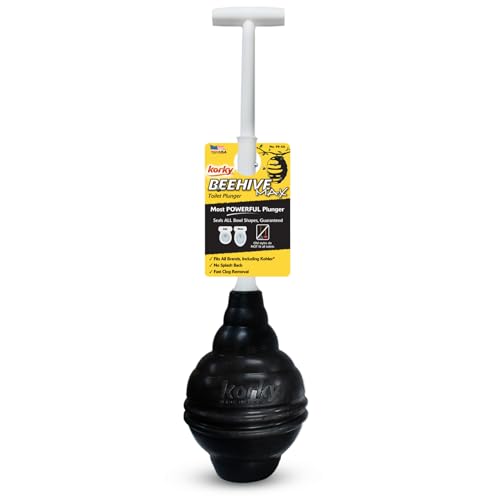
The Korky 99-4A BeehiveMAX is the plunger we recommend first because it solves the biggest frustration with the tool, getting a tight seal on different drain openings, with a tapered beehive tip that grips round, elongated and modern high-efficiency outlets equally well and a flexible rubber sleeve that folds away into a slim drip holder.
The BeehiveMAX takes the classic Korky flange design and tapers it into a stepped beehive shape, so the soft rubber tip can wedge into a narrow modern outlet or fold out to seal a wider one. That single feature is why it ranks above flat-cup plungers: most bowls today are high-efficiency designs with smaller, oddly shaped trapways, and a generic cup slides off them. The rubber is soft enough to mold to the porcelain for an airtight seal yet thick enough to push real water, the handle gives good leverage, and it ships with a slim holder that catches drips and keeps the plunger off the floor.
Owners consistently report that the BeehiveMAX seals on bowls where their old plunger failed, that it clears clogs in just a few plunges thanks to the strong seal, and that the holder is far tidier than a bare plunger leaning in the corner. The two limits are practical: the soft flange is not as raw-powerful as a hard accordion on a truly stubborn blockage, and buyers who grew up on a stiff black cup may need a plunge or two to trust the softer rubber. For an everyday plunger that fits virtually any toilet and stores cleanly, it is the standout, and it pairs naturally with the low-flush bowls in our guide to the best flushing toilets.
The BeehiveMAX is the plunger we point most buyers to, because the tapered tip seals on the modern high-efficiency bowls that defeat a flat cup, and it clears a clog in a few firm plunges rather than a frustrating ten. The included holder keeps it sanitary, which is half the battle with this tool. If you face genuinely brutal clogs you might want an accordion as a backup, but for one plunger that just works on any toilet, this is it.

The Neiko 60166A is the pick for a strong, no-nonsense flange plunger that comes with a ventilated caddy, pairing a deep heavy-duty rubber cup with a sturdy handle and a holder that hides and dries the plunger, all for the price of a fast-food meal.
The Neiko 60166A delivers the essentials a good plunger needs at a low price. Its deep rubber cup has a fold-out flange that tucks into the bowl outlet to form a seal on standard round and elongated bowls, the handle is sturdy enough to apply real force without flexing, and it ships with a ventilated caddy so the wet plunger drips dry and stays out of sight between uses. It skips the tapered beehive tip of the Korky picks, which is precisely why it costs less, while keeping the seal-and-store basics that matter most.
Owners value getting a plunger that seals well and comes with its own holder for so little money, and they report it clears typical clogs without drama and that the caddy is more sanitary than leaning the tool in a corner. The tradeoffs are that the standard cup is not as adaptable to narrow modern outlets as a tapered tip, and the caddy is functional rather than stylish. For a buyer who wants reliable sealing and tidy storage at the lowest sensible price, or who needs to equip several bathrooms at once, it is the standout value, and it suits the same shopper weighing our guide to the best drain snakes and augers of 2026 for the clogs a plunger cannot reach.
The Neiko 60166A is the plunger we recommend when value is the deciding factor, because it nails the two things that matter, a deep sealing cup and an included caddy, for a fraction of premium prices. You give up the tapered tip that helps on the newest low-flush bowls, but for standard round and elongated toilets it seals fine and stores clean. To outfit a whole house cheaply, buy two.
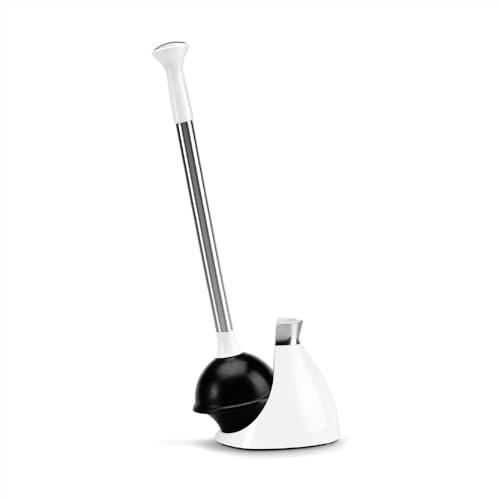
The Simplehuman Toilet Plunger is the pick for a tool you do not mind seeing in a nice bathroom, pairing a capable flange plunger with a sleek magnetic-collar caddy whose lid stays open as you lift the plunger and closes to hide it, with a steel handle that resists the rust and warping of cheap models.
Simplehuman built its name on well-engineered bathroom hardware, and the plunger carries that through. The flange cup seals on standard round and elongated bowls, but the design story is the caddy: a magnetic collar holds the plunger upright, the lid swings open automatically as you lift the handle and closes when you set it back, so the wet rubber is hidden and the whole unit stays tidy. The handle is stainless steel rather than plastic, so it resists the rusting and cracking that plague budget plungers, and the weighted base keeps the holder from tipping or sliding.
Owners praise how good the unit looks beside a toilet, the clever self-opening lid that means you never touch a dirty caddy, and the solid steel handle that feels a tier above plastic competitors. The tradeoffs are a higher price than the value picks and a seal that, while reliable, is tuned for everyday clogs rather than the brute force of an accordion. For a buyer who wants the plunger to disappear into a stylish bathroom and last for years, it is the standout design pick, and it suits the same shopper outfitting the bowls in our guide to the best flushing toilets.
The Simplehuman is the plunger we recommend when you care that the thing looks good and stays hidden, which matters in a guest bath or a small visible bathroom. The self-opening caddy lid means you never grab a grubby holder, and the steel handle outlasts plastic. You pay more and you are not buying an accordion's raw thrust, but for everyday clogs with a clean, discreet design, it is hard to beat.

The Master Plunger MP500 is the pick for the toughest clogs, using a hard accordion bellows that compresses to generate far more raw thrust than a soft flange, with a tapered nozzle that locks into the bowl outlet and a drip tray to manage the mess that brute force creates.
The MP500 trades forgiveness for raw power. Its accordion body is a stiff, ridged bellows that you compress with both hands, and because the rubber barely flexes, nearly all that force goes straight into the water column rather than being absorbed by a soft cup. The tapered front nozzle is sized to wedge into the bowl outlet for a strong seal, and a drip tray comes in the box to catch the runoff that aggressive plunging can produce. On a clog that defeats a standard flange plunger, that extra thrust is often what finally breaks it loose.
Owners reach for the MP500 when nothing else works, and they report it clears blockages that left a soft plunger useless, crediting the accordion's hard push. The tradeoffs are real: the stiff bellows is harder to seat cleanly, it can splash if you do not have a good seal before pushing, and the hard plastic-like rubber can be aggressive on older or thin porcelain. For a buyer who deals with frequent or severe clogs and wants maximum force on hand, it is the standout heavy-duty pick, and it pairs well with a backup tool from our guide to the best drain snakes and augers of 2026.
The MP500 is the plunger we recommend when soft flange models keep failing on the clogs you actually get. The accordion bellows puts almost all your force into the water, so it breaks blockages a forgiving cup cannot. Just get a solid seal before your first push or it will splash, and go easy on older porcelain. As a heavy-duty backup to a softer everyday plunger, it earns its place.
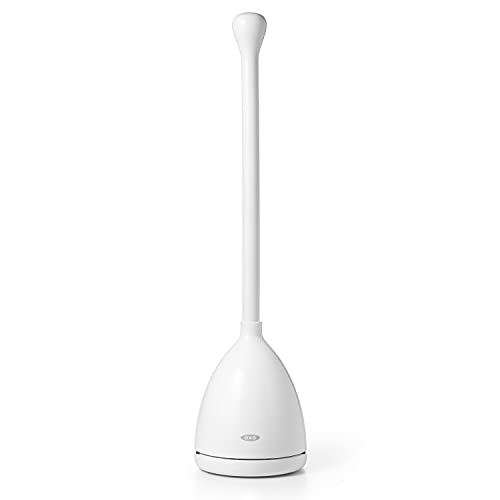
The OXO Good Grips Plunger is the pick for buyers who want the plunger completely out of sight, pairing a capable rubber flange cup with a sleek lidded canister that fully encloses the head, plus the comfortable non-slip handle OXO is known for.
OXO applies its comfort-first design philosophy to the plunger. The flange cup folds out to seal on standard round and elongated bowls, and the handle uses OXO's signature soft, non-slip grip that stays secure even with wet hands, giving good control as you plunge. The headline feature is the canister: unlike an open caddy, it fully encloses the plunger head behind a lid, so the wet rubber is hidden and contained while a raised base inside lets it drip-dry. It is the tidiest enclosure here short of a built-in cabinet.
Owners value how completely the canister hides the plunger and how comfortable the grippy handle is to push with, calling it the cleanest-looking open-floor option for a bathroom. The tradeoffs are a footprint slightly larger than a slim holder, so it needs a bit of floor space, and a soft flange tuned for everyday clogs rather than the brute force of an accordion. For a buyer who wants the plunger fully concealed with a comfortable handle, it is the standout canister pick, and it suits the same shopper furnishing the bowls in our guide to the best flushing toilets.
The OXO is the plunger we recommend when hiding the head completely matters more than anything else. The lidded canister encloses the wet rubber better than an open caddy, the base lets it dry, and the non-slip handle is genuinely comfortable to work with. It needs a little floor space and it is not a brute-force accordion, but for a clean, concealed everyday plunger, it is excellent.
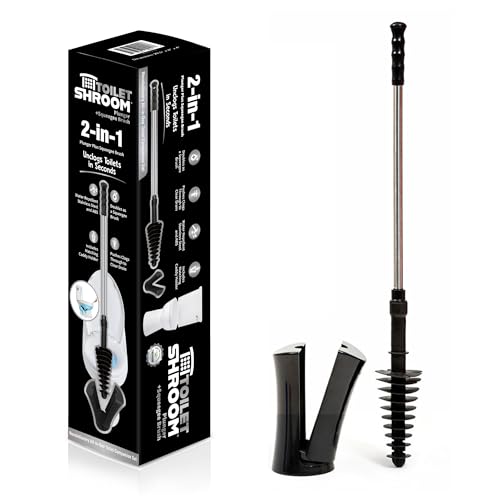
The ToiletShroom is the pick for a different approach to a stuck bowl, using a stiff rubber squeegee blade that plunges, scrapes and clears in one tool, sliding straight down the bowl outlet to push the clog through without the air-trapping splash of a cup plunger.
The ToiletShroom abandons the cup entirely. Instead of trapping air and water to hammer a clog, its stiff EVA squeegee blade slides down through the bowl outlet, physically pushing the obstruction through the trap and pulling water with it as it goes. Because there is no air cup to seal, there is no splash-back, which is the messiest part of conventional plunging. On the way out, the flat blade squeegees the bowl, and it wipes clean against a wall-mounted dock that doubles as its holder, so the tool stays sanitary without sitting in standing water.
Owners value the lack of splash-back, the way the blade scrapes and clears in one motion, and the wall dock that keeps it off the floor entirely. The tradeoffs are that it is unfamiliar, so it takes a try or two to trust, and that for a blockage deep in the trap a forceful cup or accordion can sometimes generate more hydraulic punch than a push tool. For a buyer tired of splashy, messy plunging who wants a clean, direct push, it is a clever pick, and it pairs well with our guide to best drain snakes and augers for clogs further down the line.
The ToiletShroom is the tool we recommend when splash-back is what you hate most about plunging. The squeegee blade pushes the clog through directly with no air cup, so there is no mess flying back at you, and it wipes the bowl clean on the way out. It takes a try to get used to, and a deep trap blockage may still want a cup's hydraulic hit, but for a clean, no-splash approach it is genuinely smart.
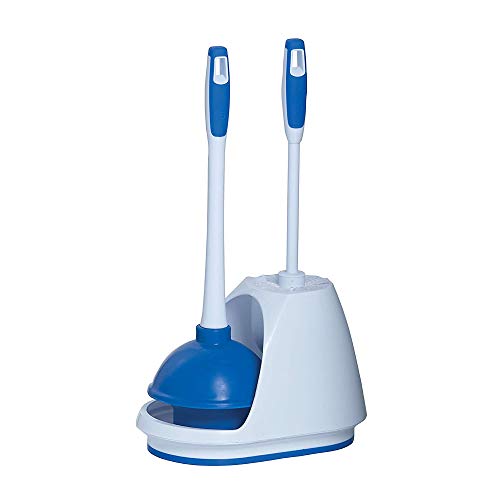
The Mr. Clean Turbo Plunger is the best bare-budget pick, delivering a ribbed turbo-style flange cup and a simple drip caddy from a recognizable household brand at the lowest cost, with the seal-and-store basics covered for an everyday bathroom.
The Mr. Clean Turbo strips the category to the basics for the lowest price. Its ribbed turbo cup has a fold-out flange that tucks into the bowl outlet to seal on standard round and elongated toilets, and it comes with a simple caddy so the plunger drips dry and stays off the floor. The handle and caddy are lightweight plastic rather than steel, which is exactly why it costs the least, while the cup itself seals well enough for the typical clogs a household actually faces.
Owners value getting a sealing flange plunger with its own holder from a familiar brand for so little, and they report it handles everyday clogs without issue and that the caddy is a welcome extra at the price. The tradeoffs are a lightweight build that is less rugged than premium models and a basic caddy that is functional rather than refined. For a buyer who wants a dependable plunger and holder for as little as possible, or a spare for a rarely-used bathroom, it is the smart entry point, and it suits the budget bowls in our guide to the best flushing toilets.
The Mr. Clean Turbo is the plunger we recommend when budget is the only thing that matters and you still want a caddy. The ribbed cup seals on standard bowls and clears everyday clogs, and the included holder keeps it tidy, all from a brand you recognize. The build is lightweight and the caddy is basic, but as a low-cost everyday or spare-bathroom plunger, it does the job.

The Korky 97-4A Max is the pick for modern high-efficiency toilets, using a stepped flange tip engineered to seal on the smaller, oddly shaped outlets of low-flush bowls where a generic cup slides off, paired with a comfortable handle and a drip holder.
The 97-4A Max is Korky's answer to the sealing problems modern toilets create. Today's high-efficiency bowls use less water and smaller, differently shaped trapways, and a flat or generic cup simply will not grip them. The 97-4A uses a soft, stepped flange tip that fits into a range of outlet sizes, molding to narrow or wider openings to build the airtight seal that lets each plunge move water through the trap. The handle is shaped for leverage, and like the BeehiveMAX it ships with a drip holder so the plunger stores cleanly.
Owners with newer toilets value how it finally seals where their previous plunger failed, clearing clogs in a few firm plunges, and they appreciate the included holder. The tradeoffs mirror every soft flange: it is not as raw-powerful as an accordion on the most stubborn blockage, and buyers used to a stiff cup may need a plunge or two to adapt. For a buyer with a modern low-flush toilet who is frustrated by a plunger that will not seal, it is the standout pick, and it pairs naturally with the high-efficiency bowls in our guide to the best flushing toilets.
The 97-4A Max is the plunger we recommend specifically for modern high-efficiency toilets, where the smaller trapway defeats an ordinary cup. Its stepped flange seals on the outlets that frustrate most plungers, so you get a clean break in a few plunges instead of splashing endlessly. It is a soft flange, not an accordion, so for the very worst clogs keep a heavy-duty model around, but for everyday sealing on a low-flush bowl it is the right tool.
If we had to cover almost every clog situation with two products, we would keep the Korky 99-4A BeehiveMAX as the everyday plunger for any bowl, thanks to its tapered tip that seals on round, elongated and modern high-efficiency outlets and folds into a tidy holder, and the Master Plunger MP500 as the heavy-duty backup for the rare clog a soft flange cannot break. That pairing covers both ends of the category, the forgiving everyday flange for fast clean sealing and the hard accordion for maximum thrust, and it keeps the seal genuinely airtight in both cases rather than letting a flat sink-style cup slide off the porcelain and splash water back at you.
A toilet plunger succeeds or fails entirely on its seal. The BeehiveMAX optimizes for that, with a stepped tapered tip that grips a range of bowl outlets where a flat cup slides off, which is why it tops the list. If you want strong sealing and an included caddy for the least money, the Neiko 60166A is the value pick, and for the toughest clogs the accordion-style Master Plunger MP500 delivers the most force.
The seal is everything, because a plunger does not push a clog with the rubber itself but with a forced column of water. The flange shape is what lets a toilet plunger seal the bowl outlet, so a clog clears in a few plunges. If your toilet clogs frequently regardless of the plunger, the bowl design may be the issue, covered in our guide to the best flushing toilets of 2026, ranked.
The two most common mistakes are not forming a seal first and not keeping the cup underwater, since plunging air just splashes and accomplishes nothing. A slow, firm rhythm that moves a column of water through the trap clears far more clogs than fast, frantic plunging. If repeated plunging does not work, the blockage may be deeper in the line, where a tool from our guide to the best drain snakes and augers of 2026 is the next step.
The right answer depends on your clogs. For typical waste and paper blockages a soft flange like the Korky BeehiveMAX clears them quickly and cleanly, while a household that regularly battles stubborn clogs benefits from the brute force of an accordion like the Master Plunger MP500. Owning both covers every situation, and a clog-resistant bowl from our guide to the best flushing toilets reduces how often you need either.
Buying a toilet plunger comes down to four checks that general bathroom guides tend to skip: the flange and cup shape that decides whether it seals on your bowl, the quality of the rubber, the handle and leverage, and how the plunger stores between uses. Work through the sections below before you buy and you will land on a plunger that breaks a clog on the first few plunges and stays sanitary, rather than one that slides off the porcelain or hardens and cracks within a year.
This is the first and most important decision. A flat sink-style cup will not seal a toilet, so you need a flange model where soft rubber folds into the bowl outlet. If you own a modern high-efficiency low-flush toilet, the smaller and oddly shaped trapway means a tapered or stepped tip, like the Korky BeehiveMAX or 97-4A Max, seals far better than a plain flange. For maximum force on stubborn clogs, an accordion bellows like the Master Plunger MP500 puts more thrust into the water but is stiffer and harder to aim. Decide between forgiving everyday sealing and brute force first, because that choice narrows the field faster than anything else.
Rubber and handle separate a good plunger from a frustrating one. Soft, flexible rubber molds to the porcelain for an airtight seal, but it must also resist hardening, cracking and tearing, which is the most common failure on cheap plungers that sit dry and brittle within a year. A longer handle gives more leverage so you can apply real force, and a non-slip grip, like OXO's, keeps your hands secure when wet. Steel handles, as on the Simplehuman, resist the rust and warping that plague plastic over time. Prioritize rubber that stays supple and a handle that does not flex under a hard push.
Match the features to how your household will actually use the plunger. A tapered-tip flange suits nearly every modern bathroom, an accordion benefits homes with frequent severe clogs, and an enclosed caddy or canister matters most in visible or guest bathrooms. What you can usually skip is paying premium money for a plain flat-cup plunger, since it will not seal a toilet well, and gimmicky add-ons that do not improve the seal. Buyers whose clogs sit deeper than a plunger can reach should compare the best drain snakes and augers of 2026, and those whose toilet runs or refills weakly after clearing a clog should check our guides to the best toilet fill valves of 2026 and the best toilet flappers of 2026.
The mistake we see most often with plungers is reaching for the flat red sink cup the house already owns and wondering why the toilet will not clear. For most homes the order of priority is the right flange or tapered tip that actually seals your bowl first, then rubber that stays flexible and does not crack, then handle leverage and grip, then how cleanly it stores. Decide whether you want a forgiving everyday flange or a brute-force accordion before anything else, because it determines the whole buy. Get those right and the rest is fine-tuning.
The Korky 99-4A BeehiveMAX is the best toilet plunger overall. It is a flange plunger with a tapered beehive tip that seals on round, elongated and modern high-efficiency bowls, soft flexible rubber that folds to grip the drain outlet, and a slim drip holder that keeps it sanitary. For the best value, the Neiko 60166A leads, and for the toughest clogs the accordion Master Plunger MP500 delivers the most force.
A toilet plunger has a soft rubber flange that folds out of the cup to fit the curved drain outlet of a toilet bowl, forming an airtight seal. A sink plunger is a flat cup designed to seal on the flat surface of a sink or tub drain, and it slides off a toilet's curved opening without sealing. Using a flat sink plunger on a toilet is the single most common reason a clog will not clear.
Insert the plunger so the flange folds into the bowl outlet, then push down gently to expel air and form a seal before plunging. Once sealed, push and pull in firm strokes for fifteen to twenty seconds, keeping the cup submerged so you move water rather than air. Break the seal to check if the water drains, and repeat if needed. Make sure there is enough water in the bowl to cover the cup.
Choose a flange plunger for everyday use because it is forgiving, easy to seal and works on almost any bowl, especially with a tapered tip for modern low-flush toilets. Choose an accordion plunger when you face frequent or severe clogs, since its hard bellows generates far more thrust, though it is stiffer and more prone to splash. Many households keep a flange as the everyday tool and an accordion as a heavy-duty backup.
Most often because it is a flat sink-style cup, not a true flange plunger, so it slides off the curved bowl outlet. Modern high-efficiency toilets make this worse, since their smaller trapways defeat a generic cup. A flange plunger with a tapered or stepped tip, like the Korky BeehiveMAX or 97-4A Max, folds into the outlet to build the airtight seal you need. Also check that enough water covers the cup, since plunging air will not seal.
A flange plunger with a tapered or stepped tip is best for high-efficiency low-flush bowls, because their smaller, oddly shaped trapways defeat a plain cup. The Korky 99-4A BeehiveMAX and 97-4A Max both use a stepped tip engineered to seal on a range of outlet sizes, which lets each plunge move water through the trap. A flat sink cup or a basic flange often slides off these bowls and will not clear the clog.
Form a seal before you push. Insert the plunger fully so the flange seats in the outlet, press down slowly to expel the trapped air, and only then begin firm strokes, keeping the cup submerged so you move water rather than air. Plunging before sealing, or plunging air, is what causes splash-back. A squeegee-style tool like the ToiletShroom, which has no air cup, avoids splash entirely by pushing the clog through directly.
Many do. Better plungers ship with a ventilated caddy, a lidded canister or a wall dock that keeps the wet rubber off the floor and lets it drip-dry, which is far more sanitary than leaning a bare plunger in a corner. The Neiko, Simplehuman, OXO and Mr. Clean picks all include storage, and the OXO and Simplehuman fully enclose the head for a discreet look. A holder is worth prioritizing for both hygiene and tidiness.
Flush the toilet and hold the plunger in the clean rushing water to rinse the rubber, or pour a little bleach or disinfectant cleaner into the bowl and plunge gently to sanitize it. Shake off excess water and let it drip-dry in its caddy, canister or dock rather than setting it wet on the floor. A model with a ventilated holder dries faster and stays cleaner, which is why included storage matters.
A soft flange plunger will not harm porcelain, but an aggressive hard accordion plunger on older or thin porcelain can, in rare cases, stress a hairline crack with extreme force. The bigger risk is forcing a clog the wrong way and pushing it deeper. Use firm but controlled strokes, get a proper seal so the force goes into the water, and if a clog resists repeated plunging, switch to a drain snake rather than plunging harder and harder.
If firm, properly sealed plunging does not clear the clog after several attempts, the blockage is likely deeper in the trap or the line than a plunger can reach. The next tool is a toilet auger, also called a closet auger, which feeds a flexible cable through the trap to break up or retrieve the obstruction. See our guide to the best drain snakes and augers of 2026 for the right tool, and avoid chemical drain cleaners in a toilet, which can damage seals.
A quality flange plunger lasts many years if the rubber stays flexible, while a cheap one can harden, crack or tear within a year, especially if it sits dry and exposed. Storing it in a caddy out of direct sunlight and rinsing it after use both extend its life. When the rubber stiffens and will no longer fold to seal, or it splits, replace it, since a plunger that cannot seal is worthless no matter how new it looks.
Not better, just different. An accordion plunger generates more raw thrust because its hard bellows puts almost all your force into the water, so it excels on stubborn clogs. A flange plunger is more forgiving, easier to seal and works on more bowls, which makes it the better everyday tool. The accordion is harder to aim and more prone to splash. Many homes keep a flange plunger for daily use and an accordion for the worst clogs.
It can, but it is not ideal. A toilet plunger's flange is shaped for a curved bowl outlet, while a sink or tub drain is flat, so the flange may not seal as cleanly there as a flat-cup sink plunger would. For a sink or tub you also usually need to block the overflow opening with a wet cloth to build pressure. For best results, use a flange plunger on toilets and a flat-cup plunger on sinks and tubs.
Korky leads on flange plungers with its tapered beehive and stepped tips that seal on modern bowls, while Master Plunger and similar makers dominate heavy-duty accordion models. Neiko and Mr. Clean offer strong value flange plungers with caddies, OXO and Simplehuman make the best-designed enclosed-storage models, and ToiletShroom takes a squeegee approach. Choosing a known brand matters most for rubber that stays flexible and a seal that holds.
Yes, ideally. Keeping a plunger in each bathroom means you are never carrying a dripping tool through the house when a clog strikes, and inexpensive value models like the Neiko or Mr. Clean make it cheap to do. A plunger with its own caddy or canister also looks tidy enough to leave in a guest or powder room. Having the right flange plunger within reach is the difference between a quick fix and a real mess.
For the best toilet plunger overall, the Korky 99-4A BeehiveMAX wins, pairing a tapered beehive tip that seals on round, elongated and modern high-efficiency bowls with a slim drip holder for tidy storage. Choose the Neiko 60166A for the best value sealing and caddy, the Simplehuman Toilet Plunger for the best design and a self-opening caddy, the Master Plunger MP500 for heavy-duty accordion thrust on stubborn clogs, the OXO Good Grips Plunger for a fully enclosed canister, the ToiletShroom for a splash-free squeegee approach, the Mr. Clean Turbo Plunger for the lowest budget, and the Korky 97-4A Max for modern low-flush bowls. Decide first whether you want a forgiving everyday flange or brute-force accordion, then check rubber quality and storage, and you will get a plunger that clears a clog fast and lasts.
Which is the best toilet flush valve? Compare 2-inch, 3-inch, adjustable, and canister flush valves by fit and flush power, plus how…
Read the guideYes, flushing a toilet can make your shower go cold, hot, or lose pressure. Learn why it happens, how to diagnose it,…
Read the guideWhen you flush one toilet and another gurgles or bubbles, it usually means a venting or drain problem. Here are the causes,…
Read the guide