
Best Japanese Bathroom Vanities (2026)
Bathroom Remodeling4.6
A curated ranking of floating and low-profile vanities in natural wood tones and flat-panel cabinetry, built for a calm, minimalist bathroom.
Read the guideA curated ranking of furniture-style bathroom vanities with carved corbels, turned legs and raised-panel doors that pair authentic 19th-century looks with real storage.
Research updated June 2026.
The best Victorian bathroom vanity is the James Martin Brookfield Vanity, a furniture-style cabinet with carved corbels, fluted columns and a natural marble top that reads as a genuine 19th-century antique washstand. For a compact option, the Home Decorators Collection Sadie Vanity leads, and the Home Decorators Collection Windlowe is the best all-around washstand-style pick.
A Victorian bathroom vanity has to do something a pedestal sink cannot: combine ornate, high-relief period styling with real storage. Where original 19th-century bathrooms often used a simple pedestal sink, the Victorian-styled vanity borrows its silhouette from antique washstands and dressers, with carved corbels, turned or fluted legs, raised-panel doors and an aged wood or painted finish, while functioning as a modern cabinet with drawers and a cutout for plumbing. Getting this right means choosing genuine solid-wood or furniture-grade construction, a silhouette with real carved detailing rather than a flat modern cabinet, and a countertop material period-appropriate to the look.
We do not run our own durability trials. Instead we compare published manufacturer specifications, the material and construction quality, the leg and door styling against genuine antique furniture shapes, the countertop material and sink configuration, and the patterns across thousands of aggregated owner reviews on assembly, drawer function and finish wear. For Victorian vanities specifically we weighted four things above all else: authentic furniture-style silhouette with genuine high-relief detailing, because carved corbels, turned or fluted legs and raised-panel doors are what separate a Victorian vanity from a flat modern cabinet; solid wood or furniture-grade construction, since a period look on particleboard will not hold up the way genuine wood does; countertop material, since marble and other natural stone read as more period-correct than modern quartz patterns; and finish quality, since a distressed, glazed or painted finish needs to look intentional rather than simply worn. If you want the broadest performance-first ranking of bathroom fixtures, see our pillar guide to the best flushing toilets.
Every pick here had to combine an authentic furniture-style silhouette with genuine carved or high-relief detailing, real solid-wood or furniture-grade construction rather than laminate-wrapped particleboard, and a countertop material appropriate to the period look. We favored turned or fluted legs with visible space beneath the cabinet, carved corbels and raised-panel or beadboard door fronts over flat slab doors, and marble, soapstone or butcher-block countertops over modern engineered-quartz patterns. We weighted aggregated owner reports about assembly quality, drawer glide function and finish durability over marketing photography, and we do not accept payment for placement.
| Model | Style Fit | Key Spec | Best For | Check Price |
|---|---|---|---|---|
| James Martin Brookfield | Carved corbels, fluted columns | Solid wood frame | Best overall | Check price |
| Sadie Vanity | Compact turned-leg vanity | Solid wood frame | Best compact | Check price |
| Windlowe Vanity | Antique washstand style | Solid wood frame | Best washstand look | Check price |
| Hamilton Vanity | Painted cottage-style | Solid wood frame | Best value | Check price |
| RunFine Farmhouse Vanity | Farmhouse turned-leg | Engineered wood frame | Best budget | Check price |
| James Martin Providence | Double-sink furniture-style | Solid wood frame | Best double vanity | Check price |
| Ridgemore Vanity | Transitional | Solid wood frame | Best transitional | Check price |
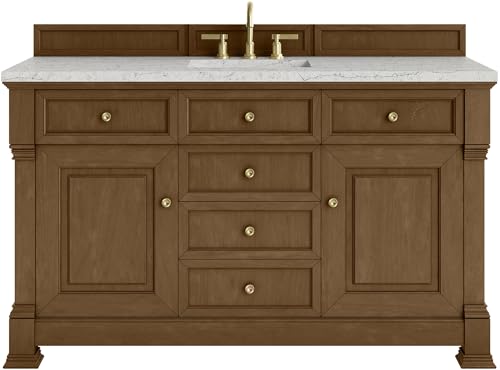
The James Martin Brookfield adds carved corbels, fluted columns and more substantial applied molding than most period-styled vanities, giving it the most authentically Victorian, high-relief presence in this guide for buyers doing a higher-end 19th-century bathroom.
The Brookfield's carved corbels beneath the countertop overhang and fluted leg columns go beyond the plain turned legs of most period-styled vanities, giving it a more substantial, high-relief furniture presence true to genuine 19th-century cabinetry. It offers a choice between natural marble and granite countertops, and the plywood panel construction over a solid wood frame is more resistant to warping than lower-grade particleboard alternatives. Two full doors and two drawers give it real storage capacity despite the ornate exterior.
Owners consistently praise the level of carved detail, noting it looks closer to a genuine antique dresser converted into a vanity than most reproductions, and the plywood panel construction holds up well in humid bathroom conditions. The tradeoff is price, since the Brookfield sits at the premium end of Victorian-styled vanities. For a buyer doing a higher-end 19th-century bathroom, it is the standout, and it pairs with the faucet detailing in our guide to the best Victorian bathroom faucets of 2026.
The Brookfield is what I recommend when the vanity itself should look like a designed antique piece rather than a cabinet with a few turned legs added. The carved corbels and fluted columns elevate it noticeably above a standard period-styled vanity, and the plywood panel construction is genuinely more durable in a humid bathroom. It costs more, but the detail is visible from across the room.

The Sadie Vanity delivers the same turned-leg furniture silhouette in a narrower footprint, fitting powder rooms and small full bathrooms where the Brookfield's larger frame will not fit.
The Sadie compresses a turned-leg, raised-panel formula into a compact 24-inch-class footprint, making it the practical choice for powder rooms and small bathrooms where a full-size furniture vanity would not fit. It keeps a natural marble top material and soft-close hardware, so the smaller size does not mean a downgrade in finish quality, just less storage volume and counter space.
Owners in small bathrooms value that this delivers genuine period character without overwhelming the room, and the marble top still elevates the look noticeably over laminate alternatives at this size. The tradeoff is limited storage, with typically one door and one drawer rather than the double-door configuration of larger vanities. For a small bathroom or powder room, it is the standout, and it pairs with the toilet sizing guidance in our guide to best flushing toilets.
The Sadie is what I recommend when the bathroom itself is small and a full-size furniture vanity would dominate the room. The turned legs and marble top still read as genuinely Victorian, just in a more compact package. If you have a powder room or a tight full bath, this fits where larger vanities will not.

The Windlowe Vanity is the piece we recommend for a genuine antique-washstand silhouette, with turned legs and raised-panel doors, and a natural marble top that reads as a 19th-century washstand converted for modern plumbing, without sacrificing real drawer storage.
The Windlowe's turned legs lift the cabinet base off the floor, and its raised-panel doors and applied molding mimic the joinery of an antique washstand rather than a flat modern cabinet box. The included marble top uses natural stone rather than an engineered pattern, which is the more period-correct material choice, and the undermount sink keeps the deck clean without a visible rim. Soft-close hinges are a modern convenience hidden behind the traditional door fronts.
Owners consistently report that the leg and door detailing genuinely reads as antique furniture rather than a built-in cabinet with applied trim, and that the marble top elevates the overall look noticeably over a laminate or quartz alternative. The main limitation is that its distressed finish options lean weathered rather than crisp painted white, so buyers wanting a cleaner cottage look should consider the Hamilton instead. For a buyer who wants the complete antique washstand silhouette with real storage, it is the standout, and it pairs naturally with the sink styling in our guide to the best Victorian bathroom sinks of 2026.
The Windlowe is the vanity I point most buyers to when they want a genuine antique-washstand look rather than a modern cabinet with period trim glued on. The turned legs and raised-panel doors do the visual work, and the natural marble top is the detail that separates it from cheaper reproductions. Confirm the distressed finish suits your room, and it is hard to beat for authenticity with real storage.
The Hamilton Vanity delivers a clean, crisp painted cottage look with beadboard-style door panels and turned legs at a mid-range price, making it the value pick for buyers who want a period silhouette without paying for elaborate carved detailing.
The Hamilton uses beadboard-style paneling on its door fronts rather than raised panels, and a crisp painted white finish rather than a distressed or weathered treatment, giving it a cottage-vintage character that suits coastal and farmhouse-adjacent bathrooms as much as strict period restorations. Turned legs still lift the cabinet base for a furniture-style look, and soft-close hinges keep the hardware modern behind the traditional door fronts.
Owners value the clean, bright look that works well in smaller or naturally lit bathrooms, and the reasonable price relative to more heavily detailed period lines. The tradeoff is that beadboard paneling reads as more cottage than strictly Victorian, and buyers wanting deep wood-tone or heavily distressed finishes should look elsewhere. For a fresh, crisp period-adjacent look at a fair price, it is a strong pick, and it complements the guide to bathroom vanities of 2026.
The Hamilton is what I recommend when the goal is cottage-vintage rather than heavy Victorian ornamentation, especially in a bright coastal-leaning bathroom. The beadboard panels and crisp white finish feel lighter than a distressed or dark wood-tone vanity. For most updated period remodels, it delivers a look people actually like living with day to day.
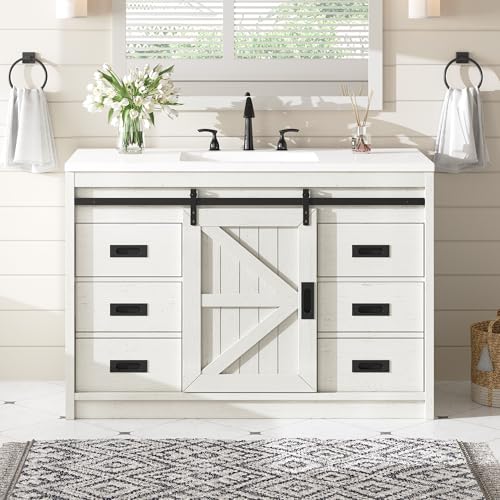
The RunFine Farmhouse Vanity delivers turned legs and a distressed painted finish at the lowest cost of entry into this style category, using engineered wood panels rather than solid wood to hit a lower price point.
The RunFine strips period vanity styling to its essentials: turned legs, a distressed painted finish and simple raised-panel-style door fronts, using engineered wood construction to reach a price well below solid-wood furniture-style lines. This is a real tradeoff in long-term durability, since engineered wood panels are more susceptible to swelling if exposed to standing water, but for a budget remodel or rental it delivers the visual silhouette that matters most.
Owners value getting real turned-leg farmhouse character at a price well below the Brookfield or Windlowe, which makes it a favorite for rentals, flips and quick refreshes. The tradeoff is construction quality, since engineered wood does not match the longevity of solid wood in a humid bathroom over many years. For a buyer who wants a farmhouse-period look for as little as possible, it is the smart entry point, and it pairs well with the guide to best flushing toilets.
The RunFine is what I recommend when budget is the deciding factor and the vanity does not need to last twenty years. You give up solid-wood longevity, but you keep the turned-leg silhouette and distressed finish that actually reads as period from across the room. For rentals, flips or a fast refresh, it is the cheapest sensible buy.

The James Martin Providence scales the furniture-style silhouette up to a full double-sink configuration, using a longer run of turned legs and raised-panel doors so a shared primary bathroom can have Victorian character on both sides.
The Providence extends the same turned-leg, raised-panel formula used in smaller period vanities across a wider frame that supports two undermount sinks and a shared countertop, typically 60 to 72 inches wide. Four doors and two drawer banks give it substantially more storage than a single-sink vanity, useful for a shared primary bathroom, and the plywood panel construction resists warping better than particleboard in a larger piece exposed to more daily humidity.
Owners in shared primary bathrooms value having consistent period styling across a full double-sink setup rather than two separate smaller vanities pushed together, and the storage capacity fits a shared household well. The tradeoff is floor space, since a double vanity needs a wider wall run than most single-sink options in this guide. For a shared primary bathroom, it is the standout, and it pairs with the faucets in our guide to the best Victorian bathroom faucets of 2026.
The Providence is what I recommend when two people share a primary bathroom and both want their own sink without breaking the period styling. The turned legs and raised-panel doors scale up convincingly rather than looking stretched, and the storage genuinely helps two people share the space. Measure your wall run carefully first, since this needs real width.
The Ridgemore leans transitional rather than strictly Victorian, with cleaner slab-style legs and simpler door fronts that suit a bathroom mixing period character with a more updated overall look.
The Ridgemore trades turned legs for simpler tapered slab legs and swaps raised-panel doors for a flatter, cleaner front, positioning it closer to transitional styling than a 19th-century restoration piece. The warm walnut finish option leans into wood-tone character rather than a painted antique look, making it a versatile choice for bathrooms that want to nod to period furniture styling without committing to fully ornate detailing.
Owners value the versatile styling that works in both period and transitional remodels, and the warm wood-tone finish that pairs well with brass hardware. The tradeoffs are that it will look too clean for a strict 19th-century restoration and lacks the carved detailing of the Brookfield or Windlowe. For a buyer who wants a vanity that flatters a broader range of styles, it is a strong pick, and it complements the sink styling in our guide to the best Victorian bathroom sinks of 2026.
The Ridgemore is what I recommend when the bathroom mixes styles and a heavily carved Victorian vanity would feel out of place. It has enough of the furniture-style silhouette to read as period-adjacent while staying clean enough for a transitional room. If you want a strict 19th-century look, go Brookfield or Windlowe, but for broad style flexibility, the Ridgemore fits more bathrooms.
If I had to cover most Victorian bathrooms with two vanities, I would keep the Brookfield for anyone doing a genuine carved, high-relief 19th-century-styled full bathroom, and the Sadie for anyone with a small bathroom or powder room where the full-size furniture piece would dominate the room. That pairing covers both the standard case and the tight-space case, and it keeps solid-wood construction and a genuine natural marble top in both rather than letting a period-adjacent shape hide particleboard and laminate.
The James Martin Brookfield Vanity is the best Victorian bathroom vanity overall. It pairs carved corbels, fluted columns and a natural marble top on a solid wood frame with real drawer and cabinet storage, delivering the most authentically 19th-century, high-relief silhouette in this guide. For a compact powder-room option, the Home Decorators Collection Sadie Vanity leads.
A Victorian bathroom vanity succeeds on the authenticity of its carved, high-relief silhouette and the quality of its wood construction. The Brookfield optimizes both, pairing carved corbels and fluted columns with a solid wood frame, which is why it tops the list. If your bathroom is smaller, the Sadie delivers turned-leg period styling in a compact footprint.
A furniture-style vanity, like the Brookfield or Windlowe, is raised on visible turned or fluted legs with open space beneath the cabinet base, mimicking an antique washstand or dresser moved into the bathroom, the more authentic Victorian silhouette. A built-in style vanity with a solid toe-kick base, even with raised-panel doors and an aged finish, reads as more modern cabinetry. Choose furniture-style for maximum authenticity and a lighter visual footprint; built-in style offers marginally more enclosed storage volume.
Every pick in this guide uses furniture-style legs specifically because that detail, combined with carved corbels or fluting, is what most reliably signals genuine 19th-century character to the eye. For a vanity-adjacent option with no legs at all, see the pedestal and console options in our guide to the best Victorian bathroom sinks of 2026.
Solid wood construction is not strictly necessary but is strongly preferred for both authenticity and longevity. Original antique furniture pieces were solid wood, and a Victorian-styled vanity built on a solid wood frame with plywood panels resists warping from bathroom humidity far better than particleboard or MDF alternatives. Budget options like the RunFine Farmhouse Vanity use engineered wood to reach a lower price, which is a reasonable tradeoff for a rental or short-term use but not for a long-term primary bathroom.
Check the listed construction material specifically, since "solid wood" sometimes refers only to the frame while door panels use veneer or engineered wood, which is a common and generally acceptable hybrid approach among the reputable lines in this guide.
Buying a Victorian bathroom vanity comes down to four checks that general vanity buying guides gloss over: deciding between furniture-style and built-in cabinetry, confirming solid wood or furniture-grade construction, choosing a countertop material appropriate to the period look, and matching the finish to your bathroom's overall Victorian direction. Work through the sections below before you buy and you will land on a vanity that looks authentically 19th-century while providing real, durable storage.
This is the first decision because it determines the overall visual weight of the piece. A furniture-style vanity on visible turned or fluted legs, like every pick in this guide, is the more authentic Victorian silhouette and reads as lighter in the room. A built-in style vanity with a solid base offers marginally more enclosed storage but looks more like modern cabinetry regardless of the door detailing applied to it. If authenticity is the priority, choose furniture-style every time.
A genuine solid wood frame, ideally with plywood rather than particleboard panels, resists the warping and swelling that bathroom humidity causes over years of use far better than lower-grade engineered wood. Premium picks like the Brookfield and Windlowe use this construction as standard, while budget options like the RunFine trade some longevity for a lower price. Confirm good bathroom ventilation regardless of construction quality, since even solid wood benefits from reduced ambient humidity.
A distressed or weathered white finish, like the Windlowe's, suits a strict antique or farmhouse restoration. A crisp painted white finish with beadboard paneling, like the Hamilton's, suits a lighter cottage-vintage look. A warm wood-tone finish, like the Ridgemore's, suits a transitional bathroom. Decide which of these directions matches your bathroom's other fixtures and finishes before choosing a specific vanity, since mixing a heavily distressed vanity with crisp modern chrome fixtures elsewhere can look inconsistent.
The mistake I see most often with Victorian vanities is choosing purely on finish color and discovering the construction is particleboard that swells within a couple of years in a humid bathroom. For most homes the order of priority is furniture-style legs and carved detailing first, since that is what reads as authentic, then solid wood or plywood panel construction for longevity, then a countertop material that matches your authenticity goals, then a finish direction that matches your other fixtures. Get those right and the rest is picking a finish you like.
The James Martin Brookfield Vanity is the best Victorian bathroom vanity overall. It pairs carved corbels and fluted columns with a natural marble top on a solid wood frame, giving buyers real drawer and cabinet storage without sacrificing the high-relief, 19th-century authenticity that defines genuine Victorian furniture.
Three details separate a genuinely Victorian-styled vanity from a generic traditional one: carved corbels or high-relief applied molding, visible turned or fluted legs that lift the cabinet base off the floor like an antique washstand, and raised-panel or beadboard door fronts rather than flat slab doors, paired with a natural marble or aged wood-tone finish rather than a modern engineered pattern. A flat-front cabinet on a solid toe-kick base, even in white, reads as modern regardless of hardware.
It is strongly preferred but not strictly required. Solid wood, especially with plywood door panels, resists the warping and swelling that bathroom humidity causes far better than particleboard or MDF. Budget vanities using engineered wood can still deliver the period silhouette at a lower price, a reasonable tradeoff for a rental or short-term use but less ideal for a long-term primary bathroom.
Natural marble is the most period-correct countertop material, since it was the standard choice for antique washstands and higher-end 19th-century bathroom furniture. Marble is porous and needs periodic sealing, while engineered marble or quartz in a similar white or gray tone offers a lower-maintenance compromise that still reads as appropriately period from a normal viewing distance.
Most furniture-style Victorian vanities, including every pick in this guide, include a matching undermount vitreous china sink as part of the countertop package, so buyers do not need to source a separate compatible sink. Confirm the specific listing includes the sink rather than selling the countertop and cabinet alone.
A furniture-style vanity sits on visible turned or fluted legs with open space beneath the cabinet, often with carved corbels, mimicking an antique washstand moved into the bathroom, the more authentic Victorian look. A built-in vanity has a solid toe-kick base flush to the floor, which is more common in modern cabinetry and reads as less period-correct even with similar door detailing applied.
Roughly comparable, though the storage layout differs. Furniture-style vanities typically use one or two full doors plus sometimes a drawer, similar to modern single-sink vanities, though the open leg space beneath does not add storage. Double-sink Victorian vanities like the James Martin Providence offer four doors and two drawer banks, comparable to a modern double vanity of similar width.
Installing a Victorian-styled vanity follows the same process as any modern vanity: setting the cabinet, leveling it, connecting the plumbing and securing it to the wall. It is a manageable do-it-yourself project for someone comfortable with basic plumbing, though the marble or stone countertop is heavy and easier to set with a second person.
A distressed white or weathered gray finish with turned legs, like the Windlowe or RunFine, suits a farmhouse-period direction best. Pair it with oil-rubbed-bronze or matte-black hardware and a similarly styled ornate faucet for a cohesive look. Our guide to the best Victorian bathroom faucets of 2026 covers matching fixtures.
Solid-wood furniture-style vanities with carved detailing and natural marble tops, like the Brookfield or Windlowe, typically cost more than an equivalent flat-front modern vanity with an engineered-quartz top, due to the additional carved corbels, leg and door detailing and the natural stone material. Budget options like the RunFine narrow that gap considerably by using engineered wood and lower-cost countertop materials.
Start with the vanity's finish direction, distressed antique, crisp cottage or warm transitional wood-tone, then coordinate the hardware and faucet finish, oil-rubbed bronze, polished nickel or brass, across the vanity, faucet and any shower or tub fixtures for a cohesive palette. Our guides to Victorian bathroom faucets and Victorian showers cover matching pieces.
For the best Victorian bathroom vanity overall, the James Martin Brookfield wins, pairing carved corbels, fluted columns and a natural marble top with durable plywood panel construction and real storage. Choose the Sadie Vanity for a compact powder room, the Windlowe for the most genuine antique-washstand silhouette, the Hamilton Vanity for the best all-around value with a crisp cottage look, the RunFine Farmhouse Vanity for the lowest cost of entry, the James Martin Providence for a shared double-sink primary bathroom, and the Ridgemore Vanity for a cleaner transitional look. Decide between furniture-style and built-in cabinetry first, then confirm solid wood or plywood construction, choose a countertop material that matches your authenticity goals, and you will get a vanity that looks period-correct and holds up in a real bathroom.
How we rank & our data sources
We do not run physical lab tests. Rankings are built from published, verifiable data and real owner feedback, never paid placement.
Researched by admin · Last updated July 3, 2026 · Our review method
A curated ranking of floating and low-profile vanities in natural wood tones and flat-panel cabinetry, built for a calm, minimalist bathroom.
Read the guide
A budget-versus-premium comparison of cultured marble and natural granite bathroom vanity tops, covering construction, durability, chipping, sealing needs and realistic cost, so…
Read the guide
Chinese-influenced bathtubs favor deep-soaking freestanding forms, formal symmetrical silhouettes, and rich dark or warm-toned exteriors that pair naturally with lacquered cabinetry and…
Read the guide