Best Chinese Showers (2026)
Showers4.6
Clean round shower heads, restrained lever trims and warm gold or bronze finishes that suit a rich, symmetrical bathroom without giving up…
Read the guideA curated ranking of shower systems with ornate telephone-style, high-relief cross-handle and exposed-pipe styling that still meet EPA WaterSense flow standards.
Research updated June 2026.
The best Victorian shower is the Kingston Brass Vintage Wall Mount Shower System, a telephone-style exposed-pipe set in aged brass or oil-rubbed bronze with an ornate cross-handle valve and a WaterSense 1.75 GPM shower head. For a period-correct clawfoot pairing, the Kingston Brass Vintage Clawfoot Tub Shower Riser leads, and the Kohler Artifacts is the best premium high-relief finish.
A Victorian shower has to solve two problems that fight each other: it needs to look like it came from a 19th-century bathroom, with exposed risers, a telephone-style handheld, ornate cross handles with high-relief detailing and an aged metal finish, while actually delivering modern pressure-balanced safety and a WaterSense-certified flow rate. Reproduction hardware makes this possible, but the finish quality, valve type and true flow rate vary widely between brands that photograph almost identically. That is why we weight authenticity of finish and hardware shape alongside the certified specs, not looks alone.
We do not run our own pressure trials. Instead we compare published manufacturer specifications, the certified GPM flow rate and WaterSense status, the valve type and whether it includes anti-scald pressure balancing, the finish technology used to replicate an aged brass, oil-rubbed-bronze or polished-nickel look, and the patterns across thousands of aggregated owner reviews on installation and long-term wear. For Victorian showers specifically we weighted four things above all else: authentic period silhouette, because a telephone-style handheld and exposed ornate cross-handle valve are what make a shower read as genuinely Victorian rather than merely old-fashioned; finish durability, since reproduction bronze and nickel finishes can wear thin faster than modern PVD coatings if the manufacturer cuts corners; certified WaterSense flow, because an ornate-look shower head still has to meet the 2.0 GPM federal cap and ideally the 1.75 GPM WaterSense standard; and safety, since exposed-pipe systems need a modern pressure-balance or thermostatic valve behind the aged handles. If you want the broadest performance-first ranking of bathroom fixtures, see our pillar guide to the best flushing toilets.
Every pick here had to combine an authentic period silhouette, a real reproduction finish rather than a printed coating, and a certified WaterSense or near-WaterSense flow rate. We favored aged brass, oil-rubbed-bronze and polished-nickel finishes that patina or resist tarnish the way original hardware does, ornate high-relief cross-handle valves over modern single levers, and telephone-style handheld showers over fixed modern heads. We weighted aggregated owner reports about pressure, leaks and finish wear over marketing photography, and we do not accept payment for placement.
| Model | Style Fit | Key Spec | Best For | Check Price |
|---|---|---|---|---|
| Kingston Brass Vintage Wall Mount | Telephone exposed-pipe | 1.75 GPM | Best overall | Check price |
| Kingston Brass Clawfoot Riser | Clawfoot tub add-on | 2.0 GPM | Best for clawfoot tubs | Check price |
| Kohler Artifacts | Turned-metal, high-relief | 1.75 GPM | Best premium finish | Check price |
| Moen Weymouth | Modern-Victorian hybrid | 1.75 GPM | Best hybrid | Check price |
| Kingston Brass Concord | Concealed-valve trim | 2.0 GPM | Best budget | Check price |
| Pfister Ashfield | Traditional lever-cross | 1.75 GPM | Best value | Check price |
| Grohe Grohtherm | Thermostatic period | 1.75 GPM | Best thermostatic safety | Check price |

The Kingston Brass Vintage Wall Mount is the shower we recommend first because it delivers the full telephone-style exposed-pipe silhouette, an aged-brass or oil-rubbed-bronze finish, an ornate cross-handle valve and a WaterSense-adjacent 1.75 GPM flow at a price that does not punish you for wanting authentic period styling.
The Vintage Wall Mount system runs an exposed riser from a wall-mount valve up to a fixed shower head, with a separate telephone-style handheld resting on a wall hook and connected by a flexible metal hose, which is the silhouette most people picture when they think of a Victorian shower. The ornate cross-handle valve controls temperature and includes a pressure-balance rough-in that keeps water temperature stable if another fixture in the house draws water, and the oil-rubbed-bronze finish is designed to darken slightly with age rather than flake or wear through to base metal the way cheap coatings do. The shower head itself runs a 1.75 GPM flow, under the 2.0 GPM WaterSense threshold for showerheads.
Owners consistently report that the exposed-pipe look reads as genuinely 19th-century rather than as a modern fixture pretending to be old, and that the finish holds its color well after regular use. The main limitation is spatial: exposed piping needs enough wall height and clearance to look intentional rather than cramped, so very small or oddly configured showers should measure first. For a buyer who wants the complete period silhouette without piecing together separate parts, it is the standout, and it pairs naturally with the fixtures in our guide to the best Victorian bathroom faucets of 2026.
The Vintage Wall Mount is the shower I point most buyers to when they want the real telephone-style look rather than a modern head dressed up in bronze. The ornate cross handle, exposed riser and hook-mounted handheld all read as period-correct, and the pressure-balance valve keeps it safe under the nostalgic exterior. Measure your wall clearance first, and it is hard to beat for the look.

The Clawfoot Tub Shower Riser is purpose-built to add a shower to a freestanding clawfoot tub, using a deck-mount or floor-mount supply line that rises up and over the tub rim to a fixed shower head, so a period tub can function as a shower without cutting into the wall.
The Riser mounts directly to the tub deck or the floor beside a freestanding clawfoot tub and arcs up and over the bather with a curved pipe that terminates in a fixed shower head, solving the specific problem of adding a shower to a tub that was never plumbed for one. The ornate cross-handle valve matches the era-correct look of clawfoot hardware, the finish options mirror what most reproduction clawfoot tub faucets use, and the 2.0 GPM shower head sits at the federal maximum, which is standard for this style of exposed riser rather than a wall-recessed system.
Owners with clawfoot tubs value that this solves a real installation gap, since most clawfoot tubs have no shower option at all without one, and that the curved riser looks intentional rather than bolted-on. The tradeoff is that it is purpose-built for a freestanding tub and does not apply to a standard alcove shower. For a clawfoot bathroom, it is the standout, and it pairs with the tub itself in our guide to the best Victorian bathroom vanities of 2026.
This riser is the answer whenever someone asks how to add a shower to a clawfoot tub without tearing into the wall. The curved arm and ornate cross handle look like they belong with the tub rather than added later, and both deck-mount and floor-mount versions exist depending on your plumbing. If you own a clawfoot tub and want to shower in it, this is the direct solution.

The Kohler Artifacts is the pick for buyers who want museum-grade Victorian detailing, with turned metal cross handles bearing high-relief work, a telephone-style handheld and Kohler's full range of aged finishes, backed by a limited lifetime warranty.
The Artifacts collection is Kohler's dedicated traditional line, with turned brass cross handles carrying pronounced high-relief detailing, a telephone-style handheld on a decorative hook and finish options like Vibrant polished nickel that are engineered to resist tarnish while still reading as a warm aged metal. The Rite-Temp valve is a pressure-balance cartridge backed by Kohler's limited lifetime warranty, and the 1.75 GPM shower head keeps flow efficient without a weak stream. The overall build feels heavier and more finished than most reproduction lines.
Owners consistently praise the weight and finish quality of the metal hardware, noting it feels closer to true 19th-century fixtures than most modern reproductions, and the Rite-Temp valve's reliability over years of use. The tradeoff is price, since Kohler's Artifacts line sits at the premium end of Victorian-styled showers. For a buyer who wants the best possible finish quality and is not working to the tightest budget, it is the standout, and it pairs with the vanities in our guide to the best Victorian bathroom vanities of 2026.
The Artifacts system is what I recommend when finish quality matters more than price. The turned handles have real heft and high-relief detailing, the Vibrant nickel finish resists tarnish better than most, and the Rite-Temp valve carries Kohler's lifetime warranty. It costs more than the Kingston Brass options, but the hardware feels closer to something salvaged from a real Victorian home.
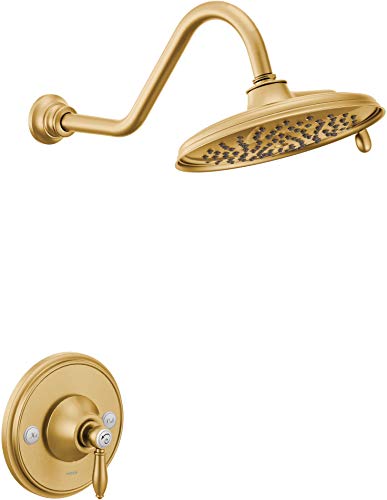
The Moen Weymouth is the pick for a bathroom that wants Victorian-inspired detailing without a fully exposed-pipe commitment, pairing traditional lever-cross handles and a stepped rosette design with a concealed modern valve and Moen's spot-resistant finish.
The Weymouth uses a concealed valve behind the wall, so only the traditional lever-cross trim, stepped rosette plates and shower arm show, giving it a period-inspired look while keeping the plumbing modern and easy to retrofit into an existing shower's rough-in. Moen's spot-resistant finish technology extends to the bronze and nickel options here, which is unusual for Victorian-styled hardware and means less visible water spotting than an unlacquered-brass finish. The WaterSense-adjacent 1.75 GPM shower head keeps flow efficient.
Owners value that this system installs into a standard modern shower valve without exposed piping, making it the easiest Victorian-styled option to retrofit, and that the spot-resistant finish stays cleaner-looking than true antique brass. The tradeoff is that it is a hybrid rather than a fully authentic exposed system, so buyers chasing a true telephone-style look should choose the Kingston Brass Vintage Wall Mount instead. For an easy retrofit with period detailing, it is a strong pick, and it complements the sinks in our guide to the best Victorian bathroom sinks of 2026.
The Weymouth is what I recommend when someone loves the Victorian look but does not want to redo their wall plumbing for exposed pipes. The lever-cross handles and rosettes give a period feel, and Moen's spot-resistant finish is genuinely easier to live with day to day. It is a compromise on full authenticity, but a smart one for most renovations.

The Kingston Brass Concord delivers a simplified Victorian-style trim, with a single fixed shower head, cross-handle valve and a period finish at the lowest cost of entry into this style category.
The Concord strips Victorian styling to its essentials: a fixed shower head, a cross-handle valve and a period-styled escutcheon, without the telephone handheld or exposed riser of pricier systems. It still carries a genuine cross-handle valve rather than a modern lever, and the oil-rubbed-bronze option gives it real period character despite the lower price. The 2.0 GPM flow sits at the federal maximum for showerheads.
Owners value getting authentic cross-handle styling without the higher cost of an exposed telephone system, which makes it a favorite for rental properties and quick bathroom refreshes. The tradeoff is the missing handheld, so buyers who want the full telephone-style experience should step up to the Kingston Brass Vintage Wall Mount. For a budget-conscious Victorian refresh, it is the smart entry point, and it pairs with the flushing performance covered in our guide to the best flushing toilets.
The Concord is what I recommend when the goal is a Victorian look on a real budget, especially for a rental or flip. You give up the telephone handheld, but the cross-handle valve and bronze finish still read as period-correct rather than generic modern chrome. For a fast, affordable style upgrade, it is the sensible buy.

The Pfister Ashfield balances a traditional lever-cross look with Pfister's Pforever lifetime valve warranty at a mid-range price, making it the value pick for buyers who want dependable period styling without paying premium-brand rates.
The Ashfield uses a concealed pressure-balance valve with traditional lever-cross trim and a diverter that routes water between the shower head and an optional handheld, giving it a traditional rather than strictly antique look. Pfister backs the valve with its Pforever lifetime warranty covering drips and cartridge failure, and the 1.75 GPM flow keeps it efficient. The tuscan bronze finish leans warmer than plain oil-rubbed bronze, giving it a softer period character.
Owners value the reliable pressure balance, the lifetime warranty backing the valve, and the reasonable price relative to premium Victorian-specific lines. The tradeoff is that it reads as traditional rather than fully antique, without the exposed piping of a true telephone system. For a buyer who wants dependable period styling at a fair price, it is the standout value, and it complements the picks in our guide to the best Victorian bathtub faucets and showerheads of 2026.
The Ashfield is what I recommend when you want traditional styling and a valve you can trust for the long term without paying for a specialty period brand. The Pforever warranty is the part that matters most here, and the lever-cross trim looks appropriately classic. It will not fool a preservationist, but it satisfies most Victorian-inspired remodels.

The Grohe Grohtherm pairs traditional cross-handle styling with a true thermostatic valve rather than a standard pressure-balance cartridge, giving households with children or older adults a precise, pre-settable water temperature behind a period-inspired exterior.
The Grohtherm's defining feature is its thermostatic valve, which uses a wax-element cartridge to hold a set water temperature precisely regardless of pressure changes elsewhere in the house, a meaningful safety upgrade over a standard pressure-balance valve for homes with young children or elderly bathers. The cross-handle trim and traditional rosettes keep the period-inspired look, while the internal engineering is fully modern. The 1.75 GPM shower head keeps the system efficient.
Owners with kids or aging family members specifically value the ability to preset and lock a safe maximum temperature, removing the risk of a scalding surprise. The tradeoff is a higher price than a standard pressure-balance system and a look that leans traditional rather than fully antique. For safety-conscious households who still want Victorian-inspired hardware, it is the standout, and it pairs with the flooring and layout guidance in our guide to bathroom vanities of 2026.
The Grohtherm is what I recommend when safety outweighs strict period accuracy, particularly with young kids in the house. A thermostatic valve holds temperature far more precisely than a pressure-balance cartridge, and the cross-handle trim still gives a nod to Victorian styling. It costs more, but the safety margin is worth it for the right household.
If I had to cover most Victorian bathrooms with two systems, I would keep the Kingston Brass Vintage Wall Mount for anyone chasing the full exposed-pipe telephone silhouette, and the Moen Weymouth for anyone retrofitting period styling into an existing concealed valve without redoing wall plumbing. That pairing covers both the from-scratch restoration and the practical remodel, and it keeps the flow rate efficient and the valve pressure-balanced in both cases rather than letting the ornate look hide an unsafe or wasteful fixture.
The Kingston Brass Vintage Wall Mount Shower System is the best Victorian shower overall. It pairs an exposed telephone-style riser, an ornate cross-handle pressure-balance valve and an oil-rubbed-bronze finish with a WaterSense-adjacent 1.75 GPM shower head. For a clawfoot tub pairing, the Kingston Brass Vintage Clawfoot Tub Shower Riser leads.
A Victorian shower succeeds on the authenticity of its silhouette and the reliability of its valve underneath. The Vintage Wall Mount optimizes both, pairing a true exposed-pipe telephone look with a pressure-balanced valve, which is why it tops the list. If you want period detailing without redoing your wall plumbing, the Moen Weymouth's concealed valve is the easier retrofit.
An exposed-pipe telephone system, like the Kingston Brass Vintage Wall Mount, is the most period-authentic look but needs wall clearance and is best suited to a full remodel or a period restoration. A concealed-valve system with Victorian-style trim, like the Moen Weymouth or Pfister Ashfield, hides the plumbing behind the wall and is far easier to retrofit into an existing shower's rough-in. Choose exposed pipe for authenticity, concealed for a simpler installation.
Most homeowners doing a standard remodel choose a concealed valve with period trim because it reuses existing plumbing, while dedicated 19th-century restorations or clawfoot tub setups favor the fully exposed system. For the tub-side version of this same choice, see our guide to the best Victorian bathtub faucets and showerheads of 2026.
The federal maximum for shower heads is 2.5 gallons per minute, but EPA WaterSense certification requires 2.0 GPM or lower, and several Victorian-styled picks in this guide run 1.75 GPM. A telephone-style Victorian shower head still relies on modern aerating or laminar-flow engineering inside a reproduction shell, so a 1.75 to 2.0 GPM ornate shower head feels comparable to a modern efficient shower head despite the old-world exterior.
Do not assume an ornate-styled shower head automatically uses more water than a modern one; the finish and handle shape are cosmetic, while the internal flow restrictor is what determines GPM. Check the listed flow rate specifically rather than assuming based on style.
A pressure-balance valve, standard on most Victorian-styled systems, automatically compensates if water pressure drops elsewhere in the house, preventing a sudden scalding or cold-shock surge. A thermostatic valve, like the one in the Grohe Grohtherm, goes further by letting you preset and lock an exact water temperature. Pressure-balance is the safe standard for most households; thermostatic is the upgrade worth paying for with young children or elderly bathers.
Both valve types can sit behind fully ornate cross-handle trim, so the choice does not affect the period look, only the internal safety engineering and the price.
Buying a Victorian shower comes down to four checks that general shower buying guides gloss over: deciding between exposed-pipe and concealed-valve styling, confirming the finish is a genuine reproduction rather than a printed coating, checking the certified flow rate, and matching the valve type to your household's safety needs. Work through the sections below before you buy and you will land on a shower that looks authentically 19th-century while performing like a modern fixture.
This is the first decision because it determines your installation scope. An exposed telephone-style system like the Kingston Brass Vintage Wall Mount is the most authentic look but needs enough wall clearance for the riser and handheld hook to sit naturally, and it is best planned during a full remodel. A concealed valve with Victorian trim, like the Moen Weymouth or Pfister Ashfield, reuses an existing shower's rough-in and only swaps the visible hardware, making it dramatically easier to retrofit. If you are not gutting the shower wall, concealed valve is almost always the practical choice.
Victorian finishes fall into three real categories: living finishes like unlacquered brass that are meant to darken and patina with age, engineered aged finishes like oil-rubbed bronze that arrive pre-darkened and stay largely stable, and spot-resistant modern coatings applied over a period shape, like Moen's spot-resistant bronze. All three can look convincing in photos, but they behave very differently over years of use. If you want a finish that ages and develops character, look for unlacquered or living-finish brass; if you want low maintenance, oil-rubbed bronze or a spot-resistant coating holds its look with less effort.
Every shower on this list includes some form of anti-scald protection, but the level differs. A standard pressure-balance valve, found on the Kingston Brass and Kohler Artifacts systems, automatically adjusts if pressure drops elsewhere in the house and meets code in most jurisdictions. A thermostatic valve, like the Grohe Grohtherm, adds the ability to preset an exact maximum temperature, which is a meaningful upgrade for households with young children, older adults or anyone who showers at inconsistent water pressure. Choose thermostatic if safety precision matters most; pressure-balance is sufficient and less expensive for most other households.
The mistake I see most often with Victorian showers is buying purely on finish color and missing the handle type or valve underneath. For most homes the order of priority is exposed-pipe versus concealed-valve first, since that decides your install scope, then a genuine cross-handle layout rather than a single modern lever dressed in bronze, then finish type based on how much maintenance you want, then valve safety level. Get those right and the rest is picking a finish you like.
The Kingston Brass Vintage Wall Mount Shower System is the best Victorian shower overall. It pairs an exposed telephone-style riser, an ornate cross-handle pressure-balance valve and an oil-rubbed-bronze finish with a WaterSense-adjacent 1.75 GPM shower head, giving buyers the most authentic period silhouette without sacrificing modern safety.
Three details separate a genuinely Victorian-styled shower from a generic dated one: an exposed or visibly-piped riser rather than a fully hidden modern valve, an ornate cross-handle or lever-cross layout instead of a single modern lever, and a warm aged finish like oil-rubbed bronze, polished nickel or unlacquered brass rather than plain chrome. A telephone-style handheld on a wall hook is the signature detail most associated with the look.
Yes, using a dedicated clawfoot tub shower riser like the Kingston Brass Vintage Clawfoot Tub Shower Riser, which deck-mounts or floor-mounts beside the tub and arcs a curved pipe up to a fixed shower head. This avoids cutting into a wall, since most clawfoot tubs were never plumbed for an overhead shower.
Yes, generally. An exposed-pipe telephone system needs a supply line run to a specific wall height with enough clearance for the riser and handheld hook, which is easiest to plan during a full remodel. A concealed-valve system with Victorian trim reuses an existing shower's rough-in and typically only requires swapping the visible trim kit, making it a much simpler retrofit.
The federal maximum is 2.5 GPM, EPA WaterSense certification requires 2.0 GPM or lower, and several Victorian-styled shower heads run as low as 1.75 GPM. The reproduction shell does not affect flow; the internal restrictor does, so an ornate-styled head can be just as water-efficient as a modern one.
A pressure-balance valve automatically maintains a roughly steady temperature if water pressure changes elsewhere in the house, which prevents sudden scalding or cold shocks and is standard on most Victorian-styled systems. A thermostatic valve goes further, letting you preset and lock an exact maximum temperature using a wax-element cartridge, which is a worthwhile upgrade for households with children or older adults.
A quality oil-rubbed-bronze finish from an established brand is engineered to resist wearing through to base metal under normal use, though heavy scrubbing with abrasive cleaners can thin it over years. Living or unlacquered-brass finishes, by contrast, are meant to darken and patina intentionally. Wipe Victorian-finished hardware with a soft cloth rather than abrasive pads to preserve the finish longest.
Many do, in the form of a telephone-style handheld connected by a flexible metal hose and resting on a decorative wall hook, which is the classic Victorian silhouette. Some budget or single-head systems, like the Kingston Brass Concord, skip the handheld for a simpler fixed-head design. Check the listing if a handheld is a priority for you.
A concealed-valve Victorian trim kit that reuses an existing rough-in is a manageable do-it-yourself swap for someone comfortable with basic plumbing. A fully exposed-pipe telephone system or a new clawfoot tub riser typically involves running new supply lines and is better handled by a licensed plumber, especially if it changes your existing rough-in location.
Oil-rubbed bronze and polished nickel are the two most common pairings with clawfoot tubs, since both were widely used on original 19th-century tub and shower hardware. Match the shower riser's finish to the tub's own faucet and feet hardware for a cohesive look rather than mixing bronze fixtures with chrome tub feet.
Specialty period lines like Kohler Artifacts or a full exposed telephone system typically cost more than an equivalent plain modern shower head due to the additional ornate cross-handle hardware, the handheld hose assembly and premium finish coatings. Budget-friendly options like the Kingston Brass Concord narrow that gap considerably by simplifying to a single fixed head.
Start with the finish, matching oil-rubbed bronze, polished nickel or chrome across the shower, sink faucet and any bathtub fixtures so the metals read as one cohesive palette. Then match the handle style, since ornate cross handles on the shower paired with a single modern lever on the sink will look inconsistent. Our guides to Victorian bathroom faucets and Victorian bathroom vanities cover matching pieces.
For the best Victorian shower overall, the Kingston Brass Vintage Wall Mount wins, pairing a true exposed telephone-style silhouette and an oil-rubbed-bronze finish with a pressure-balanced, efficient flow. Choose the Kingston Brass Clawfoot Riser if you own a freestanding clawfoot tub, the Moen Weymouth for an easy concealed-valve retrofit, the Kohler Artifacts for the highest-end high-relief finish quality, the Kingston Brass Concord for the lowest-cost period refresh, the Pfister Ashfield for the best all-around value, and the Grohe Grohtherm if precise thermostatic safety matters most. Decide between exposed-pipe and concealed-valve styling first, then prioritize a genuine cross-handle layout and a finish built to last, and you will get a shower that looks period-correct and performs like a modern fixture.
How we rank & our data sources
We do not run physical lab tests. Rankings are built from published, verifiable data and real owner feedback, never paid placement.
Researched by admin · Last updated July 3, 2026 · Our review method
Clean round shower heads, restrained lever trims and warm gold or bronze finishes that suit a rich, symmetrical bathroom without giving up…
Read the guide
Straight-lined tub fillers and simple fixed showerheads in warm oil-rubbed bronze finishes that deliver honest Arts and Crafts styling and real WaterSense-compliant…
Read the guideStrong, honest lines, warm oil-rubbed bronze finishes, and simple lever or cross-handle valves for a shower system built around Arts and Crafts…
Read the guide