


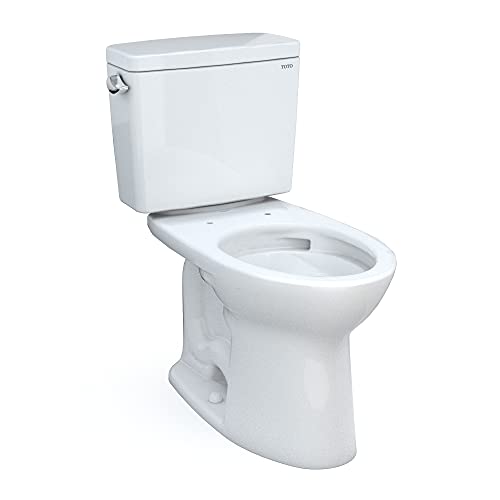
TOTO Drake Two-Piece Toilet vs Kohler Highline Two-Piece Toilet: Which Should You Buy?
Comparisons4.6
We compared the TOTO Drake and Kohler Highline two-piece toilets: both hit MaP 1000 at 1.28 GPF. See flush systems, verified specs…
Read the guideA spec-driven, honest comparison of skirted (concealed trapway) toilets and standard two-piece toilets, covering cleaning effort, installed cost, design appeal, flush performance, installation difficulty and long-term reliability, so you can choose the right style for your bathroom and your budget.
Skirted toilets win on cleaning ease and modern aesthetics but cost $80 to $200 more upfront and require more careful installation. Two-piece toilets cost less, install faster and offer wider model selection, making them the better value pick for most bathrooms. Choose skirted only if minimalist design or reduced scrubbing time is a genuine priority.
Walk into any plumbing showroom today and you will notice two distinct silhouettes sitting side by side. The first has a smooth, unbroken skirt running from the bowl rim down to the floor, hiding every curve and crevice of the trapway. The second shows its anatomy openly: a visible S-curve trapway on each side of the bowl, bolted tank on top, familiar profile that has not changed much in 80 years. Both flush water from bowl to drain. Beyond that basic function, they differ in meaningful ways that affect how long you spend cleaning, how much you pay, how hard they are to install and how the bathroom looks in a listing photo or a renovation reveal.
This is not a question with one universally correct answer. Skirted toilets solve a real problem (the exposed trapway is genuinely difficult to clean), but they introduce a different set of tradeoffs. Understanding those tradeoffs with actual data rather than marketing copy is what this guide delivers. For a broader overview of the top-performing models across both styles, the pillar guide to the best flushing toilets ranks them on flush performance, clog resistance and value side by side.
We do not test toilets in a lab. We compare manufacturer specifications, published MaP (Maximum Performance) flush-test gram scores, EPA WaterSense listings, trapway and flush-valve dimensions, installation documentation, and aggregated owner ratings across major retailers. Where one style clearly fits a situation better, we say so plainly.
The table below uses published specs from representative models in each category. Skirted side: TOTO Aquia IV (skirted, two-piece), Woodbridge T-0001, Swiss Madison Sublime. Two-piece side: TOTO Drake II, Kohler Highline, American Standard Champion 4. The highlighted cell shows which style leads on that dimension.
| Factor | Skirted toilet | Standard two-piece |
|---|---|---|
| Exposed trapway crevices | None (concealed) | Yes, both sides |
| Cleaning time per session (est.) | ~2 to 3 min | ~4 to 6 min |
| Typical retail range (toilet only) | $350 to $900+ | $150 to $700 |
| Installation complexity | Moderate to high | Standard |
| Model selection (major brands) | Growing; narrower | Extensive |
| Flush valve size (common) | 3-inch | 3 to 4-inch |
| Top MaP score (best models) | 800 to 1,000 g | 800 to 1,000 g |
| EPA WaterSense models available | Yes | Yes |
| Tank repair access (DIY) | Varies; often standard | Straightforward |
| Modern/minimalist aesthetic | Strong | Traditional to neutral |
A skirted toilet has a flat, smooth ceramic panel (the skirt) that wraps around the base of the bowl, completely hiding the S-shaped trapway channel that would otherwise be visible on either side. From the front and sides, the toilet looks like a solid rectangular or tapered block with no exposed plumbing curves. Standard two-piece toilets leave the trapway visible, which creates ledges, ridges and tight gaps where soil and bacteria accumulate.
The trapway is the internal S-curve or P-curve that holds a water seal in the bowl and moves waste into the drain stack. On a conventional two-piece toilet, this channel forms two prominent bumps on each side of the base. They are functional, not decorative, and manufacturers have left them exposed for over a century because encasing them in ceramic adds material cost, mold complexity and weight.
Skirted designs emerged as a mainstream product category in the early 2000s, led by European brands and later adopted by American manufacturers. TOTO introduced skirted versions of several flagship lines including the Aquia IV dual-flush. Kohler offers the Veil and the Santa Rosa in skirted profiles. American Standard produces the Studio S and the Concealed Trapway lines. Swiss Madison and Woodbridge brought skirted designs into the accessible mid-range under $500. In every case, the internal trapway geometry is identical to its exposed-trapway counterpart; the outer skirt is purely an aesthetic and hygiene shell.
The skirted shell does not change how the toilet flushes or drains. Flush performance is determined by the trapway diameter, the flush valve size, the water volume and the bowl geometry, none of which change when a manufacturer adds the outer ceramic skirt. Buyers who expect skirted models to flush differently are responding to marketing, not mechanics. Evaluate flush performance using published MaP scores, which are the same for skirted and non-skirted versions of the same base model.
Yes, skirted toilets are genuinely easier to clean. The exposed trapway on a two-piece toilet creates ridges, seams and tight recesses that collect mineral deposits, dust, hair, and bacteria, and that require a brush or cotton swabs to clean properly. A skirted base eliminates all of those crevices and reduces side-cleaning to a single wipe of the smooth ceramic surface. The time savings are real and cumulative over years of ownership.
Cleaning difficulty is one of the most underweighted factors when people shop for toilets, and it is where skirted designs deliver their clearest, most practical advantage. Let's be specific about what the problem actually is on a standard two-piece toilet.
On each side of the bowl base, the exposed trapway forms a rounded ridge approximately 3 to 4 inches tall. Between the floor and the bottom of that ridge is a gap of roughly 1 to 2 inches. Between the ridge and the tank is another recessed zone. Toilet brush heads are too large to reach these areas effectively. Spray cleaners pool in the gap at the base rather than running off cleanly. Mineral deposits from splashback and condensation build up in these recesses over months. In a busy household bathroom or a half-bath with high traffic, this accumulation becomes a real hygiene problem that requires quarterly deep-cleaning with a detail brush or old toothbrush.
The skirted base removes this problem entirely. The ceramic surface runs smooth from bowl rim to floor on all sides. Cleaning takes one pass with a damp cloth or a quick spray-and-wipe. Multiple owner reviews across Houzz, Reddit plumbing communities and major retail sites consistently cite cleaning ease as the most appreciated benefit after purchase, often more than the aesthetics that drove the initial purchase decision.
One caveat: the floor-to-base seal matters more on a skirted toilet. If the caulk or silicone bead at the base is incomplete or fails, waste water can wick under the skirt and become invisible until it causes floor damage. Proper installation, including a full perimeter seal with a small gap at the back for drainage detection, is essential. See the related guide on toilet installation steps for sealing specifics.
Skirted toilets typically cost $80 to $200 more than comparable non-skirted models from the same brand, based on published MSRP comparisons across TOTO, Kohler, American Standard and Woodbridge. Installation labor can add $50 to $150 more on skirted models because concealed trapway bolt access requires either a floor-mounted back-bolt kit or a wall-mount adapter, adding time to the roughin work. Budget shoppers will find better value in a well-engineered two-piece design.
Cost differences break down into three areas: the toilet price itself, the installation hardware, and the labor if you use a plumber.
Toilet price premium. Comparing the TOTO Drake II (two-piece, elongated, 1.28 GPF) to the TOTO Aquia IV skirted version with similar features illustrates the gap clearly. The Drake II typically retails in the $350 to $450 range. The Aquia IV Dual Flush Skirted version retails in the $500 to $650 range. The Woodbridge T-0001 skirted model lands in the $250 to $350 range, which represents the lowest accessible price point for a quality skirted toilet. Below $250, skirted options exist but often have thinner ceramic, less reliable flushing, or proprietary parts that are difficult to source.
Installation hardware cost. Standard two-piece toilets use a conventional wax ring and two floor bolts that tap into the closet flange. Installation is well-understood by every plumber and experienced DIYer. Skirted toilets often require a back-to-wall bolt kit or a specialized mounting bracket that replaces the standard closet flange bolt approach. This hardware is usually included by manufacturers like TOTO and Kohler but adds 30 to 60 minutes of labor time if a plumber is involved. Kohler's skirted models use a proprietary anchor mounting system. TOTO skirted models use a uni-bolt system with a specific wax ring profile. These are manageable but not the same as a standard installation.
Replacement part availability. Because skirted designs vary by brand and model, replacement flush valves, trip levers and fill valves are less standardized than the near-universal parts used by traditional two-piece toilets. Fluidmaster and Korky fill valves fit nearly every standard two-piece toilet in the US market. Skirted TOTO models require TOTO-specific flush valves. This is not a deal-breaker, but it matters if you are planning to own this toilet for 20 years and expect standard hardware-store parts to be available for repairs.
The total cost of ownership on a two-piece toilet is lower not just because of purchase price, but because of standardized repair parts, easier DIY maintenance and a wider labor pool comfortable servicing them. If budget and long-term repairability matter more than aesthetics, a Kohler Highline or TOTO Drake in two-piece configuration delivers equal or better flush performance at a lower lifetime cost.
Yes, skirted and two-piece toilets flush with equivalent performance when the underlying bowl and trapway design are the same. MaP flush-test scores, published by map-testing.com and used by the EPA WaterSense program, are identical for skirted and non-skirted versions of the same base bowl model from TOTO, Kohler and American Standard. The outer ceramic skirt does not affect trapway diameter, water volume or flush velocity.
This is perhaps the most important clarifying point in the entire comparison. Buyers sometimes assume that a smooth, modern-looking skirted toilet must have superior internal engineering. Others assume the opposite: that traditional two-piece toilets flush more powerfully because they look more industrial. Both assumptions are wrong. The flush performance is determined by internal geometry, not external appearance.
The MaP (Maximum Performance) test is the most reliable public data point for comparing flush strength. Conducted by independent labs, MaP tests measure how many grams of solid waste a toilet can reliably clear in a single flush. The maximum score is 1,000 grams. Top-performing models in both categories achieve this ceiling:
The practical takeaway is to look up the MaP score for the specific model you are considering rather than making assumptions based on style. A $250 two-piece Gerber Viper with a 1,000 gram MaP score flushes better than a $400 skirted model with a 500 gram score. Style does not predict performance.
For guidance on how MaP scores translate to real-world use, the related guide on understanding MaP flush test scores explains the methodology and what each score tier means for residential versus commercial use.
Skirted toilets align more naturally with contemporary and minimalist bathroom design because the smooth, unbroken silhouette complements frameless glass showers, floating vanities and large-format floor tiles. Two-piece toilets remain appropriate in transitional and traditional bathrooms where the classic tank-and-bowl profile fits the design language. The choice should be driven by the overall design direction, not by a belief that skirted toilets are inherently more premium.
Bathroom design trends have moved strongly toward minimalism over the past decade. Exposed plumbing lines, visible bolt caps and ridged trapways read as visual noise in a bathroom with clean geometry. A skirted toilet reduces the visual complexity of the toilet footprint and allows the eye to travel more easily across the floor plane, which makes a small bathroom feel slightly more open.
Interior designers working on renovation projects frequently cite the toilet silhouette as one of the lower-cost ways to modernize a bathroom without retiling. Swapping a traditional two-piece for a skirted model at the same rough-in dimension can update the aesthetic impact of a bathroom considerably, especially when the toilet is visible from the bathroom doorway.
That said, not all skirted toilets look equally modern. Entry-level skirted models sometimes retain a boxy, blunt profile that reads as outdated within a few years. Models worth investing in from a design standpoint include the Swiss Madison Sublime (clean waterfall silhouette), the TOTO Aquia IV (refined proportions, widespread brand recognition), the Kohler Veil (tall, architectural profile) and the Woodbridge T-0001 (good proportions for the price point). The American Standard Studio S offers a transitional profile that works in both modern and traditional contexts.
Two-piece toilets are not design liabilities. The Kohler Highline is a consistently well-reviewed model that sits cleanly in a traditional bathroom. The TOTO Drake has a profile that architects have specified in quality residential projects for decades. And in a bathroom with wainscoting, hex tile and classic fixtures, a traditional two-piece is more coherent than a modern skirted toilet would be.
When renovating to sell, a skirted toilet photographs better than a two-piece in listing photos because the smooth base reflects light evenly and does not create the shadow lines that a visible trapway does. Real estate staging professionals in competitive markets note that bathroom fixture upgrades have an outsized effect on perceived renovation quality relative to their cost. If the bathroom is being renovated for resale within five years, a skirted model in the $350 to $500 range is a reasonable investment for visual impact alone.
Yes, skirted toilets are moderately more complex to install than standard two-piece toilets. The most common reason is that the concealed trapway skirt blocks access to the standard floor bolts, requiring either a back-bolt mounting kit that attaches to the floor behind the toilet or a brand-specific anchor system. Manufacturers include installation hardware, but the process requires more steps, more precision and more patience than a conventional wax ring and bolt installation.
Standard two-piece toilet installation follows a procedure that has been unchanged for decades: set the wax ring on the closet flange, lower the toilet onto the bolts, hand-tighten the nuts, level the bowl, connect the water supply, and done. An experienced DIYer can complete this in 30 to 45 minutes. A plumber can do it in 20.
Skirted installation adds complication at the bolt-access step. Because the ceramic skirt wraps around the base, the bolt heads are hidden once the toilet is set. Manufacturers address this in different ways:
First-time DIYers should budget extra time for a skirted installation and read the full manufacturer documentation before starting. Plumbers familiar with skirted installs charge the same labor rate but typically add 30 to 60 minutes to the job estimate. If you are having a plumber do the work anyway, the installation complexity is not a strong reason to avoid skirted models. If you plan to DIY and have never installed a toilet before, start with a two-piece for the first installation and consider skirted for a future upgrade.
The related guide on measuring toilet rough-in distance covers the pre-installation step that applies to both styles equally. Getting the rough-in right before purchasing is more important than the installation method itself.
The skirted category has expanded significantly since 2018. Below are the most commonly recommended models based on published MaP scores, EPA WaterSense status, owner review aggregates and brand reliability data.
TOTO Aquia IV (skirted, dual flush 1.0/1.28 GPF). The most credible skirted model from a brand with the deepest flush-engineering history in North America. Dual flush with a manual selector, 800 to 1,000 gram MaP performance depending on flush mode, EPA WaterSense certified, TOTO's proprietary CeFiONtect ceramic glaze for stain resistance. Available in elongated and round. The skirted version of the Aquia IV shares the same bowl geometry as the non-skirted version. Check price on Amazon
TOTO UltraMax II (one-piece, not technically skirted but fully concealed). For buyers who want the cleanest possible profile with maximum flush power, the UltraMax II uses a one-piece construction that conceals the trapway within the bowl body. MaP score of 1,000 grams. 1.28 GPF. TORNADO FLUSH technology. One-piece design simplifies installation compared to true skirted models. Check price on Amazon
Woodbridge T-0001 (skirted, 1.28 GPF). The most popular entry-level skirted model in the US market by sales volume. MaP score around 800 grams. Includes a soft-close seat, a back-bolt mounting kit and a one-year warranty. Not a TOTO or Kohler in terms of long-term reliability data, but owner reviews are consistently positive for cleaning ease and appearance at the price point. Check price on Amazon
Swiss Madison Sublime II (skirted, 1.28 GPF). A design-forward option with a waterfall-style bowl rim and tall, slim profile. Appeals to buyers prioritizing modern aesthetics. MaP testing data is less rigorously published for Swiss Madison than for TOTO or Kohler. Best suited for lower-traffic bathrooms where aesthetic impact matters more than maximum flush performance. Check price on Amazon
Kohler Veil (skirted, 1.28 GPF). Kohler's architectural-grade skirted toilet with a tall, rectangular profile and an anchor wall-mounting or floor-mounting system. Uses Kohler's Class Five flushing technology. Widely specified in hotel and high-end residential projects. Sits at a higher price point than Woodbridge or Swiss Madison. Check price on Amazon
American Standard Studio S (skirted, 1.28 GPF). A transitional-style skirted design from a brand with one of the longest reliability track records in US residential plumbing. Uses American Standard's EverClean surface treatment for antimicrobial protection. A reliable choice for buyers who want a trusted brand with widely available replacement parts and service. Check price on Amazon
Two-piece toilets represent the majority of toilet sales in North America and include the most rigorously tested models in the entire category.
TOTO Drake (two-piece, 1.28 GPF, elongated). The most recommended toilet by plumbers in the US market based on poll data from plumbing industry forums and contractor review aggregates. G-Max flushing system, 1,000 gram MaP score, EPA WaterSense certified, universal height available as the Drake ADA model. Available in numerous color finishes. The single most reliable choice in the two-piece category for residential use. Check price on Amazon
TOTO Drake II (two-piece, 1.28 GPF, elongated). Updated version of the Drake with a wider 3-inch flush valve versus the original 2-inch valve. Slightly faster flush and better water evacuation. Same 1,000 gram MaP ceiling. This is the version most plumbers and contractors specify when asked for the current Drake recommendation. Check price on Amazon
American Standard Champion 4 (two-piece, 1.28 GPF). The highest-volume selling toilet in the Champion product line and one of the most cited 1,000 gram MaP models in the industry. Features a 4-inch accelerator flush valve and a fully glazed 2 3/8-inch trapway. Best known for clog resistance. Wide distribution in big-box stores. Check price on Amazon
Kohler Highline (two-piece, 1.28 GPF). The consistent value leader in the Kohler two-piece lineup. AquaPiston flush technology, 1,000 gram MaP score in the Highline Arc and Classic configurations, wide availability of replacement parts. A reliable, no-surprises toilet that performs at a lower price point than most TOTO equivalents. Check price on Amazon
Gerber Viper (two-piece, 1.28 GPF). Frequently overlooked by casual shoppers but consistently recommended by plumbers for its 1,000 gram MaP score, fully glazed trapway and accessible price point. Gerber has a strong reliability track record in commercial settings that translates well to high-traffic residential bathrooms. See the related guide on the best Gerber toilet models for a deeper look at the lineup. Check price on Amazon
The decision framework is straightforward when you separate the genuine advantages from marketing language.
Choose a skirted toilet if:
Choose a two-piece toilet if:
The cleaning advantage of skirted toilets is real and underappreciated. Anyone who has owned a two-piece toilet for ten years and tried to detail-clean the trapway crevices will immediately understand why the skirted design is worth a premium. But the performance advantage is not real. Both styles flush identically when the underlying bowl model is equivalent. Buy skirted for hygiene and aesthetics; buy two-piece for value and simplicity.
A skirted toilet has a smooth ceramic panel enclosing the trapway on each side of the bowl, creating a flat, unbroken surface from rim to floor. A two-piece toilet leaves the trapway exposed, which is the standard design in North America. The internal plumbing and flushing mechanism are functionally identical; the difference is entirely in the outer shell and the cleaning implications it creates.
No. Flush performance is determined by trapway diameter, flush valve size, water volume per flush and bowl geometry, not by whether the trapway is concealed. The MaP (Maximum Performance) test scores for skirted and non-skirted versions of the same base bowl model are identical. Evaluate flush performance using published MaP scores, not by toilet style.
Yes, moderately. Standard two-piece toilets use a wax ring and two floor bolts that any plumber or experienced DIYer can handle in 30 to 45 minutes. Skirted models often require a back-bolt kit or a proprietary anchor system because the skirt blocks access to standard floor bolts. The installation hardware is typically included by major brands, but the process takes longer and requires closer attention to manufacturer instructions.
Yes, if the rough-in measurement is the same. The standard rough-in in US homes is 12 inches from the finished wall to the center of the drain. Both skirted and two-piece toilets are made in 10, 12 and 14-inch rough-in versions. Measure your rough-in before purchasing either style and confirm the model specification matches. The toilet style does not affect rough-in compatibility.
No. Skirted toilets use the same ceramic glazes as standard toilets and clean with the same products: mild all-purpose cleaners, toilet bowl cleaners and a soft cloth for the exterior. Avoid abrasive scrubbers on any ceramic toilet surface, skirted or not, as they can scratch the glaze and make surfaces harder to clean over time. TOTO's CeFiONtect glaze and American Standard's EverClean surface are available on some skirted models and reduce the frequency of deep-cleaning needed.
Tank repairs are generally the same cost because the tank mechanism on a skirted two-piece toilet is identical to a standard two-piece. Fill valves, flush valves and trip levers are accessible from the top of the tank. The added cost comes when sourcing brand-specific parts. TOTO and Kohler skirted models use proprietary flush valves that are not interchangeable with universal hardware-store parts, which can add cost and lead time compared to the near-universal parts that fit most two-piece designs.
The TOTO Aquia IV skirted in round bowl configuration offers one of the most compact footprints among credible skirted models, making it a strong choice for small bathrooms. The Woodbridge T-0001 in round bowl is another well-reviewed option at a lower price point. For very small bathrooms, also consider a wall-hung toilet, which eliminates the floor footprint entirely, though at significantly higher installation cost.
Yes, and the caulking is more important on a skirted toilet than on a two-piece. Because the skirt wraps around the base, any water that wicks under the skirt from a failed wax ring seal or condensation drip is hidden from view. A properly applied bead of silicone caulk around the perimeter of the base, with a small gap at the back to allow any leak to become visible, provides both a seal and an early warning system. Never skip the floor seal on a skirted model.
The EPA WaterSense label appears on the product packaging and in the manufacturer's specification sheet. The EPA WaterSense program certifies toilets that use 1.28 GPF or less and have passed independent performance testing. The full list of certified models is searchable at epa.gov/watersense. Both skirted and two-piece models can be WaterSense certified; the certification is based on water use, not toilet style.
No, though they are sometimes confused. A one-piece toilet integrates the tank and bowl into a single molded ceramic unit, which also conceals the trapway. A skirted toilet can be either one-piece or two-piece in construction; the skirted label refers specifically to the concealed trapway shell around the base of the bowl, not to whether the tank and bowl are separate. TOTO's UltraMax II is a one-piece with a concealed trapway profile. The TOTO Aquia IV skirted is a two-piece with a ceramic skirt.
For residential use, a MaP score of 600 grams or higher is generally adequate. A score of 800 grams or higher provides a meaningful margin for heavier use. The maximum score of 1,000 grams indicates the toilet reliably cleared the maximum test load in all trials and is the benchmark cited for high-traffic or problem-drain situations. Scores below 500 grams are associated with more frequent clogging complaints in owner reviews. The map-testing.com database allows you to search any specific model by name to check its published score.
Yes. Comfort height (also called ADA height, chair height or right height depending on the brand) refers to a seat height of 17 to 19 inches from the floor, compared to standard height at 15 to 16 inches. This dimension is available in skirted models from all major brands. TOTO's Aquia IV skirted is offered in comfort height. Kohler Veil is available in comfort height. Woodbridge and Swiss Madison both offer comfort height skirted options. Confirm the spec sheet for the specific model before purchasing.
Yes. A bidet seat mounts to the bowl rim using standard bolt holes that are the same on skirted and non-skirted toilets. The skirt does not affect bidet seat compatibility. What can affect compatibility is the bowl shape (elongated vs round) and the seat depth, which must match the bidet seat model. Always verify the bowl shape and the distance from the bolt holes to the front of the bowl when pairing a bidet seat with any toilet model. TOTO's washlet line is designed to pair with TOTO bowls specifically.
Warranty terms are the same or equivalent across both styles from major brands. TOTO offers a one-year warranty on parts and a limited lifetime warranty on the vitreous china for all models, including skirted versions. Kohler offers a limited lifetime warranty on the toilet and a one-year warranty on parts for both styles. Woodbridge and Swiss Madison offer one-year warranties on their skirted models, which is shorter than the major brand standards. American Standard's warranty terms vary by product line but include china coverage for multiple years. Always verify warranty terms in the product documentation before purchasing.
Ceramic toilet bowls from quality manufacturers last 20 to 50 years regardless of style. The practical lifespan is more often limited by the internal tank hardware (flushing mechanism, fill valve, flapper or flush valve cartridge) than by the ceramic itself. These components typically need replacement every 5 to 15 years depending on water quality and usage. Two-piece toilets hold a slight durability advantage in this respect because replacement parts are more standardized and widely available, but both styles are long-lasting when purchased from established brands.
Skirted toilets can contribute positively to perceived bathroom quality in a home sale because they photograph better and align with current design trends. However, no study isolates the toilet style as a distinct resale value factor; buyers respond to the overall bathroom condition and design coherence rather than specific fixtures. A high-quality skirted toilet in a well-renovated bathroom contributes to the overall impression. The same toilet in a bathroom with dated tile and poor lighting will not move the needle on its own.
The American Standard Champion 4 is the most consistently cited model for clog resistance in the two-piece category, with a 4-inch accelerator flush valve and a fully glazed 2 3/8-inch trapway that is among the widest in any residential toilet. The TOTO Drake II with its 3-inch flush valve is the next most recommended by plumbers. Both post 1,000 gram MaP scores. For households with documented clogging problems, the Champion 4 is the most defensible specification based on published performance data and owner review volume.
Yes, but selection is narrower than in two-piece models. TOTO offers skirted models in Colonial White, Sedona Beige and Cotton White in addition to standard white. Kohler's skirted line is primarily available in white and biscuit (off-white). Woodbridge and Swiss Madison produce skirted models almost exclusively in white. If you need a specific color match for an existing bathroom, two-piece models offer significantly wider color availability across all major brands including the historical earth-tone ranges from American Standard and Kohler.
Before purchasing, confirm three things in the installation documentation: the mounting method (back-bolt kit, anchor system or modified wax ring), whether the required hardware is included or sold separately, and the rough-in dimension compatibility. Also confirm that the installation does not require cutting the closet flange or modifying the drain stack, which some non-standard skirted designs require. TOTO and Kohler provide detailed installation PDFs on their websites that can be reviewed before purchase to assess whether the installation is within your skill level.
For the majority of buyers, a two-piece toilet from TOTO, Kohler or American Standard delivers equal flush performance, lower cost, simpler installation and better long-term repairability than a skirted alternative. The skirted design makes a compelling case only when cleaning convenience and modern bathroom aesthetics are genuine priorities, not when flush power is the concern, because MaP-tested data shows no performance gap between the two styles. If budget allows and the bathroom design direction supports it, the TOTO Aquia IV skirted or the Woodbridge T-0001 represent the two most defensible entry points into the skirted category. For everyone else, the TOTO Drake II or the American Standard Champion 4 in two-piece configuration remain the benchmark recommendations in residential toilet buying.
We compared the TOTO Drake and Kohler Highline two-piece toilets: both hit MaP 1000 at 1.28 GPF. See flush systems, verified specs…
Read the guideHome / Comparisons / TOTO Drake vs TOTO Drake II TOTO Drake Two-Piece Toilet vs TOTO Drake II Two-Piece Toilet: Which Should…
Read the guideA data-driven look at resale impact, long-term availability, and which color choice makes more sense for your bathroom and your budget.
Read the guide