

Where Does Toilet Water Go After You Flush
Buying Guides4.6
When you flush, where does it go? Follow toilet water from the bowl through the trap, drain, and stack to a septic…
Read the guideA data-driven look at how much a toilet replacement actually returns at resale, which models appraisers and buyers notice, and what to spend to maximize your bathroom's contribution to your home's price.
A mid-range toilet upgrade (fixture plus professional install) typically returns 70-80 percent of its cost at resale when part of a broader bathroom refresh. Replacing a visibly stained or leaking toilet before listing almost always recoups full cost. Luxury smart toilets return less on average but help premium listings stand out in competitive markets.
Yes, but the relationship is indirect. Appraisers do not assign a specific dollar amount to a toilet in isolation; instead they assess overall bathroom condition and finish level. A dated or damaged toilet drags down the bathroom's condition rating, which can reduce the appraised value by more than the toilet's own replacement cost. A clean, functioning, water-efficient model signals to buyers that the home has been maintained, supporting a higher perceived value and faster sale.
The National Association of Realtors 2023 Remodeling Impact Report ranks bathroom renovations among the top five projects for cost recovery at resale, with a midrange bath update (which typically includes fixture replacement) returning roughly 71 percent of project cost nationally. That figure assumes a full update; a toilet-only swap in an otherwise untouched bath returns less. Still, the calculus changes when the existing fixture is visibly worn: buyers negotiating a lower price after a home inspection will frequently cite a stained or slow-flushing toilet as leverage, often demanding credits that exceed a straightforward replacement.
Condition is the key word. A 1990s-era 3.5 gallons-per-flush (GPF) toilet that still works is not a selling crisis, but it telegraphs age to buyers and inspectors. Replacing it with an EPA WaterSense-certified model at 1.28 GPF or lower positions the bathroom as updated and lets listing agents honestly describe the home as "water-efficient." That language resonates in markets where utility costs are a concern.
Real estate professionals consistently advise sellers to address anything a home inspector is likely to flag before listing. A running toilet, a hairline crack in the porcelain, or a rocking base caused by a failed wax ring are items that show up in inspection reports and give buyers negotiating power. Fixing these before listing removes that leverage entirely and is almost always cheaper than the resulting price reduction.
Industry data suggests a standalone toilet replacement returns approximately 65-80 percent of its total cost (fixture plus labor) at resale when performed as part of a bathroom refresh, and closer to 90-100 percent when replacing a clearly deteriorated fixture that would otherwise generate a buyer credit. The highest returns come from bringing a bathroom up to current code and condition standards, not from installing luxury features in a mid-range home.
Breaking down the numbers helps clarify where the return actually comes from. A professional toilet replacement typically runs $200-$500 in labor depending on your market, plus the fixture cost. Total out-of-pocket for a respectable mid-range upgrade often lands between $450 and $900. If that investment prevents a buyer from demanding a $1,200 credit during negotiations, the effective ROI exceeds 100 percent.
The math shifts for high-end smart toilets. A TOTO Neorest AH or similar bidet-seat-integrated unit can cost $3,000 to $6,000 installed. In a $500,000 home, this may not move the needle on appraisal value in the same proportion. Luxury buyers notice luxury fixtures and will appreciate the upgrade, but the return is more about competitive differentiation than measurable appraisal lift. In high-end markets where competing listings also feature smart toilets, not having one can actually work against you.
| Toilet Tier | Fixture Cost Range | Install Cost (Est.) | Typical Return at Resale | Best For |
|---|---|---|---|---|
| Basic replacement (like-for-like) | $100-$250 | $200-$350 | 90-100% (removes inspection flag) | Replacing damaged or non-functioning unit |
| Mid-range WaterSense (1.28 GPF) | $250-$600 | $200-$400 | 70-85% | Best value for most sellers |
| Premium elongated comfort height | $500-$900 | $250-$450 | 60-75% | Master baths in mid-to-upper range homes |
| Smart / integrated bidet toilet | $1,200-$5,000+ | $300-$600 | 40-60% | Luxury listings, competitive high-end markets |
TOTO, Kohler, and American Standard are the three brands most commonly recognized and associated with quality in North American real estate transactions. Buyers who notice brand names at all tend to view TOTO and Kohler as premium signals. American Standard is widely accepted as a solid mid-range performer. Lesser-known brands are not necessarily inferior, but they do not carry the same buyer perception value.
Brand recognition in a real estate context operates differently than in a product review. Most buyers are not reading model numbers; they are forming impressions. A glossy, clean toilet in a neutral elongated design reads as quality regardless of brand. However, when a savvy buyer or their agent does look at the fixture, recognizing "TOTO" or "Kohler" confirms that the seller invested in quality rather than the cheapest builder-grade fixture available.
For the master bath of a home priced above the neighborhood median, consider the TOTO Drake II or the TOTO UltraMax II. Both carry MaP scores of 1,000 grams at 1.28 GPF, hold EPA WaterSense certification, and use TOTO's CEFIONTECT glaze for stain resistance. These are not marketing claims; they are independently verified figures from the Maximum Performance (MaP) testing program, which is conducted by third-party laboratories according to ANSI/ASME standards.
The Kohler Cimarron and Kohler Highline are strong mid-range choices that appraisers and buyers recognize immediately. The American Standard Champion 4 earns its place in this category with its 4-inch flush valve and 2-3/8-inch fully glazed trapway, delivering consistent flush performance without the premium TOTO price point.
For those on a tighter renovation budget, the American Standard Cadet 3 offers EPA WaterSense certification and a recognized brand name at an accessible cost. The Woodbridge T-0001 is a design-forward one-piece option that photographs exceptionally well for listings and costs significantly less than comparable TOTO one-piece designs. For secondary baths, Gerber's Avalanche series delivers reliable flush performance at builder-grade pricing with a brand name that carries warranty support and nationally available replacement parts.
MaP testing scores are the single most useful objective metric when comparing toilet flush performance. A toilet rated at 1,000 grams at 1.28 GPF is independently confirmed to handle a standard waste load with a single flush. Buyers will never ask about MaP scores at an open house, but they will notice if the toilet does not flush properly during their walkthrough. Specifying a high MaP-rated model eliminates that risk entirely.
Dual-flush toilets do not consistently add measurable resale value over a well-specced single-flush WaterSense model, but they can be a useful talking point in markets where water costs are high or where eco-conscious buyers are common. The critical factor is that the dual-flush mechanism must work reliably; a dual-flush toilet with a finicky flush selector is a liability, not an asset.
The TOTO Aquia IV is the most commonly cited dual-flush model in the premium segment, offering 1.0 GPF / 0.8 GPF in a sleek skirted design that photographs well and earns a strong MaP score at its full flush setting. The Swiss Madison Chateau is a popular design-forward alternative at a lower cost, though independent MaP testing data is more limited for that brand compared to TOTO, Kohler, and American Standard.
Buyers in water-stressed regions (California, Arizona, Nevada) are more attuned to GPF claims than buyers in regions where water is plentiful. In those markets, displaying the EPA WaterSense label on the toilet or noting it in the listing description is a genuine value signal. Outside those markets, a standard 1.28 GPF WaterSense single-flush unit performs equivalently for resale purposes.
See our detailed analysis in our best dual-flush toilets guide and our article on water-saving toilets if conservation efficiency is a primary driver of your upgrade decision.
A toilet replacement delivers the best return when paired with coordinated vanity, flooring, and lighting updates rather than done in isolation. A new toilet in a bathroom with a cracked mirror and vinyl flooring from 1995 does not move the needle the same way as a cohesive refresh where all fixtures belong to the same decade and design family. Consistency of finish level is what appraisers and buyers respond to.
The midrange bathroom remodel benchmarked by Remodeling Magazine's Cost vs. Value study historically returns around 65-70 percent of cost nationally, with wide regional variation. That study includes flooring, vanity, tub and shower, and toilet together. Isolating the toilet contribution is not straightforward, but the principle is clear: a single updated fixture in an outdated room adds far less value than a coordinated refresh.
If budget limits the scope of work, prioritize in this order for resale impact: first, address anything structural or mechanically faulty, including a running toilet or a cracked tank; second, clean or re-caulk all fixtures; third, update lighting; fourth, replace the toilet if it is visibly dated, stained beyond cleaning, or low-efficiency; fifth, update vanity hardware and mirrors. A new toilet as part of that sequence is far more impactful than a new toilet as a standalone cosmetic choice.
Staging professionals consistently note that buyers form impressions in the first 90 seconds of a bathroom walkthrough. A clean, white, modern toilet at comfort height in a bright bathroom reads as "updated" regardless of brand. Mismatched fixture styles, visible water stains, or a toilet that rocks on its base communicate neglect and give buyers room to mentally discount the entire property.
For a full breakdown of the best flushing toilets across every category and price point, our primary guide covers MaP scores, GPF ratings, and owner review data for over 40 models. If you are evaluating comfort height options specifically, our comfort height toilet guide covers ADA compliance and resale accessibility considerations in detail.
The features that deliver the best return at resale are: a fully glazed trapway with a minimum 2-inch diameter for reliable flushing, EPA WaterSense certification at 1.28 GPF or less, an elongated bowl in white or bone, comfort height (17-19 inches), and a soft-close seat. These are features buyers notice and appreciate without adding significant cost to the fixture.
A fully glazed trapway is the single most functionally important feature. Trapways that are glazed reduce friction and buildup, translating directly to fewer clogs. The American Standard Champion 4 and Cadet 3 both prioritize wide, glazed trapways as a central engineering feature. TOTO achieves a similar result through the combination of CEFIONTECT glaze and their Tornado Flush rim design, which eliminates the rim holes where traditional toilets collect buildup.
Elongated bowls are preferred by the majority of adult buyers and have become the default in new construction for most markets. Round bowls can be appropriate for tight spaces but should be avoided if square footage is not a constraint. An elongated bowl in a generous bathroom signals intentional design rather than the cheapest spec available.
Comfort height toilets, which measure 17 to 19 inches from floor to seat, are explicitly ADA-compliant and are preferred by older buyers, taller adults, and anyone with knee or hip issues. As the buyer population ages, comfort height becomes increasingly default rather than premium. The incremental cost over standard height is typically zero to modest for most mid-range models.
Soft-close seats deserve more credit than they receive in ROI discussions. A buyer who experiences a loud slam during a walkthrough registers it as a quality negative. A seat that closes silently registers as quality positive. Many mid-range and premium toilets include soft-close seats standard; if a model does not, aftermarket universal soft-close seats are a low-cost addition.
Gerber's warranty program is worth noting for investment property owners. Gerber offers a limited lifetime warranty on vitreous china components and a 1-year warranty on mechanical parts. For rental properties being prepared for sale, a recognized brand with accessible warranty support and nationwide parts availability is a practical advantage that a purely design-focused fixture may not offer.
A new toilet does not receive a specific line-item credit in most appraisals. However, it contributes to the overall condition rating of the bathroom, which does affect appraised value. Replacing a damaged or outdated toilet removes a negative condition flag and supports a higher condition grade for the room overall.
Install an EPA WaterSense-certified toilet at 1.28 GPF or less. This is the most common standard for modern construction and resonates with buyers as "current." Ultra-high-efficiency models at 1.0 GPF or 0.8 GPF are a bonus in water-conscious markets but are not required to signal an updated bathroom in most regions.
One-piece toilets photograph better for listings because of their clean, modern silhouette with no visible tank seam. They are generally more expensive but are often worth the premium for a master bath that will be featured prominently in listing photos. Two-piece toilets are easier to transport and install and perform identically for buyers who see the toilet in person.
Yes, significantly. A running toilet is frequently noted in home inspection reports. Buyers use inspection findings to request price reductions or repair credits. Repairing or replacing a running toilet before listing eliminates that negotiation point for a fraction of the credit buyers would otherwise demand.
In homes priced above the top quartile of the local market, a smart toilet can differentiate the listing and appeal to buyers who would otherwise look at competing properties. In average-priced homes, the installation cost is unlikely to be fully recouped at resale. The exception is when competing listings in the same price bracket also feature smart toilets; at that point, not having one can become a disadvantage.
A MaP score of 600 grams or higher at the rated GPF is considered good. A score of 800 grams or higher is excellent. The TOTO Drake, TOTO Drake II, TOTO UltraMax II, American Standard Champion 4, and Kohler Cimarron all achieve 1,000 grams (the maximum test load) and are widely regarded as the benchmark for single-flush reliability.
If it is functioning and not visibly stained, replacement is optional from a pure functionality standpoint. However, if it is a 3.5 GPF or 1.6 GPF pre-2010 model, its water use is higher than current standards, which some buyers will notice. If the bathroom is being refreshed for sale anyway, including the toilet in the update is worthwhile given the relatively low incremental cost.
White is strongly preferred for resale. Almond, biscuit, and bone toilets can make bathrooms look dated even when the fixtures are relatively new. If you have a colored toilet from the 1980s or 1990s, replacing it with a white model is one of the highest-return cosmetic updates available in a bathroom renovation.
Comfort height (also called chair height) toilets measure 17 to 19 inches from floor to seat, versus the standard 15 inches. They are favored by taller adults and by individuals with mobility limitations. Because they meet ADA accessibility standards, they are broadly appealing and are increasingly the default choice in new construction. Specifying a comfort height model is rarely penalized by younger buyers and is actively preferred by a growing segment of the buyer pool.
A soft-close seat is a low-cost addition that buyers notice immediately and perceive as a quality signal. Many mid-range and premium toilets include them standard. If you are buying a toilet that does not include a soft-close seat, adding one separately is almost always worthwhile from a buyer perception standpoint.
Professional toilet installation by a licensed plumber typically ranges from $150 to $400 depending on your location, whether the existing toilet needs to be removed and disposed of, and whether any flange repair or shut-off valve work is needed. Markets with high labor costs tend toward the upper end of that range. Factor installation cost into your total project cost when calculating ROI.
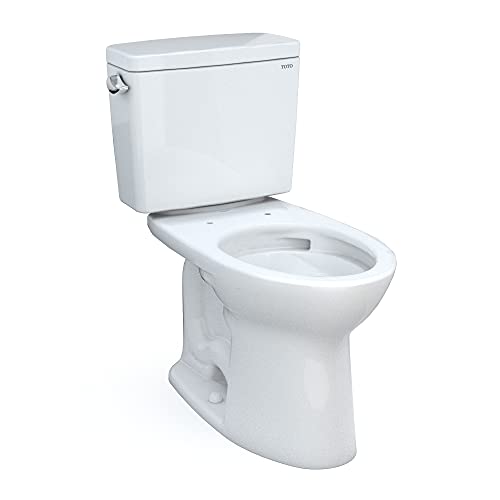
The TOTO Drake II is a two-piece elongated toilet rated at 1.28 GPF with a MaP score of 1,000 grams, EPA WaterSense certification, and TOTO's CEFIONTECT ceramic glaze for stain and bacteria resistance. It is frequently cited because it hits the intersection of verified performance, brand recognition, and a cost point that works for mid-to-upper bathrooms. Its combination of third-party-verified scores and widely available owner reviews make it easy to recommend with confidence.
In luxury markets, integrated bidet toilet units like the TOTO Neorest series are a genuine differentiator. In average markets, buyers may not be familiar with the product category or may prefer not to pay for a feature they did not request. A bidet seat added to a quality standard toilet is a middle ground that is easy to remove if a specific buyer does not want it.
Brand matching is not necessary, but finish level consistency is. A ceramic toilet, a chrome faucet, and a modern vanity do not need to share a brand name, but they should belong to similar aesthetic and quality tiers. A high-gloss TOTO toilet next to a builder-grade vanity creates a mismatched impression that undermines both fixtures. Aim for a cohesive overall look rather than brand uniformity.
Most buyers are not actively searching for the WaterSense label, but it gives listing agents a concrete, credible claim to include in property descriptions. In markets where water rates are high or where eco-conscious buyers are prevalent, this can be a genuine differentiator. It also protects the seller from a buyer who discovers post-purchase that a fixture uses more water than current standards require.
A straightforward toilet swap on a functioning, level flange with no supply line complications is accessible for someone comfortable with plumbing basics. The risk is hidden complications: a corroded or cracked flange, a non-standard rough-in distance, or a damaged subfloor beneath the old wax ring. If any of these exist and are not addressed, you may spend more on repairs than professional installation would have cost. Many sellers prefer a licensed plumber who will identify any related issues during the visit.
Yes. The standard North American rough-in is 12 inches from the wall to the center of the drain flange. Some older homes have 10-inch or 14-inch rough-ins. Measure your rough-in before purchasing a replacement. Buying a toilet with the wrong rough-in requires either structural adjustment or a toilet specifically made for that non-standard measurement. TOTO, Kohler, and American Standard all offer models in 10-inch and 14-inch variants, but selection is more limited than the standard 12-inch range.
Prioritize a fully glazed trapway with a large diameter (2 inches minimum, 2-1/8 to 2-3/8 inches preferred) combined with a high MaP flush score. These two features together mean the toilet will flush reliably and completely without clogging. A toilet that clogs during a buyer walkthrough or in the early weeks of ownership is one of the fastest ways to generate negative word-of-mouth after a sale.
Quality porcelain toilet bodies are rated for 50 years or more by manufacturers. The mechanical components (fill valve, flush valve, flapper) typically need replacement every 5-15 years. TOTO and Kohler both publish warranty information confirming the toilet bowl and tank carry limited lifetime warranties for the original purchaser. Longevity supports ROI both because it signals quality to buyers and because it reduces the likelihood of the buyer facing a repair cost shortly after purchase.
The American Standard Champion 4 is one of the most recommended models for resale scenarios because it combines a recognized brand name, a wide 4-inch flush valve, a 2-3/8-inch fully glazed trapway, and a 1,000-gram MaP score at 1.6 GPF (with some versions also available at 1.28 GPF). Its reputation for clog-free performance is well-documented across aggregated owner reviews, making it easy to represent honestly in a listing without overstating its features.
Replacing a visibly worn, stained, or low-efficiency toilet before listing your home is one of the highest-certainty bathroom investments available. A mid-range WaterSense-certified model from TOTO, Kohler, American Standard, or Gerber at 1.28 GPF, properly installed by a licensed plumber, removes inspection red flags, signals current maintenance standards, and supports buyer confidence at the negotiating table. For most homes in most markets, this is the sweet spot for toilet upgrade ROI: enough to matter without over-investing in fixtures that appraisers cannot easily credit. Luxury smart-toilet spending makes sense for high-end listings where competing properties already feature them, not as a baseline upgrade in average-priced homes.
When you flush, where does it go? Follow toilet water from the bowl through the trap, drain, and stack to a septic…
Read the guideDo toilets need electricity to flush? Most do not. Learn which toilets use power, how a standard flush works, and how to…
Read the guideFind out how many gallons per flush an old toilet really uses, how to check your own tank, and how much water…
Read the guide