


Best 30-Inch Bathroom Vanities (2026)
Bathroom Remodeling4.6
Thirty inches is the sweet spot between a cramped 24-inch vanity and a full 36-inch cabinet, giving a single-sink bathroom real drawer…
Read the guideA complete guide to planning a classic, elegant bathroom with the right fixtures, finishes, hardware, and plumbing choices that hold their value for decades.
Traditional bathroom design centers on symmetry, natural materials, and classic fixture silhouettes. Paired vitreous china fixtures in white or bisque, chrome or brushed nickel hardware, wainscoting, and subway or hexagonal mosaic tile create a cohesive look that has held resale and aesthetic value for over a century and continues to satisfy modern performance standards.
Traditional bathroom design draws from European and American architectural styles popularized between the 1880s and 1960s, emphasizing symmetry, layered trim details, natural or ceramic materials, and an unhurried, formal elegance. It differs from farmhouse or transitional design primarily through its use of ornate hardware profiles, recessed-panel cabinetry, crown and chair-rail molding, and period-appropriate fixture silhouettes like two-piece toilets with tank lids, pedestal sinks, and freestanding or skirted tubs.
The traditional bathroom is one of the most requested remodel categories on the Houzz platform year after year. Its persistence is not nostalgia alone. The style is inherently forgiving of incremental updates, pairs naturally with almost every architectural home style built before 1990, and relies on materials such as ceramic tile, solid wood, and vitreous china that outlast many modern synthetic alternatives.
For homeowners who want longevity over trend-chasing, a well-executed traditional bathroom delivers on every front: durability, resale appeal, and daily functional satisfaction. Below, this guide covers every decision layer, from large-format layout choices to the specific toilet models that best honor a classic aesthetic while delivering 21st-century flush performance.
The core elements of a traditional bathroom are: white or neutral vitreous china fixtures (toilet, sink, tub) with a two-piece or skirted silhouette; recessed-panel or raised-panel vanity cabinetry in a painted or stained wood finish; ceramic or natural stone tile with a classic pattern such as subway, hexagonal mosaic, or basketweave; crown molding and wainscoting; and chrome, oil-rubbed bronze, or brushed nickel hardware in a period profile. Together these elements produce the coherence that defines the style.
Traditional bathrooms almost always feature a centered vanity flanked by matching sconces or recessed lights at equal height, a centered mirror or medicine cabinet, and plumbing fixtures arranged in a logical, balanced plan. Before ordering any fixtures, produce a scaled drawing or use a free tool like NKBA's bathroom planner to confirm clearances (NKBA guideline G4 recommends a minimum 21 inches in front of the toilet; 30 inches is more comfortable for a classic feel).
Standard full-bath dimensions of 5 x 8 or 5 x 9 feet can accommodate a traditional layout comfortably. Master baths of 8 x 10 feet or larger allow for separate tub and shower compartments, a layout that is almost mandatory in luxury traditional projects. If your footprint is under 40 square feet, a pedestal sink rather than a vanity preserves visual breathing room and reads more authentically classical.
The dominant finish color in a traditional bathroom is white. Specifically, most fixture manufacturers produce a handful of whites: TOTO uses Cotton and Colonial White; Kohler offers White and Almond; American Standard has White and Bone. Coordinating these across a toilet, sink, and tub from the same manufacturer avoids the subtle but visible mismatch that occurs between brands. If your vintage home has bisque or almond fixtures already in place, American Standard's Almond matches many older installations better than a stark white.
Wall color traditionally runs to soft neutrals: warm white, pale grey, sage, or a classic navy or forest green used as an accent behind built-in shelving or in a wainscot panel. Benjamin Moore's Chantilly Lace (OC-65) and Sherwin-Williams Alabaster (SW 7008) are two of the most commonly specified white shades for traditional baths because they complement both white and almond china without reading cold or yellow under incandescent light.
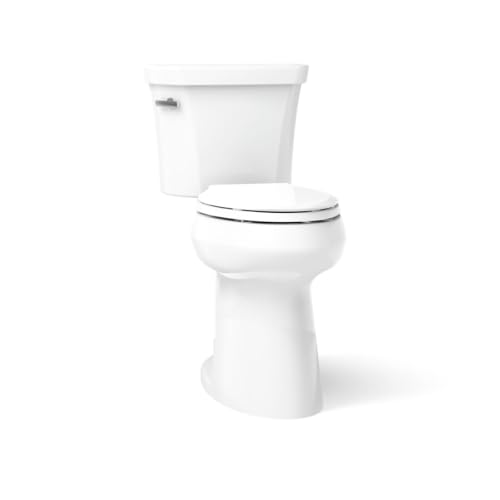
Two-piece elongated toilets and skirted (concealed trapway) one-piece models fit a traditional bathroom best. Two-piece toilets with a visible tank and standard round or elongated bowl evoke the classic look most directly, while skirted one-piece toilets offer a cleaner silhouette for bathrooms that pair traditional molding with a somewhat updated feel. Avoid wall-hung toilets and tankless smart toilets in strictly traditional rooms, as those silhouettes read as contemporary.
The toilet is the largest vitreous china element in any bathroom and the most visible plumbing fixture. In a traditional design, choosing the right toilet profile is as important as choosing the right vanity style.
| Model | Style | GPF | MaP Score | WaterSense | Trapway | Check Price |
|---|---|---|---|---|---|---|
| TOTO Drake (CST744SL) | Two-Piece, Elongated | 1.28 | 1,000 g | Yes | 3-inch flush valve, 2-1/8 inch fully glazed | Check price |
| TOTO Drake II (CST454CEFG) | Two-Piece, Elongated | 1.28 | 1,000 g | Yes | 3-inch flush valve, 2-1/8 inch fully glazed | Check price |
| Kohler Highline (K-3999) | Two-Piece, Elongated | 1.28 | 800+ g | Yes | Class Five 2-1/8 inch fully glazed | Check price |
| American Standard Champion 4 (2034.014) | Two-Piece, Elongated | 1.6 | 1,000 g | No (1.6 GPF) | 4-inch accelerator flush, 2-3/8 inch fully glazed | Check price |
| American Standard Cadet 3 (2403.128) | Two-Piece, Round/Elongated | 1.28 | 1,000 g | Yes | 3-inch Speed Connect, 2-1/8 inch fully glazed | Check price |
| Kohler Cimarron (K-3589) | Two-Piece, Elongated | 1.28 | 800+ g | Yes | Class Five 2-1/8 inch fully glazed | Check price |
| Gerber Viper (21-302) | Two-Piece, Elongated | 1.28 | 1,000 g | Yes | Fully glazed 2-1/8 inch | Check price |
| Woodbridge T-0001 | One-Piece, Skirted, Elongated | 1.28 / 0.8 dual | 800 g | Yes | Fully skirted, 2-1/8 inch | Check price |
The best flushing toilets for any design category are tested using the Maximum Performance (MaP) protocol, which measures how many grams of solid waste a toilet can clear in a single flush. A score of 800 g or higher is considered excellent; 1,000 g is the top rating. All models in the table above achieve 800 g or better, making them genuinely capable flush performers regardless of the aesthetic context you place them in.
For a traditional bathroom, the TOTO Drake two-piece elongated toilet is the most widely specified model among plumbing designers because its proportions -- a low-profile tank and a classically shaped bowl -- echo older toilet silhouettes while delivering a MaP-certified 1,000 g flush at 1.28 GPF. Its G-Max flushing system has been on the market since 2004 with near-zero complaint rates in aggregated owner review data. If you prefer a cleaner contemporary-traditional hybrid look, the Woodbridge T-0001's fully skirted one-piece body hides the trapway and is easy to clean, but its bowl profile reads slightly more modern. For a strictly formal traditional room, stay with the TOTO Drake or the Kohler Highline.
Standard toilet height (rim height 14 to 15 inches) was the norm before the ADA comfort-height movement. Traditional bathrooms historically used standard height, which is appropriate for able-bodied adults of average stature. If comfort height (16 to 18 inches rim height) is medically necessary or preferred, TOTO, Kohler, and American Standard all produce their most popular traditional-profile models in comfort height versions without changing the tank or bowl silhouette materially. The TOTO Drake in comfort height is the CST744SLB.1 (Sedona Beige is one available color option for period-appropriate warmth).
See our related guide on ADA-compliant toilet options for full dimension tables and NKBA clearance requirements.
The three tile patterns most authentically traditional for bathroom use are: 3x6-inch white subway tile in a stacked or brick-offset pattern on walls; 1-inch white hexagonal mosaic tile with black dot accents on floors; and basketweave tile (alternating rectangular and square tiles in a woven matrix) for floors in powder rooms or master baths. These three patterns appear in American bathroom design as early as the 1890s and have never genuinely gone out of fashion.
The 3x6 subway tile is the single most versatile traditional wall tile. It was invented in 1904 for the New York City subway system and adopted almost immediately into residential bathrooms because of its easy-clean glazed surface and its visual rhythm of horizontal lines that make rooms feel wider. Standard installation uses a half-brick offset pattern (each tile shifted 50% from the row below). A stacked bond (tiles aligned vertically) reads more contemporary. For a high-traditional look, install subway tile to wainscot height (around 42 to 48 inches) with a pencil liner cap, then paint above.
Larger format tiles such as 4x16 or 4x12 subway variants are popular in transitional interpretations but can feel slightly off-period in a strictly traditional scheme. For shower surrounds in a traditional bath, a 4x16 white ceramic in a horizontal stack is a reasonable compromise. Natural stone tile -- Carrara marble in particular -- is period-appropriate and genuinely traditional, but its maintenance requirements (sealing every 12 to 24 months) make it a commitment. Porcelain that mimics Carrara grain performs comparably for most buyers.
The hex mosaic floor is so strongly associated with traditional American bathrooms that its continued use in 21st-century renovations reads as authentically historical rather than retro. A 1-inch or 2-inch white hexagonal mosaic tile on a mesh backing with standard white grout delivers a coefficient of friction (COF) of 0.60 or higher in most ANSI A137.1-rated products -- above the 0.42 minimum recommended for wet bath floors. Adding a small black hex or dot accent in a border or random field pattern is a classic period detail that adds visual interest without breaking the color palette.
Basketweave floors (a pattern of small rectangular tiles flanking a square center tile, all in a woven repeat) are seen frequently in 1910s to 1940s American homes. For a master bath with an antique or clawfoot tub, a basketweave floor in white Thassos marble or white porcelain with dark gray grout is the most authentically period choice available.
Traditional bathroom hardware is selected based on finish, profile shape, and coordination across all metal elements in the room. Chrome remains the most historically accurate finish for a traditional bathroom and the easiest to maintain. Oil-rubbed bronze and unlacquered brass are period-appropriate alternatives for warmer color schemes. All hardware in a room -- faucet, towel bars, toilet paper holder, robe hooks, shower arm, and door hinges -- should share the same finish for visual coherence.
Traditional faucet profiles feature cross or lever handles, a gooseneck or traditional curved spout, and exposed fittings. The Kohler Bancroft, Moen Brantford, and Delta Cassidy lines are three of the most widely used traditional bathroom faucet families because they are available in coordinating bath accessories, are offered in multiple finishes, and are stocked nationally for easy replacement parts. Two-handle widespread faucets (with separate hot and cold valves on 8-inch centers) are more traditional than single-handle models and pair better with recessed-panel vanities with wider aprons.
Traditional vanities use recessed-panel or raised-panel door styles in either a painted finish (most common: white, soft gray, or navy) or a stained hardwood such as maple, birch, or oak. Inset cabinet doors (where the door sits flush inside the frame rather than overlaying it) are the most formal traditional choice and the most expensive to build correctly. They require precise alignment and high-quality hinge hardware. Full-overlay doors with a traditional profile are a practical compromise widely used in production cabinetry lines by Kraftmaid, Merillat, and Medallion.
Vanity tops in traditional bathrooms use marble, quartz with a marble look, or solid surface materials. Cultured marble (a resin-and-marble-powder composite) was the dominant traditional bath top from the 1970s through the 1990s and is still widely available because it is cast with an integrated sink, eliminating the seam that collects mold in drop-in sink installations. It is not as durable against scratching as solid quartz but can be polished and resealed in place.
Traditional bathroom lighting uses bath bars or sconces mounted at eye level on either side of the mirror (approximately 60 to 65 inches from the floor to the center of the fixture), or a centered bar above the mirror if lateral space is insufficient. Shaded sconces in a drum, globe, or bell shape in a chrome, nickel, or oil-rubbed bronze finish work with almost all traditional palette schemes. For high-traditional master baths, a small chandelier centered over a freestanding tub is both functional and period-correct, provided the ceiling height is 8 feet or more. All bathroom lighting must be rated for damp or wet locations per NEC Article 410.
A framed mirror in a matching wood finish to the vanity is the traditional choice. Medicine cabinets with a framed wood door are also traditional and highly functional. Frameless rectangular mirrors read as contemporary. For formal traditional bathrooms, an ogee or rope-molded frame profile matches the detail level of recessed-panel cabinetry. Mirror sizes traditionally scale to the vanity width: a 48-inch vanity typically takes a 36 to 42-inch mirror to leave room for the sconces without crowding.
Vitreous china for plumbing fixtures, ceramic or porcelain tile for floors and walls, and solid wood (painted or sealed) for cabinetry are the three surface categories that have demonstrated the greatest durability over decades of bathroom use. Chrome and brushed nickel hardware with solid brass cores outlast zinc alloy or pot metal alternatives significantly. Natural stone is beautiful but requires routine maintenance to prevent staining and etching in high-moisture environments.
Modern toilet and sink manufacturers apply proprietary glaze coatings over vitreous china to reduce staining and bacterial adhesion. TOTO's CeFiONtect glaze creates an exceptionally smooth surface that requires less frequent cleaning and resists the yellowing that uncoated china develops over decades of exposure to hard water and cleaning chemicals. American Standard's EverClean antimicrobial glaze is another widely referenced option. Both are applied during the firing process and are not a paint or aftermarket coating, so they do not wear off under normal cleaning.
For a traditional bath intended to last 20 to 30 years before the next major renovation, specifying a toilet and sink with a factory glaze coating such as CeFiONtect or EverClean is a low-cost upgrade (usually no additional charge on models that include it standard) that meaningfully extends the clean appearance of the fixture over time. See our dedicated review of EverClean glaze for more detail on cleaning performance.
Grout is the most maintenance-intensive surface in a traditional tiled bathroom. Traditional white grout in a subway tile installation shows mold growth and discoloration within 2 to 5 years without regular sealing and cleaning. Three practices extend grout life materially: using a polymer-modified grout rather than unsanded grout; applying a penetrating silicone grout sealer on installation day and annually thereafter; and using a 2 to 1 bleach-to-water solution on mold spots rather than abrasive cleaners that degrade the grout surface. Epoxy grout is the most durable option (nearly impervious to staining) but is more difficult to install and less common in DIY renovations.
For the joint between the tub or shower floor and the wall tile, use silicone caulk rather than grout. Grout in movement joints cracks within months as the tub flexes under load. A color-matched 100% silicone sealant (available in white, almond, and clear from GE, DAP, and Mapei) applied in a single smooth bead at installation holds this critical joint for 10 or more years before replacement is needed.
Wainscoting -- wall paneling applied from the baseboard to a chair rail height of roughly 36 to 42 inches -- is one of the defining visual elements of a traditional bathroom. It comes in three main execution methods: beadboard (narrow vertical planks with a V-groove channel between them, historically associated with Victorian and cottage styles); recessed-panel wainscoting (raised stiles and rails framing a flat recessed center, more formal and Federal or Colonial in character); and tile wainscoting (subway or field tile to chair rail height capped with a bullnose or decorative liner tile).
In wet zones such as shower surrounds, tile wainscoting is the only appropriate choice. In dry zones -- the wall behind the toilet, the wall flanking the vanity -- painted MDF or wood wainscoting is common and cost-effective. Paint-grade MDF wainscoting kits from manufacturers like House of Antique Hardware and similar suppliers install in a single weekend and transform a flat-walled bathroom into a traditional space for a few hundred dollars in materials.
A traditional bathroom sometimes incorporates a clawfoot tub or freestanding tub, which requires freestanding tub fillers (floor-mounted or deck-mounted faucets on a pedestal) rather than standard tub deck fittings. Freestanding tub fillers require a supply line buried in the floor, which means planning the rough plumbing before tile installation. If your renovation is adding a freestanding tub where a built-in alcove tub previously was, budget for subfloor work and confirm that your floor structure can support the concentrated load (a cast iron clawfoot tub filled with water can weigh 500 to 800 pounds).
For shower enclosures in a traditional bathroom, frameless glass panels with minimal hardware in chrome or brushed nickel read cleanly without competing with the detailed tilework. Fully framed aluminum shower doors in a chrome finish are period-appropriate for 1950s to 1970s traditional homes but look dated in a renovated space trying to feel timeless. A frameless door on a single pivot hinge is the most timeless choice. Read our accessibility guide if the shower user has mobility considerations that may influence the door type or threshold height.
Long-term value in a traditional bathroom toilet depends on three factors: flush reliability (does it clear the bowl in a single flush consistently?), parts availability (can you find a replacement flapper, fill valve, or flush valve 15 years from now?), and aesthetic durability (does the profile look as correct in a traditional bathroom a decade from now as it does today?).
On flush reliability, the TOTO Drake two-piece has one of the longest uninterrupted production histories in the North American market. Its G-Max and E-Max flush mechanisms use a large-diameter 3-inch flush valve that generates significant water column pressure on activation. Aggregated owner reviews across Lowe's, Home Depot, and Amazon consistently rate it at 4.6 to 4.8 out of 5 stars across thousands of verified purchases. The Kohler Highline uses Kohler's Class Five flushing technology with a 2-1/8-inch fully glazed trapway and similarly earns top marks in long-term owner satisfaction surveys.
On parts availability, both TOTO and Kohler maintain parts programs for discontinued and in-production models. Kohler's GP family of flush valves and fill valves has been backward-compatible across multiple Highline generations. American Standard's Speed Connect system (used in the Cadet 3) allows tank-to-bowl connection without any tools and uses replacement parts that have remained in production continuously since the early 2000s. Gerber, a subsidiary of Globe Union, has strong dealer parts support in the US and Canada. For a toilet that will be used daily for 20-plus years in a permanent home, specifying from these four brands reduces the likelihood of an orphaned part.
See our American Standard Cadet 3 review for a deeper look at how that model performs for traditional-bath buyers on a mid-range budget.
The one specification decision that most remodelers overlook is the rough-in dimension. Most toilets ship with a 12-inch rough-in (the distance from the finished wall behind the toilet to the center of the floor flange). Older homes built before 1960 may have 10-inch or 14-inch rough-ins. Ordering the wrong rough-in creates a gap behind the toilet tank or prevents the toilet from sitting flush against the wall -- both cosmetically unacceptable in a traditional design where tight, clean lines matter. TOTO and American Standard offer many of their core models in 10-inch and 14-inch rough-in versions; Kohler does as well. Measure the existing rough-in before ordering any toilet.
EPA WaterSense-certified toilets use 1.28 GPF or less -- 20% less than the federal maximum of 1.6 GPF. In a household of four people flushing an average of five times per day each, upgrading from a 3.5 GPF toilet (common in homes built before 1994) to a 1.28 GPF WaterSense model saves approximately 9,000 gallons per year, according to EPA published estimates. In many water districts, this qualifies for a rebate of $25 to $150 per toilet.
WaterSense certification requires flush performance testing in addition to flow-rate testing, meaning a toilet cannot earn the label by simply restricting water flow if it sacrifices waste clearance. This makes WaterSense certification a useful minimum filter when evaluating traditional-style toilets: any model bearing it has cleared the EPA's performance threshold in addition to meeting the 1.28 GPF limit. All of the TOTO, Kohler, and American Standard Cadet 3 models in the table above carry WaterSense certification. The American Standard Champion 4, which uses 1.6 GPF, does not but delivers outstanding clog resistance through its oversized 4-inch flush valve and 2-3/8-inch fully glazed trapway -- the largest trapway in the standard residential market.
Traditional bathrooms emphasize formal symmetry, ornate hardware profiles, period tile patterns (subway, hex mosaic, basketweave), and recessed-panel cabinetry. Transitional design softens these elements with cleaner lines, less molding, and simpler hardware -- it bridges traditional and contemporary without committing fully to either.
Yes, historically. Two-piece toilets (separate tank and bowl) were the standard design for virtually all of the 20th century. One-piece toilets became widely marketed in the 1980s. For a strictly period-correct traditional bathroom, a two-piece toilet in white with a round or elongated bowl is the most authentic choice.
The American Standard Cadet 3 is consistently cited as the best value traditional-style toilet. It delivers a MaP-certified 1,000 g flush at 1.28 GPF (WaterSense certified), uses a fully glazed 2-1/8-inch trapway, and is available in a two-piece elongated configuration at a lower cost than comparable TOTO or Kohler models. Parts are widely stocked at major home improvement retailers.
White grout with white subway tile is the most historically authentic combination, mimicking the look of early 20th-century institutional and residential bathrooms. Light gray grout (such as Mapei Warm Gray or Keracolor Platinum) is a popular modern interpretation that hides discoloration better while still reading as traditional.
Yes, and it is one of the most authentically period choices available. Pedestal sinks dominated residential bathrooms from the 1890s through the 1950s before vanity cabinets became standard. Modern pedestal sinks from Kohler (Memoirs, Devonshire lines), American Standard (Retrospect, Boulevard), and TOTO (Promenade) maintain traditional proportions while meeting current water efficiency requirements.
Polished chrome is the most historically accurate traditional bathroom hardware finish, used in American bathrooms since the early 1900s. Oil-rubbed bronze became popular in the 1990s as a traditional-leaning alternative with a warmer tone. Unlacquered brass (which develops a natural patina) is the most formal Victorian-era choice. Brushed nickel is a softer modern interpretation that pairs well with transitional-traditional schemes.
Use a pedestal sink instead of a vanity to preserve visual floor space. Install subway tile to ceiling height to draw the eye upward. Use a round-front toilet rather than elongated to gain 2 inches of depth clearance. Add a framed mirror with a bold molding profile to create a focal point. Keep hardware finishes unified to reduce visual noise.
Traditional bathroom wainscoting typically runs 36 to 42 inches from the floor to the chair rail cap in dry areas, and 48 to 60 inches in wetter zones near the tub or vanity. Tile wainscoting in a shower surround is typically installed to full height (ceiling or 72 to 84 inches minimum in a walk-in shower per most building codes).
Yes. The visible silhouette difference between a standard-height (14 to 15 inches) and comfort-height (16 to 18 inches) toilet is subtle enough that most observers cannot identify it by sight. TOTO, Kohler, and American Standard produce their most popular traditional models in both heights using the same tank and bowl profile, so the aesthetic is not materially affected.
Marble is historically appropriate and beautiful in a traditional bathroom but requires maintenance. It must be sealed on installation and resealed every 12 to 24 months to resist moisture absorption. It is also susceptible to etching from acidic cleaning products. Polished Carrara marble is the most popular variety for traditional bath floors. Honed (matte-finish) marble is more slip-resistant but shows water spots more readily.
MaP (Maximum Performance) testing measures how many grams of simulated solid waste a toilet can evacuate in a single flush. A score of 350 g is the minimum acceptable; 800 g or higher is excellent; 1,000 g is the maximum test load. Toilets earning a 1,000 g MaP score -- including the TOTO Drake, American Standard Cadet 3, and Champion 4 -- will almost never clog under normal residential use conditions.
The trapway is the S-shaped internal passage through which waste exits the toilet bowl. A fully glazed trapway has the same smooth ceramic coating as the visible interior of the bowl, which reduces friction, prevents waste adhesion, and makes the flush more powerful and clog-resistant. Partially glazed or unglazed trapways are more prone to buildup over time. All models in this guide use fully glazed trapways.
An unskirted toilet has a visible trapway on the outside of the bowl, which is the traditional look for most two-piece toilets. A skirted toilet wraps smooth porcelain around the outside of the trapway, creating a flat side surface that is easier to clean and gives a more streamlined look. Skirted designs are associated with contemporary and transitional styles but appear on some traditional-friendly models like the Woodbridge T-0001.
A quality traditional bathroom renovation using vitreous china fixtures, ceramic or porcelain tile, solid wood or MDF cabinetry, and solid brass-core hardware can last 20 to 40 years before requiring significant updates. The style itself does not trend out of fashion, which means the design investment retains its visual value far longer than contemporary or trend-driven aesthetics.
Traditional bathroom design consistently performs well in resale scenarios, particularly in established neighborhoods where homes feature pre-1990 architecture. According to Remodeling Magazine's annual Cost vs. Value report, a midrange bathroom remodel typically recoups 60 to 70 percent of its cost at resale. Traditional finishes such as subway tile, white fixtures, and chrome hardware appeal to the broadest buyer pool and avoid the polarizing reactions that heavily contemporary or ultra-bold designs can provoke.
For a guest bathroom where aesthetics are important but daily heavy use is not expected, the Kohler Highline in white with a Polished Chrome trip lever is a strong choice. Its classic tall-tank profile has been in production for decades and matches the visual expectation of a formal traditional guest bath. It carries WaterSense certification at 1.28 GPF and uses Kohler's Class Five flushing technology for reliable single-flush performance.
Round-front bowls (approximately 16.5 inches from seat bolt to front rim) are the more historically common shape and are appropriate for smaller bathrooms where gaining 2 inches of depth clearance matters. Elongated bowls (approximately 18.5 inches) are considered more comfortable by most adults and have been increasingly dominant since the 1990s. Either is appropriate in a traditional bathroom; the choice is driven by space and personal comfort preference, not aesthetics.
Clawfoot tubs are among the most authentically traditional elements possible in a bathroom and are well suited to Victorian, Craftsman, Colonial, and Georgian style homes. Modern reproduction clawfoot tubs are available in cast iron (heaviest, best heat retention, most period-correct) and acrylic (lighter, less expensive, easier to install). Cast iron requires verifying that the floor structure can support the concentrated weight before installation.
IRC Section M1507 and most local building codes require a minimum exhaust ventilation rate of 50 CFM for intermittent use or 20 CFM continuous in a bathroom. For a traditional bathroom with wood wainscoting, wood cabinetry, and natural stone, adequate ventilation is especially important to prevent moisture damage to organic materials. A quiet bathroom exhaust fan (rated at 0.3 sones or less) can be installed in a traditional bathroom without disrupting the visual design since the grille is ceiling-mounted and largely invisible.
In a dark or windowless traditional bathroom, use bright white tile throughout (subway or hex) and a soft warm white on any painted surfaces. Polished chrome hardware reflects light better than oil-rubbed bronze in low-light conditions. Install sconces at eye level on both sides of the mirror rather than relying on a single overhead fixture. A well-placed vanity mirror with a tall framed surround can visually double the light from your sconces.
A traditional bathroom built on white vitreous china fixtures, classic tile patterns, recessed-panel cabinetry, and unified hardware finishes is one of the most durable and resale-friendly design investments a homeowner can make. For the toilet, the TOTO Drake two-piece elongated in white stands out as the model that best honors the traditional aesthetic while delivering a MaP-certified 1,000 g flush at 1.28 GPF with WaterSense certification. Pair it with a Kohler or Delta faucet in chrome, 3x6 white subway tile, and a painted wainscoting profile in the 36 to 42-inch range for a bathroom that looks considered, performs reliably, and requires no apology in any era.
Thirty inches is the sweet spot between a cramped 24-inch vanity and a full 36-inch cabinet, giving a single-sink bathroom real drawer…
Read the guide
Cast iron is the material homeowners choose when heat retention and permanence matter more than installation weight, and Kohler remains the brand…
Read the guideStep-by-step fixes for the bathroom vanity problems that show up most often, from misaligned drawers and doors to water damage at the…
Read the guide