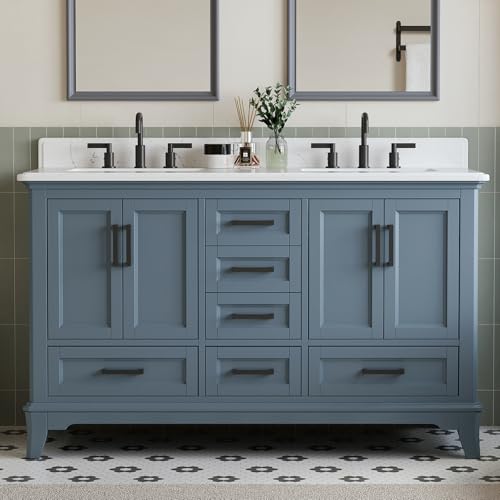
Best Bathroom Vanities for a Primary Bathroom (2026)
Bathroom Remodeling4.6
A primary bathroom vanity anchors the room's daily routine and its storage, which is why size, double-sink capacity, and drawer organization matter…
Read the guideA bathroom vanity does double duty in a lot of pet households: it hides the litter box or feeding station, stores grooming supplies, and, if the cabinet latch is not secure, gives a curious dog or cat direct access to cleaning chemicals and medications. This guide covers built-in pull-out pet feeding stations some vanity and cabinet lines now offer, how to retrofit pet storage into an existing vanity, and the cabinet latch hardware that actually keeps pets out of what is stored underneath.
Research updated July 2026.
A vanity's own cabinet base is rarely built for pet feeding out of the box, but a growing number of custom and semi-custom cabinet lines now offer a pull-out drawer insert with built-in food and water bowls that tucks flush into a vanity or adjacent cabinet toe-kick when not in use. For most households, retrofitting an existing vanity's lower cabinet with a slide-out tray and stainless bowls, plus a genuinely secure childproof-style latch on any door storing cleaning supplies, delivers most of the same benefit without a custom build.
Pets and bathroom vanities intersect in three practical ways: feeding and water stations that owners want tucked out of the way, grooming supply storage that needs to be organized and pet-accessible for humans but not pet-accessible for the animal, and the real safety gap of curious pets getting into cleaning chemicals stored in the same cabinet a litter box or feeding station sits near. Each of these has a specific, buyable solution rather than a single universal fix.
This guide covers built-in and retrofit pull-out feeding stations, cabinet organization for grooming supplies, and the latch hardware that actually stops pets, not just kids, from opening a cabinet door. For general vanity storage strategies that also apply to pet households, see the bathroom storage ideas guide.
A small but growing number of custom and semi-custom cabinetry manufacturers offer a pull-out pet feeding drawer as an add-on module, most commonly in kitchen cabinet lines and increasingly available for bathroom vanity cabinetry ordered through the same custom cabinet shops. The drawer holds two embedded stainless steel bowls flush with the drawer face, slides out on the same soft-close runners as a normal drawer, and tucks fully closed when not in use, keeping the vanity's front panel visually uninterrupted.
This is not yet a standard feature on off-the-shelf big-box vanities from major toilet and fixture brands, so households wanting a factory-integrated pet feeding drawer are generally looking at a custom cabinet order rather than a stock purchase. The cost and lead time of a custom order is the main tradeoff against the more common retrofit approach below.
Households planning a full vanity replacement or new bathroom build who want this feature should ask custom cabinet makers directly, since the module is usually not listed as a standard catalog option even where the shop is capable of building it.
The most practical retrofit is a slide-out tray or drawer organizer, sized to the existing cabinet opening, fitted with two raised stainless steel or ceramic bowls that sit slightly recessed so they do not tip during normal pet use. These trays install on basic drawer slide hardware inside an existing vanity's lower cabinet, requiring no changes to the cabinet box itself, and pull forward for feeding, then push back in when not in use.
For vanities with open floor space beneath a pedestal sink or a vanity with an open shelf rather than a closed cabinet, a simple raised pet feeding stand with a non-slip base placed directly on that open shelf achieves a similar tucked-away look without any drawer hardware at all. This works especially well in bathrooms where the vanity's lower shelf already sits unused.
Whichever approach is used, place the feeding station away from the direct path of the vanity's cabinet doors and any adjacent toilet, so opening a door or using the toilet does not routinely disturb food or water bowls, and clean the area at the same frequency as the rest of the bathroom floor to avoid moisture buildup around the bowls.
A retrofit slide-out tray gets you roughly 90 percent of the benefit of a custom-built pet feeding drawer at a small fraction of the cost and with a same-week installation instead of a custom order. Reserve the full custom cabinet route for a ground-up bathroom remodel where the added cost is a rounding error against the rest of the project; for an existing vanity, retrofit first.
The same magnetic and strap-style childproof cabinet latches sold for keeping toddlers out of under-sink storage work equally well against most dogs and cats, since both rely on blocking the door from opening rather than relying on a child's inability to figure out a mechanism. Dogs, particularly larger and more determined breeds, can sometimes defeat a lightweight adhesive-mounted latch through sustained pushing or pawing in a way a toddler typically cannot, so households with strong or persistent dogs should look at a latch rated for higher pull-force or a mechanical hook-and-loop strap latch rather than the lightest adhesive options.
Cats are less likely to force a latched door open through brute strength but are notably better than dogs at manipulating simple hooks or unlatched cabinet doors with a paw, so a latch that requires a genuine push-and-slide or magnetic key motion, rather than a simple hook a paw could flip, is the more reliable choice in cat households.
Whatever latch is used, the underlying rule does not change from the childproofing case: any cabinet storing drain cleaner, toilet bowl cleaner, bleach-based products, or medications needs a real latch, not just a closed door, in any household with a pet that has access to the bathroom.
| Latch Type | Best Against | Installation | Notes |
|---|---|---|---|
| Adhesive Magnetic Latch | Cats, small dogs | No drilling, adhesive mount | Weakest against sustained force from large dogs |
| Strap/Hook Latch | Dogs and cats | No drilling, adhesive or screw mount | Good general-purpose option, higher pull resistance |
| Sliding Bar Latch | Large, persistent dogs | Screw-mounted for strength | Highest holding force, most secure |
| Simple Hook-and-Eye | Neither reliably | Screw-mounted | Easily flipped open by a cat's paw |
| Closed Door, No Latch | Not effective | None | Not a real barrier for most pets within weeks |
Many households place a litter box in the open floor space beneath a pedestal sink or beside a vanity cabinet, which works well as long as the vanity's cabinet doors do not swing directly into that space and airflow around the box is not blocked. A vanity with a closed cabinet base is a poor location for a litter box itself, since ventilation is limited, but the adjacent open floor space next to the cabinet, or a repurposed lower vanity drawer with the front panel removed and a litter mat placed beneath, both work as tucked-away placement options in a small bathroom.
Grooming supplies, brushes, nail clippers, and shampoo, are well suited to a vanity's upper drawers, ideally the same drawer organizers used for cosmetics and personal care items, since these are supplies a pet does not need protected access away from, only tidy storage. Reserve the latched lower cabinet strictly for chemicals and hazardous items, and keep pet grooming supplies in the more accessible upper storage where they are actually easy to reach during use.
The following picks retrofit into most existing vanities or adjacent floor space without requiring a custom cabinet order.

A slide-out feeding tray with two recessed stainless steel bowls fits into the lower cabinet of most standard vanities using basic drawer slide hardware, giving pets a stable feeding spot that disappears behind a closed cabinet door when not in use.
Measure the cabinet opening width and depth before ordering, since fit varies by model, and confirm the tray's slide hardware clears any existing plumbing supply lines running through the cabinet interior. Owner feedback on similar kitchen-cabinet feeding drawers, which use the same mechanism, notes that the recessed bowl design significantly reduces spill compared to a flat tray with bowls simply resting on top.
This is the retrofit that gets closest to a true built-in feeding station without a custom cabinet order. Check for plumbing clearance inside the cabinet before buying, since a vanity's supply lines and P-trap sometimes occupy more of the lower cabinet depth than a similar kitchen cabinet would.

A sliding bar latch mounted across two adjacent cabinet doors holds against sustained pawing and pushing from larger, more determined dogs far better than lightweight adhesive latches, keeping cleaning supplies genuinely out of reach.
Screw-mounted hardware means this latch is not a no-drill option, so renters should use the strap-latch alternative below instead unless landlord approval covers the small screw holes involved. For owned homes with a strong dog and hazardous chemical storage, the added security is worth the minor installation step.
Most cabinet latch failures with dogs come down to underestimating sustained force versus a single push. A determined dog will paw at a latch repeatedly over minutes, not seconds, and a lightweight adhesive latch that survives one push can still fail under that repeated pressure. Size the latch to the dog, not to the lightest available option.

An adhesive-mounted strap latch secures a vanity cabinet door against curious cats and most dogs without a single screw, making it the right choice for renters who cannot drill into a fixture they do not own.
Clean the cabinet surface with rubbing alcohol before applying the adhesive mount, and allow full cure time before relying on the latch. This is the same adhesive-mount logic renters use for shelving and other no-drill upgrades, and it holds up well against the pull force of most cats and smaller dogs, though it is not rated for a large, determined dog's sustained pushing.
For renters, this is the correct default latch, since it leaves the vanity exactly as it was at move-out. If a large dog defeats it, that is a real signal to step up to a screw-mounted sliding bar latch with landlord approval rather than doubling up on adhesive strength alone.
Pet hair, moisture from wet paws and fur, and occasional splashed water and food make bathroom vanities in pet households work harder than average. Solid wood and plywood cabinet boxes tolerate incidental moisture better than MDF or particleboard over years of use, the same durability logic that applies to any bathroom vanity in a humid environment. Matte or satin cabinet finishes hide scratches from claws better than high-gloss finishes, and a countertop material resistant to scratching, quartz or solid surface over cultured marble, holds up better if pets are regularly jumping up onto the vanity top itself.
For flooring directly around a feeding station or litter box, a washable mat placed under the bowls or box catches spilled water, food, and litter tracking before it reaches the actual bathroom floor, and is far easier to clean or replace than trying to keep the floor finish itself spotless.
It is possible but not ideal without modification, since a closed vanity cabinet limits airflow and odor dissipation significantly compared to open floor space. If a cabinet location is the only option, remove or prop open the cabinet door, or cut a ventilation opening, rather than closing a cat into a sealed box inside a fully enclosed cabinet.
Not reliably. Magnetic latches work well against cats and smaller dogs but are more prone to being forced open by a large, determined dog's sustained pushing or pawing than a mechanical strap or sliding bar latch. Households with large or persistent dogs should choose a latch rated for higher pull force rather than the lightest adhesive magnetic option.
Drain cleaners, toilet bowl cleaners, and bleach-based disinfectants are among the most hazardous products commonly stored under a bathroom vanity, since they can cause serious chemical burns or poisoning if a pet chews through a container or licks a spill. These products belong in a latched cabinet, ideally positioned away from where a pet regularly spends time, such as near a feeding station or litter box.
A slide-out feeding tray retrofit can be added to most standard vanity cabinets with an open lower compartment 15 inches or wider, using basic drawer slide hardware. A fully integrated, flush-front feeding drawer built into the cabinet face itself is typically a custom cabinet order rather than a retrofit onto an existing stock vanity.
Cats are notably skilled at flipping open simple hooks with a paw, so a hook-and-eye latch is one of the least reliable options against a determined cat. A latch requiring a push-and-slide motion or a magnetic key, rather than a simple lift-and-flip hook, is much more resistant to cat manipulation.
Storing pet and human medications together in the same latched cabinet is generally fine from a security standpoint, since the goal is simply keeping all medications out of pet and child reach, but keep them clearly labeled and separated within the cabinet to avoid mix-ups when reaching for a specific medication, particularly under time pressure.
A washable silicone or rubber mat sized larger than the feeding bowls catches spilled water and food before it reaches the bathroom floor and is easy to rinse or wipe clean daily. This protects grout lines and vinyl flooring from repeated moisture exposure far better than relying on the floor finish alone to withstand daily spills.
Adhesive latches bond most reliably to smooth, painted, or laminate cabinet surfaces and less reliably to heavily textured or unfinished wood surfaces. Clean the surface with rubbing alcohol and test the latch's hold for 24 to 48 hours with light pressure before fully relying on it, especially on any surface that is not smooth and non-porous.
Yes, primarily through claw scratches on cabinet fronts near floor level and moisture damage from repeated contact with wet paws or spilled water near a feeding station. Matte or satin finishes hide minor scratches better than high-gloss finishes, and placing a washable mat under feeding stations reduces moisture exposure to the cabinet base significantly.
It depends on what is being stored. An open shelf works well for a feeding station or grooming supply basket that does not need to be pet-proofed, since there is nothing hazardous involved. A closed, latched cabinet is the better choice for anything you specifically need to keep away from the pet, such as cleaning chemicals or medications.
Daily rinsing and a more thorough wash every two to three days is a reasonable baseline for pet food and water bowls, similar to standard veterinary hygiene guidance for feeding equipment generally. Removable stainless steel bowls in a slide-out tray make this easier than bowls fixed permanently into a custom drawer, since they can be pulled out and washed in a sink directly.
Most pet households do not need a fully custom vanity to get pet-friendly storage right. A slide-out feeding tray retrofits into an existing cabinet's lower compartment for most of the benefit of a built-in feeding drawer, and a genuinely secure latch, sized to the specific pet, closes the real safety gap between "closed cabinet door" and "actually pet-proof." Match latch strength to your pet: adhesive strap latches for cats and smaller dogs, screw-mounted sliding bar latches for large or persistent dogs. Keep hazardous chemicals in the latched cabinet and grooming supplies in the accessible upper drawers, and the vanity works for the whole household, humans and pets included.
How we rank & our data sources
We do not run physical lab tests. Rankings are built from published, verifiable data and real owner feedback, never paid placement.
Researched by admin · Last updated July 20, 2026 · Our review method
A primary bathroom vanity anchors the room's daily routine and its storage, which is why size, double-sink capacity, and drawer organization matter…
Read the guide
A powder room is the smallest, most visible bathroom in the house, seen by nearly every guest but used only for a…
Read the guide
A vanity in a short-term rental takes a different kind of abuse than one in an owner-occupied home: harsh turnover-cleaning products, guests…
Read the guide