
Best 30-Inch Bathroom Vanities (2026)
Bathroom Remodeling4.6
Thirty inches is the sweet spot between a cramped 24-inch vanity and a full 36-inch cabinet, giving a single-sink bathroom real drawer…
Read the guideMDF, medium-density fiberboard, is an engineered wood product made from compressed wood fibers and resin, and it has become the standard material for budget-friendly bathroom vanities because it machines into smooth, consistent panels and, with the right moisture-resistant laminate or coating, holds up reasonably well to bathroom humidity. We compared real MDF construction, moisture-resistant finishes, and configurations from Kingston Brass and other budget-focused vanity brands to find the options that deliver genuine value without cutting corners on the details that matter.
The Kingston Brass moisture-resistant MDF vanity is the best overall MDF bathroom vanity, combining a genuinely sealed laminate surface with budget-friendly pricing for a full vanity package. A compact 24 to 30-inch MDF vanity is the best pick for a small guest bathroom or powder room, and a moisture-resistant MDF double-sink vanity is the top choice for a primary bathroom remodel on a tighter renovation budget.
MDF is not solid wood, and buyers should understand that distinction clearly before purchasing. It is made by breaking wood down into fine fibers, then compressing them with resin under heat and pressure into dense, uniform panels. That manufacturing process is exactly what makes MDF appealing for vanity construction: it has no grain to fight against, machines into perfectly smooth edges and panel faces, and costs meaningfully less than sourcing and milling solid hardwood boards.
Because MDF is more vulnerable to water than solid wood if left unprotected, we weighted moisture-resistant finishing above nearly everything else for this list. A quality MDF vanity uses a sealed laminate, thermofoil, or painted finish that creates a genuine moisture barrier over the fiberboard core, and that finish quality is what actually determines whether a budget vanity holds up or swells and delaminates within a couple of years. For a comparison against real hardwood construction, see our best solid wood bathroom vanities guide.
MDF works well for a bathroom vanity when it is protected by a genuinely moisture-resistant laminate, thermofoil, or painted finish that creates a real barrier between the fiberboard core and bathroom humidity. Its smooth, consistent panels also make MDF vanities more affordable than solid hardwood, since the material requires less labor-intensive milling.
Standard MDF is not waterproof on its own and can swell or deteriorate if directly exposed to standing water over time. A quality MDF bathroom vanity uses a moisture-resistant laminate or sealed coating over the core specifically to address this, and that finish, not the raw MDF, is what determines real-world durability.
A well-finished MDF vanity with a genuine moisture-resistant coating can last many years of normal bathroom use, though it generally has a shorter practical lifespan than solid wood and cannot be sanded and refinished the way solid hardwood can. For most budget-conscious buyers, a quality MDF vanity still delivers years of reliable service at a meaningfully lower cost.
Seven real MDF vanities chosen for moisture-resistant finish quality, hardware durability, and value.
| Vanity | Best For | Key Spec | Notes | Check Price |
|---|---|---|---|---|
| Kingston Brass Moisture-Resistant MDF Vanity | Best overall | MDF, sealed laminate finish | Genuine moisture barrier at a budget price | Check price |
| 24-Inch Compact MDF Vanity | Best small bathroom fit | MDF, 24 to 30 in | Fits powder rooms and small guest baths | Check price |
| 60-Inch MDF Double-Sink Vanity | Best budget primary bathroom double vanity | MDF, 60 in, two basins | Double-vanity function at a fraction of solid wood cost | Check price |
| MDF Vanity Combo with Mirror | Best complete budget package | MDF, includes sink and mirror | Full vanity outfitted in one purchase | Check price |
| Painted Shaker-Style MDF Vanity | Best classic painted look | MDF, painted shaker-style doors | Smooth paint finish MDF handles well | Check price |
| Budget MDF Floating Vanity | Best affordable modern look | MDF, wall-mounted | Contemporary style without solid wood pricing | Check price |
| Thermofoil-Wrapped MDF Vanity | Best seamless moisture barrier | MDF, thermofoil wrap | Continuous wrapped finish resists moisture at edges | Check price |
Each pick is ranked on moisture-resistant finish quality and hardware durability first, then value and design.

The Kingston Brass moisture-resistant MDF vanity is the best all-around budget vanity, combining a genuinely sealed laminate surface with real value for a full bathroom package.
What separates this vanity from a lower-quality MDF piece is the sealed laminate finish, which genuinely bonds to the fiberboard core rather than sitting as a thin, easily chipped surface layer. That finish is the entire reason MDF works in a bathroom at all, since it creates the moisture barrier the raw fiberboard core does not have on its own.
For a bathroom remodel with a real budget constraint, this vanity delivers a complete, functional package, cabinet, countertop, and often a sink, at a fraction of what a comparable solid wood vanity costs. Owner reviews consistently describe the laminate finish holding up well to normal daily use, provided a bathroom fan runs during and after showers.
When budget is the primary constraint on a vanity purchase, we check the finish description closely before recommending any MDF option, and this is one where the sealed laminate is genuinely well executed, not just a marketing term. That detail is what determines whether the vanity lasts.

A 24-inch compact MDF vanity fits the smallest bathrooms and powder rooms while still delivering a moisture-resistant finish and real storage in a minimal footprint.
A powder room or small guest bathroom often has very little floor space to work with, and a 24-inch MDF vanity is sized specifically for that constraint while still including at least basic drawer storage rather than a bare pedestal-style cabinet. Because MDF machines cleanly into smooth panels regardless of size, the compact scale does not sacrifice finish quality compared to a larger vanity.
For a guest bathroom used occasionally rather than daily, the moisture exposure is generally lower than a primary bathroom sees, which makes MDF's finish requirements slightly less demanding here than in a heavily used space. It remains worth confirming the finish is genuinely moisture-resistant regardless of expected usage frequency.
For the smallest bathrooms, we recommend MDF over solid wood almost by default, since the cost savings are significant and a lightly used powder room does not demand solid wood's superior long-term humidity resistance the way a primary bathroom would.
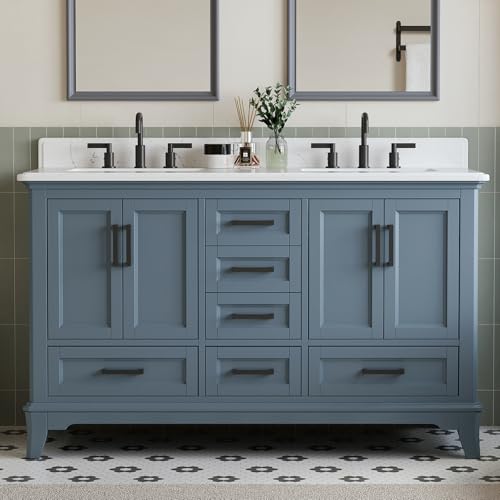
A 60-inch MDF double-sink vanity delivers real double-vanity functionality for a primary bathroom remodel at a fraction of what a comparable solid wood double vanity costs.
A double-sink vanity is one of the more expensive single items in a primary bathroom remodel budget, and building one from MDF rather than solid hardwood is a straightforward way to deliver the same two-basin daily functionality while freeing up budget for a better countertop, faucets, or lighting elsewhere in the project. The moisture-resistant finish approach is the same as smaller MDF vanities, just applied across a larger panel surface.
Because a 60-inch double vanity sees more total daily water exposure across two basins than a single-sink vanity, the quality of the moisture-resistant finish matters even more here, and it is worth checking that the specific model's coating is described as genuinely sealed rather than a basic surface laminate. For a primary bathroom remodel where the budget has to stretch across many fixtures, this is a sensible place to save.
When a primary bathroom remodel budget is tight and something has to give, we often steer the savings toward the vanity material rather than the countertop or faucets, since a well-finished MDF double vanity still delivers full daily function for two people.

An MDF vanity combo bundles the cabinet, countertop, sink, and a matching mirror into one purchase, the most straightforward way to fully outfit a budget bathroom remodel.
Bundling the cabinet, countertop, sink, and mirror into one purchase is a genuine time and cost saver for a budget remodel, removing both the expense and the design guesswork of matching separate components from different manufacturers. The MDF cabinet uses the same sealed laminate approach as standalone MDF vanities, and the included countertop is typically cultured marble, a manufactured material that looks similar to natural stone at a lower cost.
For a full bathroom remodel where speed and simplicity matter as much as cost, a combo kit removes several separate purchasing decisions and generally ships as a coordinated set that installs together cleanly. The tradeoff is less flexibility to mix and match specific finishes compared to building the vanity from individual pieces.
For a first-time DIY bathroom remodel, we recommend a combo kit specifically because it removes the risk of ordering mismatched components. The cultured marble countertop tradeoff is a reasonable one for the simplicity it delivers.

A painted shaker-style MDF vanity takes advantage of MDF's smooth, seamless surface to deliver a crisp, classic painted look that a wood-grain surface cannot match as cleanly.
One place MDF genuinely outperforms solid wood is a painted finish, since MDF's grain-free surface accepts paint in a smooth, even coat without the texture variation that wood grain can telegraph through even a well-applied finish. A shaker-style door, with its recessed center panel, is a classic look that has remained popular for decades and pairs especially well with a clean painted MDF surface.
The main long-term consideration with any painted surface, MDF or solid wood, is that a chip or deep scratch exposes the material underneath, and matching a touch-up paint exactly to a factory finish years later can be difficult. For a classic or transitional bathroom design where a crisp painted look matters more than wood grain visibility, this is a strong MDF application.
When a buyer wants a classic painted vanity rather than a visible wood grain look, we actually recommend MDF over solid wood, since the smoother substrate genuinely takes paint better and costs less to achieve the same crisp result.
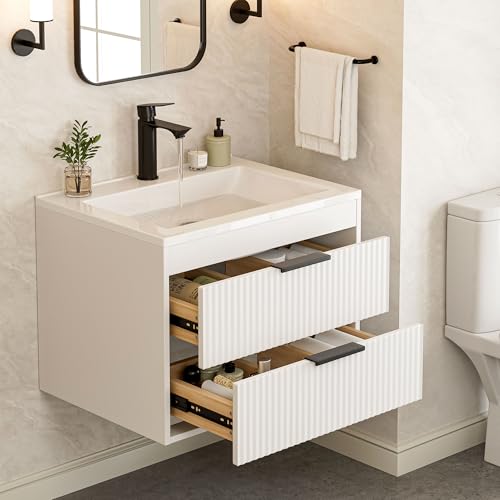
A budget MDF floating vanity delivers a modern, wall-mounted look for a fraction of the cost of a solid wood or premium engineered wood equivalent.
A floating vanity's modern, wall-mounted look is often associated with a higher price point, but MDF construction brings that silhouette within reach of a genuinely budget-conscious remodel. Because MDF is lighter than solid hardwood, the wall-mounting hardware and blocking requirements are somewhat less demanding than for a solid wood floating vanity, though blocking rated for the vanity's weight is still necessary.
For a smaller bathroom that wants the visually open, contemporary feel of a floating vanity without a premium material budget, this delivers that look with the same core moisture-resistant finish approach used across other MDF vanities. It remains important to confirm the specific coating is genuinely sealed given the added exposure a floating design can have around its mounting points.
The floating silhouette is often the single detail that makes a bathroom feel modern and updated, and MDF is how we make that achievable on a real remodel budget rather than reserving it for premium material projects only.

A thermofoil-wrapped MDF vanity uses a continuous, seamless vinyl wrap over the fiberboard core, giving it a genuine advantage at resisting moisture intrusion around panel edges and corners.
Thermofoil is a vinyl film that is heat-and-pressure-fused around an MDF panel as a single continuous wrap, rather than laminate sheets applied to flat faces and joined at seams. That continuous application is a genuine advantage for moisture resistance, since it eliminates the seams where a standard laminate can be more vulnerable to water intrusion over time, particularly around drawer fronts and door edges that see the most daily handling.
For a bathroom with above-average humidity, a smaller room with limited ventilation or a household that showers frequently without running a fan, thermofoil's seamless wrap is worth the modest price difference over standard applied laminate. The one real caution is that thermofoil can peel if exposed to prolonged direct heat, such as a hair styling tool left resting directly against the cabinet.
For a bathroom we know will see heavy daily humidity, especially one without great ventilation, we specifically recommend thermofoil-wrapped MDF over standard laminate. The seamless wrap is a real, measurable upgrade in moisture resistance, not just a different look.
Across all seven picks, the MDF pattern is consistent: the moisture-resistant finish, whether sealed laminate, thermofoil, or paint, is what actually determines how well the vanity performs, not the raw MDF core itself. MDF delivers real value across compact, double-sink, and floating configurations at a meaningful cost savings over solid wood, in exchange for a shorter practical lifespan and no ability to sand and refinish the surface if it is ever damaged.
The right MDF vanity depends on your bathroom's humidity level, your budget constraints, and whether you want a painted, laminate, or thermofoil finish. These checks cover the decisions that matter most.
Standard MDF is not waterproof on its own, so a sealed laminate, thermofoil wrap, or quality painted finish is what actually protects the fiberboard core from bathroom humidity. Check the product description for explicit moisture-resistant finish details before buying.
A bathroom with limited ventilation or frequent daily use benefits from thermofoil's continuous, seamless wrap, which resists moisture intrusion at panel edges and corners better than standard applied laminate.
MDF vanities cost meaningfully less than solid wood, but they cannot be sanded and refinished if the surface is eventually damaged. For a budget remodel or a vanity expected to be replaced within a decade or two, that tradeoff is often worth accepting.
The Kingston Brass moisture-resistant MDF vanity is the best overall pick, with a genuinely sealed laminate finish at a real budget price.
MDF, medium-density fiberboard, is made from wood fibers compressed with resin under heat and pressure into dense, uniform panels, unlike solid wood which uses real hardwood boards.
Standard MDF is not waterproof on its own, but a quality bathroom vanity uses a moisture-resistant laminate, thermofoil, or sealed painted finish to protect the fiberboard core from daily humidity exposure.
No, unlike solid wood, MDF cannot be sanded down and refinished if the surface finish is damaged. A significant chip or water damage typically means the affected panel or the whole vanity needs replacement.
Thermofoil is a vinyl film heat-fused as a continuous wrap around an MDF panel, which resists moisture intrusion at edges and seams better than laminate sheets applied to flat panel faces and joined at seams.
A well-finished MDF vanity with genuine moisture-resistant coating can last many years of normal use, generally a shorter practical lifespan than solid wood, though sufficient for most budget-conscious remodels.
Yes, MDF's smooth, grain-free surface actually takes a painted finish more evenly than solid wood, making it a strong choice for a classic shaker-style or painted vanity design.
Unprotected MDF can swell or deteriorate with prolonged direct water exposure, which is why a genuine moisture-resistant finish, not the raw MDF core, is the detail that determines a bathroom vanity's real-world durability.
Yes, 60-inch MDF double-sink vanities are available and deliver the same two-basin functionality as a solid wood double vanity at a meaningfully lower cost.
MDF is lighter than solid wood, which can simplify wall-mounting requirements, though both still need wall blocking rated for the vanity's weight. MDF also costs less, making the floating look more accessible on a budget.
Yes, running a bathroom fan during and after showers reduces daily humidity exposure and helps any vanity material, including a well-finished MDF vanity, last longer.
MDF delivers genuine value for a budget-conscious bathroom vanity, and the moisture-resistant finish, not the raw fiberboard core, is what actually determines how well it performs over years of daily use. The Kingston Brass moisture-resistant vanity leads for most buyers, a compact 24-inch option handles the smallest bathrooms well, and thermofoil-wrapped MDF is worth the modest upgrade for a bathroom with above-average humidity.
Thirty inches is the sweet spot between a cramped 24-inch vanity and a full 36-inch cabinet, giving a single-sink bathroom real drawer…
Read the guide
Cast iron is the material homeowners choose when heat retention and permanence matter more than installation weight, and Kohler remains the brand…
Read the guideStep-by-step fixes for the bathroom vanity problems that show up most often, from misaligned drawers and doors to water damage at the…
Read the guide