Bathroom Vanity Trends 2026
Bathroom Remodeling4.6
Floating cabinets, mixed-metal hardware, furniture-style pieces, integrated LED mirrors, and a real shift toward sustainable materials, here is what is actually showing…
Read the guideA kids bathroom vanity has to survive daily bumps, spilled toothpaste, and drawers pulled open by small, enthusiastic hands, which shifts the buying priorities toward durable countertop materials, rounded edges, and simple storage kids can actually reach and use. We compared real vanity dimensions, materials, and configurations to find the options built for a kids bathroom's rougher daily demands, from a compact 24-inch single-sink unit to a 60-inch double vanity for siblings sharing a bathroom.
Research updated June 2026.
A 48-inch double-sink vanity with a quartz countertop and rounded edges is the best overall configuration for a kids bathroom shared by siblings, giving each child their own basin and easy-clean storage. A 30-inch single-sink vanity is the right call for a kids bathroom used by one child or with limited floor space, and a vanity with a lower counter height suits a bathroom designed for younger children who need to reach the sink independently.
A kids bathroom vanity takes a different kind of daily punishment than a primary or guest bathroom vanity. Toothpaste gets smeared across the counter, drawers get yanked open and slammed shut, and a step stool is often parked nearby, all of which makes rounded edges, a durable countertop, and simply organized storage more important here than premium finishes or a double-vanity floor plan built for two adults getting ready together.
Because of that daily-use pattern, we weighted safety profile and countertop durability above nearly everything else for this list. A quartz or solid-surface countertop resists staining from toothpaste and craft supplies far better than laminate, and rounded, eased edges reduce the risk of a bump during the running and reaching that comes with a kids bathroom routine. For sink options to pair with any of these vanities, see our best sinks for a kids bathroom guide.
A kids bathroom vanity benefits most from rounded, eased-edge countertops that reduce bump risk, paired with a durable material like quartz that resists staining from toothpaste and craft supplies. If the bathroom is shared by siblings, a double-sink configuration around 48 to 60 inches wide gives each child a dedicated basin, while a single-sink vanity works well for one child or a smaller bathroom footprint.
A 48 to 60-inch double-sink vanity is a practical size for a kids bathroom shared by two siblings, giving each child their own basin during busy before-school routines. A single-sink vanity between 24 and 36 inches works well for a kids bathroom used by one child or a smaller room where floor space is limited.
Quartz is the best countertop material for a kids bathroom vanity because it is nonporous, never needs sealing, and resists staining and scratching from toothpaste, craft supplies, and general daily wear better than laminate or cultured marble. Solid-surface countertops are a reasonable and often more affordable alternative, offering similar stain resistance with a slightly softer overall feel underfoot and at the edges.
Seven real vanity configurations chosen for safety, daily durability, and style in a kids bathroom.
| Vanity Type | Best For | Key Spec | Notes | Check Price |
|---|---|---|---|---|
| 48-Inch Double-Sink Vanity with Rounded Quartz Top | Best overall for siblings sharing | 48 in, quartz counter, two basins | Dedicated basin per child, rounded edges | Check price |
| 30-Inch Single-Sink Vanity | Best for one child or smaller rooms | 30 in, single basin | Compact footprint, easy to keep clean | Check price |
| Lower-Height Vanity for Younger Kids | Best independent reach for young kids | Reduced counter height, single basin | Lets young children reach without a stool | Check price |
| 60-Inch Double-Sink Vanity with Quartz Top | Best maximum storage for siblings | 60 in, quartz counter, two basins | More separation and drawer space per child | Check price |
| 36-Inch Vanity with Full-Extension Drawers | Best organized storage kids can use | 36 in, full-extension drawers | Easy for kids to see and reach items | Check price |
| Budget Vanity Combo with Mirror | Best budget upgrade | Varies, includes sink and mirror | Lower cost complete vanity package | Check price |
| Painted Wood Vanity in a Fun Color | Best playful design statement | Varies, painted wood cabinet | Adds personality to a kids bathroom remodel | Check price |
Each pick is ranked on safety profile and daily durability first, then storage and style.

A 48-inch double-sink vanity with a rounded quartz countertop is the best overall configuration for a kids bathroom shared by siblings, giving each child a dedicated basin with a safer, eased-edge counter profile.
A 48-inch double-sink vanity solves the most common daily friction point in a shared kids bathroom: two children needing a sink and counter space at the same time before school. Each basin sits close enough together to fit a smaller kids bathroom footprint while still giving each child their own space, without the full 60-inch spread built for two adults.
We recommend specifying a rounded or eased-edge quartz counter over a standard sharp square edge for a kids bathroom, since it meaningfully reduces the risk of a bump or scrape during the running and reaching that comes with daily kid use. Quartz itself is nonporous and never needs sealing, which matters given how much toothpaste, soap, and the occasional craft project this counter sees.
For a kids bathroom shared by two children, this is the configuration we recommend as the default starting point. The rounded edge detail is not a minor styling choice, it is the change that actually reduces bump injuries in a room where kids move quickly and are still building spatial awareness.

A 30-inch single-sink vanity is the right call for a kids bathroom used by one child or with limited floor space, keeping the footprint compact and easy to keep clean.
Not every kids bathroom needs a double-sink setup, and a 30-inch single-sink vanity gives a genuinely manageable amount of counter space around one basin without the added cleaning burden of a wider countertop. Its smaller footprint also fits into kids bathrooms where a full double vanity would crowd the room or block a door swing, common in older homes with smaller secondary bathrooms.
For a kids bathroom used by one child, or where siblings have staggered morning schedules, a well-sized single-sink vanity is often the more practical and cost-effective choice, and the smaller counter surface is genuinely faster to wipe down each day than a larger double-vanity spread.
We recommend a 30-inch single-sink vanity whenever the kids bathroom's floor plan is tight or only one child uses the room regularly. A smaller counter that is actually easy to wipe clean daily beats a larger vanity that becomes a chore to maintain.

A vanity built or adapted to a lower counter height lets young children reach the sink and mirror independently, encouraging good hygiene habits without a step stool.
For a bathroom designed specifically around a young child's use, a lower counter height, typically 28 to 30 inches instead of the standard 32 to 34 inches, is a genuine functional upgrade that lets a child wash hands and brush teeth without climbing onto a step stool every time. Reducing the reliance on a stool also reduces a real, if often overlooked, fall risk in the bathroom.
The tradeoff is that a lower vanity height is sized to a child, not a growing family long-term, so many households plan to swap in a standard-height vanity again once children are older, or choose an adjustable step system instead. For a bathroom used primarily by toddlers and early elementary-age kids, though, the independence this configuration builds is worth the eventual swap.
When a kids bathroom is being designed specifically around young children, we recommend seriously considering a lower counter height rather than defaulting to a standard vanity plus step stool. It is a small measurement change that meaningfully improves both independence and safety for the years it is needed.
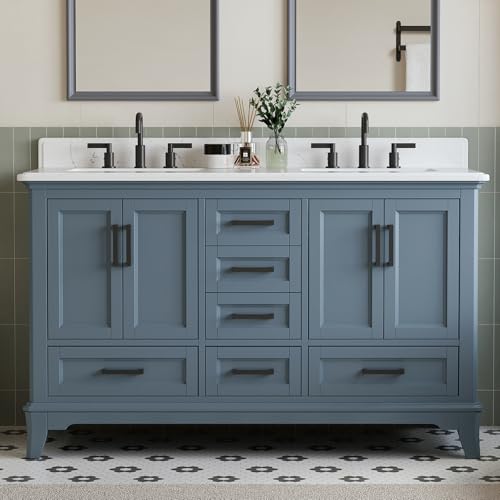
A 60-inch double-sink vanity gives siblings sharing a kids bathroom more separation and storage than the compact 48-inch option, for households with the wall space to support it.
For a larger kids bathroom shared by two or more siblings, sizing up to 60 inches gives noticeably more separation between the two basins than the compact 48-inch option, roughly 28 to 30 inches apart rather than 20 to 22, which reduces the daily elbow-to-elbow crowding that can turn a shared morning routine into a squabble.
The extra width also means more drawer and cabinet storage, giving each child a dedicated space for their own toothbrush, cup, and bath supplies rather than sharing a single crowded drawer. For a kids bathroom remodel with the space to support it, this is the configuration that maximizes daily comfort for a multi-child household.
When a kids bathroom has the wall space and serves more than two children over the years, we recommend sizing up to 60 inches rather than settling for the more compact 48-inch option. The extra separation and storage genuinely reduce daily sibling friction during busy mornings.

A 36-inch vanity with full-extension drawers gives kids genuinely usable, easy-to-see storage for their own bath and grooming supplies.
The detail that makes this vanity work well for a kids bathroom is full-extension drawer hardware, which slides completely out rather than stopping partway, letting a child see and reach everything stored inside without digging blindly toward the back. That visibility genuinely helps younger kids find and put away their own items during a routine, building independence rather than relying on a parent to hand things over.
Soft-close hardware on both the drawers and cabinet doors holds up well to the enthusiastic, sometimes forceful way kids open and close storage, avoiding the loud slam and eventual hardware wear that standard hinges develop over years of daily use in a kids bathroom specifically.
When a kids bathroom needs to actually teach organization rather than just store items, we look specifically for full-extension drawers over standard partial-extension hardware. The difference in how easily a child can find and put away their own things is significant.

A budget vanity combo that includes the cabinet, countertop, sink, and mirror in one package is the most affordable way to fully outfit a kids bathroom without pricing out each component separately.
A vanity combo bundles the cabinet, countertop, sink, and a matching mirror into one purchase, which typically costs less than sourcing each piece separately and removes the guesswork of matching finishes across multiple products. For a kids bathroom, where the vanity may need updating again as children grow or their taste changes, that combination of cost savings and simplified decision-making is a genuine advantage.
The tradeoff is usually the countertop material: many budget combos use cultured marble, a manufactured material that looks similar to natural stone but is less resistant to scratching and staining than quartz. For a kids bathroom on a tighter budget where a full update in several years is expected anyway, that tradeoff is often worth accepting.
The vanity combo is the sensible answer when a kids bathroom remodel needs a complete vanity without a big investment, especially knowing the room may get refreshed again as children age into different needs. You are trading some countertop durability for real savings and simplicity.

A painted wood vanity in a bright, playful color adds real personality to a kids bathroom remodel without sacrificing the durable countertop and rounded edges that matter for daily use.
A kids bathroom is one of the few rooms in the house where a bold cabinet color is genuinely appropriate, and a painted wood vanity in a durable enamel finish lets a remodel reflect a child's personality without sacrificing practicality. The enamel finish resists the scuffing and fingerprints a kids bathroom sees daily, holding up as well as a standard neutral cabinet despite the color.
Pairing the colorful cabinet with a durable, neutral countertop like quartz keeps the functional surface easy to clean and stain-resistant, while the cabinet itself carries the room's personality. If a child's taste changes as they get older, a quality painted cabinet can typically be repainted rather than fully replaced.
For a kids bathroom remodel where personality matters as much as function, we point parents toward a painted wood cabinet over a colored laminate, since the enamel finish genuinely holds up to daily wear better and can be refreshed with a repaint down the line.
Across all seven configurations, the kids bathroom pattern is consistent: prioritize rounded, safe edges and a durable, easy-clean countertop, size the vanity to how many children actually share the room, and choose full-extension, soft-close drawer hardware so kids can use their own storage independently. A kids bathroom vanity rewards spending on safety and durability over premium finishes, since it takes daily wear that a primary bathroom vanity never sees.
The right configuration depends on how many kids share the bathroom, their ages, and how much daily wear the room realistically takes. These checks cover the decisions that matter most.
A rounded or eased-edge quartz counter, rather than a standard sharp square edge, meaningfully reduces bump risk in a kids bathroom where children move quickly and are still building spatial awareness.
A 48 to 60-inch double-sink vanity is worth the investment for a kids bathroom shared by two or more siblings, while a compact 30-inch single-sink vanity is often the more practical choice for one child or a smaller room.
Full-extension drawers that slide completely out give kids genuine visibility and access to their own stored items, and soft-close hardware holds up better to the enthusiastic, sometimes forceful daily opening and closing a kids bathroom vanity experiences.
A playful painted wood vanity suits a kids bathroom remodel meant to reflect a child's current personality, while a neutral quartz-topped vanity in a classic configuration has more staying power if you want the room to transition smoothly as kids become teens.
A 48 to 60-inch double-sink vanity works well for a kids bathroom shared by two siblings, while a 24 to 36-inch single-sink vanity suits one child or a smaller room.
Yes. A rounded or eased-edge countertop meaningfully reduces the risk of a bump or scrape during the running and reaching that comes with daily kids bathroom use.
Quartz is the most durable choice, resisting daily staining and scratching from toothpaste and craft supplies better than laminate or cultured marble, and it never needs sealing.
For a bathroom designed specifically around young children, a lower counter height around 28 to 30 inches lets kids reach the sink independently without a step stool, though most households eventually transition back to a standard height as children grow.
A compact 48-inch double vanity places the basins roughly 20 to 22 inches apart, while a 60-inch vanity increases that separation to about 28 to 30 inches, reducing daily crowding between siblings.
Full-extension drawers slide completely out of the cabinet, letting a child see and reach everything stored inside without digging blindly, which genuinely helps younger kids find and put away their own items.
Yes, as long as the cabinet uses a durable enamel paint finish, which resists scuffing and fingerprints as well as a standard neutral cabinet while adding personality to the room.
Vanity combos that bundle the cabinet, countertop, sink, and mirror are a cost-effective option for a budget-conscious kids bathroom remodel, especially since the room may need updating again as children grow.
Yes. A 60-inch double vanity needs a genuinely spacious kids bathroom to avoid crowding the room and blocking door swings or walkways. Measure the available wall space carefully before sizing up.
No, they do not need to match. A kids bathroom vanity can prioritize rounded edges, durability, and storage kids can reach, while a primary bathroom vanity focuses more on daily adult routine and design.
A kids bathroom vanity takes rougher daily use and needs closer safety consideration than a vanity anywhere else in the house, which is why rounded edges and countertop durability matter more here than premium finishes. A 48-inch double-sink vanity with a rounded quartz top leads for most sibling households, a compact single-sink vanity is the smart pick for one child or a smaller room, and a lower-height vanity delivers real independence for younger children.
How we rank & our data sources
We do not run physical lab tests. Rankings are built from published, verifiable data and real owner feedback, never paid placement.
Researched by admin · Last updated July 11, 2026 · Our review method
Floating cabinets, mixed-metal hardware, furniture-style pieces, integrated LED mirrors, and a real shift toward sustainable materials, here is what is actually showing…
Read the guide
A budget bathroom vanity does not have to mean particleboard that swells at the first sign of water. Affordable vanity lines from…
Read the guide
A mid-range bathroom vanity is where most remodels actually land: real quartz or solid-surface countertops, soft-close drawers, and finish options that look…
Read the guide