
Best 30-Inch Bathroom Vanities (2026)
Bathroom Remodeling4.6
Thirty inches is the sweet spot between a cramped 24-inch vanity and a full 36-inch cabinet, giving a single-sink bathroom real drawer…
Read the guideFarmhouse bathroom vanities pair reclaimed or shiplap-style wood finishes with simple shaker-panel doors and black or bronze hardware. This guide ranks the farmhouse-style vanities worth building a remodel around in 2026.
A 36-inch shaker-panel vanity in a weathered or matte white oak finish with black cup-pull hardware is the strongest all-around farmhouse pick, balancing authentic shiplap-adjacent styling with practical storage. For smaller powder rooms, a console-style vanity with exposed black metal legs delivers the same farmhouse cues in a compact footprint.
| Model | Style Fit | Key Spec | Best For | Check Price |
|---|---|---|---|---|
| Home Decorators Collection Sadie Vanity | Shaker panel, weathered oak | 36 in, single sink | Best overall farmhouse vanity | Check price |
| Kingston Brass Fauceture Console Vanity | Exposed black metal legs | 24-30 in, single sink | Best small-bathroom console | Check price |
| OVE Decors Shiplap-Panel Vanity | Shiplap plank front panel | 30-42 in, single sink | Best shiplap detailing | Check price |
| Home Decorators 60-inch Double Vanity | Shaker panel, double sink | 60 in, double sink | Best double-sink farmhouse vanity | Check price |
| Modway Rustic Farmhouse Vanity | Distressed wood-look finish | 24-30 in, single sink | Best budget farmhouse vanity | Check price |
| Home Decorators Bellington Vanity | Beadboard-panel doors | 30-48 in, single sink | Best beadboard detailing | Check price |
| Wyndenhall Farmhouse Vanity, Butcher Block Top | Shaker panel, butcher block | 30-36 in, single sink | Best butcher-block top | Check price |
Farmhouse vanities are defined by shaker or beadboard panel doors, weathered or matte wood finishes rather than high-gloss lacquer, and black or oil-rubbed bronze hardware such as cup pulls and cross-shaped cabinet knobs. Some models add shiplap-style horizontal plank detailing to the cabinet face for an even stronger rustic reference.
Shaker-style cabinet doors, with their recessed center panel and simple square frame, are the most common cabinet door style used across farmhouse vanity lines because the style avoids the raised-panel or ornate molding details associated with traditional or Victorian cabinetry. The flat, functional profile fits the farmhouse emphasis on utility over ornamentation.
Wood species and finish matter as much as door style. Weathered oak, whitewashed pine, and matte painted finishes in white, sage green, or navy are common farmhouse vanity finishes, while high-gloss lacquer or dark cherry stains are more associated with traditional or transitional styles. Hardware in matte black or oil-rubbed bronze, especially bin-style cup pulls, reinforces the look.
Both are used across farmhouse vanity lines. Solid wood, typically oak, pine, or fir, offers the most authentic farmhouse material story and holds up well to refinishing, while engineered wood with a veneer or laminate wood-look finish is more common in budget and mid-range vanities and is generally more resistant to warping in humid bathroom environments.
Solid wood vanities require more careful moisture management, including proper ventilation and prompt cleanup of standing water around the sink, since solid wood is more prone to swelling and joint separation over years of bathroom humidity exposure than engineered wood with a sealed veneer surface. Buyers in humid climates without strong bathroom ventilation may find engineered wood construction more practical despite solid wood's stronger farmhouse authenticity.
Butcher block, honed marble or quartz, and simple white or gray quartz surfaces all pair well with farmhouse vanity cabinets. Butcher block delivers the strongest farmhouse-kitchen visual reference, while honed (matte) stone surfaces avoid the high-gloss look associated with more contemporary or glam bathroom styles.
Polished, high-shine granite or marble countertops can clash with the matte, weathered aesthetic of a farmhouse vanity cabinet, so buyers building a cohesive farmhouse look typically specify a honed or leathered stone finish, or a butcher-block top sealed with a food-safe or waterproof finish for bathroom durability, over a glossy polished stone surface.
The Sadie vanity uses a weathered oak-finish shaker-panel cabinet with black cup-pull hardware, delivering full storage capacity in a 36-inch single-sink footprint suited to a primary bathroom farmhouse remodel.
The Sadie's shaker-panel doors avoid raised molding or ornate trim, keeping the visual focus on the weathered oak finish and black hardware that define the farmhouse look. Soft-close door and drawer hinges are standard, which is a practical durability feature given how frequently a bathroom vanity's doors and drawers see daily use.
The vanity is sold as a cabinet-only unit or with a matching vanity top depending on retailer configuration, giving buyers flexibility to pair it with a butcher-block, honed-stone, or simple white cultured-marble top depending on budget and desired farmhouse intensity. Aggregated owner reviews note that the weathered finish photographs slightly darker than it appears in person, with most buyers describing the actual tone as a warm mid-brown gray.
For a primary bathroom remodel where storage matters as much as style, the Sadie strikes the right balance of authentic farmhouse finish, functional soft-close storage, and a widely available size range from 30 to 42 inches.

This console vanity pairs a slim wood top and small storage shelf with exposed black metal legs, giving the exposed-hardware farmhouse look in a footprint as narrow as 24 inches.
The console format trades enclosed cabinet storage for a lighter visual footprint and genuinely exposed structural hardware, matching the exposed-leg detail found on farmhouse console sinks and pairing naturally with matte black or bronze faucet hardware. The open lower shelf is commonly styled with a woven storage basket, a popular farmhouse substitute for closed-door storage.
Owner reviews describe the assembly as straightforward, with the metal leg frame bolting to the wood top and requiring wall anchoring for stability given the cantilevered weight of the sink basin. The narrow 24-inch width option makes this one of the few farmhouse vanity styles genuinely viable in a compact powder room.
When floor space is tight, a console vanity is the only farmhouse-styled option that does not compromise the exposed-hardware aesthetic to fit a smaller footprint, since shrinking a shaker-panel cabinet often results in an awkwardly narrow door rather than a coherent design.

OVE Decors builds a horizontal shiplap-style plank front panel directly into the cabinet doors, delivering one of the most literal farmhouse design references available in a manufactured vanity line.
The shiplap plank detailing gives the cabinet doors a textured, horizontal-line profile that directly echoes shiplap accent walls, one of the most recognized farmhouse interior design elements outside of plumbing fixtures. This makes the OVE Decors line a natural pairing for bathrooms already using shiplap paneling on the walls or tub surround.
Available in White and Weathered Gray finishes, the line leans toward the lighter, more modern-farmhouse end of the aesthetic spectrum rather than the darker weathered-oak tones of the Sadie vanity. Owner reviews rate the plank detailing as a genuine visual upgrade over a flat shaker panel, though a small number note that the grooves between planks require slightly more attention when cleaning to avoid dust buildup.
For a farmhouse bathroom already using shiplap on the walls, matching the vanity face to the same horizontal-plank language creates a more intentional, cohesive design than a plain shaker panel would.
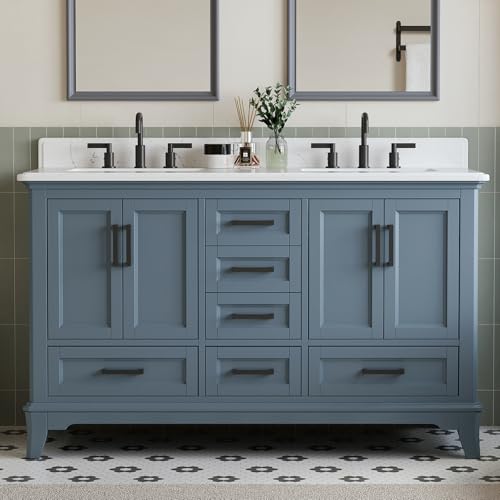
This 60-inch vanity extends the shaker-panel, weathered-finish farmhouse look to a double-sink configuration, giving couples separate basins without sacrificing the cohesive farmhouse aesthetic.
Scaling the farmhouse shaker-panel design to a 60-inch double-sink footprint requires careful proportioning so the cabinet doesn't read as an oversized single vanity; this line addresses that by using four evenly spaced door panels and a center bank of drawers, a layout that keeps the shaker-panel rhythm visually balanced across the wider cabinet face.
Owner reviews of double-sink farmhouse vanities generally focus on plumbing rough-in spacing, and buyers should confirm the vanity's dual sink centers align with existing supply and drain rough-in locations before ordering, since a mismatch requires plumbing relocation. The four-door, two-drawer configuration on this model provides significantly more storage than two single vanities placed side by side.
Double-sink farmhouse vanities are less common than single-sink options, and this 60-inch line is one of the more successful executions at maintaining proportional shaker-panel rhythm across the wider cabinet face rather than simply stretching a single-sink design.
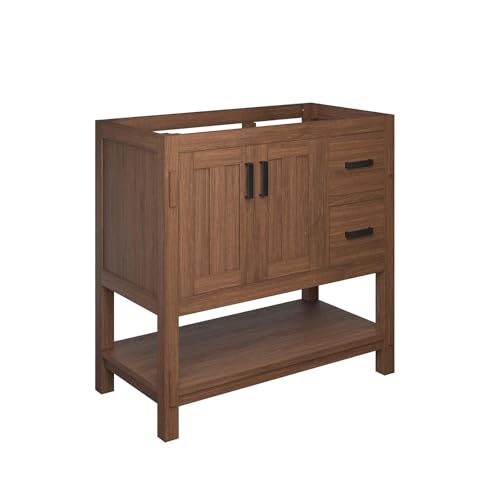
Modway's rustic farmhouse vanity uses a distressed wood-look laminate finish over an engineered wood frame, delivering the rustic farmhouse color palette at one of the more accessible price points in the category.
The laminate distressed finish approximates the weathered-wood look at a lower manufacturing cost than a true wood veneer, which is the primary trade-off buyers accept at this price tier. The finish is durable against daily moisture exposure since laminate is inherently more water-resistant than raw or lightly sealed solid wood.
With only one door and one drawer, storage capacity is limited compared to the larger shaker-panel vanities on this list, making it best suited to a secondary bathroom, guest bath, or a household with modest bathroom storage needs. Owner reviews describe the assembly process as straightforward and the finish as a close visual match to more expensive weathered-wood vanities in typical bathroom lighting.
For buyers prioritizing budget over authenticity of materials, the Modway rustic vanity delivers a convincing distressed farmhouse look with better moisture resistance than a true solid-wood vanity, a reasonable trade-off for a secondary bathroom.

The Bellington vanity uses vertical beadboard-groove paneling on its cabinet doors, a farmhouse and cottage-adjacent detail that reads slightly more traditional than the horizontal shiplap plank look.
Beadboard paneling, with its narrow vertical grooves, has a longer design history in American cottage and farmhouse interiors than shiplap and reads as slightly more traditional and detailed. The Bellington applies this paneling to the cabinet doors rather than the surrounding walls, concentrating the textural detail on the vanity itself.
Solid wood door frames surrounding an engineered panel center give the Bellington a heavier, more substantial feel at the door edges than an all-laminate construction, which owner reviews consistently cite as a noticeable quality difference. The oil rubbed bronze hardware, rather than matte black, gives this vanity a warmer overall finish more suited to traditional-farmhouse than strictly modern-farmhouse palettes.
Beadboard detailing is an underused farmhouse cue relative to shiplap, and the Bellington's vertical panel texture combined with bronze hardware gives it a distinct, slightly more traditional identity within the broader farmhouse vanity category.

Wyndenhall pairs a shaker-panel cabinet with a factory-sealed butcher-block countertop, delivering the strongest visual crossover between a farmhouse kitchen island and a bathroom vanity.
Butcher-block countertops require periodic resealing to maintain water resistance around the sink cutout, a maintenance step not required by stone or quartz tops, and buyers should plan to reapply a waterproof sealant annually or as water beading on the surface diminishes. When properly maintained, a sealed butcher-block top holds up well in bathroom use and delivers a warmth that stone tops cannot replicate.
The solid wood cabinet frame, rather than an engineered wood veneer, gives the Wyndenhall a more substantial build quality reflected in owner reviews, which frequently note the weight and rigidity of the doors and drawer fronts as noticeably higher than laminate-veneer competitors at a similar price point.
The included butcher-block top is the standout feature here, since most vanity lines require sourcing the countertop separately. For buyers who want the farmhouse-kitchen crossover look without shopping two separate product categories, Wyndenhall delivers both in one purchase.
Single-sink farmhouse vanities are typically available from 24 to 42 inches wide, with 30 and 36 inches being the most common sizes for a primary bathroom. Double-sink vanities generally start at 60 inches to provide adequate spacing between the two basins.
Solid wood offers the most authentic farmhouse material and refinishes well over time, but is more susceptible to warping in humid bathrooms without good ventilation. Engineered wood with a wood-look veneer or laminate finish is more moisture-resistant and is a practical choice in bathrooms with limited airflow.
Matte black and oil rubbed bronze are the two most common farmhouse vanity hardware finishes, typically in a cup-pull or bar-pull style rather than small round knobs. Satin or brushed brass is increasingly used in modern-farmhouse schemes as a warmer alternative to black.
No single material is required, but butcher block, honed stone, and matte quartz surfaces coordinate best with the weathered, non-glossy aesthetic of farmhouse cabinetry. Polished, high-shine stone countertops can visually clash with a matte farmhouse cabinet finish.
No. Apron-front sinks require the vanity's face frame to be cut or built with an opening that exposes the sink's front panel. Standard shaker-panel or shiplap-panel vanities on this list are designed for drop-in, undermount, or vessel sinks rather than apron-front installation unless specifically noted by the manufacturer.
Reseal the butcher block periodically with a food-safe or waterproof sealant, wipe up standing water around the sink promptly, and avoid placing wet items directly on unsealed edges. Most manufacturers recommend resealing annually or when water no longer beads on the surface.
Console vanities work well in powder rooms and small secondary bathrooms but offer limited storage since they lack enclosed cabinet space. For a primary bathroom with daily storage needs for toiletries and supplies, a shaker-panel cabinet vanity is generally more practical.
Shiplap uses wide horizontal wood planks with a visible overlapping seam, while beadboard uses narrower vertical planks with a rounded bead groove between each board. Shiplap is more associated with modern-farmhouse styling; beadboard has a longer history in traditional cottage and farmhouse interiors.
Some are sold as complete sets with a matching vanity top and pre-drilled faucet holes, while others are cabinet-only, requiring the buyer to source the countertop, sink, and faucet separately. Check the specific product listing to confirm what is included before purchase.
Ensure the bathroom has an exhaust fan rated for the room's square footage and run it during and after showers, wipe up standing water around the sink base promptly, and avoid placing the vanity directly beneath a shower without a door or curtain containing splash. Engineered wood construction is more forgiving of imperfect ventilation than solid wood.
The Home Decorators Collection Sadie vanity is the strongest all-around farmhouse pick for a primary bathroom, combining a weathered oak finish, shaker-panel doors, and black cup-pull hardware with practical soft-close storage. Small bathrooms and powder rooms are better served by the Kingston Brass console vanity, which delivers exposed black-leg hardware in a compact footprint. Buyers wanting the strongest material crossover with a farmhouse kitchen should look to the Wyndenhall vanity's included butcher-block top, while households needing two sinks should size up to the 60-inch double-sink option to maintain proportional shaker-panel styling.
Thirty inches is the sweet spot between a cramped 24-inch vanity and a full 36-inch cabinet, giving a single-sink bathroom real drawer…
Read the guide
Cast iron is the material homeowners choose when heat retention and permanence matter more than installation weight, and Kohler remains the brand…
Read the guideStep-by-step fixes for the bathroom vanity problems that show up most often, from misaligned drawers and doors to water damage at the…
Read the guide