
Best 30-Inch Bathroom Vanities (2026)
Bathroom Remodeling4.6
Thirty inches is the sweet spot between a cramped 24-inch vanity and a full 36-inch cabinet, giving a single-sink bathroom real drawer…
Read the guideA tub for an elderly or mobility-limited household has to solve a real safety problem, the high step-over wall of a standard tub, without turning bath time into a hazard on its own. We compared low step-in thresholds, walk-in door seals, grab-bar-compatible walls, and real owner reviews from Kohler, American Standard, and Safe Step to find the tubs that hold up to daily use by someone with limited mobility.
The Safe Step Walk-In Tub is the best overall accessible bathtub, combining a low step-over threshold, a sealed side door, and a built-in seat that removes the two biggest fall risks a standard tub presents. For buyers who are not ready for a full walk-in tub conversion, the Kohler Elevance Rising Wall Bath is the top pick, since its wall lowers for entry and raises to bathe, and the American Standard Gelcoat Alcove Tub with grab-bar-rated walls is the best budget-friendly option for adding accessibility to a standard bathroom layout.
A bathtub is one of the more dangerous fixtures in a home for someone with limited mobility, not because bathing itself is risky, but because a standard tub's 14 to 18 inch step-over wall asks an unsteady user to balance on one leg while lifting the other over a slick, wet edge. Falls in the bathroom are one of the most common causes of injury among older adults, and the tub-shower combination is where a disproportionate share of those falls happen. Fixing that risk means changing the entry method, not just adding a grab bar to a fixture that was never designed for the task.
This guide ranks tubs specifically for elderly and accessibility use. We favor walk-in tubs with low or no step-over thresholds, tubs engineered to accept grab-bar hardware in the wall, and built-in seating that reduces the risk of a slip while standing to bathe. For the rest of an accessible bathroom remodel, see our ADA bathroom guide and our accessible bathroom remodel guide.
A safer bathtub for elderly or mobility-limited users has a low step-over threshold, ideally under 4 to 7 inches on a walk-in model compared to 14 to 18 inches on a standard tub, along with a built-in seat, a textured slip-resistant floor, and walls reinforced to accept grab bars. Walk-in tubs solve the step-over problem directly with a sealed side door, while a standard alcove tub can be made safer with reinforced walls for grab bars and a transfer bench, even without a full walk-in conversion.
The step-over height is the single biggest risk factor in a standard tub, since it forces a user to balance on one leg over a wet, often slick surface while transferring their weight. A walk-in tub removes that entirely by replacing the high wall with a low-threshold door that seals watertight once closed, letting a user step in on a level or near-level surface before the tub fills. Built-in seating is the second major safety feature, since standing to bathe on a wet surface is a leading cause of bathroom falls regardless of tub type.
A walk-in tub is worth it for a household where a family member has significant difficulty stepping over a standard tub wall, has fallen in the bathroom before, or uses a cane, walker, or other mobility aid regularly. The tradeoff is that a user must sit inside while the tub fills and drains, which takes several minutes at the start and end of each bath, a real change in routine that some buyers do not anticipate before installation. For households where the primary need is just added stability rather than step-over elimination, a standard tub retrofitted with grab bars and a transfer bench may be sufficient.
The wait time for filling and draining a walk-in tub is the most common adjustment new owners mention in reviews, since the door cannot be opened until the water has fully drained, unlike a standard tub a bather can exit at any point. Most walk-in tubs include a fast-drain feature specifically to address this, and some include a quick-fill faucet as well, but the routine change is real and worth discussing with the person who will actually use the tub before committing to a full conversion.
No, grab bars need to be anchored into solid wall blocking behind the tub surround, not into the tub wall or standard drywall alone, so not every bathtub installation can support a grab bar without additional wall reinforcement. Tubs and surrounds built or installed with grab-bar blocking already in place, like the American Standard Gelcoat Alcove Tub paired with a reinforced surround, let a contractor add bars later without opening the wall, while a standard retrofit may require removing surround panels to add blocking first.
Seven real tubs chosen for step-over safety, seating, and grab-bar compatibility.
| Bathtub | Best For | Key Spec | Notes | Check Price |
|---|---|---|---|---|
| Safe Step Walk-In Tub | Best overall | Low step-over, sealed door, built-in seat | Removes step-over risk and standing-to-bathe risk | Check price |
| Kohler Elevance Rising Wall Bath | Best low step-in without a sealed door | Lowering wall for entry, raises to bathe | No wait for a door seal to drain before exit | Check price |
| American Standard Gelcoat Alcove Tub | Best budget grab-bar-ready pick | Reinforced walls for grab bars | Standard tub format at a lower cost | Check price |
| Ella Ultra Low Threshold Walk-In Tub | Best ultra-low step-over | 3-inch threshold, outward-swing door | One of the lowest step-over heights available | Check price |
| Kohler Elevance with Whirlpool Jets | Best therapeutic option | Walk-in with hydrotherapy jets | Active muscle relief for arthritis or joint pain | Check price |
| American Standard Walk-In Soaker Tub | Best mainstream walk-in value | Low threshold, built-in seat | Widely available parts and service network | Check price |
| Universal Tubs Wheelchair Accessible Walk-In | Best wide-door wheelchair transfer | Extra-wide door opening | Easier transfer from a wheelchair or shower chair | Check price |
Each pick is ranked on step-over safety and seating first, then grab-bar compatibility and installation fit.

The Safe Step Walk-In Tub is the best overall accessible bathtub, pairing a low step-over threshold and sealed side door with a built-in seat that removes the two biggest tub-related fall risks.
The Safe Step tub earns the top spot because it addresses the actual mechanics of a bathroom fall rather than adding safety features around the edges of a standard tub. The sealed side door lets a user step in and sit down before any water is run, removing the balance-on-one-leg moment that a standard tub's high wall requires. The built-in seat then removes the second major risk, standing on a wet surface to wash or rinse.
Integrated handrails are positioned at the entry point and near the seat, giving a consistent, stable point of contact throughout the bathing process rather than relying on a single retrofitted grab bar. Owner reviews consistently describe the entry and exit process as dramatically less stressful than a standard tub, with the main adjustment being the wait time for filling and, especially, for the fast-drain cycle to finish before the door can be safely opened.
For a household where step-over height and standing-to-bathe are the real, documented risks, and often after a fall has already happened, the Safe Step is the tub we point families toward first. It solves the mechanical problem directly rather than trying to make the old problem marginally safer.
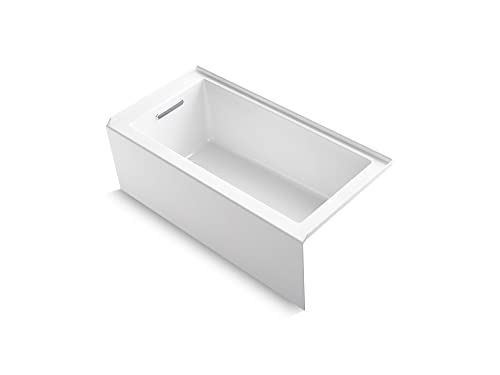
The Kohler Elevance uses a wall that lowers for entry and rises to bathe, giving a low step-in without the wait time a sealed walk-in door requires.
The Elevance solves the walk-in tub's most common complaint, the wait to drain before exiting, by using a different mechanism entirely. Instead of a sealed door, a motorized wall section lowers to near floor level for entry, then rises and seals once the user is seated, holding water in the tub. To exit, the wall lowers again immediately, without needing to wait for the tub to drain first.
That difference matters most for a bather who might need to exit quickly, whether due to a change in comfort, an emergency, or simply not wanting to sit in draining water for several minutes. Owner reviews note the motorized mechanism operates smoothly and quietly, with the tradeoff being a meaningfully higher price than a standard sealed-door walk-in tub and a motor and seal system that requires occasional professional service.
For a household concerned about being able to exit the tub quickly if needed, not just entering safely, the Elevance's rising wall design is a genuine functional advantage over a sealed door. It is worth the added cost for the added flexibility.

A standard-format alcove tub engineered with reinforced walls to accept grab bars, giving households not ready for a full walk-in conversion a meaningful safety upgrade.
Not every household is ready for a full walk-in tub conversion, whether due to cost, a rental situation, or simply not yet needing that level of accessibility. The Gelcoat Alcove Tub keeps the standard tub format and step-over height but is built to accept grab-bar hardware directly into reinforced points in the surround, rather than requiring a contractor to guess at blocking placement.
Paired with a transfer bench that spans the tub wall, this format lets a user sit outside the tub and slide across rather than stepping over, which meaningfully reduces fall risk without the cost or the standing-water routine of a walk-in tub. Owner reviews describe it as a sensible middle step for households planning ahead, or for a rental property that cannot undergo a full accessible conversion.
When a full walk-in tub is not the right fit yet, whether for cost or timing reasons, this is the tub we recommend as the interim step. Paired with a transfer bench and properly placed grab bars, it meaningfully reduces risk without the bigger commitment.
The Ella Ultra Low Threshold model has one of the lowest step-over heights available in a walk-in tub, a meaningful difference for users with very limited leg lift.
Standard walk-in tubs already lower the step-over height significantly compared to a regular tub, but for users with very limited hip or knee flexion even a 5 to 7 inch threshold can be difficult. The Ella model pushes that dimension down further, to around 3 inches, which is close to a curbless shower entry and meaningfully easier for the most mobility-limited users.
Because the door swings outward rather than inward, a user does not need to reach over or around the door itself while entering, an additional small but real reduction in the physical coordination required. Owner reviews highlight the low threshold as the deciding factor for buyers who found even standard walk-in tubs still too difficult to step into, though the outward swing does require enough clear bathroom floor space in front of the tub for the door to open fully.
For a user whose mobility limitations go beyond what a standard walk-in tub comfortably accommodates, the ultra-low threshold on this model is worth the added cost. It is the tub we suggest when even a 5-inch step still feels too high.
A walk-in-style accessible tub with hydrotherapy jets added, giving users with arthritis or chronic joint pain active relief alongside the standard accessibility features.
Many households considering an accessible tub are doing so alongside age-related joint pain or arthritis, and this model adds adjustable hydrotherapy jets to the same low-threshold, seated-entry format found in a standard walk-in tub. The jets can be positioned toward the back, legs, or feet, giving genuine therapeutic value beyond just a safer bathing routine.
Because the jet pump requires a dedicated GFCI-protected electrical circuit, installation cost and complexity run higher than a non-jetted walk-in tub, a real consideration to price into the project alongside the plumbing work. Owner reviews describe the combination of safety and therapeutic benefit as worth the added cost for users managing chronic pain, with jet line cleaning as an ongoing maintenance task.
When arthritis or chronic joint pain is part of why a household needs an accessible tub in the first place, the added hydrotherapy function is not a luxury add-on, it is directly relevant to the medical need driving the purchase.

A mainstream-brand walk-in tub that keeps the core low-threshold and seated-entry safety features with the backing of a widely available service and parts network.
Specialty walk-in tub brands often mean a narrower installer network, which can matter when a household needs service or warranty support years down the line. American Standard's version delivers the same fundamental low-threshold, sealed-door, built-in-seat format with the backing of a mainstream plumbing brand's much wider network of dealers and installers.
The fast-drain feature is specifically engineered to reduce the amount of time a bather sits waiting after finishing, addressing the most common complaint about walk-in tubs generally. Owner reviews describe it as a dependable, no-surprises option, without some of the premium features, like a rising wall or whirlpool jets, found on higher-end competitors.
For a household that wants the core walk-in tub safety benefits backed by a brand with an established, easy-to-find service network, this is the practical mainstream choice. It does the fundamentals well without a specialty price tag.

An extra-wide door opening makes transferring from a wheelchair or shower chair meaningfully easier than a standard walk-in tub door width.
A standard walk-in tub door is sized for someone stepping in under their own power, which can still be a tight fit for a wheelchair-to-tub transfer using a sliding board or shower chair. This model widens the opening specifically to accommodate that kind of transfer, with the built-in seat positioned to align at a height and angle that makes a lateral slide-over transfer more direct.
Owner reviews from caregivers assisting a wheelchair user describe the wider opening as a meaningful practical improvement over a standard walk-in tub door, reducing the physical effort required during transfer. The bathroom itself needs enough clear floor space for a wheelchair to approach the tub directly, which is worth confirming against the room's layout before ordering.
When a wheelchair-to-tub transfer is the actual daily routine, not just an occasional need, the wider door on this model is the detail that makes the difference between an assisted transfer that works smoothly and one that is a daily struggle for both the user and caregiver.
Across all seven picks, the pattern for an accessible bathtub is consistent: eliminate or drastically lower the step-over height, add a built-in seat so standing on a wet surface is never required, and confirm the wall construction can support grab bars where needed. A full walk-in tub is the strongest solution for households with documented step-over difficulty, while a reinforced standard tub with a transfer bench is a reasonable interim step for households not ready for that bigger project.
Match the tub to the specific mobility limitation, not a general accessibility label.
Every sealed-door walk-in tub requires the bather to sit inside while it fills and, more importantly, while it drains before the door can safely open. This is the single most common adjustment new owners mention, and it is worth discussing directly with the person who will use the tub daily before committing, since a model with a rising wall like the Kohler Elevance avoids this wait entirely at a higher price point.
Grab bars must anchor into solid wall blocking, not the tub wall or standard drywall alone. If choosing a standard tub with plans to add grab bars, confirm with the installer that blocking is added at the correct height and location during the install itself, since retrofitting blocking after a wall is finished means removing surround panels.
Walk-in tubs are large, heavy fixtures that are sometimes awkward to maneuver through a standard bathroom doorway or hallway. Confirm delivery and installation access with the installer before ordering, since this is one of the more common and costly surprises in an accessible bathroom remodel.
Yes, walk-in tubs and accessible bathtub conversions generally cost significantly more than a standard alcove or freestanding tub, due to the sealed door engineering, built-in seating, and often more involved installation and electrical work. Households not ready for that investment can still meaningfully reduce fall risk with a standard tub built for grab-bar compatibility, paired with a transfer bench, at a much lower cost than a full walk-in conversion.
The Safe Step Walk-In Tub is the best overall accessible bathtub, removing both the step-over fall risk and the standing-to-bathe fall risk with a sealed low-threshold door and a built-in seat. Choose the Kohler Elevance Rising Wall Bath if avoiding the drain-wait matters most, the Ella Ultra Low Threshold model for users with very limited leg lift, or the American Standard Gelcoat Alcove Tub as a lower-cost interim step with grab-bar-ready walls. Confirm the fill-and-drain routine works for the actual user and verify wall blocking before ordering, then check the current price on Amazon.
A walk-in tub with a low or ultra-low step-over threshold and a built-in seat, like the Safe Step Walk-In Tub or the Ella Ultra Low Threshold model, most directly addresses the transfer risk that leads to falls in a standard tub.
Most walk-in tubs have a step-over threshold between 4 and 7 inches, compared to 14 to 18 inches on a standard tub. Some ultra-low models bring that down to around 3 inches for users with very limited hip or knee flexion.
Yes, on a standard sealed-door walk-in tub, the door cannot be safely opened until the water has drained, which takes several minutes even with a fast-drain feature. Rising-wall models like the Kohler Elevance avoid this wait.
Yes, but only if the wall has solid blocking behind the surround to anchor the bar. Standard drywall or the tub wall itself is not rated to support a grab bar's load, so blocking must be added during installation or as a retrofit that opens the wall.
Medicare generally does not cover walk-in tubs, as they are classified as a home modification rather than durable medical equipment. Some private insurance, long-term care policies, or state Medicaid waiver programs may offer partial coverage. Check with your specific plan before budgeting.
A walk-in tub still fills with water for a seated soak and requires waiting to drain before exiting, while a walk-in shower has a curbless or low-threshold entry with no standing water and no wait time, making it a different accessibility solution for households that prioritize showering over bathing.
Most walk-in tubs fit the same footprint as a standard alcove tub, typically 60 inches by 30 to 32 inches, but outward-swinging doors need additional clear floor space in front of the tub to open fully. Confirm this with the specific model's installation specifications.
In many cases yes, since most walk-in tubs are built to standard alcove dimensions, though the plumbing, electrical for jets, and door swing clearance should all be confirmed against the existing bathroom layout before ordering.
Standard walk-in tubs can be difficult for a wheelchair-to-tub transfer due to door width and seat positioning. Models built with a wider door opening and a seat aligned for lateral transfer, like the Universal Tubs Wheelchair Accessible Walk-In, are a better fit for that specific need.
Fill time varies by model and water pressure but typically takes several minutes, during which the bather sits inside the sealed, empty or partially empty tub. Some models offer a quick-fill faucet option to reduce this wait.
A transfer bench spans the wall of a standard tub, letting a user sit outside the tub and slide across rather than stepping over. It is generally used with a standard tub rather than a walk-in tub, since a walk-in tub's sealed door and low threshold are designed to be entered directly rather than via a bench.
Only jetted or whirlpool walk-in tubs require a dedicated GFCI-protected circuit for the pump motor. A standard non-jetted walk-in tub does not require additional electrical work beyond what a normal bathroom already has.
Thirty inches is the sweet spot between a cramped 24-inch vanity and a full 36-inch cabinet, giving a single-sink bathroom real drawer…
Read the guide
Cast iron is the material homeowners choose when heat retention and permanence matter more than installation weight, and Kohler remains the brand…
Read the guideStep-by-step fixes for the bathroom vanity problems that show up most often, from misaligned drawers and doors to water damage at the…
Read the guide