
Bathroom Vanity Care for Hard Water and Well Water Areas
Bathroom Remodeling4.6
Homeowners with hard water or well water often shop for a "hard water resistant vanity," but the honest answer is that the…
Read the guideA vanity cabinet is not shaped like a kitchen cabinet, and organization products built for kitchens frequently do not fit a vanity's narrower openings or work around its p-trap and supply lines. This guide covers drawer dividers, pull-out trays, door-mounted organizers, and under-sink stacking systems that are specifically sized and shaped for vanity cabinets, plus the plumbing-clearance details most organization product listings never mention.
Research updated June 2026.
Adjustable drawer dividers solve the top-drawer clutter problem, a pair of narrow pull-out trays (not one wide tray) work best under the sink where the p-trap splits the cabinet floor into two zones, door-mounted organizers work well for lightweight items but should be checked against the door's hinge weight rating, and stacking bins should be measured against the cabinet opening before buying since vanity door openings run narrower than kitchen sink cabinet openings.
Vanity cabinets present a specific organization problem that generic bathroom storage advice does not address: the sink drain and p-trap, and often the supply lines, run through the lower-center portion of the cabinet, splitting the usable floor space into two side zones rather than one open area. Most under-sink organizer kits are designed and marketed for kitchen sink base cabinets, which are wider (typically 30 to 36 inches with a single large door opening) than a standard vanity's 18 to 30-inch single-door opening. A kit that fits a kitchen cabinet frequently does not fit inside a vanity door at all.
This guide breaks vanity organization down by the specific cabinet zone: drawers, the under-sink floor area around the plumbing, and the inside of the cabinet doors. It builds on the broader bathroom vanity buying guide and complements our general bathroom storage guide and bathroom storage ideas, which cover storage outside the vanity cabinet itself.
Adjustable expandable drawer dividers, typically bamboo, acrylic, or coated wire, are the most effective tool for vanity drawer organization because they fit a wide range of drawer widths and let you create custom compartment sizes rather than being locked into a fixed grid. They work differently depending on drawer depth: shallow top drawers (3 to 4 inches) suit low dividers for small flat items like floss and hair ties, while deeper bottom drawers (8 to 10 inches) benefit from stackable trays that use the full depth rather than a single flat divider layer that wastes vertical space.
If the bottom drawer is shallower than expected because it is notched around the p-trap, measure the actual usable depth before buying stackable trays, since a false-bottom drawer may only offer 3 to 4 inches of real depth despite looking like a full-size drawer from the outside.
Buy drawer dividers only after measuring the drawer's interior width at both the front and back, not just the front opening. Many vanity drawer boxes taper slightly or narrow around internal drawer glide hardware, and a divider sized to the front opening alone can bind or refuse to sit flat at the back of the drawer.
Pull-out sliding trays that clip onto the existing cabinet floor give full visibility of stored items without kneeling or reaching blindly around the p-trap, which is the main advantage over a static shelf. The detail most listings omit is that a standard vanity's p-trap and supply lines occupy the center of the cabinet floor, so a single wide pull-out tray usually has to be cut or notched around the pipe, which most off-the-shelf trays are not designed to do.
Two narrower pull-out trays, one on each side of the plumbing, generally work better in a vanity than one wide tray, since each can be sized to fit its side of the cabinet floor without any cutting or fitting around the trap arm.
Before buying any pull-out system, open the vanity doors and measure the distance from each side wall to the p-trap, not just the total cabinet width. This single measurement determines whether a two-tray approach or a single trimmed tray is the realistic option for your specific cabinet.
| Organization Tool | Best Cabinet Zone | Works Around Plumbing | Install Effort |
|---|---|---|---|
| Adjustable Drawer Dividers | Any drawer | N/A, no plumbing in drawers | None, drop in |
| Narrow Pull-Out Trays (pair) | Under-sink floor | Yes, one tray per side of trap | Low, screws into cabinet floor |
| Wide Pull-Out Tray | Under-sink floor | Only if notched or cut | Moderate, may need trimming |
| Stacking Bins / Turntable | Under-sink floor, side zones | Yes, if sized correctly | None, freestanding |
| Door-Mounted Organizer | Inside cabinet door | N/A | Low, check hinge weight rating first |
Stacking bins and turntable-style lazy susans work well in the side zones of a vanity cabinet floor, on either side of the p-trap, as long as their footprint is measured against the actual usable floor space rather than the total cabinet width printed in the vanity's specifications. A common mistake is buying an under-sink organizer kit marketed for kitchen use, since kitchen sink base cabinets have a wider single door opening (often 30 inches or more) than a typical vanity's 18 to 30-inch opening, and the kit simply will not pass through the vanity door.
Curved or corner-notched bins designed to wrap around a pipe are the most space-efficient option directly beside the p-trap, while straight-sided stacking bins work better in the open zone farther from the plumbing.
Lightweight hooks, adhesive-mounted pouches, and slim over-the-door racks work well on vanity cabinet doors for items like hair tools, cleaning cloths, or small bottles. The caution that generic storage advice skips is that vanity cabinet doors, especially those with concealed six-way adjustable hinges rather than heavy exposed furniture hinges, are not rated for the same load as a kitchen pantry door. A fully loaded rack holding a hair dryer, straightener, and multiple bottles can, over months of daily opening and closing, sag the hinge or cause the door to hang unevenly.
Check the manufacturer's stated door weight capacity if listed, and when in doubt, favor adhesive hooks and lightweight mesh pouches over rigid multi-shelf door racks on any vanity door thinner than a typical kitchen cabinet door.
If a vanity door starts to sag or the hinge no longer holds it flush after adding a door organizer, remove weight from the rack rather than trying to re-adjust the hinge repeatedly. Six-way adjustable concealed hinges have a limited adjustment range, and repeated readjustment to compensate for excess door-mounted weight eventually strips the hinge screw holes.
These picks cover the four cabinet zones above: drawers, the under-sink plumbing area, and cabinet doors.

An expandable bamboo divider that adjusts to fit drawer widths from roughly 11 to 21 inches, covering most single-vanity drawer stacks without needing a custom-cut insert.
Measure the drawer's interior width at both front and back before ordering, since some vanity drawer boxes narrow slightly toward the rear where glide hardware is mounted.
Check price on Amazon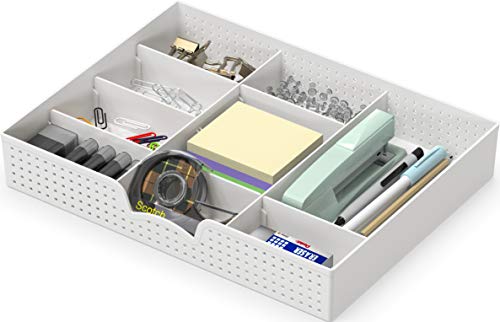
Stackable trays that use the full vertical space of a deep bottom drawer rather than leaving a single flat divider layer with wasted height above it.
Verify actual drawer depth before ordering. If the sink drain routes through the lower cabinet, some manufacturers reduce the bottom drawer's real depth to clear the trap arm, even though the drawer front looks full-size.
Check price on Amazon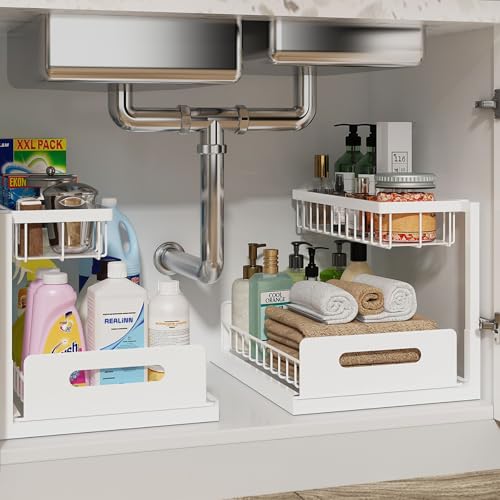
A narrower sliding pull-out tray that fits inside one side of the cabinet floor, avoiding the p-trap rather than requiring it to be cut or notched.
Measure from each side wall to the p-trap before buying, and order two units sized to those two measurements rather than one tray sized to the full cabinet width.
Check price on Amazon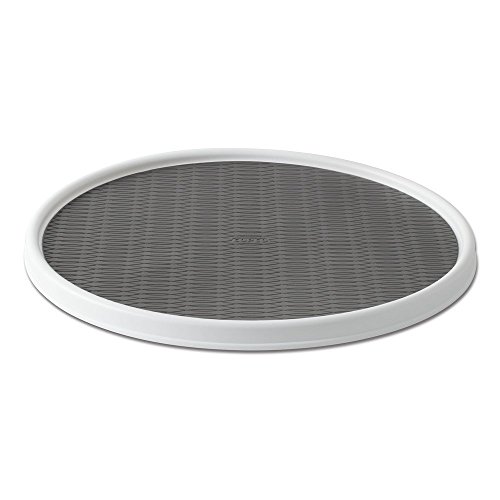
A freestanding rotating turntable that sits in the open floor zone to one side of the plumbing, giving full access to bottles and supplies without stacking or reaching to the back of the cabinet.
Measure cabinet floor width against the turntable's diameter, including the door swing clearance needed to remove items from the front edge when the door is open.
Check price on Amazon
A lightweight wire rack that hangs over the top edge of a vanity cabinet door, adding storage for cleaning supplies or spare toiletries without any drilling or adhesive.
Favor this style over a rigid multi-shelf rack on any vanity with concealed six-way adjustable hinges, which have a lower load tolerance than heavy exposed furniture hinges.
Check price on AmazonKitchen sink base cabinets typically have a single door opening of 30 inches or wider, while a standard vanity's single-door opening is often 18 to 30 inches. An organizer kit sized for a kitchen cabinet frequently cannot pass through a vanity's narrower door opening at all, regardless of how the interior floor space compares.
Use two narrower pull-out trays or stacking bins, one on each side of the p-trap, rather than one wide tray sized to the full cabinet width. This avoids needing to notch or cut any product to clear the pipe.
Yes. Even a shallow top drawer benefits from a low-profile divider that separates small items like floss, hair ties, and cotton swabs, preventing the drawer from becoming a single mixed pile within a few weeks of daily use.
It depends on the hinge type. Vanities with concealed six-way adjustable hinges generally tolerate less added door weight than furniture pieces with heavy exposed hinges. As a general precaution, keep over-door loads to lightweight items and avoid hanging a hair dryer or multiple heavy bottles on a single rack long-term.
A false-bottom drawer looks full-depth from the outside but is actually shallow, typically 3 to 4 inches, because the sink drain or p-trap runs beneath it and the manufacturer reduced the drawer box depth to clear the plumbing. Measure the actual interior depth before buying stacking trays sized for a full-depth drawer.
Bins generally work better than loose placement for cleaning supplies stored on the cabinet floor, since they contain any drips or spills and can be pulled out fully for access, rather than requiring you to reach in around the plumbing to retrieve an item from the back.
A slim pull-out trash bin can fit in the open zone of a vanity cabinet floor if there is enough clearance on one side of the p-trap. Measure the available width on your least-obstructed side before buying, since most pull-out trash systems are sized for kitchen cabinets and may be too wide for a vanity's floor zone.
Woven baskets sized to the shelf depth are the standard solution for open-shelf vanities, since they contain loose items and keep the shelf looking tidy despite bathroom humidity. Avoid storing humidity-sensitive items like paper products on fully open shelves without a covered bin.
A heat-resistant silicone mat inside a deep bottom drawer, combined with a stackable tray to separate the tool from cords and smaller accessories, is safer and more organized than hanging a hot tool from a lightweight door-mounted rack, which is not designed for heat exposure.
Yes, but measure clearance around the supply line risers in addition to the drain and p-trap. Floor-mounted supply lines typically add one or two vertical obstructions near the back wall of the cabinet, which affects bin placement more than sliding tray placement, since bins need floor contact on all sides.
Wipe down bins, trays, and dividers every few months, since bathroom humidity promotes mold and mildew growth on organizers left in a closed, damp cabinet longer than open shelving would allow. Replace any organizer showing mold growth rather than attempting to fully sanitize porous materials like unsealed wood.
Measure before buying anything. Vanity cabinets are narrower and more obstructed by plumbing than the kitchen-cabinet organizers most storage products are designed around, and the single biggest organization mistake is buying one wide tray or bin sized to the total cabinet width instead of two narrower units sized to each side of the p-trap. Adjustable drawer dividers, a pair of narrow pull-out trays, and lightweight door organizers checked against hinge weight ratings solve nearly every vanity storage problem without any cutting or modification.
How we rank & our data sources
We do not run physical lab tests. Rankings are built from published, verifiable data and real owner feedback, never paid placement.
Researched by admin · Last updated July 21, 2026 · Our review method
Homeowners with hard water or well water often shop for a "hard water resistant vanity," but the honest answer is that the…
Read the guide
A true powder room technically has no bathtub, since the definition is a toilet and sink only, but plenty of homeowners use…
Read the guide
A primary bathroom vanity anchors the room's daily routine and its storage, which is why size, double-sink capacity, and drawer organization matter…
Read the guide