
Best Bathtubs for a Powder Room (2026)
Bathroom Remodeling4.6
A true powder room technically has no bathtub, since the definition is a toilet and sink only, but plenty of homeowners use…
Read the guideHomeowners with hard water or well water often shop for a "hard water resistant vanity," but the honest answer is that the vanity cabinet itself is rarely what hard water damages. This guide explains what mineral-laden water actually stains and etches around a vanity, why the countertop and faucet matter far more than the cabinet box, and how well water's iron content creates a different stain pattern than generic municipal hardness.
Research updated June 2026.
Hard water and well water do not meaningfully damage a vanity's cabinet box. What they damage is the countertop finish (etching unsealed natural stone, hazing over time) and the faucet and fixtures (limescale buildup and, with well water specifically, rust-colored iron staining). Sealed engineered quartz or solid surface tops resist this far better than unsealed marble, but the faucet and fixture material matters more for hard water outcomes than any vanity material choice.
A common shopping instinct in hard water and well water areas is to look for a vanity marketed as resistant to mineral buildup. The honest answer is that this framing targets the wrong component most of the time. The wood, plywood, or MDF cabinet box beneath the countertop has no meaningful interaction with dissolved calcium, magnesium, or iron, because it is never in sustained contact with it under normal use. The countertop surface and the faucet and fixtures mounted on it are where hard water and well water actually leave a mark.
This guide walks through what hard water and well water actually affect around a vanity, which countertop materials hold up best, why well water's iron content produces a different stain than generic hardness, and where to actually invest your budget if mineral buildup is a real problem in your bathroom. It complements our bathroom well water guide, best bathroom faucet for hard water, and hard water bathroom guide.
No, not in any meaningful way. Hard water and well water primarily affect two components near a vanity: the countertop surface, where mineral-laden water sits and dries repeatedly around the sink basin, and the faucet and fixture hardware, where dissolved minerals precipitate out as the water passes through and evaporates. The cabinet box itself, whether plywood, solid wood, or MDF, is not in sustained contact with water under normal use and does not develop the etching or scale buildup that affects countertops and fixtures.
The one exception is a leaking supply line dripping onto the cabinet floor over time, but that is a general water-exposure problem, not specific to hard water mineral content.
Vanity material choice matters far less for hard water outcomes than faucet and fixture material choice. If a hard water problem is severe enough to justify a real budget response, that budget is better spent on a quality faucet finish and, if iron staining is significant, a whole-house water softener or iron filter, rather than on a "hard water resistant" vanity cabinet, which addresses a problem the cabinet was never really exposed to.
Engineered quartz resists hard water damage best among common vanity countertop materials because it is not calcium-based and does not etch on contact with mineral deposits, and its near-zero porosity means it requires no sealing to maintain that resistance. Sealed granite performs well too, since it is silica-based and does not etch, though it needs annual resealing to maintain its stain resistance as the sealer wears. Solid surface materials resist staining well and are repairable if minor etching or scratching does occur.
Unsealed or infrequently sealed natural marble and travertine are the most vulnerable countertop materials in hard water areas, because they are calcium-based and etch on contact with the mineral deposits left behind as hard water evaporates, developing a white haze or visible spotting over time, distinct from the more general scratching or dulling that affects any stone surface.
| Countertop Material | Sealing Needed | Etching Risk From Hard Water | Staining Risk From Well Iron |
|---|---|---|---|
| Engineered Quartz | No | Very Low | Low, wipe promptly |
| Sealed Granite | Yes, annually | Low | Low to Moderate |
| Solid Surface | No | Low | Low, repairable if stained |
| Cultured Marble (Integrated) | No | Low to Moderate | Moderate |
| Unsealed Natural Marble/Travertine | Yes, frequently | High | High, absorbs into pores |
Iron and manganese dissolved in well water oxidize on contact with air at the faucet spout, drain, and sink overflow, leaving reddish-orange or brown deposits that are visibly different from the chalky white or gray limescale generic hard water leaves. These iron stains also settle into grout lines and caulk around the sink and, in porous unsealed stone, can soak in deeply enough that surface cleaning does not fully remove them.
Because iron staining looks different from generic hardness scale and behaves differently (it stains more than it etches), a homeowner noticing persistent rust-colored marks around a vanity sink should suspect well-water iron content specifically, not just general hardness, and consider a home water test to confirm iron and manganese levels before assuming the vanity or faucet itself is defective.
A basic well water test measuring iron, manganese, and hardness costs relatively little and settles the question definitively rather than guessing from stain appearance alone. If iron levels are high, an iron filter or water softener addresses the staining at its source far more effectively than any countertop or faucet upgrade alone.
Faucets with brass or stainless steel internals finished in chrome or brushed nickel tend to show mineral spotting less visibly than matte black or other matte finishes, which display white mineral spots and water marks much more noticeably against a dark, non-reflective surface. Regular wipe-downs with a diluted vinegar solution or a dedicated hard-water cleaner prevent buildup from accumulating on both the faucet and the surrounding countertop before it hardens into a harder-to-remove deposit.
The most effective long-term fix for both faucet scaling and countertop or grout staining is addressing the water itself with a whole-house water softener for general hardness, or an iron filter if well water testing confirms elevated iron and manganese. Brands like Culligan, SpringWell, and Aquasana Rhino are commonly used for whole-house treatment, and this investment has a larger effect on visible mineral buildup around a vanity than any material substitution within the vanity itself.
These picks emphasize sealed quartz and cultured marble tops that resist hard water etching and staining better than unsealed natural stone, which matters more for a vanity in these areas than the cabinet material underneath.

A vanity and quartz-top combo that ships as a matched pair, removing the guesswork of pairing a separately sourced top with a cabinet, and giving a countertop surface that resists hard water etching without any sealing maintenance.
Pair this combo with a chrome or brushed nickel faucet rather than a matte black finish if hard water spotting is a concern, since matte finishes show mineral deposits far more visibly than reflective ones.
The quartz top on a combo like this solves the countertop half of the hard water equation. Do not assume it solves the faucet half -- budget separately for a quality faucet finish if scaling has been a recurring problem.
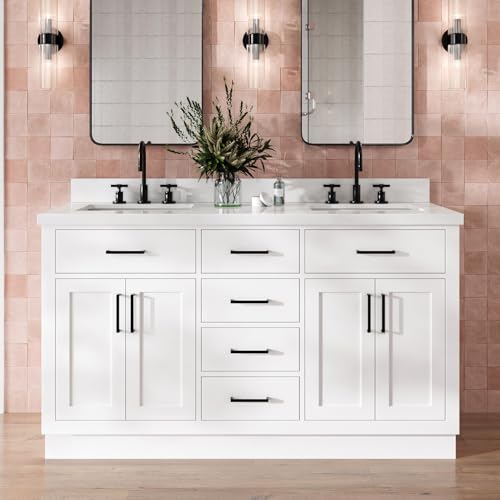
A 60-inch double sink combo with a quartz top, giving two-basin households the same hard-water etching resistance across the full countertop rather than needing to match a separately sourced top to a wider cabinet.
With two basins and two faucets, hard water spotting doubles in visible surface area, which makes a low-maintenance quartz top and a reflective faucet finish more valuable here than in a single-sink bathroom.
If well water iron staining is a known issue in the home, wipe both basins and faucet bases promptly after use rather than letting water sit and evaporate, since iron stains set faster than generic hardness scale does.

A cultured marble integrated top molds the sink basin directly into the countertop with no seam, which removes the caulk joint where hard water deposits and grime most commonly accumulate on a drop-in sink installation.
Cultured marble is a polyester resin and marble powder composite, not natural calcium-based marble, so it does not etch the way real marble does under hard water exposure, while still offering the seamless, easy-wipe surface that reduces where deposits can settle.
Do not confuse cultured marble with natural marble when shopping in a hard water area. The names sound identical but perform very differently: cultured marble resists hard water etching reasonably well, while natural marble is one of the most vulnerable countertop materials to it.

A compact 24-inch combo sized for a powder room or small secondary bathroom, where a matched sink and top still simplify the search for hard-water-appropriate materials at a smaller footprint.
Confirm the specific top material offered with this combo at the time of purchase, since combo listings can vary the included countertop by configuration, and verify it is sealed or non-porous before assuming hard-water performance.
In a small secondary bathroom used less frequently, hard water deposits often go unnoticed longer simply because the sink is used less. A quick monthly wipe-down with a vinegar solution prevents buildup from setting in a low-traffic bathroom just as it does in a primary one.
Not really. Hard water primarily affects the countertop surface and the faucet, not the cabinet box. A vanity with a sealed quartz or solid surface top and a quality faucet finish addresses the real hard water exposure points; the cabinet material itself does not need to be "hard water resistant."
Generic hard water leaves chalky white or gray limescale deposits from calcium and magnesium. Well water iron staining is reddish-orange or brown, caused by dissolved iron and manganese oxidizing on contact with air, and it stains porous surfaces more than it etches them.
A whole-house water softener reduces the calcium and magnesium responsible for limescale buildup on faucets and countertops throughout the home, which indirectly protects the vanity area. It is generally a more effective investment than choosing a specific vanity material for hard water resistance alone.
Faucets accumulate mineral deposits fastest at the point where water exits and evaporates on the exterior of the spout and handles, which are exposed to air constantly. A sink basin drains most of its water away, limiting the standing-water evaporation that leaves mineral spots, though splash areas around the drain can still show some buildup.
Matte black shows white mineral spotting more visibly than chrome or brushed nickel because the contrast between light-colored deposits and a dark, non-reflective surface is stark. Matte black is not damaged any faster by hard water, but the cosmetic spotting is more noticeable and requires more frequent wiping to keep it looking clean.
Yes. A basic well water test measuring hardness, iron, and manganese tells you whether you are dealing with generic hardness, significant iron staining, or both, which determines whether a water softener, an iron filter, or both are the appropriate fix, rather than guessing based on stain color alone.
No, not under normal conditions. Engineered quartz is not calcium-based, so it does not etch from mineral deposits the way natural marble does. Quartz can still show a surface film or slight dulling from mineral residue if never wiped, but this is a cleanable surface deposit, not permanent etching.
For quartz, solid surface, or sealed granite, a diluted vinegar solution or a dedicated hard-water cleaner formulated for the specific material, followed by a thorough rinse, removes most surface mineral deposits safely. Avoid abrasive scrubbing pads on solid surface materials, which can dull the finish, and avoid vinegar on unsealed natural stone, which can worsen etching.
Cultured marble performs reasonably well against hard water because it is a resin composite rather than true calcium-based natural marble, but it is generally considered slightly more susceptible to staining over many years than engineered quartz, which has near-zero porosity and requires no sealing at all.
The overflow hole retains a small amount of standing water and air exposure longer than the rest of the basin, which is exactly the condition that causes dissolved well-water iron to oxidize and deposit visibly. This is a common, specific sign of elevated iron content worth testing for directly.
Generally no. Since hard water does not meaningfully affect the cabinet box, that budget is better allocated to a sealed quartz or solid surface countertop, a quality faucet finish, and, if needed, a whole-house water softener or iron filter, all of which address the actual points of hard water exposure.
Hard water and well water are real problems around a vanity, but they show up on the countertop and the faucet, not the cabinet box. Choose a sealed engineered quartz or solid surface top over unsealed natural stone, pair it with a chrome or brushed nickel faucet rather than matte black if spotting is a concern, and if well water iron staining is significant, test the water and invest in a softener or iron filter rather than shopping for a "hard water resistant" cabinet that was never really exposed to the problem in the first place.
How we rank & our data sources
We do not run physical lab tests. Rankings are built from published, verifiable data and real owner feedback, never paid placement.
Researched by admin · Last updated July 21, 2026 · Our review method
A true powder room technically has no bathtub, since the definition is a toilet and sink only, but plenty of homeowners use…
Read the guide
A vanity cabinet is not shaped like a kitchen cabinet, and organization products built for kitchens frequently do not fit a vanity's…
Read the guide
A primary bathroom vanity anchors the room's daily routine and its storage, which is why size, double-sink capacity, and drawer organization matter…
Read the guide