
Bathroom Vanity Care for Hard Water and Well Water Areas
Bathroom Remodeling4.6
Homeowners with hard water or well water often shop for a "hard water resistant vanity," but the honest answer is that the…
Read the guideA vanity in a short-term rental takes a different kind of abuse than one in an owner-occupied home: harsh turnover-cleaning products, guests who do not report a slow leak, and a camera lens that judges every finish choice before a booking is even made. This guide covers the materials that survive commercial cleaning cycles, the styling that photographs consistently across listings, and why moisture resistance matters more here than almost any other bathroom scenario.
Research updated June 2026.
A vanity with a plywood cabinet box, a catalyzed lacquer or thermofoil finish, and an engineered quartz or solid-surface countertop in a neutral white or light gray shaker or flat-panel style is the safest choice for Airbnb and short-term rentals. It resists commercial cleaning chemicals, photographs consistently across listings, and if damaged is easy to replace with a similar stock model without a visible mismatch.
An owner-occupied vanity gets used by the same one or two people who notice problems immediately. A rental vanity gets used by a different household every few days, cleaned by a turnover crew working fast and often with whatever chemical is under the sink, and left unattended for stretches where nobody is checking on it. Those three differences change which vanity qualities actually matter for a host.
This guide covers the material and finish choices that hold up to that pattern, the styling choices that keep listing photos consistent, and the honest reason moisture resistance deserves more weight here than in a typical bathroom. It builds on the general bathroom vanity buying guide and pairs with our best toilet for Airbnb and best toilet for vacation rental guides if you are furnishing the whole bathroom.
Engineered quartz or sealed solid-surface countertops and cabinet doors finished in catalyzed lacquer or thermofoil hold up best to the frequent, fast, chemical-heavy cleaning that short-term rental turnover crews use. Quartz needs no sealing and resists the bleach-based sprays and disinfecting wipes cleaning services default to, while catalyzed lacquer chemically crosslinks during curing and resists solvent contact far better than a single-coat painted finish.
Unsealed natural stone, single-coat painted MDF, and laminate with exposed cut edges are the materials most likely to degrade under commercial cleaning. Laminate specifically is vulnerable at the countertop-to-backsplash seam, where repeated wiping with harsh cleaner eventually breaks down the sealant.
A cleaning crew rotating through several properties in a day uses whatever product is fastest, which is usually a bleach-based spray or disinfecting wipe, not the gentle pH-neutral cleaner a homeowner might choose for their own bathroom. A finish that tolerates occasional bleach contact without discoloring is a genuine operational requirement for a host, not a luxury upgrade.
| Material | Commercial Cleaning Tolerance | Sealing Required | Best For Rentals |
|---|---|---|---|
| Engineered Quartz Top | High | No | Any rental, any turnover frequency |
| Sealed Solid Surface | High | No, repairable if scratched | Rentals wanting a repairable surface |
| Catalyzed Lacquer Cabinet | High | N/A | High-turnover units |
| Thermofoil Cabinet | Moderate to High | N/A | Budget-tier rentals, keep hair tools off doors |
| Unsealed Natural Stone | Low | Yes, frequently | Not recommended for rentals |
| Laminate, Exposed Seams | Low | N/A | Not recommended for high-turnover units |
White, warm white, and light gray shaker or simple flat-panel vanities photograph consistently across the widely varying lighting conditions of listing photos, phone cameras, and different times of day. Neutral finishes reflect light evenly and rarely clash with the bedding, towels, and staging a host changes seasonally, while bold colors or ornate furniture-style vanities can look dated in photos within a few years and limit staging flexibility.
Neutral, widely stocked finishes also solve a practical problem bold or discontinued colors do not: if the vanity is damaged, a replacement in the same stock white or gray finish is easy to source, while a designer color from a limited run may already be discontinued by the time it needs replacing, leaving a visible mismatch.
In your own home, a slow drip under the sink gets noticed within days because someone opens that cabinet regularly. In an unattended rental between guest turnovers, which can run from a few days to several weeks in the off-season, a small supply-line or p-trap leak can silently swell a particleboard cabinet floor before anyone reports it, since a guest who is not the owner has little incentive to inspect under a cabinet or report a minor drip promptly.
A plywood cabinet box resists this kind of unattended moisture exposure far longer than particleboard, and a simple battery-powered water leak sensor placed inside the vanity cabinet, such as a Wyze or Govee leak sensor, gives a host an early alert that a guest never will.
The single most common preventable rental-vanity failure is not guest damage -- it is an unreported leak that goes unnoticed for one or two full booking cycles. A twenty-dollar leak sensor and a plywood-box cabinet address the two most likely failure points for a fraction of the cost of replacing a swollen cabinet.
These picks balance cleaning-chemical tolerance, neutral photogenic styling, and moisture resistance across different rental budgets and bathroom sizes.

A straightforward 30-inch shaker vanity in a widely stocked neutral finish, sized for the standard guest bathroom footprint most rentals have. Easy to source a matching replacement if a unit is damaged.
The plywood box holds up to unattended moisture exposure better than particleboard alternatives at a similar price, which matters more in a rental than an owner-occupied home.
Buy an extra can of matching touch-up paint or keep the model number on file. Replacing a chipped door panel is far cheaper than replacing the whole cabinet, but only if you can match the finish.

A 24-inch vanity for compact rental bathrooms and studio units where every inch of floor space affects listing photos and guest comfort alike.
Limited storage means fewer places for a cleaning crew to leave supplies behind between guests, which some hosts consider a minor advantage since it forces a consistent, minimal in-bathroom setup.
In compact rental bathrooms, a wall-mounted shelf above the vanity often solves the storage shortfall this size creates without adding cabinet floor footprint that eats into the room's photographed sense of space.

A flat-panel modern vanity with a clean, uncluttered profile that reads well in the wide-angle photography most listing platforms favor, without the ornate details that date faster in photos.
The flat-slab door style has fewer joints and recesses than a furniture-style vanity, which also means fewer places for cleaning crews to miss when disinfecting between guests.
Push-to-open or minimal bar-pull hardware photographs cleaner than ornate pulls, but verify the mechanism holds up to guest use -- push-to-open hardware in high-turnover units sees more force than in an owner-occupied home and should be checked periodically for looseness.
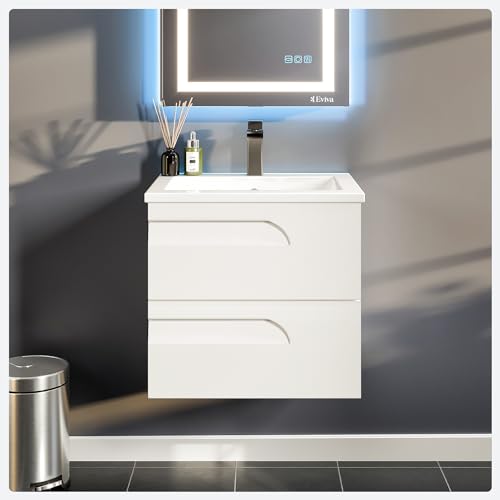
A wall-mounted vanity that leaves the floor beneath it open, which lets a cleaning crew mop the full bathroom floor in one pass rather than working around cabinet legs and a toe kick.
Because there is no toe kick or floor-level cabinet base, there is also no low, hard-to-reach gap where mildew and hair can accumulate unnoticed between cleanings, a real advantage in a unit nobody occupies full time.
Floating vanities require verified wall-stud support and are best installed by a licensed contractor. For a rental, the faster turnover cleaning and consistently photogenic open-floor look generally justifies the higher installation cost over the life of the unit.
Choosing a striking or unusual finish because it looks good in one listing photo, without considering that the finish may be discontinued within a few years, making any future damage repair or replacement visibly mismatched. Neutral, widely stocked finishes avoid this problem entirely.
Yes, if you manage several properties. Standardizing on one or two vanity models simplifies repairs, lets you keep spare parts like door hinges or drawer slides on hand, and means a damaged component can often be swapped from spare stock rather than special-ordered.
Install a battery-powered leak sensor inside the vanity cabinet near the supply lines and p-trap, choose a plywood rather than particleboard cabinet box, and have your cleaning crew do a quick visual check under the sink at every turnover as a standard part of the cleaning checklist.
The same materials that perform best generally, such as engineered quartz, matter more in a rental because of the frequency and harshness of commercial cleaning. Quartz requires no sealing and tolerates the bleach-based products most turnover crews default to without discoloring.
Thermofoil is an acceptable budget-tier choice for rentals as long as guests and cleaning crews avoid placing hot styling tools directly against the door surface, since sustained heat causes the PVC film to bubble and delaminate. For rentals with hair-tool use, catalyzed lacquer is more forgiving.
Avoid dark, glossy finishes and bold designer colors from limited production runs. Dark glossy surfaces show water spots and fingerprints heavily in photos and in person, and limited-run colors are difficult to match if a replacement panel or unit is needed later.
At minimum, every turnover cleaning should include opening the vanity doors and checking for moisture, odor, or loose hardware. A more thorough inspection, including checking drawer slide function and countertop seams, should happen at least quarterly or after any guest complaint involving the bathroom.
Only if the bathroom has adequate clearance to support it. A double vanity in a rental sleeping four or more guests can reduce morning bottleneck complaints, but a cramped double vanity in too small a room causes more complaints than it solves. Match vanity width to the room, not just occupancy count.
A single-handle faucet in chrome or brushed nickel is generally the most durable and easiest to repair pairing for a rental, since replacement cartridges are widely stocked and the finish shows mineral spotting less visibly than matte black in areas with harder water.
Not necessarily. Floating vanities speed up cleaning and photograph well, but the installation cost and structural requirements make more sense for higher-end listings or smaller bathrooms where the open-floor look adds real photographed value. Standard freestanding vanities remain the more economical default for most units.
Keep the vanity, countertop, and hardware finish unchanged between photo refreshes, and only update soft staging elements like towels, soap dispensers, and small decor. Changing the vanity itself forces a full new photo shoot and can create inconsistency with older photos guests have already seen.
A quality plywood-box vanity with a catalyzed lacquer finish and quartz top typically lasts 8 to 12 years in a high-turnover rental, roughly half the lifespan expected in an owner-occupied home, due to the higher cleaning frequency and varied guest use. Budget particleboard vanities often need replacement within 3 to 5 years under the same conditions.
A plywood-box vanity in a neutral white or gray finish with an engineered quartz top gives hosts the best combination of cleaning-chemical tolerance, consistent listing photography, and easy replacement if damage occurs. Add a battery-powered leak sensor inside the cabinet to catch the moisture problems guests are least likely to report, and standardize on the same model across multiple units to simplify repairs and spare-parts stock.
How we rank & our data sources
We do not run physical lab tests. Rankings are built from published, verifiable data and real owner feedback, never paid placement.
Researched by admin · Last updated July 20, 2026 · Our review method
Homeowners with hard water or well water often shop for a "hard water resistant vanity," but the honest answer is that the…
Read the guide
A true powder room technically has no bathtub, since the definition is a toilet and sink only, but plenty of homeowners use…
Read the guide
A vanity cabinet is not shaped like a kitchen cabinet, and organization products built for kitchens frequently do not fit a vanity's…
Read the guide