Best Bathroom Faucets for a Small Bathroom (2026)
Faucets & Sinks4.6
A small bathroom faucet has to fit a compact sink and a shallow counter without overwhelming either one, since a full-size widespread…
Read the guideA small bathroom sink has one job above all others: give up as little floor and counter space as possible without turning hand-washing into an exercise in elbow control. We compared real basin dimensions, mounting depth, and install type from Kohler, American Standard, and Kingston Brass to find the sinks that actually work in a tight footprint, not just ones marketed as compact.
Research updated June 2026.
The American Standard Ovalyn Sink in its compact drop-in configuration is the best overall small bathroom sink, since its narrow oval basin fits a shallow vanity without sacrificing the vitreous china durability a full-size sink offers. The Kohler Devonshire pedestal sink is the top pick for a bathroom too tight for a vanity at all, and a wall-mount corner sink is the best space-saving choice for a bathroom under five feet wide.
A small bathroom sink is judged by a different standard than one in a primary suite. Nobody expects a powder room or a cramped hall bathroom to have double-vanity counter space, so the real question becomes how little footprint a sink can occupy while still being comfortable enough for daily hand-washing and quick grooming. That shifts the buying priority away from basin depth and toward projection distance from the wall, overall width, and whether the sink needs a vanity cabinet underneath it at all.
Because of that space-first pattern, we weighted footprint and mounting flexibility above nearly everything else for this list. A pedestal or wall-mount sink that eliminates the vanity cabinet entirely often does more for a small bathroom's usable floor space than any compact vanity sink can, while a narrow oval or corner basin lets a tight vanity still fit in the room without forcing a full remodel. For sink options built for a bathroom used every day by the same person or two, see our best sinks for a primary bathroom guide.
A small bathroom sink benefits most from a narrow overall width and a shallow projection from the wall, which matters more here than basin depth or double-vanity capacity. Pedestal and wall-mount sinks remove the vanity cabinet entirely and typically free up the most floor space, while a compact oval or corner-mount vanity sink is the better choice when some enclosed storage underneath is still needed.
A pedestal sink like the Kohler Devonshire frees up the most visual and physical floor space in a small bathroom, since there is no cabinet base to work around, though it sacrifices under-sink storage entirely. A wall-mount sink saves even more floor space than a pedestal by eliminating the pedestal column too, leaving the floor beneath fully open, which matters most in a bathroom under five feet wide. A compact vanity sink is the right call when the room still needs enclosed storage for towels and toiletries and can spare 24 to 30 inches of wall width.
Compact vanity sinks and corner-mount sinks can run as narrow as 19 to 24 inches wide, compared to the 30 to 36-inch width common in a standard single-sink vanity. A wall-mount sink can go even narrower, since it does not need a full vanity cabinet footprint beneath it, making it the choice for the tightest available wall space.
Seven real sinks chosen for footprint, mounting flexibility, and durability in a small bathroom.
| Sink | Best For | Key Spec | Notes | Check Price |
|---|---|---|---|---|
| American Standard Ovalyn Sink | Best overall compact vanity sink | Vitreous china, drop-in/undermount | Narrow oval basin fits a shallow vanity | Check price |
| Kohler Devonshire Pedestal Sink | Best for a vanity-free footprint | Vitreous china, pedestal | Removes the cabinet base entirely | Check price |
| Kohler Wall-Mount Sink | Best for maximum floor space | Vitreous china, wall-mount | No pedestal column, floor fully open | Check price |
| Kingston Brass Corner Sink | Best for an under-five-foot bathroom | Vitreous china, corner-mount | Tucks into an unused corner | Check price |
| American Standard Compact Pedestal Sink | Best budget pedestal | Vitreous china, pedestal | Lower cost than premium pedestal lines | Check price |
| Kohler Verticyl Round Vessel Sink | Best small vessel for a narrow shelf | Vitreous china, vessel | Small footprint on a shallow console | Check price |
| 24-Inch Compact Vanity Sink Combo | Best with built-in storage | Vitreous china or cultured marble top | Narrowest configuration with a cabinet | Check price |
Each pick is ranked on footprint and mounting flexibility first, then material durability and style.

The American Standard Ovalyn is the best overall small bathroom sink, with a narrow oval basin that fits a shallow vanity while keeping the vitreous china durability a full-size sink offers.
A small bathroom vanity rarely has room for a wide rectangular basin, and the Ovalyn's narrower oval shape is sized specifically to fit a shallow cabinet without hanging over the edges or crowding a nearby wall or door swing. It still uses the same fired vitreous china glaze found in American Standard's larger sinks, so durability is not the tradeoff for the smaller footprint.
Because it installs as either a drop-in or an undermount, it works with whatever compact vanity or laminate counter a small bathroom remodel already has in place, without forcing a full counter replacement. For a powder room or a tight hall bathroom being refreshed on a budget, it is the sensible default choice.
For a small bathroom specifically, we favor the Ovalyn because it does not try to be a statement piece, it simply fits the space and holds up to daily use. That practicality is exactly what a tight footprint calls for.
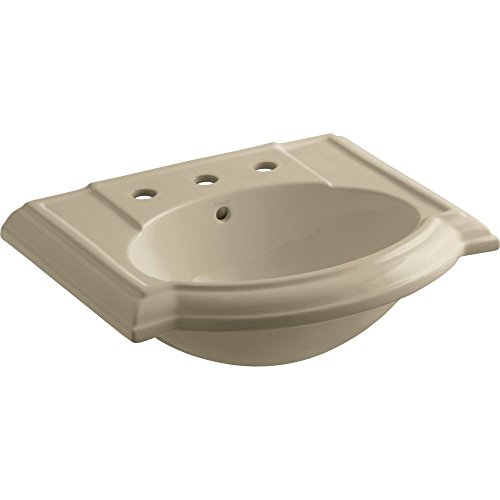
The Kohler Devonshire pedestal sink removes the vanity cabinet from the equation entirely, freeing up real floor space in a bathroom too tight to spare a cabinet footprint.
A vanity cabinet, even a compact one, still occupies 18 to 24 inches of floor depth that a small bathroom often cannot spare. The Devonshire's pedestal base holds the basin at standard height while taking up only the width of the slender column itself, which makes the room read as more open even when the actual square footage has not changed.
The tradeoff is storage: there is nowhere to stash toiletries or extra towels beneath a pedestal sink, so this pick makes the most sense in a bathroom that already has a linen closet or medicine cabinet elsewhere. Owner reviews consistently note how much larger a small bathroom feels once a bulky vanity is swapped for a pedestal.
When a small bathroom's biggest problem is simply feeling cramped, we point buyers toward a pedestal sink before anything else. Losing the storage is a real tradeoff, but the visual and physical space it returns to the room is usually worth it.
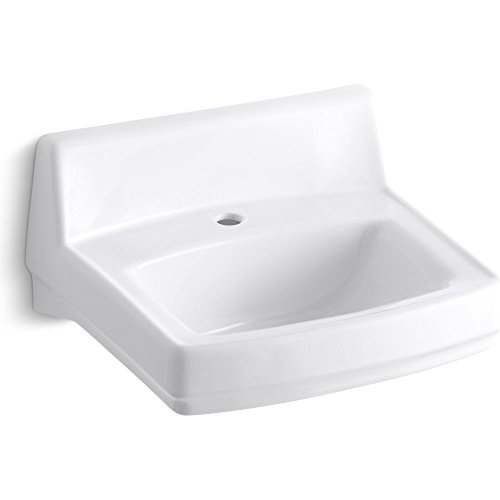
A wall-mount sink leaves the floor beneath it completely open, making it the maximum-space-saving option for a bathroom under five feet wide.
Even a slender pedestal column occupies some visual and physical space, and a true wall-mount sink removes that column entirely, bolting the basin directly to the wall with the floor beneath left fully open. In a bathroom under five feet wide, that open floor space can be the difference between a room that feels workable and one that feels like a closet.
Because the floor is unobstructed, a wall-mount sink is also a common choice for a small bathroom being planned with future accessibility in mind, since it leaves knee clearance beneath the basin. Installation does require confirming the wall has blocking rated to support the mounted weight, which is worth checking with a contractor before committing.
For the tightest bathrooms we plan around, under five feet of width, a wall-mount sink is often the only sink type that genuinely does not eat into the room's usable floor space. It is the pick when every inch actually counts.

A corner-mount sink tucks into an otherwise unused corner, making it the right call for a small bathroom whose floor plan simply has no straight wall to spare.
Some small bathrooms are not just short on square footage, they are also awkwardly shaped, with a door swing, a tub, or a toilet claiming most of the straight wall space. A corner sink solves that by using a triangular basin that mounts across an inside corner, a spot that would otherwise sit empty in most floor plans.
Because it does not need a straight run of wall the way a standard sink does, it can unlock a workable layout in a bathroom that seemed too oddly shaped to fit a sink comfortably. The basin itself is smaller than a standard oval or rectangular sink, a fair tradeoff for reclaiming an unused corner.
We recommend a corner sink specifically when a small bathroom's problem is shape, not just size. It is a niche solution, but for the right oddly configured room, it is often the only sink that actually fits without a layout change.
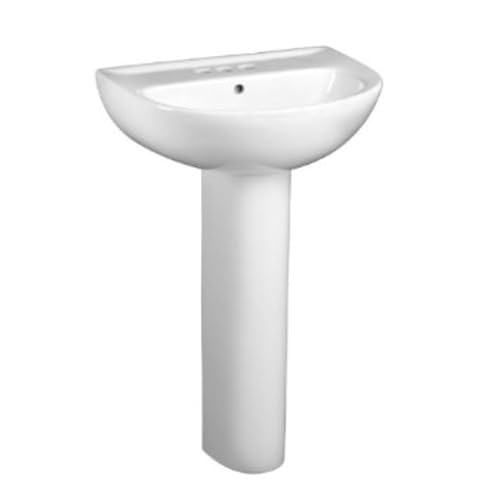
A budget-friendly pedestal sink that delivers the same space-saving benefit as premium pedestal models at a more accessible price.
Not every small bathroom refresh has room in the budget for a premium pedestal sink, and this American Standard option delivers the identical space-saving benefit, an open floor with no cabinet base, at a noticeably lower price point. The compact oval basin is sized appropriately for a small room without feeling undersized for daily hand-washing.
Because pedestal sinks are a simple, well-established design, the lower price here does not come at the cost of the vitreous china durability that matters for daily use. It is a straightforward, no-frills choice for a small bathroom remodel where the budget needs to stretch across other fixtures too.
When a small bathroom needs the space benefit of a pedestal sink but the budget is tight, this is where we point buyers. You are not sacrificing the core space-saving advantage to save money here.

A small round vessel sink sits atop a narrow console or shelf, giving a tight bathroom a design-forward look without needing a full vanity footprint.
A vessel sink can work well in a small bathroom when it sits on a shallow floating shelf or narrow console rather than a full vanity cabinet, since the shelf itself can be cut to a much smaller depth than a standard vanity would require. The round Verticyl's compact diameter is well suited to that kind of narrow surface.
Because the sink sits above the counter rather than being cut into it, the shelf beneath it needs less structural depth than an undermount installation would, which can be the detail that makes a design-forward sink fit into a genuinely small footprint. Pairing it with a tall vessel-height faucet is a required step, not optional.
For a small powder room that still wants a design moment rather than a purely utilitarian sink, a compact vessel on a narrow shelf is the way to get there without needing full vanity depth.

A 24-inch vanity and sink combo is the narrowest configuration that still includes enclosed storage, for a small bathroom unwilling to give up a cabinet entirely.
Not every small bathroom can go without any enclosed storage, and a 24-inch vanity combo is the compromise: it is the narrowest cabinet width that still gives a drawer or small cabinet door for toiletries, while taking up meaningfully less wall space than a standard 30 to 36-inch vanity. The integrated top keeps the basin and counter as one sealed piece, avoiding any seam for grime to collect in.
Because it ships as a matched cabinet and top, it removes the guesswork of pairing a separate sink to a compact cabinet, a common source of fit problems in small bathroom remodels. For a room that genuinely needs at least a little enclosed storage but cannot spare more than two feet of wall, this is the practical answer.
When a buyer tells us they need at least some enclosed storage no matter how small the bathroom is, a 24-inch combo is usually where we land. It is the smallest footprint that still functions as a real vanity, not just a sink.
Across all seven picks, the small bathroom pattern is consistent: prioritize footprint and mounting flexibility over basin size or storage capacity, since floor and wall space is the true scarce resource in this room type. Pedestal and wall-mount sinks free up the most space at the cost of storage, while a narrow vanity combo is the right tradeoff when some enclosed storage still matters.
The right sink depends on how much floor space you can spare, whether you need enclosed storage, and the room's exact shape. These checks cover the decisions that matter most.
A pedestal or wall-mount sink like the Kohler Devonshire or Kohler Wall-Mount frees up the most floor space but offers no storage at all. If the bathroom has a separate linen closet or medicine cabinet, that tradeoff is usually worth it; if not, a compact vanity combo may be the better fit.
Compact vanity sinks like the American Standard Ovalyn or 24-inch vanity combo need at least 19 to 24 inches of straight wall. If your small bathroom does not have that much uninterrupted space, a corner sink or a wall-mount option becomes the more realistic choice.
If your small bathroom's real problem is shape rather than pure square footage, a corner-mount sink like the Kingston Brass Corner Sink can unlock a workable layout by using a dead corner instead of competing for the same wall space as the tub, toilet, or door swing.
The American Standard Ovalyn is the best overall pick, with a narrow oval basin that fits a shallow vanity without sacrificing durability. A pedestal or wall-mount sink is the better choice if no vanity storage is needed.
A pedestal sink frees up the most floor space but offers no storage. A compact vanity sink keeps some enclosed storage while still fitting a narrow footprint, typically 19 to 24 inches wide.
Wall-mount sinks and corner-mount sinks are generally the narrowest true footprints, since neither requires a full vanity cabinet or pedestal column beneath the basin.
The basin itself can be a manageable DIY task, but confirming and installing wall blocking rated for the sink's weight is best handled by a contractor, especially in an older home.
Yes, specifically for an awkwardly shaped small bathroom where a standard straight-wall sink does not fit well. It uses an otherwise unused corner rather than competing for the same wall space as the tub or toilet.
Yes, a compact vessel sink on a narrow floating shelf or console can work well in a small bathroom, since the shelf needs less structural depth than a full undermount vanity installation.
All of it. A pedestal sink has no cabinet or drawer space, so any toiletries or towels normally stored under a vanity need another location, such as a linen closet or wall-mounted shelving.
A 24-inch vanity and sink combo is generally the narrowest configuration that still includes at least one drawer or cabinet door, making it the practical minimum for enclosed storage.
Not necessarily. A small bathroom, such as a powder room or hall bath, has more flexibility to prioritize footprint over matching a primary bathroom's larger, storage-focused sink and vanity.
A quick wipe-down after regular use keeps a vitreous china sink looking clean, since the nonporous glaze resists staining. A small bathroom sink that sees less traffic than a primary bath sink can go longer between deeper cleanings.
Installation complexity is similar, though a pedestal sink requires exposed supply and drain lines to be finished neatly, since there is no cabinet to conceal them, unlike a vanity sink where the plumbing sits hidden behind cabinet doors.
A small bathroom sink is judged on footprint first and everything else second, which is why mounting flexibility matters more here than in any other bathroom in the house. The American Standard Ovalyn leads for most buyers who still want a vanity, the Kohler Devonshire pedestal sink is the smart pick for reclaiming floor space, and a wall-mount sink delivers the maximum space savings for a bathroom under five feet wide.
How we rank & our data sources
We do not run physical lab tests. Rankings are built from published, verifiable data and real owner feedback, never paid placement.
Researched by admin · Last updated July 11, 2026 · Our review method
A small bathroom faucet has to fit a compact sink and a shallow counter without overwhelming either one, since a full-size widespread…
Read the guide
A powder room sink has to solve a tight footprint and still look like an intentional design choice, since it is the…
Read the guide
A true powder room has no tub or shower, so this guide is written for the common conversion scenario: a half-bath expanded…
Read the guide