
Best White Bathtubs (2026)
Bathroom Remodeling4.6
White remains the default and most widely stocked bathtub color for a reason: it resells well, matches virtually any tile or vanity…
Read the guideA black bathroom vanity has become one of the most popular ways to bring real contrast and a modern edge into a bathroom remodel, whether that means a deep matte black shaker cabinet, a black wall-mounted floating design, or black hardware paired with a lighter cabinet body. We compared real vanity configurations, finishes, and countertop pairings to find the black vanity options that hold up to daily use while making the design statement buyers are after.
Research updated June 2026.
A 60-inch matte black double-sink vanity with a white or light quartz countertop is the best overall configuration for most primary bathrooms, giving the room real contrast without making the whole space feel dark. A 48-inch matte black single-sink vanity is the right call for a smaller bathroom or one-person primary bathroom, and a black floating wall-mount vanity is the top choice for a primary bathroom chasing the most modern, minimalist look available.
A black bathroom vanity works because of contrast, not because dark cabinetry alone makes a bathroom look better. Nearly every well-reviewed black vanity in this guide is paired with a lighter countertop, typically white or light gray quartz, which keeps the room from reading as heavy or cave-like while still delivering the bold visual statement black cabinetry is chosen for. That pairing matters more with vanities than it does with a black sink or toilet alone, since a vanity occupies far more visual real estate in the room.
Finish matters just as much as color here. A matte or satin black cabinet finish shows fingerprints, water splashes, and dust considerably less than a glossy lacquer, which is a real daily consideration for a fixture opened and closed multiple times a day. For sink options to pair with any of these vanities, see our best black bathroom sinks guide, and for the full primary bathroom vanity lineup across every color, see our best vanities for a primary bathroom guide.
A black bathroom vanity works best when paired with a lighter countertop, wall color, or flooring that provides genuine contrast, since an all-black room without any lighter surfaces can feel small and dim rather than modern. Matte or satin black finishes are also more practical for daily use than high gloss, since they resist showing fingerprints and water splashes.
A light countertop, typically white or light gray quartz, is the more popular and generally more successful pairing with a black vanity cabinet, since the contrast keeps the bathroom feeling open and balanced rather than heavy. A dark countertop on a black cabinet can work in a larger, well-lit bathroom, but it requires more careful lighting planning to avoid the space feeling closed in.
Quartz remains the most common countertop choice paired with a black vanity because it is nonporous, available in a wide range of light finishes, and resists the staining and heat damage that daily use from hair tools and skincare products can cause. White or light gray quartz specifically creates the strongest visual contrast against a black cabinet, which is the pairing most black vanity buyers land on after seeing an all-dark room in person.
Seven real vanity configurations chosen for finish durability, contrast pairing, and daily storage in a black-cabinet bathroom.
| Vanity Type | Best For | Key Spec | Notes | Check Price |
|---|---|---|---|---|
| 60-Inch Matte Black Double-Sink Vanity, White Quartz Top | Best overall for two-person use | 60 in, matte black, two basins | Strong contrast, dedicated storage per person | Check price |
| 48-Inch Matte Black Single-Sink Vanity | Best for one-person or smaller rooms | 48 in, matte black, single basin | Generous storage without a double-vanity footprint | Check price |
| Black Floating Wall-Mount Vanity | Best modern minimalist look | 48-60 in, wall-mounted | Visually opens the floor space | Check price |
| Black Shaker Vanity with Brass Hardware | Best warm contrast finish | 36-48 in, shaker style, brass pulls | Softens an all-black cabinet look | Check price |
| 72-Inch Black Double-Sink Vanity | Best maximum storage | 72 in, matte black, two basins | Largest footprint, most drawer space | Check price |
| Black and Wood Two-Tone Vanity | Best two-tone design | 48-60 in, black base, wood accents | Softer transitional black look | Check price |
| Budget Black Vanity Combo with Mirror | Best budget upgrade | Varies, includes sink and mirror | Lower cost complete black vanity package | Check price |
Each pick is ranked on finish durability and contrast pairing first, then configuration and style.

A 60-inch matte black double-sink vanity with a white quartz top is the best overall black vanity configuration, delivering strong contrast and dedicated storage for two people without making the room feel dark.
This configuration solves the same daily-use problem any double-sink vanity solves, giving two people their own basin and storage zone, while adding the visual weight and modern edge a black cabinet brings to a primary bathroom remodel. The white quartz top is doing real design work here: without it, a full 60 inches of black cabinetry can make even a moderately sized bathroom feel smaller and dimmer than it actually is.
Matte black lacquer or laminate finishes hold up well to the multiple daily open-and-close cycles a primary bathroom vanity sees, and the matte texture specifically resists showing fingerprints and light water splashes better than a glossy black finish would. Quartz remains the practical top choice regardless of cabinet color, since it never needs sealing and resists the daily contact with skincare products and hot tools this counter sees.
For a primary bathroom going black, this is the configuration we recommend as the default. The white quartz top is not optional in our research, it is the detail that keeps the room from feeling like a cave once the cabinetry is actually installed.
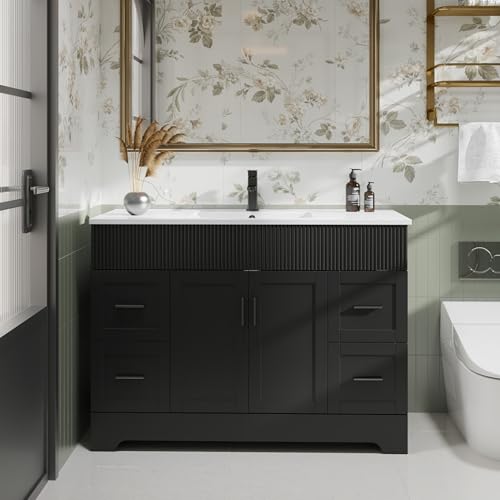
A 48-inch matte black single-sink vanity is the right call for a smaller bathroom or one-person primary bathroom that still wants the bold black cabinet look.
Not every bathroom has the floor space or the need for a 60-inch double vanity, and a well-sized 48-inch single-sink black vanity delivers the same bold cabinet color in a footprint that fits guest bathrooms, smaller primary bathrooms, and powder rooms with real counter space to spare. Because a smaller room amplifies the visual weight of a dark cabinet more than a large one does, pairing it with a light countertop and keeping the surrounding wall color bright matters even more here than in a larger double-vanity room.
For a single-occupant primary bathroom or a couple with staggered schedules who do not need simultaneous sink access, this size gives real counter space for a tray of skincare products or a hair dryer without the room feeling cramped by cabinetry.
In a smaller bathroom, we actually pay closer attention to wall and countertop color when the cabinet goes black, not less. A 48-inch black vanity in a small room with dark walls can feel genuinely cramped, so keep the rest of the palette light.
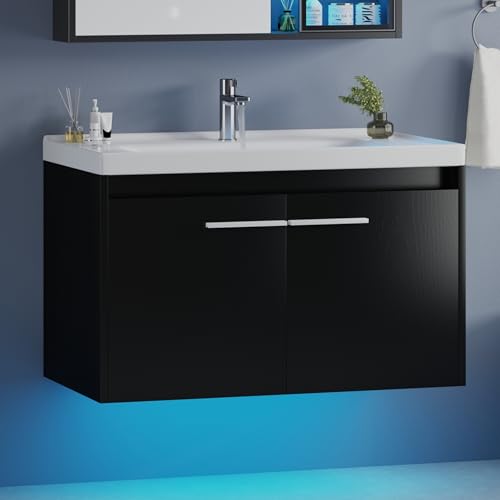
A black floating wall-mount vanity delivers the most modern, minimalist black bathroom look available, with the visible floor space beneath it keeping the room from feeling weighed down.
A floating design is arguably the most effective way to use black cabinetry without the room feeling visually heavy, since the exposed floor beneath the vanity breaks up the mass of the dark cabinet and keeps light moving across the room. That makes it a natural pairing with black, more so than with lighter cabinet colors where the floating effect matters less to the room's overall visual weight.
Installation requires the wall to have blocking rated for the mounted weight, which is worth confirming or adding during a full bathroom remodel rather than treating it as a simple retrofit. Pairing the floating black cabinet with a light quartz top and keeping the visible floor tile light in color maximizes the airy, modern effect this style is chosen for.
Of every way to use black in a bathroom vanity, the floating design is the one we have seen photograph and live the best in person. The visible floor space is doing more work to keep the room feeling open than people expect going in.
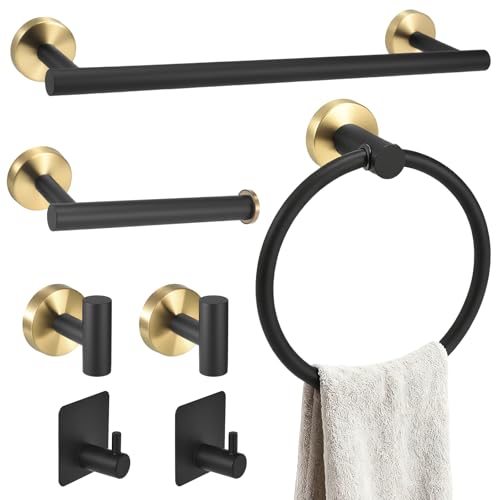
A black shaker-style vanity with brass or gold hardware softens the boldness of an all-black cabinet with a warm metal contrast, a popular pairing for a transitional bathroom design.
Pairing black cabinetry with warm brass or brushed gold hardware, rather than matching black pulls, is one of the most consistently well-reviewed combinations in this category because the warm metal breaks up the all-black surface and keeps the vanity from reading as flat or severe. The shaker door style, with its simple recessed panel, is versatile enough to suit both a fully modern bathroom and a more traditional or transitional remodel.
Because brass shows fingerprints and water spots more readily than black hardware would, it needs a similar wipe-down routine to a black sink or faucet, but most buyers find the visual payoff worth that small tradeoff. If the rest of the bathroom uses black fixtures, plan the metal finish for the faucet and mirror frame to coordinate with the brass hardware rather than clashing with it.
When a buyer wants black cabinetry but is worried it will feel too stark or modern for their overall design, we suggest brass hardware first. It is a small change that meaningfully warms up the whole vanity.
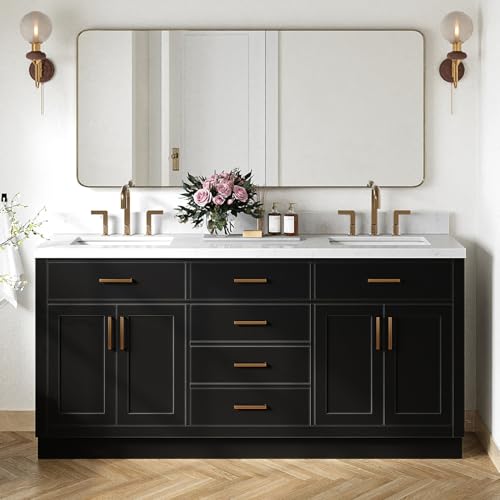
A 72-inch black double-sink vanity is the maximum-storage configuration for a larger primary bathroom, giving each person the most drawer and counter room on this list.
At 72 inches of black cabinetry, this configuration is only appropriate for a genuinely large primary bathroom, since that much dark surface area in a smaller room will overwhelm the space regardless of countertop color. In a room built to support it, the extra width gives noticeably more separation between the two basins, roughly 36 to 40 inches apart rather than 28 to 30, which reduces daily crowding for two people.
Lighting becomes a bigger factor at this scale than it does with a smaller black vanity, since a long run of dark cabinetry can absorb more ambient light than expected. Plan for stronger vanity lighting directly above the mirror and confirm the room has enough natural or overhead light to keep the space from feeling dim once the cabinet is installed.
Before recommending a 72-inch black vanity, we confirm the room's lighting plan first. This much black cabinetry needs real light output above the mirror, or the whole room reads darker than the buyer expected once it is built.

A black and wood two-tone vanity combines a black cabinet base with natural wood accents, a softer take on the black trend that suits a warmer, more transitional bathroom.
A two-tone vanity uses black for the main cabinet body while introducing a natural or stained wood element, often an open shelf, a top drawer front, or a display niche, which softens the overall look and gives the design more warmth than an all-black cabinet alone. For a bathroom leaning into natural materials elsewhere, such as wood-look tile or woven textiles, this pairing ties the room together more cohesively than solid black cabinetry would.
Because it combines two distinct finishes, matching the wood tone to other wood elements in the bathroom, such as a mirror frame or shelving, takes more planning than choosing a single-finish black vanity, but the payoff is a design that reads as more current and less severe than an all-black room.
For a buyer who likes the idea of black cabinetry but is nervous about it feeling too stark, the two-tone black-and-wood option is usually the compromise that gets them there. It keeps the bold statement while adding real warmth.
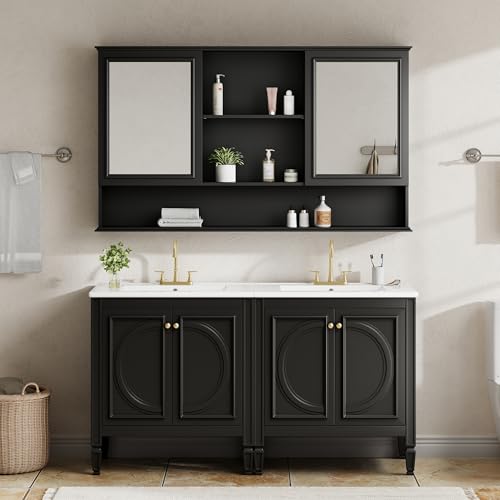
A budget black vanity combo that includes the cabinet, countertop, sink, and mirror in one package is the most affordable way to fully outfit a black bathroom without pricing out each component separately.
A vanity combo bundles the cabinet, countertop, sink, and a matching mirror into one purchase, which typically costs less than sourcing each black-finish piece separately and removes the guesswork of matching finishes across multiple products. Most budget black combos pair the cabinet with a white or light cultured marble top by default, which conveniently solves the contrast pairing question without any extra planning.
The tradeoff is usually cabinet construction: many budget combos use laminate over MDF rather than solid wood or plywood, which is less durable to daily moisture exposure over a long ownership period. For a bathroom remodel where budget is the top constraint, that tradeoff is often worth accepting in exchange for a complete, coordinated black vanity package.
The vanity combo is the sensible answer when a bathroom needs a complete black vanity and the budget does not stretch to custom or premium-material components. The included light countertop also means you cannot accidentally choose the wrong contrast pairing.
Across all seven configurations, the pattern for a black vanity is consistent: pair it with a lighter countertop and keep the surrounding wall color bright, choose a matte or satin finish over gloss for daily practicality, and plan lighting more deliberately than you would for a lighter-colored vanity. Black rewards a room that has been designed around the contrast rather than a black cabinet dropped into an otherwise unchanged space.
Plan the contrast, finish, and lighting together rather than choosing the cabinet color in isolation.
A white or light gray quartz top is the pairing most black vanity buyers land on, since it keeps the bathroom feeling open rather than heavy. Reserve a dark countertop on a black cabinet for a larger, well-lit bathroom that can support the extra visual weight.
A matte or satin black cabinet finish resists showing fingerprints, water splashes, and dust considerably better than a glossy lacquer, which matters for a fixture opened and closed multiple times daily.
Brass or brushed gold hardware against a black cabinet, or a two-tone black-and-wood design, gives the room warmth that an all-black, all-matched-hardware vanity does not. This is worth considering for a transitional bathroom rather than a fully modern one.
A 60-inch matte black double-sink vanity with a white quartz top is the best overall pick for most primary bathrooms, delivering strong contrast without making the room feel dark.
It can, if paired with a dark countertop and dim lighting. Pairing black cabinetry with a light countertop, bright walls, and strong vanity lighting keeps a small bathroom from feeling closed in.
White or light gray quartz is the most popular and generally most successful pairing, since it creates genuine contrast that keeps the room feeling open rather than heavy.
Matte or satin black is generally the more practical choice, since it hides fingerprints and water splashes far better than a glossy lacquer finish, which shows smudges clearly and needs more frequent cleaning.
Brass or brushed gold hardware adds warmth and contrast against black cabinetry, while matte black hardware creates a more seamless, monochromatic look. Either works, depending on whether the room leans warmer transitional or fully modern.
Yes, often the best choice. The visible floor space beneath a floating vanity helps offset the visual weight of black cabinetry, which is especially valuable in a smaller room.
Pair it with a light countertop, keep the surrounding wall color bright, and invest in strong vanity lighting above the mirror. These three factors matter more to how the finished room feels than the cabinet color alone.
Black-finish vanities can cost somewhat more than a comparable white or wood-tone model, depending on the brand and finish quality, though budget combo options are available at accessible price points.
A floor-standing black vanity is a manageable DIY project for an experienced homeowner, though plumbing connections typically require a licensed plumber. A floating black vanity requires wall blocking and is best left to a contractor.
A white vitreous china sink creates the strongest contrast against black cabinetry, while a black sink on a black vanity creates a more monochromatic, fully committed dark look. Both are common pairings depending on the desired effect.
Not fundamentally, but a black cabinet shows water spots and dust more visibly than a lighter finish, so a slightly more frequent wipe-down with a microfiber cloth keeps it looking its best.
How we rank & our data sources
We do not run physical lab tests. Rankings are built from published, verifiable data and real owner feedback, never paid placement.
Researched by admin · Last updated July 11, 2026 · Our review method
White remains the default and most widely stocked bathtub color for a reason: it resells well, matches virtually any tile or vanity…
Read the guide
Almond is the warm off-white bathtub color American Standard and Kohler have kept in production for decades so homeowners with an existing…
Read the guideA freestanding bathtub is the one fixture in a bathroom remodel chosen almost entirely for how it makes the room feel, since…
Read the guide