Best Toilet Flush Valve: How to Choose the Right One
Plumbing4.6
Which is the best toilet flush valve? Compare 2-inch, 3-inch, adjustable, and canister flush valves by fit and flush power, plus how…
Read the guideThe toilet shut off valve, also called the angle stop or supply stop, is the small valve on the wall behind the toilet that lets you cut the water to that fixture without shutting off the whole house. When it seizes, weeps from the stem, or refuses to fully close, a simple toilet repair turns into an emergency, and a corroded old multi-turn stop is the part most likely to leave you mopping the floor mid-flush. Modern quarter-turn ball valves fixed that: one ninety-degree flip stops the water cleanly, and they do not freeze up the way the old compression stops do. We ranked the best toilet shut off valves by valve mechanism, the connection type that decides whether you sweat, push, or thread them on, the outlet size that has to match your supply line, the body material and lead-free certification that codes require, and the patterns across hundreds of thousands of aggregated owner reviews.
The BrassCraft G2CR19X C quarter-turn angle stop is the best toilet shut off valve for most installs. Its lead-free brass body, compression inlet, and ninety-degree ball mechanism shut the water off cleanly and will not seize the way old multi-turn stops do, while fitting the standard 1/2 in. inlet by 3/8 in. outlet of nearly every toilet. For a no-solder, push-to-connect upgrade choose the SharkBite 23036-0000LFA, and for the best value pick the Eastman 10872LF.
A toilet shut off valve is the part you reach for the moment anything goes wrong with a toilet, and it is the part most likely to fail you when you need it. Every toilet has one of these small valves where the water line comes out of the wall or floor, and its only job is to let you cut the supply to that single fixture so you can replace a fill valve, swap a supply line, or stop an overflow without running to the basement to kill water to the whole house. The trouble is that for decades the standard was a multi-turn compression stop, a valve you twist several turns to close. Those valves sit untouched for years, the rubber washer hardens, the stem packing dries out, and the first time you try to turn the handle it either will not budge, snaps off, or closes most of the way but keeps weeping. A frozen or leaking shut off valve is the reason a fifteen-minute toilet repair becomes a flooded bathroom. The modern answer is the quarter-turn ball valve: a stainless or chrome ball with a single ninety-degree handle that goes from full open to fully closed in one flip, with nothing to dry out or seize.
We do not install or bench-test these valves ourselves. Instead we compare published manufacturer specifications, the valve mechanism that decides reliability, the connection type and outlet size that decide whether the stop fits your plumbing, the lead-free certification that codes require, and the patterns across hundreds of thousands of verified owner reviews. For a repair part the priorities are specific. Beyond simply does it shut the water off, we asked five questions of every valve here: is it a reliable quarter-turn ball or an old-style multi-turn stop, what connection does it use and does that match your pipe, is the outlet the standard 3/8 in. compression that toilet supply lines need, is the body lead-free brass and code certified, and how forgiving is it to install for a first-time DIYer. Every valve below pairs a clean shut-off with a lasting, leak-free seal. The shut off valve is only one part of a toilet repair, so our guide to the best toilet fill valves of 2026 covers the part it feeds, and our pillar guide to the best flushing toilets covers the fixture itself.
Every valve here had to shut the water off completely and stay leak-free for years, while installing cleanly for someone who has never replaced a stop before. We started with the valve mechanism, because it is the single biggest predictor of reliability: a quarter-turn ball valve has a smooth chrome or stainless ball that rotates against seats, with no rubber washer to harden and no stem packing to dry out, so it closes reliably even after sitting untouched for a decade, while the old multi-turn compression stop is the design that seizes and weeps. We confirmed the connection type next, since this decides the install: compression stops thread onto the pipe and tighten a ferrule with no soldering, sweat stops solder onto copper for a permanent joint, threaded stops screw onto a male pipe thread, and push-to-connect stops shove onto copper, PEX, or CPVC with no tools at all. We checked that the outlet is the standard 3/8 in. compression size that toilet supply lines use, because an outlet that does not match the line means an adapter or a second trip. We required lead-free brass bodies and cUPC or NSF 372 certification, which codes now mandate for any valve on a drinking-water line, and we favored solid forged-brass bodies over thin plated ones for longevity. Throughout, we weighted verifiable specs and aggregated owner feedback over marketing language, and we do not take payment for placement. The table below summarizes how the picks compare on the numbers that decide a shut off valve.
| Shut Off Valve | Best For | Mechanism | Connection | Outlet | Rating | Check Price |
|---|---|---|---|---|---|---|
| BrassCraft G2CR19X C | Best overall | Quarter-turn ball | Compression | 3/8 in. | 4.8 | Check price |
| SharkBite 23036-0000LFA | Best no-solder push-fit | Quarter-turn ball | Push-to-connect | 3/8 in. | 4.7 | Check price |
| Eastman 10872LF | Best value | Quarter-turn ball | Compression | 3/8 in. | 4.6 | Check price |
| Keeney 2092PCLF | Best for solder joints | Quarter-turn ball | Sweat (solder) | 3/8 in. | 4.6 | Check price |
| Watts LFBRPC-0375 | Best premium brass | Quarter-turn ball | Compression | 3/8 in. | 4.6 | Check price |
| BrassCraft OCR19X C | Best threaded fit | Quarter-turn ball | FIP threaded | 3/8 in. | 4.5 | Check price |
| Dahl 611-31-31 mini-ball | Best for tight spaces | Quarter-turn ball | Compression | 3/8 in. | 4.7 | Check price |
| Eastman 10884LF Dual Outlet | Best dual outlet | Quarter-turn ball | Compression | 3/8 in. x2 | 4.5 | Check price |

The BrassCraft G2CR19X C is the shut off valve we recommend to almost everyone because it gets every fundamental right. It is a quarter-turn ball angle stop in a forged lead-free brass body, with the standard 1/2 in. nominal (5/8 in. OD) compression inlet and 3/8 in. compression outlet that fit nearly every toilet supply line, so it is the safe, no-research replacement when an old stop seizes or weeps.
The reason it works is the quarter-turn ball design BrassCraft builds to a high standard. Instead of a rubber washer that hardens and a stem that dries out, a smooth chrome-plated ball rotates ninety degrees between PTFE seats, so the valve opens and closes cleanly even after years untouched, and there is no packing to weep at the stem. The compression connection means no soldering: you slide the nut and brass ferrule onto a clean copper stub, seat the valve, and tighten the nut, which is the most forgiving install there is. The 3/8 in. compression outlet matches the overwhelming majority of toilet supply lines off the shelf, so there is no adapter to chase.
Owners consistently describe the G2CR19X as the valve that finally replaced a stop they could not turn, with the smooth quarter-turn action and the solid brass feel drawing the most praise across hundreds of thousands of reviews. Plumbers reach for the BrassCraft G2 line because it seals first time and stays sealed, and the lead-free certification keeps it code legal anywhere. The trade-offs are minor: it costs a little more than a generic stop, and it suits copper stubs rather than PEX or CPVC, which want a push-fit valve. As the reliable, universally fitting, code-compliant default, nothing else is an easier recommendation.
If your old toilet stop is seized or weeping and you just want it fixed right, buy this one. The quarter-turn ball shuts the water cleanly with no washer to harden, the compression inlet means no torch, and the 3/8 in. outlet matches the supply line already on your toilet. It is the valve professionals install for a reason.

The SharkBite 23036-0000LFA is the upgrade pick for anyone who does not want to solder or fight a compression ferrule. It is a quarter-turn ball angle stop with a push-to-connect inlet that pushes straight onto copper, PEX, or CPVC pipe with no tools, no glue, and no torch, making it the fastest stop to install and the only one that handles plastic supply stubs as easily as copper.
The push-to-connect fitting is what sets it apart. Inside the inlet, a stainless steel grab ring and an EPDM O-ring grip and seal the pipe the instant you push it on, so a copper, PEX, or CPVC stub goes from bare pipe to a sealed, working valve in seconds with no preparation beyond deburring and marking the insertion depth. That makes it the obvious choice when the supply stub is plastic, which a compression or sweat stop cannot easily handle, or when you simply do not want to own a torch. It keeps the same reliable quarter-turn ball and the standard 3/8 in. compression outlet, and it can be removed and reused with the SharkBite disconnect clip.
Owners praise how genuinely fast and foolproof the install is, with several noting it let them replace a stop on PEX or CPVC where a soldered valve was impossible, and others crediting it with turning a dreaded repair into a two-minute job. The grip-and-seal design just works. The trade-offs are real: it costs more than a compression or sweat stop, and the pipe stub must be long enough to reach the marked insertion depth, which a very short stub may not. Where you have plastic pipe or no desire to solder, it is the clear pick.
Choose the SharkBite when your supply stub is PEX or CPVC, or when you simply refuse to solder. Push it onto a deburred, marked stub and it seals instantly, no torch and no ferrule, which is why it is the go-to for plastic pipe and nervous first-timers. Just confirm the stub is long enough to reach the insertion mark.
The Eastman 10872LF is the value benchmark, delivering the same quarter-turn ball reliability and lead-free brass as the premium stops at a noticeably lower price. When you are replacing several stops at once or just want a dependable angle valve without paying for a name, this is the easy choice.
The 10872LF keeps the things that matter and trims the price. It uses the same quarter-turn ball mechanism, so it shuts off cleanly in one flip with no washer to harden, and it is built from lead-free brass that meets the NSF 372 standard codes require. The standard 1/2 in. compression inlet and 3/8 in. compression outlet match the typical copper stub and toilet supply line, so it installs with no torch and no adapter, exactly like the more expensive stops. What you give up against a premium brand is mainly a slightly lighter body and less brand recognition, not the core function.
Owners value getting a real quarter-turn stop that seals and holds for the price of a basic part, with the smooth action and tool-free compression install earning the usual praise. It is a favorite for outfitting a whole house or a rental at once. The trade-offs are modest: the body is a touch lighter than a BrassCraft or Watts, and like all compression stops it suits copper rather than plastic stubs. For the best blend of price and quarter-turn reliability, it is the standout value.
Buy the Eastman 10872LF when you want quarter-turn reliability without the premium. It seals on the same compression inlet, shuts off in one flip, and meets the same lead-free code, so for the price of one high-end stop you can replace every seized valve in the house. The premium brands are a little heavier; this does the same job.

The Keeney 2092PCLF is the pick when you want a permanent, soldered joint rather than a compression fitting. It is a quarter-turn ball angle stop with a sweat inlet that solders directly onto a copper stub, giving the most robust, leak-proof connection there is, with no ferrule that could ever loosen.
The sweat connection is the case for this valve. A soldered joint fuses the valve to the copper stub into a single piece, so there is no ferrule to seat, no nut to loosen over time, and no chance of the slow weep that a poorly torqued compression fitting can develop. For a stop that will sit untouched behind a toilet for decades, many plumbers consider the sweat joint the most reliable connection of all. It keeps the same quarter-turn ball mechanism for clean shut-off and the standard 3/8 in. compression outlet for the supply line, pairing a permanent inlet with an easy outlet.
Owners who solder praise the rock-solid, never-leaks joint and the confidence of a permanent connection, especially in spots they do not want to revisit. It is the choice of those comfortable with a torch. The trade-offs are clear and the mirror image of the SharkBite: it requires soldering skill, flux, and a torch, so it is not for the solder-averse, and it only suits copper pipe, not PEX or CPVC. For a permanent joint on copper, though, it is the most dependable connection here.
Reach for the Keeney sweat stop when you have copper and want a joint you will never think about again. A soldered connection becomes one piece with the pipe, so there is nothing to loosen or weep over the decades it sits behind the toilet. You need to be comfortable with a torch; if you are not, the BrassCraft compression or SharkBite push-fit is the better call.
The Watts LFBRPC-0375 is the premium-build pick, a quarter-turn ball stop in a heavy forged lead-free brass body engineered for the longest service life. For buyers who want the most solid, durable valve and a name with a long plumbing pedigree, it is the buy-once choice.
The Watts upgrades the basics with mass and quality. Its forged brass body is heavier and more robust than budget stops, the chrome plating resists corrosion in damp bathroom conditions, and the quarter-turn ball is built to cycle reliably for the long haul. It uses the same standard compression inlet and 3/8 in. compression outlet, so the install is the same tool-free, no-torch job as any compression stop, you simply get a more substantial valve at the end of it. Watts is a long-established plumbing brand, and the LFBRPC line carries full lead-free certification for code compliance anywhere.
Owners praise the heft and obvious quality, describing it as the stop that feels like it will outlast the toilet, with the smooth quarter-turn action and corrosion-resistant finish drawing repeated mention. It is the pick for people who want the best and are willing to pay for it. The trade-offs are simple: it costs more than the Eastman or a generic stop, and like all compression valves it suits copper rather than plastic stubs. Where longevity and build quality matter most, it is the standout premium choice.
Choose the Watts when you want the most solid valve and plan to forget about it for decades. The heavy forged body and corrosion-resistant plating outlast lighter stops, and the quarter-turn ball stays smooth for the long haul, all on the same easy compression install. In soft conditions a budget stop is fine; when you want buy-once quality, this is it.

The BrassCraft OCR19X C is the pick when your supply stub is threaded rather than smooth copper. It is the threaded-inlet sibling of the G2 line, a quarter-turn ball stop whose female iron pipe (FIP) inlet screws directly onto a male-threaded stub-out, the right answer for galvanized stubs or a threaded copper adapter coming out of the wall.
The threaded inlet is the whole point. Older homes and some installs end the supply at a male iron pipe thread rather than a smooth copper stub, and a compression valve cannot grip a thread. The OCR19X solves that with a 1/2 in. FIP inlet that screws straight onto the male thread with pipe-thread tape, no soldering and no ferrule. It keeps the same BrassCraft quarter-turn ball reliability and the standard 3/8 in. compression outlet for the supply line, so once threaded on it behaves exactly like the overall-winner G2 stop. It is the clean fix when the wall hands you a thread instead of a smooth pipe.
Owners with threaded stubs praise the exact fit and the no-solder install, noting it solved a stub that a compression valve simply could not grip. It is the natural companion to the G2 for older plumbing. The trade-offs are situational: it only suits a male-threaded stub, so on smooth copper you want the compression G2 instead, and it does not address plastic pipe. For a threaded supply stub specifically, though, it is the correct and easiest valve.
Buy the OCR19X when the pipe coming out of your wall is threaded, common in older homes with galvanized or adapted stubs. Wrap the male thread with tape and screw the valve on, no torch and no ferrule needed. If your stub is smooth copper, the compression G2 is the right BrassCraft instead; match the inlet to what the wall gives you.
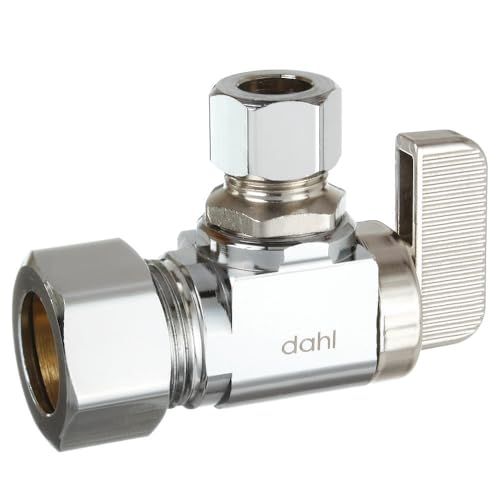
The Dahl 611-31-31 mini-ball valve is the specialist for tight spaces and the connoisseur's choice for quality. Dahl built its reputation on compact, heavy-duty mini-ball angle stops, and this one packs a robust quarter-turn ball valve into a smaller body that fits behind pedestal sinks and toilets where a full-size stop will not.
The compact, premium build is the case for the Dahl. Its mini-ball body is shorter and more solid than a typical stop, which lets it fit where wall clearance is tight, behind a close-set toilet or a pedestal, while the heavy lead-free brass and precision ball make it one of the most durable valves in the category. It uses the same standard compression inlet and 3/8 in. compression outlet, so the install is the familiar no-torch job, and the quarter-turn action is as clean and reliable as any here. Plumbers who know the brand specify Dahl when they want a valve that combines a small footprint with serious build quality.
Owners and pros praise the solid feel, the smooth action, and the way it fits cramped spots that defeat a larger stop, with the brand's reputation for quality coming up repeatedly. It is the enthusiast's pick. The trade-offs: it costs more than mainstream stops, reflecting its build, and like the other compression valves it suits copper rather than plastic stubs. Where clearance is tight or you simply want the best-made valve, it is the standout.
Pick the Dahl mini-ball when clearance behind the toilet is tight or you want a valve a plumber would choose for themselves. The compact body fits where a full-size stop binds against the wall, and the heavy brass and precise ball make it one of the most durable stops you can buy. It costs more, but in a cramped spot or for buy-once quality it earns it.

The Eastman 10884LF dual-outlet stop is the pick when one supply stub has to feed two fixtures, most often a toilet and a bidet seat or attachment. It is a quarter-turn angle stop with two 3/8 in. outlets, so a single valve splits the supply cleanly without adding a separate tee.
The second outlet is the entire reason to buy this stop. Installing a bidet seat or a handheld bidet usually means tapping the toilet's water line, and a dual-outlet angle stop does that in one piece: the inlet connects to the supply stub as usual, one 3/8 in. outlet feeds the toilet tank, and the second feeds the bidet, with no extra tee, brass nipple, or adapter stack to assemble. It keeps the quarter-turn ball for clean shut-off and the lead-free brass body codes require, so it is a tidy, code-compliant way to split the supply. For anyone adding a bidet, it replaces a fiddly multi-part hookup with a single valve.
Owners installing bidets praise how cleanly it splits the line and how much simpler it is than the plastic tee adapters bidet kits often include, with the solid brass body earning extra trust on a connection that will see frequent use. It is purpose-built and does its one job well. The trade-offs are obvious: it is overkill for a plain toilet with no second fixture, and like the other compression stops it suits copper stubs. If you are adding a bidet, see our guide to the best toilet plungers of 2026 for the other essentials, and for a single fixture the standard Eastman 10872LF is the simpler buy.
Choose the dual-outlet stop only when you are feeding two fixtures, almost always a toilet plus a bidet. It splits the supply in one solid brass valve instead of the flimsy plastic tee most bidet kits ship with, which is a real upgrade on a connection you will use daily. For a plain toilet, a single-outlet stop is all you need.
Across all eight picks, one pattern holds: the quarter-turn ball valve has made the modern shut off valve reliable in a way the old multi-turn compression stop never was, and the differences come down to connection type and fit rather than whether it works. The BrassCraft G2CR19X and Eastman 10872LF win on the standard compression install for copper stubs, the difference being premium versus value. The SharkBite is the answer for PEX, CPVC, or anyone refusing to solder, the Keeney sweat stop the answer for a permanent soldered joint, and the BrassCraft OCR19X the answer for a threaded stub. The Watts is the heaviest, longest-lasting build, the Dahl the compact, top-quality pick for tight spaces, and the Eastman dual-outlet the right call when a bidet shares the line. Every one is lead-free and code certified, every one shuts the water with a single ninety-degree flip that will not seize, and every one matches the standard 3/8 in. compression outlet your toilet supply line uses. Match the inlet to what your wall gives you, copper, threaded, or plastic, and any of these ends the era of the stop you cannot turn.
Choosing a shut off valve comes down to matching the inlet to your pipe, confirming the outlet fits your supply line, and picking a quarter-turn valve over an old multi-turn design. The checks below cover the few things that decide whether the swap is clean and leak-free.
The most important choice is the inlet, because it has to match whatever comes out of your wall or floor. A smooth copper stub takes a compression valve like the BrassCraft G2 or Eastman 10872, which seals with a nut and brass ferrule and needs no soldering. A male-threaded stub takes a threaded (FIP) valve like the BrassCraft OCR19X, which screws on with pipe tape. A copper stub you want a permanent joint on takes a sweat valve like the Keeney 2092, which solders on. And a PEX or CPVC plastic stub, or any stub on which you refuse to solder, takes a push-to-connect valve like the SharkBite, which pushes straight on with no tools. Identify your stub first, then buy the matching inlet.
The outlet is where the flexible braided supply line runs up to the toilet tank, and for toilets the standard is a 3/8 in. compression outlet (which mates with the 3/8 in. compression end found on nearly every toilet supply line). Every valve in this guide uses that 3/8 in. outlet, so a standard toilet connector threads right on. Be careful not to confuse it with the larger 1/2 in. or 7/16 in. outlets used on some faucet stops; a toilet wants the 3/8 in. compression outlet, and matching it off the shelf saves an adapter and a second trip to the store.
When you are replacing a stop, almost always upgrade to a quarter-turn ball valve. The old multi-turn compression stop is the design that fails: its rubber washer hardens over years of sitting, so the handle seizes, snaps, or closes most of the way but never fully stops the water. A quarter-turn ball has no washer to degrade and no packing to dry out, so it shuts off cleanly in one ninety-degree flip even after a decade untouched. Every valve here is quarter-turn for exactly this reason. The only time to keep a multi-turn stop is matching an unusual existing fitting, which is rare.
Any valve on a drinking-water line must be lead-free, meaning it meets the NSF 372 standard for weighted lead content, and a cUPC or NSF listing marked on the package confirms it. This is not optional: codes now require lead-free brass on potable water, and an inspector will look for it. Every valve in this guide is lead-free brass and certified. Favor a solid forged-brass body over a thin plated one for longevity, since the heavier brass resists corrosion and the threads strip less easily, and avoid bargain valves that do not state a lead-free certification, which may be non-compliant.
Resist overthinking a shut off valve. The order of operations is to identify your supply stub, smooth copper, threaded, or plastic PEX/CPVC, and match the inlet to it: compression or sweat for copper, threaded for a thread, push-to-connect for plastic or no-solder. Confirm the outlet is 3/8 in. compression for the toilet line, insist on a quarter-turn ball over a multi-turn stop, and require lead-free certification. Get those right and a ten-dollar part gives you a clean, reliable shut-off for decades.
A toilet shut off valve, also called an angle stop or supply stop, is the small valve where the water line comes out of the wall or floor behind the toilet. Its job is to let you cut the water to that single fixture, so you can replace a fill valve, swap a supply line, or stop an overflow without shutting off water to the whole house. Modern quarter-turn ball stops close cleanly with one ninety-degree flip.
The clearest signs are a handle that will not turn or turns without stopping the water, a valve that closes but keeps weeping a slow drip from the stem, or water seeping where the valve meets the pipe. Close the valve and check whether the toilet fully stops filling: if water keeps coming or the stem leaks, the valve has failed. A seized or leaking stop is worth replacing promptly with a quarter-turn valve.
The BrassCraft G2CR19X C is the best overall because it pairs a reliable quarter-turn ball mechanism with a lead-free forged brass body and the standard 1/2 in. compression inlet by 3/8 in. compression outlet that fits nearly every toilet, so it shuts cleanly and installs without soldering. The SharkBite 23036 is the best no-solder push-fit, and the Eastman 10872LF is the best value.
A quarter-turn valve uses a smooth ball that rotates ninety degrees to open or close, with no rubber washer to harden, so it shuts off reliably even after years untouched. A multi-turn compression stop, which you twist several full turns, relies on a rubber washer that degrades over time, which is why old multi-turn stops seize, snap, or keep weeping. Quarter-turn is the better choice for almost every replacement.
Toilet shut off valves use a standard 3/8 in. compression outlet, because nearly all toilet supply lines mate to that size. The inlet varies with your pipe: most commonly 1/2 in. nominal (5/8 in. outside diameter) compression for a copper stub, but it may instead be a threaded, sweat, or push-to-connect inlet. Match the inlet to your stub; the 3/8 in. outlet will fit your toilet line.
These describe how the valve connects to the pipe. A compression valve seals onto a smooth copper stub with a nut and brass ferrule, no soldering. A sweat valve solders onto copper for a permanent joint. A threaded (FIP) valve screws onto a male-threaded stub with pipe tape. A push-to-connect valve like SharkBite pushes straight onto copper, PEX, or CPVC with no tools. Match the connection to your supply stub.
Yes, a compression or push-to-connect valve is a beginner-friendly repair that needs no soldering. Shut off the main water, drain the line, remove the old valve, slide on the new compression valve and ferrule (or push on a SharkBite), tighten or seat it, and turn the water back on to check for leaks. A sweat valve requires soldering and a torch, so the solder-averse should choose a compression or push-fit stop instead.
Yes, in almost every case. The shut off valve is upstream of itself, so you cannot use it to isolate its own replacement; you must turn off the water at the main or at the nearest working valve before removing it. Open a low faucet to drain the line and relieve pressure, then make the swap. Once the new quarter-turn valve is installed, you can isolate that toilet at the valve in future.
A valve that leaks past when closed usually has a worn or hardened seal, common in old multi-turn compression stops whose rubber washer has degraded. Some close most of the way but never fully seal, letting the toilet keep trickling. The reliable fix is to replace the stop with a quarter-turn ball valve, which has no washer to harden and seals fully in one flip. A stem that weeps when turned points to the same failure.
Lead-free means the brass meets the NSF 372 standard for very low weighted lead content, which codes now require for any valve on a drinking-water line. A cUPC or NSF listing marked on the package confirms it. Every modern stop sold for potable water should be lead-free brass, so look for the certification and avoid bargain valves that do not state it, especially where a permit or inspection is involved.
It depends on your pipe and comfort level. A compression valve is the standard, inexpensive choice for a smooth copper stub and needs only a wrench. A push-to-connect valve like SharkBite costs more but installs in seconds with no tools and is the only easy option for PEX or CPVC plastic stubs, or when you refuse to solder. Identify your stub: copper can take either, while plastic stubs need the push-fit.
A quality quarter-turn ball valve can last fifteen to twenty years or more because it has no rubber washer to degrade. Old multi-turn compression stops fail much sooner, often seizing or weeping within a decade as the washer hardens. Since the valve sits untouched for long stretches, it is worth replacing a stiff or aging stop with a quarter-turn before an emergency, rather than discovering it is frozen mid-repair.
An angle stop turns the water ninety degrees, taking a supply line coming horizontally out of the wall and directing it up to the toilet, which is the most common arrangement. A straight stop keeps the flow in line, used when the supply comes up vertically out of the floor. Most toilets use an angle stop because the supply typically exits the wall; check which way your stub points before buying.
Yes. A bidet seat or attachment taps the toilet's water line, and the cleanest way is a dual-outlet stop like the Eastman 10884LF, which has two 3/8 in. outlets so one valve feeds both the toilet and the bidet with no extra tee. It replaces the flimsy plastic tee adapters many bidet kits include with a solid brass valve, which is sturdier on a connection you will use daily.
An old multi-turn stop seizes because its stem and washer have corroded or hardened from years of sitting untouched. Forcing it risks snapping the handle or stem, which can cause a leak you cannot stop. The right fix is to turn off the main water and replace the frozen stop with a quarter-turn ball valve, which will not seize. Do not muscle a stuck old stop; replace it before it fails in an emergency.
It depends on the connection. A compression valve seals on a ferrule and needs no tape on the joint, though tape is fine on the outlet threads to the supply line. A threaded (FIP) valve does need pipe-thread tape or pipe dope on the male thread to seal. A sweat valve uses flux and solder, not tape, and a push-to-connect valve needs nothing. Match the sealing method to the connection type.
Yes. A stem or connection that weeps drips continuously, which over time can rot the floor, the subfloor, or a vanity base and feed mold, even though the visible drip is small. A valve that fails to fully close can also let a toilet keep running. Because a replacement quarter-turn stop is cheap and quick to install, fixing a weeping valve early prevents far more expensive water damage later.
For most toilets the BrassCraft G2CR19X C is the best shut off valve, a lead-free forged brass quarter-turn stop that fits the standard 1/2 in. compression inlet and 3/8 in. outlet of nearly every toilet, shuts the water cleanly in one flip, and will not seize the way old multi-turn stops do. Choose the SharkBite 23036-0000LFA for a no-solder push-fit on copper, PEX, or CPVC, the Eastman 10872LF for the best value on copper stubs, the Keeney 2092PCLF for a permanent soldered joint, the Watts LFBRPC-0375 for the heaviest premium build, the BrassCraft OCR19X C for a threaded stub, the Dahl 611-31-31 for tight clearances, and the Eastman 10884LF when a bidet shares the line. Identify your supply stub, match the inlet to it, confirm the 3/8 in. outlet for your toilet line, insist on a quarter-turn ball and lead-free certification, and any pick here ends the era of the stop you cannot turn on a ten-dollar part and a no-torch install.
Which is the best toilet flush valve? Compare 2-inch, 3-inch, adjustable, and canister flush valves by fit and flush power, plus how…
Read the guideYes, flushing a toilet can make your shower go cold, hot, or lose pressure. Learn why it happens, how to diagnose it,…
Read the guideWhen you flush one toilet and another gurgles or bubbles, it usually means a venting or drain problem. Here are the causes,…
Read the guide