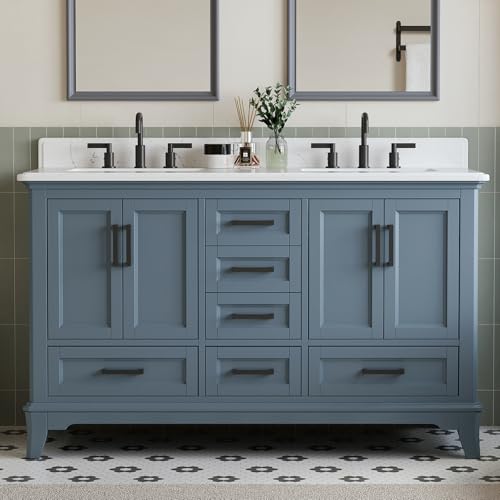
Best Bathroom Vanities for a Primary Bathroom (2026)
Bathroom Remodeling4.6
A primary bathroom vanity anchors the room's daily routine and its storage, which is why size, double-sink capacity, and drawer organization matter…
Read the guideA standard 32 to 34-inch vanity puts the sink, mirror, and faucet controls out of comfortable reach for shorter adults and out of reach entirely for most kids under about age 10. This guide covers lower vanity heights for shorter households, when a step stool is the better fix instead of remodeling, and the water and electrical safety considerations that matter most once kids are reaching for a sink on their own, including GFCI outlet placement and keeping cleaning supplies out of small hands.
Research updated July 2026.
Shorter adults, generally under about 5 feet 4 inches, are usually more comfortable with a standard 30 to 32-inch vanity height rather than a taller comfort-height 36-inch counter. For kids, a permanent lower vanity is rarely worth building in a shared family bathroom; a sturdy two-step learning stool at the standard-height sink solves the reach problem without a remodel and grows with the child better than a fixed low counter does. Whichever height you choose, keep GFCI outlets covered when not in use and cleaning supplies stored in latched cabinets, since those two safety gaps cause far more real household incidents than counter height ever does.
Vanity height conversations usually focus on tall users, but shorter adults face the identical problem in reverse: reaching up and over a counter that sits too high strains the shoulder and wrist rather than the back, and it is just as real an ergonomic issue. Kids add a separate dimension entirely, since a young child cannot reach a standard sink at all regardless of height preference, and the household has to decide between a permanent lower fixture, a step stool, or a dedicated kids' bathroom setup.
This guide separates those two groups, shorter adults and kids, because the right fix is different for each. For the opposite end of the height spectrum, see the best vanity height for tall people guide, and for a kids-focused vanity roundup covering durability and styling, see the best vanities for a kids bathroom guide.
Adults under roughly 5 feet 4 inches are generally more comfortable at a 30 to 32-inch vanity height than at the 34-inch upper end of standard height, let alone a 36-inch comfort-height counter. Reaching up and over a too-tall counter shifts strain into the shoulders, upper back, and wrists rather than the lower back, and it also raises the practical problem of seeing clearly into a mirror mounted at a height calibrated for a taller user.
Because most manufacturers market vanities primarily in the 32 to 36-inch range, shorter adults have fewer off-the-shelf choices than tall users do, and a genuinely low 30-inch vanity is more often found in powder room and secondary-bathroom product lines than in premium primary-bathroom collections. Checking the exact height specification, rather than assuming "standard" automatically means the lower end of that range, matters just as much for shorter users as it does for tall ones.
A step stool is a reasonable interim fix for a shorter adult using someone else's taller vanity, though it does not solve the mirror-height mismatch a fixed vanity replacement would.
| User | Recommended Vanity Height | Standard 32-34 in. Counter | Fix if Height Cannot Change |
|---|---|---|---|
| Adult under 5'2" | 30 in. | Uncomfortable reach and mirror sightline | Low platform step, adjustable mirror |
| Adult 5'2" to 5'4" | 30 to 32 in. | Workable but not ideal | Step platform optional |
| Child age 3-6 | 20 to 24 in. or step stool at standard height | Completely out of reach unassisted | Two-step learning stool (preferred) |
| Child age 7-10 | Standard height with a low single step | Reachable with a boost | Single wide step stool |
| Child age 11+ | Standard 32-34 in. | Generally comfortable | Usually no fix needed |
For the vast majority of households, a step stool at a standard-height vanity is the better solution than a permanently lowered sink, for a simple reason: a fixed low vanity built for a 4-year-old becomes wrong for that same child within a few years, while a step stool grows with the child by simply being used less and eventually removed. A permanently lowered vanity also creates the reverse problem for any adult in the household who needs to use that sink, turning a kids' bathroom into a space adults find uncomfortable to use themselves.
The one scenario where a genuinely lower fixed vanity makes sense is a dedicated kids-only bathroom, not shared with adults at all, where the household plans to keep young children in that space for many years or has multiple children spanning a similar young age range for an extended period. Even then, an adjustable-height step platform integrated into the vanity's toe-kick area is often a more flexible long-term investment than a fixed low counter.
A sturdy two-step learning stool with a wide, non-slip platform and side rails is the safest step-stool format for young children, since single narrow steps are a common tip-over risk, particularly when a child leans forward to reach the faucet.
Parents consistently overestimate how long a fixed low vanity stays useful and underestimate how quickly kids outgrow it. A well-built two-step stool costs a small fraction of a vanity remodel, solves the reach problem immediately, and simply gets used less over time until it is not needed at all. Save the remodel budget for a dedicated kids' bathroom project only if you are confident the space will serve young children for many years, not just the next one or two.
Two safety gaps cause far more real incidents in family bathrooms than vanity height ever does: uncovered electrical outlets near water, and unsecured cleaning products stored within a child's reach. Every bathroom outlet should be a GFCI (ground-fault circuit interrupter) outlet, which shuts off power automatically if it detects a ground fault, a code requirement in bathrooms built or renovated after 1975 in most U.S. jurisdictions. If a bathroom's outlets predate that code and were never upgraded, replacing them with GFCI outlets is a straightforward, inexpensive electrician job worth prioritizing in any household with young kids, regardless of vanity height plans.
Tamper-resistant outlet covers add a second layer of protection specifically against curious kids inserting objects into an outlet, and are now standard on GFCI outlets manufactured for residential use. Never rely on a plug-in outlet cover alone as the sole safety measure if young children are unsupervised in the bathroom for any length of time; supervision remains the primary safeguard.
Under-sink cabinet storage is where most households keep drain cleaner, toilet bowl cleaner, and other genuinely hazardous chemicals, and a standard cabinet door with no lock or latch is not a real barrier to a curious toddler or young child. A childproof cabinet latch, either an adhesive-mounted strap latch or a magnetic lock system, closes that gap directly and is one of the cheapest, highest-value safety additions in a family bathroom.
| Hazard | Risk | Fix | Cost/Effort |
|---|---|---|---|
| Non-GFCI outlet near sink | Shock risk from water contact | Replace with GFCI outlet (licensed electrician) | Low cost, one-time |
| Uncovered outlet, unsupervised child | Object insertion, minor shock | Tamper-resistant outlet or plug cover | Very low cost |
| Unlatched under-sink cabinet | Access to cleaning chemicals | Childproof strap or magnetic cabinet latch | Very low cost |
| Single narrow step stool | Tip-over while reaching for faucet | Wide two-step stool with side rails | Low cost |
| Very hot tap water at kid reach | Scald risk | Set water heater to 120°F max, anti-scald faucet valve | Low to moderate |
The following picks solve the reach problem for kids without a permanent remodel, plus one genuinely lower vanity option for households building a dedicated kids' bathroom.
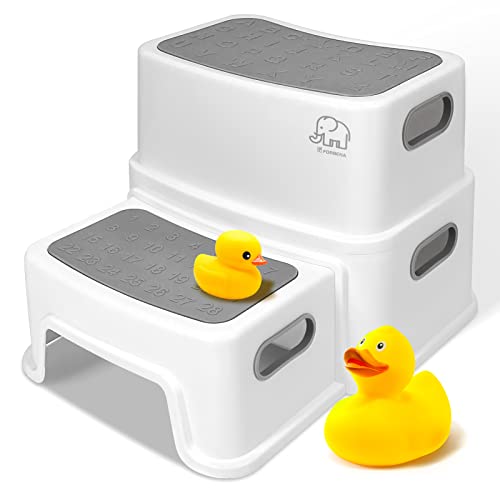
A wide two-step learning stool with non-slip tread and side rails gives young kids safe, stable reach to a standard-height vanity without touching a single fixture, and it moves to the next bathroom, or gets put away entirely, whenever the household outgrows it.
A wide base and side rails are the two features that matter most; a narrow single-step stool without rails is a genuine tip-over risk when a young child leans forward to reach the faucet handle. Store the stool tucked under the vanity or against a side wall when not in use to keep the floor clear and reduce trip hazards for other household members.
A good two-step stool with rails is the single best value safety and accessibility purchase for a family bathroom with young kids, full stop. It costs a small fraction of any vanity modification, solves the reach problem completely, and does not create a mismatch for adult users the way a permanently lowered sink would.

A magnetic childproof lock set installs on the inside of vanity cabinet doors with no visible hardware on the outside, keeping curious kids away from cleaning chemicals and small hazardous items typically stored beneath the sink.
Magnetic locks are popular because they leave no visible latch or strap on the outside of the cabinet, keeping the vanity's appearance unchanged while still blocking access from inside. As with any adhesive-mounted hardware, clean the door surface first and allow full cure time before relying on the lock, and check the latch periodically since cabinet humidity can affect adhesive longevity over years of use.
Whatever is stored under a bathroom sink, cleaning chemicals, medications, razors, deserves a real latch, not just a closed door. A closed cabinet door is not a barrier to most toddlers within a year or two of learning to open doors. A magnetic or strap latch closes that gap for a genuinely small cost and effort.

The Kingston Brass 24-inch compact combo is available at the lower end of standard vanity height, making it a practical choice for a dedicated kids' bathroom or a household where the primary user is a shorter adult, without going as far as a fully custom low-height build.
At 24 inches wide, this vanity fits genuinely small bathrooms and is a reasonable choice for a dedicated kids' room, though households should confirm the exact counter height on the specific SKU, since Kingston Brass sells visually similar 24-inch combos at slightly different heights depending on the sink and top pairing.
A genuinely low vanity makes sense only in a room used exclusively, or almost exclusively, by shorter users for the foreseeable future. For most family bathrooms shared across a range of heights, this combo works better paired with a step stool for younger kids than as a height solution on its own, since even a slightly lower counter does not close the full reach gap for very young children.
Water temperature is a genuine safety issue that has nothing to do with counter height but matters just as much in any bathroom kids use unsupervised. Setting a home's water heater to 120 degrees Fahrenheit or lower reduces scald risk significantly compared to the 140-degree default many water heaters ship with, without a meaningful loss of usable hot water for bathing or washing. Anti-scald faucet valves, which limit maximum output temperature at the fixture itself regardless of the water heater setting, add a second layer of protection and are inexpensive to retrofit onto most existing faucets.
This matters more, not less, once a step stool gives a young child independent reach to the faucet handle, since a child who can now turn the handle can also turn it to the hottest setting without adult supervision at that exact moment. Address water temperature limits at the same time you add a step stool, not as an afterthought.
A 30 to 32-inch vanity height is generally more comfortable for an adult around 5 feet tall than the 34 to 36-inch upper range, since it reduces the shoulder and wrist strain that comes from reaching up and over a too-tall counter. Mirror height should be checked and adjusted together with counter height for the same reason.
Most kids can comfortably reach a standard 32 to 34-inch vanity without assistance somewhere between ages 9 and 11, though this varies with individual growth. Before that age range, a step stool is the practical solution for the vast majority of households, since it requires no remodeling and adjusts naturally as the child grows.
Yes, as long as it is a wide, stable, non-slip stool that does not itself become a trip hazard when not in use, and as long as it is not positioned where it blocks a door swing or creates a fall risk for other users, including older adults, using the same bathroom. Choose a stool that can be pushed fully under the vanity cabinet when not needed if floor space is tight.
Yes. GFCI outlets have a built-in test and reset button and should be tested monthly by pressing test, confirming the outlet loses power, then pressing reset to restore it. A GFCI outlet that fails to trip during this test should be replaced, since a non-functioning GFCI provides no actual protection despite appearing to work normally for standard plug-in devices.
Razors, medications, and other sharp or hazardous small items are best stored in a latched cabinet positioned above counter height, out of reach even with a step stool, rather than in an easily reachable under-sink cabinet regardless of whether that cabinet has a childproof latch. Use the latched under-sink storage for cleaning chemicals and reserve higher storage for the highest-risk items.
Raising a plumbed-in vanity requires adjusting the drain and supply line rough-in heights, which is a genuine plumbing project rather than a simple swap, so most households replace the vanity outright rather than attempting to raise an existing low unit in place. If height flexibility across years matters, planning for a standard-height vanity with a step stool from the start avoids this problem entirely.
Magnetic locks are effective against the vast majority of toddlers and young children, who generally cannot manipulate the magnetic key mechanism even if they discover the latch exists. No childproofing product is completely defeat-proof against every child, so magnetic locks work best as one layer of protection alongside supervision and keeping the most hazardous items on higher shelves regardless of cabinet locks.
120 degrees Fahrenheit is the commonly recommended maximum for households with young children, reducing scald risk meaningfully compared to a 140-degree default while still providing adequate hot water for normal household use. An anti-scald mixing valve at the water heater or at individual fixtures adds further protection if a fully shared home setting cannot be lowered for other household reasons.
If the vanity itself is not being lowered and a step stool is used instead, a secondary lower mirror mounted at a child's eye height, or a tilting mirror on an adjustable arm, gives kids a usable reflection without altering the primary mirror's height for adult users. This is usually simpler and cheaper than modifying the main mirror.
Not typically for the faucet mechanism itself, but shorter adults may find a shorter spout profile more comfortable at a lower counter height, similar to how taller users at a raised counter sometimes prefer a taller spout. This is a minor comfort preference rather than a functional requirement, unlike the grip-related faucet considerations that matter for accessibility.
A magnetic or strap childproof cabinet latch on any under-sink storage containing cleaning chemicals is the highest-value, lowest-cost safety upgrade available, followed closely by confirming every bathroom outlet is a functioning GFCI. Both address real, common incident causes directly and cost a small fraction of any vanity height remodel.
Shorter adults are generally best served by a 30 to 32-inch vanity rather than a taller comfort-height counter, while kids in a shared family bathroom are almost always better served by a sturdy, wide two-step stool than by a permanently lowered sink they will outgrow within a few years. A dedicated kids' bathroom is the one scenario where a genuinely lower vanity like the Kingston Brass 24-inch combo makes sense long-term. Regardless of height, GFCI outlets and latched under-sink cabinets solve the two safety gaps that actually cause real household incidents, and a 120-degree water heater setting closes the scald risk that opens up the moment a step stool gives kids independent faucet access.
How we rank & our data sources
We do not run physical lab tests. Rankings are built from published, verifiable data and real owner feedback, never paid placement.
Researched by admin · Last updated July 19, 2026 · Our review method
A primary bathroom vanity anchors the room's daily routine and its storage, which is why size, double-sink capacity, and drawer organization matter…
Read the guide
A powder room is the smallest, most visible bathroom in the house, seen by nearly every guest but used only for a…
Read the guide
A vanity in a short-term rental takes a different kind of abuse than one in an owner-occupied home: harsh turnover-cleaning products, guests…
Read the guide