

Best Kohler Bathroom Vanities (2026)
Bathroom Remodeling4.6
Kohler is not primarily a cabinet manufacturer, and it is honest to say so upfront. The brand's real strength in the vanity…
Read the guideAn honest, spec-by-spec comparison of open, leg-style console vanities against enclosed cabinet vanities, covering storage, plumbing visibility, weight, style and cleaning, so you can decide which configuration actually fits your bathroom and how you live in it.
Research updated July 2026.
A cabinet vanity is the better pick for most households, since enclosed storage hides plumbing, holds far more toiletries and towels, and suits nearly any bathroom style without looking out of place. A vanity with legs, often called a console vanity, is the better pick if you want an open, airy, furniture-like look, easier floor cleaning underneath, and you are willing to accept less storage and more visible plumbing in exchange. Most buyers should choose based on how much storage they actually need day to day, not just which style photographs better.
A vanity with legs, also called a console vanity, is built like a piece of furniture. Its top and sink sit on slender legs with open space underneath and often open space on the sides as well, so the plumbing beneath the sink is at least partly visible unless the model includes a small shelf or a fabric skirt. A vanity with a cabinet encloses that same space with doors and drawers, hiding the plumbing entirely and turning the area beneath the sink into genuinely usable storage. Both configurations sit on the floor, which is the key difference from a wall-mounted floating vanity, but they diverge sharply in how much storage they offer and how much of the plumbing stays visible.
This decision comes down to a fairly simple trade-off: storage versus openness. A cabinet vanity almost always wins on storage, since every cubic inch beneath the counter can become a drawer or a shelf behind a closed door. A leg-style console vanity trades that storage for a lighter, more furniture-like appearance and, in most cases, easier access to the plumbing for repairs since nothing is boxed in behind cabinet doors. For the wider view of vanity configurations, see the pillar guide to the bathroom vanity buying guide. This page stays focused on the legs versus cabinet decision specifically.
We do not test vanities in a lab. We compare manufacturer construction specifications, storage capacity, material quality, and aggregated owner reviews across major retailers. No industry-standard numeric performance score exists for bathroom vanities the way MaP testing exists for toilets, so we do not invent one. Where one configuration clearly suits a use case better, we say so plainly rather than calling a single universal winner.
A side-by-side look at the two configurations. Exact storage capacity and weight vary by model and material, so always confirm the manufacturer's specification sheet for the specific vanity you buy.
| Spec | Vanity With Legs | Vanity With Cabinet |
|---|---|---|
| Storage capacity | Minimal, often none built in | Full drawers and shelving behind closed doors |
| Plumbing visibility | Exposed or partly visible | Fully hidden |
| Visual weight | Light, open, furniture-like | Heavier, more substantial |
| Floor cleaning underneath | Easy, open on most sides | Harder, must open cabinet doors |
| Plumbing access for repairs | Immediate, nothing to remove | Requires opening cabinet doors |
| Typical weight | Lighter, easier to move or wall-mount | Heavier, more material used |
| Best style fit | Farmhouse, coastal, vintage, minimalist | Traditional to modern, broadly universal |
| Small bathroom feel | Opens up visual floor space | Takes up more visible floor area |
| Model availability | Narrower selection | Widest selection across all brands |
| Relative price | Mid-range, fewer budget options | Wide range from budget to premium |
A console vanity is designed to look and feel like a piece of furniture rather than a plumbing fixture, with thin, often turned or tapered legs holding up a countertop and sink. Some console vanities include a small shelf between the legs for baskets or folded towels, and some add a single drawer at the top, but none of these come close to matching the storage of a fully enclosed cabinet. The appeal is almost entirely visual and spatial: a console vanity reads as light and open, and it lets more of the floor and the room's actual square footage show.
A cabinet vanity commits fully to storage. Every cabinet vanity encloses the plumbing behind doors, and most include at least one drawer bank in addition to a shelved cabinet area, giving a typical household enough room to store towels, cleaning supplies, hair tools and toiletries without needing a separate linen closet. This is why cabinet vanities remain the default choice in the vast majority of bathroom remodels, even though console vanities have a devoted following for their style. Our bathroom vanity styles guide covers how each configuration reads in different design styles in more depth.
If your household relies on the vanity to store the bulk of your bathroom supplies, a cabinet vanity is close to a requirement rather than a preference. A typical 30 to 36 inch cabinet vanity can include two or three drawers plus a lower cabinet shelf, which is enough for most households to keep towels, extra toiletries, cleaning supplies and hair tools out of sight and off the counter.
A console vanity, by contrast, is a poor fit for a household that needs significant bathroom storage in the vanity itself. Some buyers pair a console vanity with a separate freestanding cabinet, a wall-mounted medicine cabinet, or open shelving nearby to compensate for the lack of built-in storage, which can work well in a larger bathroom but adds cost and takes up additional floor or wall space that a cabinet vanity would not require.
If you love the console look but still need meaningful storage, a matching linen tower or a wall-mounted cabinet nearby can recover much of what the open leg design gives up. Just account for the additional floor or wall space this requires when planning your layout.
The open design of a console vanity is a genuine practical advantage for households that prioritize easy cleaning, particularly in humid bathrooms where moisture and dust tend to collect in tight, enclosed spaces. There is simply less surface area for grime to hide, and any spilled water evaporates faster without a cabinet base trapping it against the floor.
A cabinet vanity's enclosed base can trap moisture at the floor line if not properly sealed, and the interior needs periodic cleaning and airing out, particularly under the sink where minor drips are common over the life of the fixture. That said, a cabinet vanity also protects stored items and plumbing from splashes and dust far better than an open console design, so the maintenance trade-off cuts both ways depending on what you value more, an open floor or protected storage.
I generally steer households with kids or heavy daily bathroom use toward a cabinet vanity, simply because the enclosed storage keeps supplies organized and out of small hands, and the closed design protects plumbing connections from accidental bumps. For a guest bathroom, a home office half bath, or anyone who genuinely prioritizes an open, airy look over storage capacity, a console vanity is a legitimate and often underrated choice that most people overlook by default.
Weight matters most during the actual installation and delivery process. A full cabinet vanity, especially a wider double sink model, can be heavy enough to require two people to move safely, and its size makes navigating narrow hallways or stairs during delivery more of a challenge. A console vanity's open frame and legs are usually lighter and easier to carry into place, though the countertop and sink, if sold separately, still need to be handled and secured carefully regardless of which base style you choose.
Leveling is a bit more delicate on a console vanity, since each leg needs to sit evenly on the floor, and an uneven floor can cause a wobble that a full cabinet base, with more contact area along the floor, is less prone to. Shims under one or more legs typically resolve this, but it is worth checking floor levelness before ordering a console-style vanity for an older home with an uneven subfloor.
Because a console vanity's legs bear weight at a few small contact points rather than along a full cabinet base, an uneven floor shows up as a noticeable wobble more quickly than it would with a cabinet vanity. Check your bathroom floor with a level before ordering, and budget for shims if needed.
Native Trails has built its reputation substantially around console-style vanities, using sustainably sourced or reclaimed materials to create a furniture-like look that pairs naturally with a farmhouse, coastal or organic modern bathroom design. If the leg-style look is your priority, Native Trails is one of the deepest specialist catalogs available, and its material choices add a genuine sustainability angle that not every cabinet vanity brand offers.
Kohler, Kingston Brass and American Standard all lean heavily toward cabinet vanities, offering the deepest catalogs by far in that category, spanning nearly every size, finish and storage configuration a bathroom might need. James Martin sits comfortably in the middle, with strong offerings in both console and cabinet styles, making it a good brand to compare side by side if you are genuinely undecided between the two configurations. If floor space and storage are equally important to you, our guide to wall-mounted versus floor-mounted vanities covers a related structural decision worth considering alongside this one.
The mistake I see most often is a buyer choosing a console vanity purely on style, then realizing months later how much they miss having a cabinet to hide supplies and plumbing. If you are genuinely drawn to the open, furniture-like look, that is a legitimate reason to choose a console vanity, but go in with a clear plan for where your bathroom storage will actually live, whether that is a linen tower, a medicine cabinet or open shelving nearby.
A console vanity is the right pick when an open, airy, furniture-like look matters more to you than built-in storage, and you have a plan for storing towels and toiletries elsewhere in the bathroom. Choose legs if easier floor cleaning and a lighter visual footprint are priorities, particularly for a farmhouse, coastal or minimalist design style. Accept in return minimal enclosed storage and plumbing that stays at least partly visible.
Shop it here: check the current price on Amazon for the Native Trails console vanity.
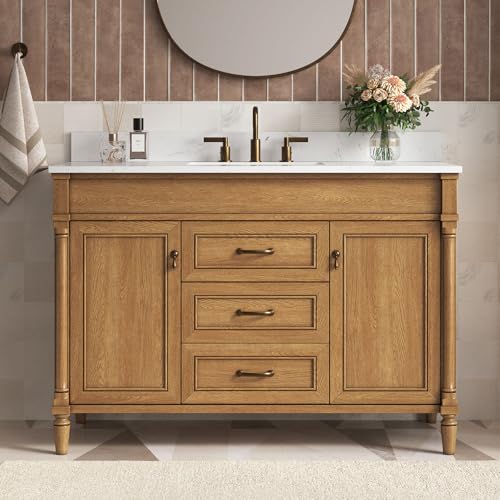
A cabinet vanity is the right pick when enclosed storage, hidden plumbing and broad style compatibility matter most. Choose cabinet if your household relies on the vanity itself to store towels, toiletries and cleaning supplies, or if you simply want the safest, most universally accepted configuration for a bathroom remodel. The trade-off is a heavier, visually bulkier piece that takes more effort to clean thoroughly underneath and around.
Shop it here: check the current price on Amazon for the Kohler Tresham cabinet vanity.
Both configurations are durable and widely available, but they serve different priorities. A cabinet vanity is the storage choice: enclosed drawers and shelving, hidden plumbing, and broad compatibility with nearly any bathroom style. A console vanity is the style-and-airflow choice: an open, furniture-like look, easier floor cleaning, and a visually lighter room, at the cost of minimal built-in storage and more visible plumbing. If storage matters most, choose a cabinet vanity. If an open, airy look matters most and you have a storage plan elsewhere, choose a console vanity with legs. Match the configuration to how you actually use your bathroom, then check the current price on Amazon for the exact model before you buy.
Ready to shop? Check the current price on Amazon for the airy Native Trails console vanity or the storage-focused Kohler Tresham cabinet vanity.
A console vanity, also called a vanity with legs, is a bathroom vanity where the countertop and sink are supported by open legs rather than an enclosed cabinet, leaving the space underneath mostly open and the plumbing at least partly visible.
Some console vanities include a small shelf between the legs for baskets or folded towels, and a few include a single drawer at the top, but none offer storage comparable to a fully enclosed cabinet vanity with multiple drawers and shelving.
A cabinet vanity hides plumbing completely behind closed doors. A console vanity leaves plumbing at least partly visible, though some designs use a fabric skirt or a small shelf to partially screen it from view.
Yes, for floor cleaning specifically. The open space beneath a console vanity lets a mop or vacuum pass through freely. A cabinet vanity requires opening the doors to clean the interior and can trap moisture at the floor line if not properly sealed.
Native Trails is one of the best-known specialists in console and leg-style vanities, often using reclaimed wood, recycled aluminum or NativeStone material. James Martin also offers strong console options alongside its cabinet lines.
A cabinet vanity is generally heavier due to its full enclosed construction and larger amount of material. A console vanity's open leg design typically uses less material and is lighter, making it easier for one person to position and level.
Not directly to the vanity itself, but you can pair it with a nearby linen tower, a wall-mounted medicine cabinet, or open shelving to recover much of the storage a cabinet vanity would provide, at the cost of extra floor or wall space.
Yes, in most cases. The open design makes a small bathroom feel larger by showing more floor space, which is a genuine visual benefit. Just plan for bathroom storage elsewhere since the console itself offers little to none.
It can, if the floor is uneven, since a console vanity's legs bear weight at only a few small contact points. A cabinet vanity's full base along the floor is less prone to wobble on an uneven subfloor. Shims under the legs typically resolve minor unevenness.
A cabinet vanity is generally better for households with kids, since enclosed storage keeps supplies organized and out of reach, and the closed design protects plumbing connections from accidental bumps and curious hands.
Not necessarily, but console vanities have fewer budget-tier options overall, since the style leans toward mid-range and premium materials like solid wood, stone or metal. Cabinet vanities span the widest price range from budget to premium.
If your bathroom storage depends on the vanity itself, buy a cabinet vanity. If you love an open, furniture-like look and have a separate plan for storing towels and toiletries, a console vanity with legs is a legitimate and often underrated choice.
The choice between a leg-style console vanity and an enclosed cabinet vanity comes down to how much storage your household needs, since neither configuration carries an industry performance rating the way flush-testing exists for toilets. Cabinet vanities are the storage pick: enclosed drawers, hidden plumbing and universal style compatibility. Console vanities are the style pick: an open, airy look with easier floor cleaning, at the cost of built-in storage. Choose cabinet if storage matters most, choose legs if the open look matters most and you have a storage plan elsewhere, then check the current price on Amazon for the exact model before you buy.
How we rank & our data sources
We do not run physical lab tests. Rankings are built from published, verifiable data and real owner feedback, never paid placement.
Researched by admin · Last updated July 13, 2026 · Our review method
Kohler is not primarily a cabinet manufacturer, and it is honest to say so upfront. The brand's real strength in the vanity…
Read the guide
An honest, spec-by-spec comparison of wall-mounted floating vanities against floor-supported freestanding vanities, covering installation requirements, weight limits, storage, cleaning and cost, so…
Read the guide
A curated ranking of freestanding clawfoot, slipper and pedestal tubs built from real cast iron or dense acrylic, finished in weathered patina…
Read the guide