
Best Black Bathroom Vanities (2026)
Bathroom Remodeling4.6
A black bathroom vanity has become one of the most popular ways to bring real contrast and a modern edge into a…
Read the guideWhite remains the single most versatile bathroom vanity color because it works in a farmhouse remodel, a modern minimalist bathroom, and a traditional powder room without ever looking out of place. We compared real vanity lines from Kohler, American Standard, and other established manufacturers, weighing finish durability, countertop pairing, and configuration options to find the white vanities worth building a bathroom around.
Research updated June 2026.
A 60-inch white double-sink vanity with a quartz top is the best overall choice for most bathrooms, since the neutral white cabinet pairs cleanly with any wall color or hardware finish while the quartz top resists daily staining. A 30 to 36-inch white single-sink vanity is the right call for a smaller bathroom or powder room, and a white floating vanity is the top pick for a bathroom chasing a bright, modern, visually open look.
White holds its value as a bathroom vanity color because it never dates the way a trend color eventually does. A white cabinet reads as classic in a farmhouse bathroom, clean and minimal in a modern remodel, and traditional in a period home, which is why it remains the best-selling vanity color across nearly every major manufacturer's lineup. That versatility also makes white the safest choice for anyone planning to sell the home eventually, since it appeals to the widest range of buyer tastes.
Because white shows every fingerprint, water spot, and dust streak more visibly than a darker finish, we weighted finish quality and material durability heavily for this list. A painted MDF vanity in white can look identical to a solid wood version in photos but will show wear at the edges and corners far sooner. For sink options to pair with any of these vanities, see our best white bathroom sinks guide, and for the countertop and vanity fundamentals, our bathroom vanity buying guide covers sizing and configuration in more depth.
A white bathroom vanity works in nearly any design style, from farmhouse to modern to traditional, because it is a neutral backdrop rather than a design statement of its own. The best white vanities use a solid wood or plywood cabinet construction with a durable painted or lacquered finish rather than a thin coat over MDF, since white finishes show chips, scuffs, and yellowing more visibly than darker colors.
White vanities show dust and water spots more visibly than darker cabinet colors, but they also show fingerprints and grime in a way that makes it obvious when the surface needs wiping, which some owners find keeps the bathroom looking cleaner over time. A matte or satin white finish hides minor smudges better than a high-gloss white lacquer, which highlights every mark under bathroom lighting.
White quartz, white marble-look quartz, and light gray or veined quartz all pair well with a white vanity cabinet, since the tonal consistency reads as intentional rather than mismatched. A contrasting dark countertop, such as black granite, also works well on a white vanity for a bathroom that wants more visual definition between the cabinet and the counter.
Seven real white vanity configurations chosen for finish durability, style versatility, and countertop pairing.
| Vanity Type | Best For | Key Spec | Notes | Check Price |
|---|---|---|---|---|
| 60-Inch White Double-Sink Vanity with Quartz Top | Best overall | 60 in, white cabinet, quartz counter | Neutral cabinet pairs with any wall color | Check price |
| 30-Inch White Single-Sink Vanity | Best for small bathrooms | 30 in, single basin, white cabinet | Fits powder rooms and tight footprints | Check price |
| White Floating Wall-Mount Vanity | Best modern bright look | 36 to 48 in, wall-mounted | Visually opens a smaller bathroom | Check price |
| White Shaker-Style Vanity | Best farmhouse and transitional look | 36 to 48 in, shaker cabinet doors | Classic recessed-panel door style | Check price |
| White Furniture-Style Vanity | Best traditional statement | 48 to 60 in, decorative legs and molding | Reads as genuine furniture | Check price |
| 72-Inch White Double-Sink Vanity | Best maximum storage | 72 in, white cabinet, two basins | Largest footprint on this list | Check price |
| White Vanity Combo with Mirror | Best budget upgrade | 24 to 48 in, includes sink and mirror | Lower-cost complete package | Check price |
Each pick is ranked on finish durability and construction quality first, then style and configuration.
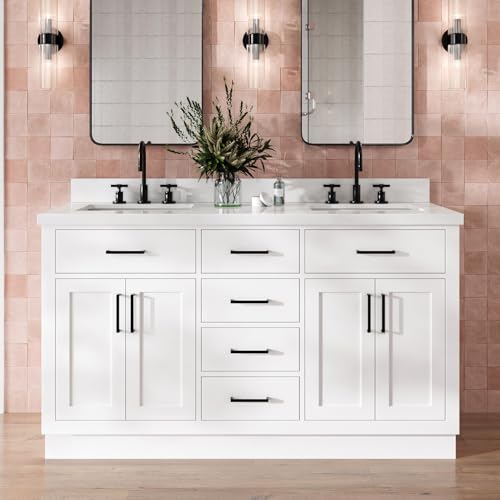
A 60-inch white double-sink vanity with a quartz top is the best overall white vanity, giving a bathroom shared by two people a neutral cabinet that pairs with any color scheme and a countertop that resists daily wear.
White is the safest and most versatile vanity color for a shared bathroom because it never competes with wall color, tile choice, or hardware finish. A 60-inch double-sink configuration gives each person a dedicated basin, and pairing it with a quartz top keeps the counter looking clean despite daily contact with skincare products and grooming tools.
Because white shows dust and water spots more readily than a gray or navy cabinet, look for a solid wood or plywood door construction with a durable painted or lacquered finish rather than a thin coat over particleboard. A quality white finish should resist yellowing from bathroom humidity over years of daily use, which is where lower-cost vanities tend to fail first.
White is what we recommend as the default vanity color for most bathrooms because it is the one choice that will not look dated in five or ten years. Pay closer attention to the finish quality here than you would with a darker color, since white reveals construction shortcuts that a navy or espresso cabinet would hide.

A 30-inch white single-sink vanity is the right pick for a smaller bathroom or powder room that still wants the bright, neutral look white delivers without the footprint of a larger cabinet.
In a smaller bathroom, a white cabinet does real visual work beyond matching decor: it reflects more light than a dark cabinet and makes the entire room read as larger and brighter, which is especially valuable in a windowless powder room or a small guest bathroom. A 30-inch width fits into tight footprints while still leaving room for a genuinely usable single basin and a few drawers.
Because a smaller vanity has less surface area overall, a white finish's tendency to show water spots is less of a maintenance burden than it would be on a wide double vanity. This size also tends to cost meaningfully less than a 60-inch double-sink configuration, making it a practical choice for a secondary bathroom.
For a small or windowless bathroom, we lean toward white specifically for the brightening effect it has on the room, not just the style match. A dark vanity in a small bathroom with no natural light can make the space feel noticeably more cramped.

A white floating wall-mount vanity combines the color's brightening effect with a wall-mounted silhouette, giving a bathroom the most visually open, modern look on this list.
A floating vanity mounts directly to the wall with the floor beneath fully visible, and pairing that silhouette with a white finish maximizes the sense of open space in a bathroom more than either choice alone. Light bounces off both the white cabinet and the visible floor, which is why this combination shows up so often in modern spa-style remodels.
Installation requires the wall to have blocking rated for the mounted weight, a detail worth confirming with a contractor before committing to a floating design rather than treating it as a simple retrofit. Cleaning is also faster than a floor-standing cabinet, since there is no base blocking access to the floor.
When a bathroom remodel is chasing a genuinely bright, spa-like feel, we recommend white specifically in the floating configuration. The two design choices reinforce each other in a way that a dark floating vanity or a white floor-standing vanity cannot quite replicate on their own.

A white shaker-style vanity with recessed-panel doors is the classic choice for a farmhouse or transitional bathroom, working as well in a century-old home as a new build.
Shaker-style doors, with their simple recessed center panel, have remained one of the most consistently popular cabinet styles because they read as both classic and current depending on what they are paired with. In white, this style has become the default choice for farmhouse bathroom remodels, but it works equally well in a transitional or simple traditional bathroom.
The main maintenance note with shaker doors is that the recessed panel grooves can collect dust more than a flat slab door, which shows up more visibly in white than in a darker finish. A quick wipe with a microfiber cloth during regular bathroom cleaning keeps this from becoming noticeable.
The white shaker vanity is what we point buyers toward when they want a specific, established look rather than a generic flat-front cabinet. It has stayed popular long enough that finding matching hardware and accessories is never a problem.

A white furniture-style vanity brings decorative legs and molding to a traditional bathroom, reading as a genuine piece of furniture rather than a builder-grade cabinet.
A furniture-style vanity uses decorative turned or tapered legs, applied molding, and hardware detailing borrowed from traditional furniture design. In white, this ornate detailing reads as elegant rather than heavy, since the light color keeps the decorative elements from visually overwhelming a smaller bathroom.
Pairing it with a natural stone countertop like marble or granite completes the traditional, higher-end look many bathroom remodels are aiming for, while the white cabinet keeps the overall palette bright enough to suit both period homes and new construction with a traditional design direction.
The white furniture-style vanity is the pick we recommend when a bathroom's overall design leans traditional and the goal is a genuine design statement rather than a purely functional cabinet. White keeps the ornate detailing from reading as dated or overly formal.

A 72-inch white double-sink vanity is the maximum-storage option on this list, giving a larger bathroom the most drawer and counter room while keeping the neutral white palette.
For a bathroom with generous wall space, a 72-inch white double vanity gives noticeably more separation between the two basins than a standard 60-inch model, which meaningfully reduces the daily crowding two people can feel at a narrower vanity. In white, this larger cabinet still reads as a neutral backdrop rather than a dominating design element, letting tile, lighting, and wall color carry the room's personality.
The tradeoff with a wider white cabinet is simply more surface area to keep clean, since water spots and fingerprints become visible across a larger span of white paint or lacquer. For a primary bathroom remodel with the space to support it, this configuration maximizes daily storage while staying visually neutral.
When a bathroom has the wall space, we recommend white at this larger size specifically because it keeps a 72-inch cabinet from visually dominating the room the way a dark finish at the same size often does.

A white vanity combo that includes the cabinet, countertop, sink, and mirror in one package is the most affordable way to fully outfit a bathroom with a coordinated white look.
A vanity combo bundles the cabinet, countertop, sink, and a matching mirror into one purchase, which typically costs less than sourcing each piece separately and removes the guesswork of matching finishes across multiple products. In white, this bundled approach is especially useful because the color coordinates easily with whatever wall paint, tile, or hardware is already in a bathroom being refreshed on a budget.
The tradeoff is usually the countertop material: many budget combos use cultured marble, a manufactured material that looks similar to natural stone but is less resistant to scratching and heat than quartz or granite. For a bathroom where budget is the top constraint, that tradeoff is often worth accepting for a complete, coordinated white vanity package.
The white combo kit is the sensible answer when a bathroom remodel needs a complete vanity on a tight budget. White specifically minimizes the risk of a mismatched look, since it coordinates with nearly any existing bathroom color scheme without additional planning.
Across all seven picks, the pattern with white vanities is consistent: prioritize solid construction and a durable painted or lacquered finish over a thin coat that will chip or yellow, since white reveals build-quality shortcuts more readily than any other color. Beyond that, white remains the safest, most versatile choice for nearly any bathroom style and will not look dated as trends shift.
The right white vanity configuration depends on your bathroom's size, how many people share it, and the overall design style you are working toward. These checks cover the decisions that matter most.
Look for a solid wood or plywood door construction with a genuine painted or lacquered finish rather than a thin coat over particleboard or MDF. White finishes show chips, scuffs, and yellowing more visibly than darker colors, so construction quality matters more here.
Shaker-style recessed panels suit farmhouse and transitional bathrooms, flat slab doors suit modern and minimalist spaces, and furniture-style legs and molding suit traditional bathrooms. White works across all three, so choose the door style based on your room's overall design rather than the color.
White or light gray quartz keeps the whole vanity tonally consistent, while a dark granite or quartz countertop creates contrast against the white cabinet for a bathroom that wants more visual definition. Both approaches work well with a white vanity.
A 60-inch white double-sink vanity with a quartz countertop is the best overall pick for most bathrooms shared by two people, offering a neutral cabinet and a durable, easy-to-clean countertop.
Yes, white is especially effective in a small bathroom because it reflects more light than a dark cabinet, making the room feel brighter and larger. A 30-inch white single-sink vanity is a strong pick for tight spaces.
White or light gray quartz keeps a tonally consistent look, while a dark granite or quartz countertop creates contrast for a bathroom that wants more visual definition between cabinet and counter.
Lower-quality painted finishes over MDF can yellow with humidity exposure over years of use. A genuine painted or lacquered finish over solid wood or plywood construction resists yellowing far better.
Yes, the white shaker style has remained one of the most consistently popular vanity styles for decades because the recessed-panel doors work in farmhouse, transitional, and even simple traditional bathrooms.
A matte or satin white finish hides minor smudges and fingerprints better than a high-gloss white lacquer, which shows every mark under bathroom lighting but has a more polished, reflective look.
Yes, white cabinets with matte black hardware and fixtures have become one of the most popular bathroom design combinations, offering strong visual contrast without committing to a fully dark color scheme.
Shaker doors have a recessed center panel that reads as classic or farmhouse, while flat-front slab doors have a smooth, seamless surface that suits modern and minimalist bathrooms. Both are commonly available in white.
Vanity combos that bundle the cabinet, countertop, sink, and mirror are a cost-effective option for a budget-conscious remodel, though they often use cultured marble countertops that are less durable than quartz or granite.
White is considered one of the safest vanity colors for resale because its neutral tone appeals to the widest range of buyer tastes, unlike a bold or trend-specific color that may not suit every buyer's preference.
A quick wipe with a microfiber cloth after daily use removes water spots and fingerprints before they build up. Avoid abrasive cleaners on painted or lacquered white finishes, since they can dull the surface over time.
White remains the most versatile bathroom vanity color because it works as a neutral backdrop in nearly any design style and holds its appeal far longer than a trend color. A 60-inch white double-sink vanity with a quartz top leads for most two-person households, a 30-inch single-sink model is the smart pick for a small bathroom or powder room, and a white floating vanity delivers the brightest, most modern look for a bathroom chasing an open, spa-like feel.
How we rank & our data sources
We do not run physical lab tests. Rankings are built from published, verifiable data and real owner feedback, never paid placement.
Researched by admin · Last updated July 11, 2026 · Our review method
A black bathroom vanity has become one of the most popular ways to bring real contrast and a modern edge into a…
Read the guide
White remains the default and most widely stocked bathtub color for a reason: it resells well, matches virtually any tile or vanity…
Read the guide
Almond is the warm off-white bathtub color American Standard and Kohler have kept in production for decades so homeowners with an existing…
Read the guide