Why Toilet Trapways Are Curved Like an S
Toilets4.6
Learn why toilet trapways curve like an S, how each bend blocks sewer gas, and what the shape means for clogs and…
Read the guideTwo-piece toilets account for the majority of all toilet installations in North America, and for practical reasons: they ship in two manageable boxes, they fit standard 12-inch rough-ins, and their internal components are universally stocked at every hardware store. The best two-piece models in 2026 clear 1000 grams on the independent MaP flush test while using only 1.28 gallons per flush, which satisfies EPA WaterSense standards and eliminates the double-flush that plagued older 3.5 GPF designs. This buying guide ranks eight proven two-piece toilets from TOTO, Kohler, American Standard, Woodbridge, Swiss Madison, and Gerber using published MaP scores, trapway geometry, flush-valve engineering, water efficiency certifications, and the consistent pattern of aggregated owner reviews across major retailers.
The TOTO Drake II is the best two-piece toilet overall: it achieves a perfect 1000 g MaP score at just 1.28 GPF through a dual-nozzle Tornado Flush that spins water around the full bowl perimeter, and its CeFiONtect ceramic glaze keeps the surface noticeably cleaner over years of use. For heavy household traffic where clogs are the priority concern, the American Standard Champion 4's 4-inch flush valve is the most clog-resistant gravity design available.
A two-piece toilet separates the tank and bowl at a bolted seam with a rubber spud gasket. That joint is the one structural difference that sets a two-piece apart from a one-piece toilet, and it matters for maintenance more than aesthetics. Every fill valve, flapper, flush valve, and tank bolt used in a two-piece toilet is a commodity part that sells at any plumbing supply counter, which means a repair that costs a plumber an hour of labor on a one-piece sealed tank often takes a homeowner twenty minutes and a few dollars on a two-piece. The seam itself can weep over time if the gasket hardens, but replacing it requires only a wrench and an afternoon, not a licensed plumber. For a broad look at how two-piece models compare to one-piece, wall-hung, and skirted alternatives, see the full roundup of best flushing toilets.
Flush performance in a two-piece toilet depends on four engineering factors that work together: trapway width (wider clears more mass per flush without blocking), flush-valve diameter (a larger opening releases more water volume faster), bowl design (the angle and placement of rim jets or Tornado nozzles determine how completely the rinse water contacts the bowl surface), and surface glaze (a ceramic surface with finer pores resists waste adhesion, reducing the chance that residue triggers a second flush). The independent MaP (Maximum Performance) test, administered by Veritec Consulting and published at map-testing.com, measures all four factors together. MaP loads a toilet with a precisely weighed payload of soybean paste and records the grams cleared in a single flush. A score of 600 g is considered adequate; 800 g is strong enough that double-flushing becomes rare in typical households; 1000 g is the ceiling, meaning the toilet cleared the full test payload without a repeat flush. Every toilet included in this guide scores 800 g or above at 1.28 GPF or less, the threshold for EPA WaterSense certification.
Eight two-piece models ranked by flush power, water efficiency, and long-term value. MaP is grams of waste cleared in a single flush (1000 g is maximum). GPF is gallons per flush. All models are 12-inch rough-in unless noted.
| Toilet | Best For | MaP Score | GPF | Bowl Height | Rating | Check Price |
|---|---|---|---|---|---|---|
| TOTO Drake II | Best overall | 1000 g | 1.28 | Universal (16.5") | 4.8 | Check price |
| American Standard Champion 4 | Best anti-clog | 1000 g | 1.6 | Right Height (16.5") | 4.6 | Check price |
| Kohler Cimarron | Best canister flush | 1000 g | 1.28 | Comfort (17") | 4.7 | Check price |
| TOTO Drake | Best proven workhorse | 1000 g | 1.28 | Universal (16.5") | 4.7 | Check price |
| Kohler Highline | Best traditional design | 800 g | 1.28 | Comfort (17") | 4.6 | Check price |
| American Standard Cadet 3 | Best budget WaterSense | 800 g | 1.28 | Right Height (16.5") | 4.4 | Check price |
| Gerber Viper | Best trade pick | 1000 g | 1.28 | Comfort (16.5") | 4.5 | Check price |
| Woodbridge T-0019 | Best dual-flush value | 800 g | 1.28 / 0.8 | Comfort (16.5") | 4.5 | Check price |
The TOTO Drake II and the American Standard Champion 4 both score the maximum 1000 g on the independent MaP flush test, meaning each cleared the full test payload in a single flush without any repeat. The Drake II achieves this at 1.28 GPF using a dual-nozzle Tornado Flush that creates centrifugal bowl coverage; the Champion 4 achieves it at 1.6 GPF using a 4-inch flush valve that delivers a higher-volume surge. For water efficiency paired with maximum flush strength, the Drake II is the better choice; for raw waste-clearing capacity with no concern for GPF, the Champion 4 is the benchmark.
The American Standard Champion 4 is the most clog-resistant two-piece toilet by design: its 4-inch flush valve is twice the opening size of a standard 2-inch flapper valve, producing a fast, high-volume water surge that clears bulk waste where narrower valves stall. Its 2 3/8-inch fully glazed trapway is among the widest passageways in this class of gravity-flush toilets. For households with a history of recurring clogs or older cast-iron drain lines, the Champion 4's combination of wide valve and wide trapway is the most effective gravity-flush solution available.
MaP (Maximum Performance) scores range from 0 to 1000 grams. A score of 600 g is the minimum considered adequate for typical residential use; 800 g is the threshold where double-flushing becomes uncommon in ordinary family households; and 1000 g is the maximum, indicating the toilet cleared the full test payload in a single flush. For daily household use with standard drain conditions, target 800 g at minimum. For large families, heavy use, or aging drain lines, choose a 1000 g model at 1.28 GPF or less so you also qualify for EPA WaterSense certification.
The Kohler Cimarron delivers 1000 g MaP performance at 1.28 GPF with Kohler's canister flush valve, which opens 90 percent wider than a standard flapper and produces a stronger bowl rinse at the same water volume, all at a mid-range price that undercuts TOTO Drake II by a meaningful margin. For buyers who want EPA WaterSense certification and solid flush power at the lowest possible entry cost, the American Standard Cadet 3 earns 800 g MaP at 1.28 GPF with an EverClean antimicrobial bowl surface.
Two-piece toilets have a seam between the tank and bowl that collects mineral deposits and soap residue, and the exposed tank bolts below the tank create two additional crevices. A one-piece toilet eliminates all of those joints, which wipes down in fewer passes. The difference in cleaning effort is real but manageable: a damp cloth across the seam once a week prevents buildup. In terms of bowl hygiene, there is no difference because bowl glaze quality determines stain resistance, not the one-piece versus two-piece body style.
Each pick below covers flush technology, published specifications, and the consistent themes from aggregated owner feedback across tens of thousands of verified purchases.
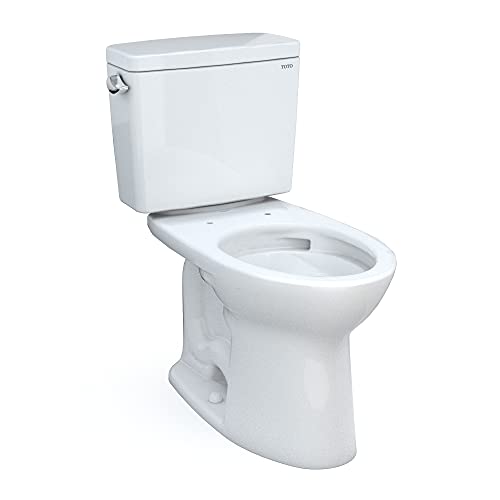
The TOTO Drake II hits the maximum 1000 g MaP flush score at just 1.28 GPF and adds CeFiONtect ceramic glaze that seals the bowl surface at the microscopic level, producing the most complete performance package available in a two-piece toilet at this price point.
The Drake II replaced the original TOTO Drake's single-jet gravity system with a dual-nozzle Tornado Flush, which injects water tangentially into the bowl rim to create a centrifugal rinsing pattern rather than a single downward pour. That rotation contacts more of the bowl surface per flush, which is why aggregated owner feedback consistently notes fewer visible skid marks and longer intervals between scrubbing compared to single-jet models at the same GPF. The CeFiONtect glaze fills ceramic pores to near-zero surface roughness, limiting the texture points where waste and mineral deposits attach. Over a multi-year ownership period, the glaze holds up without the chalky buildup that appears in unglazed or conventionally glazed competitors.
At 1.28 GPF, the Drake II carries EPA WaterSense certification and saves roughly 4,000 gallons per year in a four-person household compared to a 3.5 GPF toilet. The 12-inch rough-in is the North American standard, and the universal-height bowl at 16.5 inches sits close to chair height, which most adults over 18 find easier to rise from than a standard 15-inch seat. For older adults or anyone with knee or hip issues, comfort height is the most practical choice; see Best Toilets for Seniors: Comfort Height and Safety for a full breakdown of seat height considerations. The Drake II also accepts TOTO WASHLET bidet seats without adapters if you want to add that capability later.
The Drake II is the toilet plumbers and renovation contractors recommend most often by name, and the MaP database confirms why. No two-piece toilet at a comparable price combines 1000 g flush power, 1.28 GPF water use, and a genuinely superior glaze in the same package. The one-year warranty is shorter than American Standard's lifetime china warranty, but TOTO's manufacturing quality means warranty claims on the china itself are rare. Buy the comfort-height version unless you have young children as primary users; the standard 15-inch version is harder to find and saves nothing in flush performance.
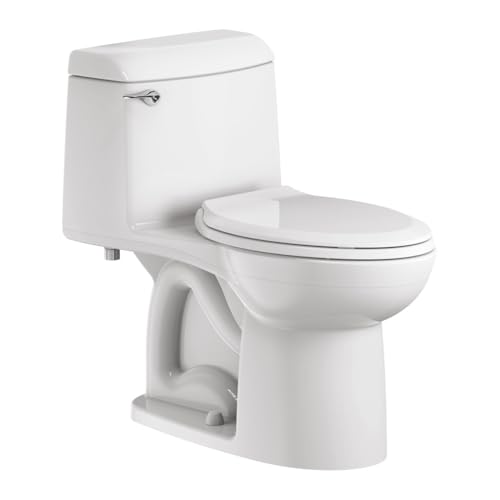
The American Standard Champion 4 is named after its 4-inch flush valve, which is twice the opening diameter of a standard flapper, producing a fast, voluminous surge that makes this the least likely to clog of any gravity-flush two-piece toilet on the market today.
American Standard's EverClean surface is an antimicrobial agent bonded into the vitreous china glaze during firing, which inhibits the growth of mold, mildew, and odor-causing bacteria inside the bowl. The 2 3/8-inch fully glazed trapway is among the widest passageways in this class of residential gravity-flush toilets, and the combination of valve size and trapway width is what keeps the Champion 4 relevant despite its 1.6 GPF rating -- the volume and the opening produce a flush that is genuinely difficult to overload in normal residential use. Households that have replaced flappers repeatedly on a standard 2-inch-valve toilet and still experience recurring clogs will notice an immediate difference. For guidance on the best toilet for a household with five or more people, see Best Toilets for Large Families (Heavy Use, Low Clog).
The primary trade-off is water consumption: at 1.6 GPF, the Champion 4 uses 25 percent more water per flush than a 1.28 GPF WaterSense toilet. In a household flushing ten times daily, that equals roughly 1,168 additional gallons per year compared to the Drake II. In states with tiered water billing, the difference adds up. The lifetime china warranty and five-year parts warranty compensate by reducing the long-term cost of replacements -- a meaningful advantage for rental properties where part availability matters more than monthly water bills.
No two-piece toilet at this price point matches the Champion 4 for raw clog-clearing reliability. The 4-inch valve is a genuine engineering improvement, not a marketing term, and the 1000 g MaP score confirms it performs exactly as advertised. The 1.6 GPF figure is the only real drawback. If water cost is secondary and preventing clog-related plumber visits is the priority, choose the Champion 4 without hesitation. It belongs in high-traffic bathrooms, rental units, and anywhere a standard toilet keeps failing.

The Kohler Cimarron earns a 1000 g MaP score at 1.28 GPF using Kohler's Class Five flush system, which pairs a canister flush valve that opens 90 percent wider than a standard flapper with an optimized bowl inlet geometry that produces a noticeably powerful single-flush feel.
Kohler's canister flush valve is the key difference between the Cimarron and most competing two-piece toilets. A standard flapper valve opens from the bottom hinge and creates a partial water-flow arc; a canister lifts fully upward, exposing the entire valve seat opening simultaneously. The result is a faster initial water release into the bowl, which produces the "powerful" flush sensation that aggregated owners frequently describe for the Cimarron. The Class Five flush system adds optimized bowl inlet ports that direct water more aggressively across the bowl surface, which contributes to its 1000 g MaP result at only 1.28 GPF. The limited lifetime warranty covers both the vitreous china and the mechanical components, which is one of the strongest coverage packages in this price category.
The Cimarron is available with a standard 2-button or single handle flush actuator and fits a standard 12-inch rough-in. Its comfort height at 17 inches sits slightly higher than the Drake II's 16.5 inches, which some owners actually prefer as a more elevated seated angle. For homeowners who want to compare the Cimarron directly against its closest Kohler sibling, see the full Best Toilets for Home: Reliable Picks for Daily Use guide, which breaks down both the Highline and Cimarron in a home-use context.
The Cimarron is the right answer for buyers who want Kohler quality and a 1000 g MaP flush without paying TOTO pricing. The canister valve genuinely changes the feel of the flush compared to a standard flapper, and Kohler's limited lifetime warranty is hard to match at the same price tier. The bowl glaze is not as fine as CeFiONtect, but the Class Five system keeps the bowl rinsed well enough that most owners report satisfactory cleanliness between weekly cleanings.
The original TOTO Drake has been one of the most-installed two-piece toilets in North America for over two decades, and its continued 1000 g MaP score at 1.28 GPF proves that its G-Max gravity flush system delivers on its original promise in independent testing year after year.
The Drake's G-Max system uses a 3-inch flush valve, which is 50 percent wider than the 2-inch valves found on entry-level gravity toilets. Combined with TOTO's siphon-jet bowl design, that wider opening produces a flush with enough water column force to achieve a 1000 g MaP rating at 1.28 GPF without relying on centrifugal bowl coverage. The Drake does not include CeFiONtect glaze, which means its bowl surface retains microscopic roughness that can require slightly more frequent cleaning than the Drake II. That difference is the primary reason the Drake II commands a premium: it is the same flush power plus a measurably better bowl surface.
Where the original Drake wins over its successor is in total installed cost and parts universality. TOTO replacement flappers, fill valves, and flush valves for the Drake are available at almost every plumbing counter and are among the least expensive OEM parts in the industry. For a landlord or property manager standardizing on a single toilet across 10 or 20 units, that parts commonality is a meaningful operational advantage. The Drake fits the same 12-inch rough-in and comfort height as the Drake II, so both models can coexist in the same property without requiring separate parts inventories.
The original Drake remains a legitimate choice in 2026, not because of nostalgia but because 1000 g at 1.28 GPF is still 1000 g at 1.28 GPF. The only argument for choosing the Drake over the Drake II is price, and it is a fair argument -- the Drake costs less and flushes identically in the MaP test. If you clean toilets weekly and do not notice glaze differences, the Drake delivers the same core result. If you want to extend cleaning intervals, spend up to the Drake II.

The Kohler Highline is one of the most widely installed toilet lines in the United States by total unit volume, and the Highline Arc version hits 800 g on the MaP test at 1.28 GPF using Kohler's AquaPiston canister technology in a timeless two-piece silhouette.
Kohler's AquaPiston canister is the same valve technology deployed across the Cimarron and Highline Arc lines, which means the Highline inherits the wider-opening flush that distinguishes canister-equipped models from standard flapper toilets. The Highline's elongated bowl shape accommodates most adults comfortably, and its comfort height at 17 inches satisfies the ADA-compliant seat-height range of 17 to 19 inches when measured from floor to seat top. For households with a family member who benefits from an ADA-compliant height, see Best Toilets for Seniors: Comfort Height and Safety for specific guidance on height, seat, and rail compatibility.
The Highline line spans dozens of configurations, including the Highline Classic (round bowl, standard height) and Highline Arc (elongated, comfort height with the AquaPiston valve). Make sure to select the Arc version if you want the canister valve and its 800 g MaP performance; older Highline Classic versions with the standard 2-inch flapper are rated lower still. The limited lifetime warranty is consistent with what Kohler offers across its premium two-piece range and covers both the vitreous china and mechanical parts.
The Highline Arc is the default choice when a homeowner wants Kohler quality, a classic bathroom look, and a solid 800 g flush without the design statement of the Cimarron's more contemporary lines. It installs easily, matches white Kohler porcelain from other fixtures closely, and its parts are stocked at every major home center in North America. Not the most exciting toilet on this list, but consistently reliable across every metric that actually matters over a 15-year ownership window.
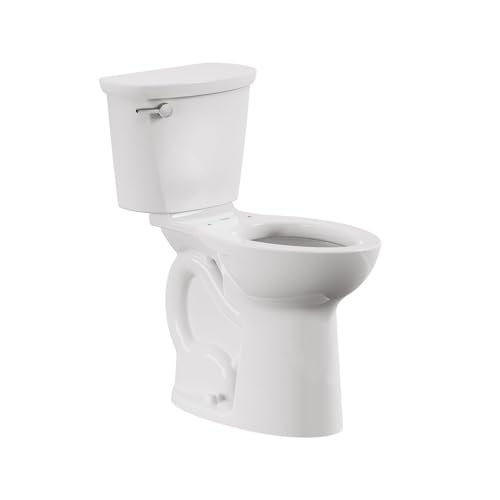
The American Standard Cadet 3 is the most straightforward path to EPA WaterSense certification at 1.28 GPF without spending mid-range money, earning an 800 g MaP score that is sufficient for typical single-family household use with clean drain lines.
The Cadet 3 uses a 3-inch flush valve combined with American Standard's PowerWash Rim bowl design, which directs the rinse water along the full inside rim perimeter rather than through a single jet. At 800 g MaP, it is not in the same category as the 1000 g performers, but for a guest bathroom or a household of two adults with clean 4-inch drain lines, 800 g produces a clean single flush in the vast majority of real-world scenarios. The EverClean antimicrobial surface found on the Champion 4 line is absent from the Cadet 3, but the vitreous china glaze is standard quality and adequate for regular cleaning cycles.
The limited lifetime warranty on the china is competitive for this price point -- American Standard is one of the few brands to offer lifetime china coverage on budget-tier models. The Right Height (16.5-inch) bowl sits within the ADA-compliant range when measured with a standard seat, which makes it slightly more accessible than a standard 15-inch model. For anyone comparing the Cadet 3 to the Champion 4 directly, the Cadet 3 uses 1.28 GPF against the Champion 4's 1.6 GPF, so it wins on water efficiency, while the Champion 4 wins clearly on maximum flush power and clog resistance.
The Cadet 3 is the sensible choice when budget is the primary constraint and the bathroom is not in heavy daily use. Do not install it in a household of four or more where the toilet sees eight to twelve flushes per day -- at 800 g MaP, a household with above-average waste loads will encounter occasional double-flushing. In light-use bathrooms or rental units where minimizing upfront cost per unit matters most, the Cadet 3 delivers WaterSense compliance and a lifetime china warranty at the lowest price point on this list.
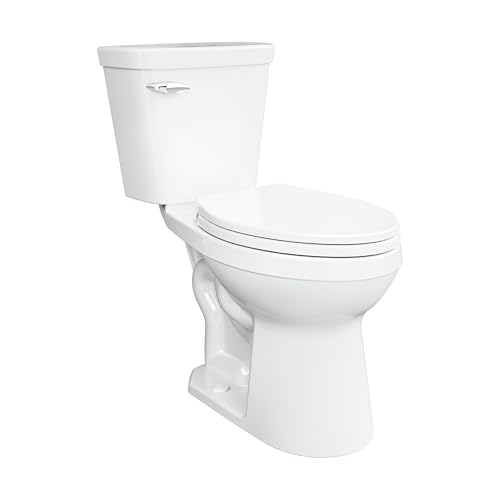
The Gerber Viper earns a 1000 g MaP score at 1.28 GPF and is the toilet most commonly specified by plumbing contractors for commercial-grade residential jobs, a pattern driven by its fully glazed 2-inch trapway, dual-flush option, and Gerber's established distribution through trade supply houses.
Gerber's tower valve dual-flush mechanism lifts like a piston rather than pivoting like a flapper, which gives it a longer functional life before the seal degrades. The full 1.28 GPF flush earns 1000 g on the MaP test; the 0.8 GPF partial flush is sufficient for liquid waste, which cuts average per-flush water use well below the WaterSense 1.28 GPF threshold for households that use the lower setting regularly. The fully glazed trapway prevents waste adhesion at the narrowest point of the flush path, which is a contributing factor to the Viper's strong clog-resistance reputation among residential plumbers.
Gerber is a less visible brand at retail than TOTO, Kohler, or American Standard, but it has a long track record in the trade channel and its products are stocked at plumbing supply houses across the country. The limited lifetime warranty covers the vitreous china and mechanical components. For households where the toilet is used primarily by adults, the dual-flush option is a meaningful water-saving feature: if half of daily flushes use 0.8 GPF instead of 1.28 GPF, average consumption drops substantially over a year.
Plumbers trust the Viper because Gerber's manufacturing quality is consistent and their trade support is responsive. The dual-flush tower valve is genuinely durable compared to standard flapper mechanisms, and 1000 g MaP at 1.28 GPF means this toilet performs at the top of the gravity-flush class. The main limitation is retail visibility -- you may need to source it through a plumbing supply house rather than a big-box store. If that is not an obstacle, the Viper is one of the most well-rounded two-piece toilets in this guide.

The Woodbridge T-0019 is a dual-flush two-piece toilet with a concealed trapway skirted design that delivers 800 g MaP performance at 1.28 GPF full flush and 0.8 GPF partial flush, offering the visual appeal of a skirted profile at a price significantly below comparable skirted one-piece models.
The Woodbridge T-0019's skirted skirt panel wraps the visible trapway in a smooth porcelain shell, eliminating the exposed S-curve that is typical of a standard two-piece bowl. That skirted look is usually reserved for one-piece toilets or premium two-piece models from TOTO and Kohler, so the T-0019 offers genuine aesthetic value for its price. The soft-close seat is included in the package at no extra cost, which is a meaningful practical addition that most competing models in this tier do not include.
The 800 g MaP score is the trade-off: adequate for light-to-moderate daily use but not in the same category as the 1000 g models above. Woodbridge backs the T-0019 with a one-year warranty, which is shorter than Kohler's or American Standard's lifetime coverage and should be factored into the total value assessment. For buyers comparing the T-0019 to the fully skirted one-piece Woodbridge T-0001, the two-piece T-0019 is easier to ship and install but has a visible seam line. For broader context on choosing between skirted and standard designs, see Best Toilets of 2026: Top Picks for Every Bathroom.
The T-0019 is the best choice on this list for buyers who want a skirted two-piece toilet without paying for a premium brand. The 800 g MaP score and the one-year warranty are the two limitations to manage, but for a master bathroom that sees two-to-four adult flushes daily, 800 g is sufficient and the skirted design genuinely elevates the bathroom's appearance. Do not use it as the primary toilet in a household of five or more -- the flush performance gap over 1000 g models becomes meaningful at that traffic level.
If you have read through all eight models and are still uncertain, the decision tree is simple: for the best single toilet that fits most households, buy the TOTO Drake II. If clogs are your documented problem, buy the American Standard Champion 4. If budget is the binding constraint and the bathroom is used lightly, the American Standard Cadet 3 is the floor for WaterSense performance. Everything between those three anchors is a question of design preference, brand loyalty, and whether dual-flush water savings justify the valve complexity in your specific household.
Understanding these five specifications will narrow any shortlist to the toilet that fits your bathroom, your household, and your plumbing before you buy.
MaP (Maximum Performance) is the only independent, standardized test that measures how many grams of solid waste a toilet clears in a single flush. It was developed by Veritec Consulting and the Alliance for Water Efficiency to give consumers and specifiers an objective comparison metric across brands. The test uses weighted soybean paste, which closely mimics human waste density, and a toilet passes a given score level if it clears that weight without any residue in the trapway. Scores run from 0 to 1000 g. For daily household use, 800 g is the practical minimum. For households with heavy use or any history of clogging, 1000 g is the right target. No other advertised specification -- not "powerful flush" or "commercial grade" -- replaces the MaP score as an objective performance indicator.
GPF means gallons per flush. Federal law in the United States caps residential toilet maximum flush volume at 1.6 GPF. EPA WaterSense certification applies to toilets that flush at 1.28 GPF or less and achieve at least 350 g on the MaP test. Every toilet on this list that is WaterSense-certified uses 1.28 GPF. The practical difference between a 1.28 GPF toilet and a 1.6 GPF toilet is approximately 3,650 gallons per year in a household that flushes ten times daily -- significant in states with tiered water billing but negligible in areas with flat-rate water costs. Dual-flush toilets like the Gerber Viper and Woodbridge T-0019 offer a partial 0.8 GPF flush for liquid waste, which reduces average consumption further if the lower setting is used consistently.
The flush valve is the mechanism inside the tank that opens to release water into the bowl. A standard flapper valve pivots on a hinge from the bottom of the valve seat and closes under water weight. A canister valve (used in Kohler models) lifts fully upward, exposing the entire valve seat opening at once for a faster initial water release. A tower valve (used in many dual-flush designs) rises vertically through the center of the valve seat. Canister and tower valves generally produce a stronger felt flush than a flapper at the same GPF because they release water volume faster in the first half-second. A flapper that fits a given manufacturer's flush valve specification is inexpensive to replace; canister and tower valves often require the same manufacturer's replacement part, which can cost slightly more but lasts longer before needing service.
The trapway is the S-shaped channel at the base of the bowl through which waste exits the toilet to the drain. Trapway width is measured in inches at its narrowest point. Standard two-piece toilets use a 2-inch trapway; heavy-duty models like the American Standard Champion 4 use a 2 3/8-inch trapway. A fully glazed trapway means the ceramic glaze that coats the bowl surface extends through the full length of the trapway, reducing friction and waste adhesion at the point where most clogs begin. An unglazed or partially glazed trapway accumulates residue over time that progressively narrows the effective opening. When comparing two toilets with similar MaP scores, the one with the larger, fully glazed trapway will perform more consistently in a household with irregular use patterns or older drain lines.
Bowl height is measured from the finished floor to the top rim of the bowl, not including the seat. Standard height is 15 inches. Comfort height (also called Right Height by American Standard) is 16 to 18 inches, sitting closer to a standard chair height. ADA-compliant height is 17 to 19 inches measured with the seat installed. Most adults over 18 find comfort height easier to stand from, particularly after sitting for more than a few minutes. Standard height is ergonomically better for children under 10 and for adults under 5 feet 4 inches who find their feet cannot reach the floor at 17-plus inches. If a household has both adults and young children as primary users, comfort height is still the correct default for most families because the taller height does not create a physical barrier for most children, while the lower height is noticeably harder for adults with knee issues.
The single specification that most buyers ignore but should prioritize is the trapway glaze, not just the trapway width. A 2 3/8-inch trapway that is not fully glazed will accumulate more waste residue over two years than a 2-inch fully glazed trapway that is properly maintained. Ask the manufacturer specifically whether the trapway glaze is continuous from bowl to drain connection, not just present at the bowl rim. Every toilet on this list with a 1000 g MaP score uses a fully glazed trapway -- that is not a coincidence.
A two-piece toilet is a toilet where the tank and bowl are manufactured and shipped separately, then bolted together at installation using a spud gasket and tank bolts. This is the most common toilet configuration in North American homes because it ships in two manageable boxes, installs with one person, and uses standard off-the-shelf internal components that are inexpensive to replace.
A one-piece toilet fuses the tank and bowl into a single casting during manufacturing, eliminating the seam between them. Two-piece toilets have a bolted joint between tank and bowl that can occasionally leak if the gasket hardens but is easy to replace. One-piece toilets look sleeker and clean faster; two-piece toilets cost less to buy and repair. Flush performance at the same GPF and trapway specification is identical regardless of body style.
The TOTO Drake II and the American Standard Champion 4 both achieve the maximum 1000 g MaP score in independent testing. The Drake II does so at 1.28 GPF using a dual-nozzle Tornado Flush; the Champion 4 does so at 1.6 GPF using a 4-inch flush valve. For water efficiency paired with maximum flush strength, the Drake II is the benchmark. For clog resistance above all else, the Champion 4 is unmatched in the gravity-flush two-piece category.
Two-piece toilets are generally easier to install because each component -- bowl and tank -- weighs significantly less than a one-piece unit. A one-piece toilet can weigh 85 to 120 pounds as a single unit, requiring two people to lift safely. A two-piece bowl typically weighs 50 to 60 pounds and the tank 15 to 25 pounds, allowing a single person to manage each piece independently. Internal components are also easier to access and adjust during installation.
The vitreous china body of a two-piece toilet typically lasts 20 to 50 years with no structural degradation if it is not physically cracked. Internal components -- flappers, fill valves, flush valves, and tank seals -- have shorter service lives of 5 to 15 years depending on water quality and use frequency. Because two-piece toilet parts are universal and inexpensive, the real effective lifespan of a two-piece toilet is open-ended as long as the china remains intact and the rough-in dimensions still fit.
EPA WaterSense is a voluntary certification program administered by the U.S. Environmental Protection Agency. A toilet earns WaterSense certification by flushing at 1.28 GPF or less and achieving at least 350 g on the MaP flush test in independent testing. WaterSense-certified toilets save roughly 20 to 60 percent more water per flush compared to toilets manufactured before the 1.6 GPF federal standard took effect, and significantly more compared to older 3.5 GPF toilets. All toilets on this list that carry 1.28 GPF ratings are EPA WaterSense certified.
MaP stands for Maximum Performance. It is an independent flush test that measures how many grams of solid waste a toilet clears in a single flush using soybean paste as a standardized waste simulant. Scores range from 0 to 1000 g. The test is administered by Veritec Consulting and published at map-testing.com. MaP scores are the most reliable way to compare toilets across brands because they test actual waste-clearing performance rather than relying on marketing terminology.
Comfort height refers to a toilet bowl rim height of 16 to 18 inches from the finished floor, which is closer to the height of a standard chair. Standard toilet bowls sit at 15 inches. Most adults over 18 find comfort height easier to stand from because it reduces the range of motion required at the knee and hip joints. Adults over 60, people with arthritis, and anyone who has had knee or hip surgery particularly benefit from comfort height. Children under 10 may find their feet do not reach the floor at comfort height, so households with young children sometimes choose standard height for the primary children's bathroom.
The Champion 4's 4-inch flush valve is designed to clear a very high volume of waste in a single pass, and achieving that performance at 1.6 GPF gave American Standard the ability to maximize the water column speed through the bowl. The model predates the EPA WaterSense program and uses 1.6 GPF intentionally to deliver maximum bulk-waste clearing reliability. American Standard has since introduced WaterSense-certified 1.28 GPF models, but the Champion 4 retains its 1.6 GPF specification as a deliberate engineering choice for clog resistance.
Yes. Because the tank and bowl on a two-piece toilet are separate components joined by a gasket and bolts, you can replace just the tank if it cracks or develops a defect, provided you can source a replacement tank with the same bolt pattern and spud size as your bowl. Major brands including Kohler, TOTO, American Standard, and Gerber sell replacement tanks separately. If the exact model tank is discontinued, a plumber can often identify a compatible replacement tank from the same product family.
CeFiONtect is TOTO's proprietary ceramic glaze that is applied to the bowl and trapway surfaces during manufacturing. It seals ceramic pores to near-zero surface roughness, which significantly reduces the ability of waste, mineral deposits, and bacteria to adhere to the bowl surface. Toilets with CeFiONtect require less frequent scrubbing and resist the brown ring staining that appears in conventionally glazed bowls over time. It is included on the Drake II and UltraMax II but not on the entry-level TOTO Drake or Entrada.
A skirted two-piece toilet adds a smooth porcelain panel that conceals the exposed trapway curve on the outside of the bowl, giving it the cleaner look of a one-piece without the one-piece price. The practical benefit is easier exterior cleaning since the smooth skirt has no crevices where dust and residue accumulate. The trade-off is that skirted models cost more than exposed-trapway models in the same tier, and wall anchor brackets are sometimes required to stabilize the skirted panel. For buyers who want a modern look at a reasonable price, the Woodbridge T-0019 is the best-value skirted two-piece on this list.
The 12-inch rough-in is the standard for nearly all two-piece toilets sold in North America. Rough-in distance is measured from the finished wall behind the toilet to the center of the floor drain (closet flange). Homes built before 1940 sometimes have 10-inch or 14-inch rough-ins. If your existing rough-in is 10 or 14 inches, verify the specification before purchasing -- most brands offer specific models for those non-standard rough-ins, or a flange offset adapter can make a 12-inch model fit a 10-inch space in some cases.
The American Standard Champion 4 is the best two-piece toilet for large families specifically because its 4-inch flush valve and 2 3/8-inch glazed trapway handle high-volume and high-frequency use without clogging. The TOTO Drake II is a close alternative for families who want to keep GPF at 1.28 -- its 1000 g MaP score is equally capable of clearing heavy loads, just at lower water consumption per flush. For a full guide to toilets ranked specifically for family use, see Best Toilets for Large Families (Heavy Use, Low Clog).
The TOTO Drake II in its universal-height (16.5-inch) configuration is the best two-piece toilet for most seniors because it combines a chair-height bowl that reduces knee and hip strain with the reliable 1000 g MaP flush and CeFiONtect glaze that minimizes cleaning effort. The Kohler Cimarron and Highline Arc are also strong options at comfort height. For seniors who need a raised seat height above 17 inches, aftermarket raised toilet seat frames are available that fit standard two-piece bowls. See the full guide to Best Toilets for Seniors: Comfort Height and Safety for safety rail and accessibility seat recommendations.
Dual-flush toilets have two flush modes controlled by two buttons (or a single button that distinguishes a short press from a long press). The partial flush uses 0.8 GPF to clear liquid waste; the full flush uses 1.28 GPF to clear solid waste. The mechanism inside the tank is typically a tower valve rather than a standard flapper, which rises vertically and controls the amount of water released based on which button is pressed. Over time, a household that uses the partial flush for the majority of visits can reduce average water consumption well below the 1.28 GPF WaterSense standard.
Kohler's Class Five flush system is the combination of an AquaPiston canister flush valve and an optimized bowl inlet port geometry used in models including the Cimarron and Highline Arc. The AquaPiston canister lifts straight up to expose the full valve seat opening simultaneously, producing a faster initial water release than a hinged flapper valve. The bowl inlet ports are positioned to direct water more aggressively across the full bowl surface. Together, these two design choices allow Kohler to achieve strong MaP performance at 1.28 GPF, reaching the full 1000 g ceiling on the Cimarron and 800 g on the Highline Arc.
No. Flush performance is determined by trapway width, flush-valve opening area, bowl inlet design, and surface glaze quality, none of which are inherently different between a two-piece and a one-piece toilet of the same model family. The TOTO Drake (two-piece) and TOTO UltraMax II (one-piece) achieve identical 1000 g MaP scores because they share the same flush technology. The body style does not determine flush strength; the internal engineering does.
Toilet flappers typically degrade in three to seven years depending on water chlorine levels, water hardness, and the frequency of use. Hard water with high chlorine content accelerates rubber degradation. A flapper that is no longer sealing properly causes a toilet to run continuously or intermittently, wasting hundreds of gallons per day. If you hear your toilet refilling when no one has flushed it, replacing the flapper is the first diagnostic step. Two-piece toilets use standard-size flappers that cost a few dollars and install in minutes without tools.
Warranty coverage varies significantly by brand and model. American Standard offers a limited lifetime warranty on the vitreous china body of the Champion 4 and Cadet 3. Kohler offers a limited lifetime warranty covering china and mechanical parts on the Cimarron and Highline. TOTO provides a one-year warranty on the Drake and Drake II, which is shorter but backed by a brand with low factory defect rates. Gerber offers a limited lifetime warranty on the Viper's vitreous china. Woodbridge's T-0019 carries a one-year warranty, which is the weakest on this list and should be factored into the purchase decision for long-term value assessments.
For most households, the TOTO Drake II is the best two-piece toilet available in 2026: its dual-nozzle Tornado Flush hits the maximum 1000 g MaP score at 1.28 GPF, the CeFiONtect glaze keeps the bowl measurably cleaner between scrubbings, and the comfort-height elongated bowl suits the majority of adult users. If clog prevention matters more than GPF efficiency, the American Standard Champion 4's 4-inch valve and 2 3/8-inch trapway is the correct answer. Budget-constrained buyers who need WaterSense certification at the lowest possible cost should look at the American Standard Cadet 3 for light-use bathrooms, while households that want a skirted modern look on a mid-range budget will find the Woodbridge T-0019 the best-looking option on this list. Every model above has been chosen based on published MaP scores, EPA WaterSense records, and manufacturer specifications -- not marketing language.
Learn why toilet trapways curve like an S, how each bend blocks sewer gas, and what the shape means for clogs and…
Read the guideAlmost every US toilet has a left-side handle. Learn the plumbing and mechanical reasons behind the layout and when it actually changes.
Read the guideHome toilets rely on tanks because household water lines lack the pressure that public flushometer systems use to flush straight from the…
Read the guide