


Best 30-Inch Bathroom Vanities (2026)
Bathroom Remodeling4.6
Thirty inches is the sweet spot between a cramped 24-inch vanity and a full 36-inch cabinet, giving a single-sink bathroom real drawer…
Read the guideA data-driven breakdown of every standard bathroom floor plan, rough-in distances, clearance codes, and how your toilet placement shapes everything else in the room.
For most homes, a 5x8 foot single-wall or L-shaped layout gives the best mix of usable floor area and code-compliant clearances. Position the toilet on the far wall from the door, specify a 12-inch rough-in, and choose an elongated comfort-height model like the TOTO Drake II (MaP 1,000 g at 1.28 GPF) to maximize both flush reliability and legroom in tight quarters.
All common residential bathroom layouts compared by footprint, toilet placement flexibility, and best use case.
| Layout | Typical Footprint | Toilet Placement | Best For | Min. Code Clearance |
|---|---|---|---|---|
| 5x8 Single-Wall | 40 sq ft | Far wall, centered | Most homes, remodels | 15" side, 21" front |
| 5x8 L-Shape | 40 sq ft | Short leg corner | Master bath upgrades | 15" side, 21" front |
| 3x6 Half-Bath | 18 sq ft | One short wall | Powder rooms, guest bath | 15" side, 21" front |
| 6x9 Split / Compartmented | 54 sq ft | Private water closet | Large families, shared bath | 15" side, 24" front (IBC) |
| 8x8 Square Master | 64 sq ft | Alcove or corner | Luxury renovations | 18" side preferred, 30" front |
| 4x8 Galley / Corridor | 32 sq ft | End wall only | Rentals, apartments, narrow lots | 15" side, 21" front |
| Wall-Hung / In-Wall Tank | Any footprint | Any wall (carrier frame required) | Ultra-compact or ADA | 15" side, 21" front (tank hidden) |
The toilet rough-in distance, typically 12 inches from the finished wall to the center of the drain flange, determines where plumbing stacks run and sets the constraints for every other fixture. Once the drain is set, vanity placement, shower position, and door swing all adapt around it. Changing a rough-in after tile is laid costs $800 to $2,500 in labor alone according to remodeling cost data from NAHB 2025 surveys, making the initial placement decision the single highest-stakes choice in a bathroom renovation.
Rough-in distances come in three standard sizes: 10 inches, 12 inches, and 14 inches, measured from the finished wall to the center of the drain. The 12-inch rough-in is by far the most common in American homes built after 1960, accounting for roughly 80 percent of installations. A 10-inch rough-in appears frequently in older homes and space-constrained apartments. A 14-inch rough-in is less common but shows up in some ranch-style homes and manufactured housing.
Why does this matter for layout planning? A toilet specified for a 12-inch rough-in placed on a 10-inch rough-in will have the tank pressed against the wall without room for the connection. Conversely, a 12-inch toilet on a 14-inch rough-in leaves a visible gap between tank and wall. Brands like TOTO, Kohler, and American Standard publish specific models for each rough-in size, though some models such as the TOTO Drake series offer adjustable rough-in options.
Before finalizing any bathroom floor plan, measure the rough-in of the existing drain or locate the planned drain position in a new build. All other dimensions flow from that anchor point.
The International Residential Code (IRC) requires a minimum 15 inches from the toilet centerline to any side wall or obstruction, and a minimum 21 inches of clear floor space in front of the toilet. The International Building Code (IBC), which applies to commercial and multi-unit residential construction, requires 18 inches from the centerline to the side wall and 30 inches of front clearance. ADA-compliant bathrooms require 18 inches of clear space on one side and 60 inches of turning diameter in the room.
These minimums are floor, not recommendations. Comfortable use typically benefits from 18 to 21 inches of side clearance and 30 inches or more of front clearance. In a standard 5x8 bathroom, the toilet is almost always placed at the end wall with 15 to 17 inches of side clearance to the tub or wall, which is code-compliant but tight for larger adults.
A practical planning note: the 15-inch minimum is measured from the toilet centerline, not from the toilet bowl edge. Since most elongated bowls extend about 18 to 19 inches wide, the outer edge of the bowl sits only 7.5 to 9 inches from the wall when clearance is at the code minimum. This creates real functional discomfort. When possible, plan for 17 to 18 inches from centerline to each side wall.
Code minimum clearances make a bathroom legal, not comfortable. If a remodel budget allows any flexibility in wall placement, spending $400 to $800 to gain an extra 3 inches of toilet side clearance pays dividends for the life of the home, particularly in master baths where comfort-height elongated toilets like the Kohler Highline or TOTO UltraMax II are standard choices. These models have bowl widths of 18 to 19 inches, so the 15-inch centerline-to-wall minimum is genuinely tight.
For bathrooms under 50 square feet, the single-wall or corridor layout with fixtures arranged along one or two adjacent walls is most efficient. In a 5x8 space, a standard toilet at the far wall, pedestal sink or wall-mount vanity, and alcove tub-shower combination maximizes clear floor area. Compact elongated toilets like the TOTO Entrada (28 inches deep, 1.28 GPF) or American Standard Cadet 3 (29.5 inches deep) fit without encroaching on the 21-inch front clearance zone.
A 5x8 bathroom measuring 40 square feet is the de facto standard for secondary bathrooms in American homes. The math of fitting three fixtures in that space leaves little room for error. The most efficient arrangement puts the toilet at the far short wall, the sink on the long wall near the door, and the tub or shower on the opposite long wall.
Key dimensions for the 5x8 single-wall layout:
Round-bowl toilets like the American Standard Cadet 3 in round configuration or the Gerber Avalanche round offer a 2-inch depth advantage over elongated bowls (roughly 26 versus 28 to 31 inches from wall to bowl front), which can be meaningful in the tightest spaces. However, elongated bowls are more comfortable for most adults and the 2-inch difference rarely determines whether a layout works or fails.
In bathrooms under 40 square feet, the toilet model choice directly affects whether the door can swing freely. The TOTO Entrada at 28 inches from wall to bowl front is one of the shortest elongated models available at 1.28 GPF with a 1,000-gram MaP score, making it a legitimate first choice for tight layouts. Do not default to a round bowl for a marginal space savings if the household contains adults who find elongated bowls significantly more comfortable.
For shared family bathrooms used by multiple people simultaneously, a compartmented or split layout with the toilet in a private water closet and the shower separate from the vanity area is the most functional design. A minimum 6x9 total footprint (54 square feet) allows a 3x6 water closet for the toilet and sink, a separate shower zone, and a double vanity. This layout reduces morning conflicts in households with children or multiple adults sharing one bathroom.
The compartmented bathroom layout, sometimes called a Jack-and-Jill design when it connects two bedrooms, typically involves a water closet door that can be latched independently from the main bathroom entry. The toilet in this configuration sits in a space as small as 30x60 inches (just 12.5 square feet) if a wall-hung toilet is used, or 36x66 inches minimum with a floor-mounted model.
For the toilet in a compartmented water closet, model selection should prioritize quiet flush operation and compact depth. The Kohler Cimarron with AquaPiston flush technology operates at noticeably lower noise levels than older siphonic designs, scoring 1,000 grams on MaP testing while using 1.28 GPF. The Swiss Madison St. Tropez one-piece also performs well in this context, with a skirted trapway that simplifies cleaning in tight quarters.
If budget allows a full 6x9 layout rather than a split, placing the vanity along the entrance hall section while the toilet and shower occupy the interior section gives each user functional independence without requiring a water closet door.
The toilet rough-in measurement directly restricts which models are compatible with a given drain location. A 12-inch rough-in is compatible with the vast majority of toilets from TOTO, Kohler, American Standard, Gerber, Woodbridge, and Swiss Madison. A 10-inch rough-in requires specifically designed models or adjustable rough-in configurations; the TOTO Drake II is available in a 10-inch rough-in version. A 14-inch rough-in is the least common and has the fewest model options, though some brands offer 10-14 inch adjustable rough-in models to cover all three sizes.
Measuring the rough-in is straightforward. With the old toilet in place, measure from the finished floor to the center of the bolts securing the toilet base to the floor. From the back finished wall, measure to those same bolt centers. That distance is the rough-in. Without the old toilet, measure from the finished wall to the center of the drain flange in the floor.
Common rough-in distances and compatible model examples:
| Rough-In | Frequency in US Homes | Compatible Models (Examples) | Notes | Check Price |
|---|---|---|---|---|
| 12 inch | ~80% | TOTO Drake, Drake II, UltraMax II, Aquia IV, Kohler Highline, Cimarron, AS Champion 4, Cadet 3, Gerber Viper, Woodbridge T-0001 | Standard; most selection | Check price |
| 10 inch | ~12% | TOTO Drake II (10"), Kohler Highline (10"), AS Cadet 3 (10") | Older homes, apartments; fewer options | Check price |
| 14 inch | ~8% | TOTO Entrada (14"), Gerber Viper (10-14" adj.), some AS models | Ranch homes, manufactured housing | Check price |
A layout that specifies a 12-inch rough-in in new construction unlocks the widest product selection and lowest replacement cost over time. If a 10-inch rough-in is unavoidable, verify the chosen toilet model specifically lists 10-inch rough-in compatibility, not just "fits 10-14 inch rough-in" without documentation.
In a master bathroom, the toilet ideally sits in a dedicated water closet or alcove separated visually from the vanity and shower zones, placed on the wall furthest from the entry door for privacy. If the footprint does not allow a water closet door, positioning the toilet behind a half-wall (kneewallheight 36 to 48 inches) provides visual separation without sacrificing square footage. A minimum 36-inch clearance on the toilet's dominant-hand side allows a TOTO Washlet or Kohler Bidet seat to function properly, which require side access for installation and use.
Master bathrooms have more design latitude than secondary baths. A typical master in new construction runs 60 to 120 square feet, making privacy and comfort the priority rather than pure footprint efficiency. The most functional master bathroom toilet placement strategies:
Choosing the right toilet for a master bath often comes down to height and bowl shape. For pair occupancy, comfort height (17 to 19 inches rim height) elongated models represent the most comfortable standard choice. See our guide to best flushing toilets for MaP score comparisons across all major brands.
For each major layout type, one model stands out on the combination of compact depth, flush reliability, and design fit.
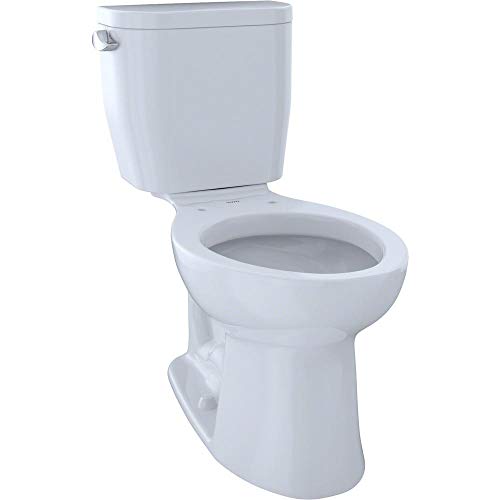
At 28 inches from wall to bowl front and a verified 1,000-gram MaP score at 1.28 GPF, the Entrada is the shortest EPA WaterSense-certified elongated toilet available from a major brand, making it the correct choice when door swing and front clearance are tight in a 5x8 layout.
Check price on AmazonTOTO's Double Cyclone flush system on the UltraMax II consistently achieves the maximum 1,000-gram MaP rating while consuming just 1.28 GPF, and the CeFiONtect glaze keeps the bowl clean between scrubbing cycles, which matters more in an open-plan master where the toilet is visible from the vanity zone.
Check price on AmazonThe Champion 4's 2.375-inch fully glazed trapway and 4-inch piston flush valve pass MaP testing at 1,000 grams on 1.6 GPF, giving shared family bathrooms with heavy daily use a meaningful buffer against clogs that leaner 1.28 GPF designs can struggle with under peak load conditions.
Check price on AmazonBathroom fixture planning starts with the toilet drain location, then works outward. The sink drain should be positioned at least 30 inches (center-to-center) from the toilet centerline to avoid clearance conflicts. The shower or tub rough-in must clear the toilet's side clearance zone. Door swing must clear the toilet bowl front by at least 1 inch; if this is impossible with a standard hinged door, a pocket or barn-style door solves the conflict without altering the fixture layout.
A practical sequence for bathroom layout planning:
Choosing fixtures that complement your layout also means selecting coordinating finishes and appropriate scale. A wall-hung vanity with the right bathroom vanity dimensions creates visual space in small baths, while an oversized freestanding vanity in a 5x8 layout eats into clearances and traffic flow.
ADA-compliant bathrooms require a 60-inch diameter turning circle for wheelchair access, a toilet centerline positioned 18 inches from the side wall with a clear floor space of 60 inches wide by 56 inches deep beside the toilet, and a toilet seat height of 17 to 19 inches (comfort height). The minimum ADA bathroom footprint is approximately 60x60 inches (25 square feet), though 60x80 inches is more functional. All of TOTO's comfort height models and Kohler's Highline series meet the 17-to-19-inch seat height requirement for ADA compliance.
ADA bathroom design differs from standard residential design in several key ways:
For ADA-compliant layouts in existing homes, wall-hung toilets like those in the Kohler Veil series offer an advantage: the bowl height can be adjusted during installation from 15 to 19 inches without changing the floor drain. This flexibility matters in homes where different users need different seat heights. Pair a wall-hung toilet with an appropriately positioned bathroom mirror at ADA height (bottom edge at 40 inches from floor) to complete a fully compliant vanity zone.
The toilet position determines where exhaust fan placement is most effective, since ventilation codes (IRC M1507) require an exhaust fan in bathrooms without operable windows, and best practice positions the fan within 6 feet of the toilet to capture odors at the source. Lighting over the toilet area should provide a minimum 50 foot-candles at task height (18 to 24 inches above the seat) to allow comfortable reading; a ceiling light centered between the toilet and vanity serves both zones adequately in bathrooms under 60 square feet.
Exhaust fan placement in relation to toilet position is a commonly overlooked detail in bathroom layout planning. The IRC requires exhaust rates of 50 CFM for intermittent use. For bathrooms with a toilet in a private water closet, a dedicated exhaust fan in the water closet is strongly recommended and required by many local codes. In open-plan baths, positioning the exhaust fan directly above or within 24 inches of the toilet captures odors more efficiently than fan placement above the shower.
When selecting an exhaust fan, choose a quiet model rated at 1.0 sone or less. See our bathroom exhaust fan guide for models matched to various room sizes and layout types, including fans with combination light fixtures that work well in small baths where fixture count is limited.
Lighting for the toilet zone specifically benefits from a dedicated overhead fixture or recessed can directly above the toilet when it sits in an alcove or water closet. In open-plan baths, a central overhead fixture combined with vanity mirror lighting serves both zones adequately. For fixture selection across all bathroom zones, our bathroom lighting guide covers color temperature, lumen requirements, and wet-zone ratings (IP44 minimum for fixtures within 3 feet of a water source).
In small bathrooms under 50 square feet, the three most important toilet features for layout compatibility are overall depth (28 to 31 inches from wall to bowl front), trapway type (fully concealed or skirted trapways are easier to clean when side clearance is tight), and flush reliability measured by MaP score. Toilets with MaP scores of 800 grams or above are strongly preferred because limited side clearance in small baths makes plunging awkward; preventing clogs is worth more than saving $50 on the fixture price.
Beyond dimensions, flush technology affects the cleaning burden in small bathrooms. Toilets in tight spaces are harder to clean around; skirted trapway designs from brands like Woodbridge (T-0001, T-0019), Swiss Madison (St. Tropez), and TOTO (Vespin II) eliminate the ridges and curves of exposed trapways that collect grime. This is not merely an aesthetic consideration in a tight layout, it is a functional one, since cleaning around a standard exposed trapway requires bending and reaching that is genuinely difficult when the toilet is 6 inches from a tub wall.
The Woodbridge T-0001 and T-0019 deserve specific mention for small bathroom layouts: both are one-piece skirted models with overall depths of 28.25 inches and 28.5 inches respectively, fully glazed trapways, and dual-flush 1.0/1.6 GPF operation. They achieve 800-plus grams on MaP testing, which is sufficient for most household use. Their clean visual profile also suits small bathrooms where every fixture is prominent.
For vanity coordination in small baths, a floating wall-mount vanity creates visual floor space and pairs well with compact toilet footprints. Explore our curated best bathroom vanities of 2026 selection for models under 24 inches deep that work in single-wall and corridor layouts.
The most common layout mistake in small bathroom remodels is purchasing a toilet based on style first, then discovering it projects too far from the wall. Check the rough-in specification and the overall bowl depth before finalizing any toilet choice. The TOTO Entrada at 28 inches and the Woodbridge T-0001 at 28.25 inches are the reference benchmarks for compact elongated models, both with 1,000-gram or 800-gram MaP scores that make them genuinely reliable despite their smaller footprint.
A full bathroom containing a toilet, sink, and tub or shower typically requires a minimum of 5x7 feet (35 square feet), though 5x8 feet (40 square feet) is more comfortable and represents the standard in American residential construction. Most building codes require at least 35 square feet for a full bath.
A half bath containing a toilet and sink requires a minimum of 18 to 20 square feet, with a typical footprint of 3x6 or 4x5 feet. The toilet and sink can share a 30-inch wall if the sink is positioned on the perpendicular wall. Some jurisdictions allow powder rooms as small as 11 square feet for toilet-only configurations.
The IRC requires a minimum 15 inches from the toilet centerline to any side wall or obstruction. Since a toilet centerline is located at the center of the bowl width (typically 9 to 9.5 inches from either side of the bowl), this leaves roughly 5.5 to 6 inches of visible clearance between the bowl edge and the wall at code minimum. For comfortable use, target 18 inches from centerline to each side.
The IRC requires 21 inches of clear floor space in front of the toilet, measured from the front of the toilet bowl to the nearest obstruction (wall, vanity, door, or fixture). The IBC requires 30 inches. ADA guidelines require 60 inches of clear floor depth in front of the toilet to allow wheelchair approach from the side.
Yes, but it requires opening the floor and relocating the drain pipe, which typically costs $800 to $2,500 in labor depending on whether the drain runs through a concrete slab or wood subfloor. Concrete slab relocation is more expensive and disruptive. In many cases, choosing a toilet compatible with the existing rough-in is more cost-effective than relocating the drain.
The toilet should face toward the door or toward the longest open dimension of the room, providing the maximum front clearance. A toilet facing a wall 21 inches away technically meets code but is uncomfortable. Orienting the toilet so that 30 to 36 inches of clear space exists in front of the bowl is a practical target. Avoid placing the toilet directly visible from the bathroom doorway; angling the door or offsetting the toilet position addresses this.
A 12-inch rough-in is the distance from the finished wall behind the toilet to the center of the floor drain flange. To measure it: with the existing toilet removed, measure from the back finished wall (not the stud, the finished drywall or tile surface) to the center of the drain opening in the floor. A 12-inch rough-in is the most common in American homes built after 1960.
For small bathrooms, the choice between one-piece and two-piece toilets matters less for footprint (both use the same floor space) and more for maintenance and aesthetics. One-piece toilets have no seam between tank and bowl, making cleaning easier in tight spaces where you cannot easily reach around the toilet. Two-piece toilets cost less and allow tank replacement without replacing the entire unit. Either works in a 5x8 layout; the total depth dimension matters more than the one-piece versus two-piece distinction.
An elongated bowl extends approximately 2 inches further from the wall than a round bowl (28-31 inches versus 26-28 inches total depth). In most 5x8 bathrooms, both sizes fit comfortably within code clearances. Choose elongated if adult comfort is the priority; choose round if the front clearance is right at the 21-inch minimum and every inch matters. For households with children under 10, round bowls can be more comfortable for smaller users.
Comfort height toilets have a seat surface 17 to 19 inches from the floor, compared to 15 to 16 inches for standard height. They are easier for adults to sit and stand from, particularly for taller individuals and those with knee or hip discomfort. Comfort height models from TOTO (Drake II at 17.5 inches), Kohler (Highline at 16.5 to 17.5 inches), and American Standard (right-height models) add no extra floor footprint versus standard height equivalents. They are the preferred choice for master bathrooms and homes where adults are the primary users.
Wall-hung toilets conceal the tank inside the wall, saving approximately 8 to 10 inches of floor depth compared to floor-mounted models. In a very tight bathroom or water closet, this can be meaningful. The trade-off is installation cost: wall-hung toilets require a carrier frame embedded in the wall, adding $800 to $1,500 in installation cost over a standard floor-mounted toilet. In a standard 5x8 bathroom with a 12-inch rough-in, a compact floor-mounted toilet like the TOTO Entrada accomplishes similar depth savings without the carrier frame cost.
The standard placement for a toilet paper holder is 26 inches from the floor and 8 to 12 inches in front of the toilet bowl centerline on the side wall. ADA guidelines specify 36 to 48 inches from the rear wall and 19 to 45 inches from the floor. In a tight bathroom where the toilet has only 15 inches of side clearance, the toilet paper holder can be mounted on the wall directly beside the toilet at the standard 26-inch height.
Yes. A private water closet within a bathroom is a valid and commonly preferred design for shared and master bathrooms. The minimum water closet dimensions are 30x60 inches for a floor-mounted toilet (15 inches clearance each side of centerline, 21 inches front clearance with door clearance added). A 36x66-inch water closet provides more comfortable proportions. The door should swing outward to preserve the 21-inch front clearance inside the water closet.
TOTO is consistently ranked highest in flush performance, with multiple models achieving 1,000 grams on MaP testing at 1.28 GPF. Kohler offers the broadest style range and strong dealer availability. American Standard's Champion 4 is the best-known option for clog prevention. Gerber and Swiss Madison offer strong value at lower price points. Brand selection should be secondary to specification matching: verify the rough-in size, bowl height, and MaP score before choosing based on brand name alone.
EPA WaterSense certification means the toilet uses 1.28 GPF or less and has been independently tested to flush at least 350 grams on a single flush (a minimum performance threshold). WaterSense toilets save approximately 13,000 gallons of water per year compared to older 3.5 GPF models. For bathroom layout planning, WaterSense certification primarily affects the fill valve size and tank dimensions slightly (1.28 GPF tanks can be marginally smaller), which has minimal impact on layout decisions. Most leading models from TOTO, Kohler, and American Standard carry WaterSense certification.
MaP (Maximum Performance) testing measures how much waste a toilet can flush in a single flush, expressed in grams of soybean paste (a standardized waste simulant). A score of 500 grams is considered adequate for residential use. A score of 800 grams is good. A score of 1,000 grams (the maximum in standard testing) means the toilet handles the heaviest expected residential waste load without clogging. For shared bathrooms, family bathrooms, and any bathroom used by multiple people daily, target a MaP score of 800 grams or higher. The American Standard Champion 4, TOTO Drake, Drake II, and UltraMax II all achieve 1,000 grams.
A bidet seat requires a dedicated 15-amp GFCI electrical outlet within 4 feet of the toilet, positioned 8 to 12 inches to the side of the toilet (never behind it, as bidet seats extend the seat footprint). Plan the outlet during rough-in; retrofitting an outlet after tile is installed requires opening the wall. Also ensure 18 to 20 inches of side clearance on the dominant-hand side for bidet seat control access. The outlet and extra clearance are the only layout adjustments needed for bidet seat compatibility.
Skirted trapway toilets (from Woodbridge, Swiss Madison, TOTO, and others) enclose the trap curve in a smooth ceramic skirt, eliminating the difficult-to-clean ridges of an exposed trapway. In bathrooms with tight side clearance (15 to 17 inches from toilet centerline to tub or wall), cleaning around an exposed trapway is genuinely difficult. Skirted models simplify this significantly and also present a cleaner visual appearance when the toilet is visible from the bathroom entry. The Woodbridge T-0001 and Swiss Madison St. Tropez are the best-known skirted options with verified MaP performance above 800 grams.
The standard rule for bathroom ventilation is 1 CFM per square foot of floor area for bathrooms under 100 square feet. A 5x8 bathroom (40 square feet) requires a minimum 50 CFM fan, which also matches the IRC minimum for intermittent exhaust in bathrooms without operable windows. For bathrooms with a separate water closet, add a second 50 CFM fan in the water closet or specify a 70 to 80 CFM unit with a duct run to serve both zones. Choose a fan rated at 1.0 sone or less for quiet operation.
A 5x8 single-wall floor plan with the toilet positioned on the far wall, 12-inch rough-in, and 17-inch minimum side clearances handles 80 percent of residential bathroom remodels correctly. Prioritize a toilet with a MaP score of 800 grams or higher, an EPA WaterSense-certified 1.28 GPF flush, and overall depth under 31 inches. The TOTO Drake II and TOTO Entrada represent the most proven choices for standard and compact layouts respectively, while the American Standard Champion 4 remains the benchmark for clog resistance in high-use shared bathrooms. Match your vanity, mirror, lighting, and exhaust fan to the toilet zone you establish first, and the rest of the layout will fall logically into place.
Thirty inches is the sweet spot between a cramped 24-inch vanity and a full 36-inch cabinet, giving a single-sink bathroom real drawer…
Read the guide
Cast iron is the material homeowners choose when heat retention and permanence matter more than installation weight, and Kohler remains the brand…
Read the guideStep-by-step fixes for the bathroom vanity problems that show up most often, from misaligned drawers and doors to water damage at the…
Read the guide