TOTO Drake Two-Piece Toilet vs Kohler Highline Two-Piece Toilet: Which Should You Buy?
Comparisons4.6
We compared the TOTO Drake and Kohler Highline two-piece toilets: both hit MaP 1000 at 1.28 GPF. See flush systems, verified specs…
Read the guideA wall hung toilet floats off the floor on a steel in-wall carrier with a concealed tank behind the tile, while a floor mounted toilet sits on a standard floor flange with its tank on top. They look different, install differently, cost differently and clean differently, but flush power follows the model you choose, not the mounting style. This guide compares both on published specs, MaP flush-test scores, EPA WaterSense data, installation requirements and aggregated owner review patterns so you can decide which mounting type belongs in your bathroom.
For nearly every bathroom replacement or remodel, the TOTO Drake II floor-mounted two-piece is the right pick: it delivers a verified 1,000-gram MaP score, WaterSense 1.28 GPF and a straightforward floor-flange install at a fraction of the cost and complexity of any wall hung system. Choose a wall hung toilet only if you are doing new construction or opening the wall anyway and the floating, floor-clearance aesthetic is worth the added investment in carrier framing and concealed plumbing.
Walk into a luxury hotel bathroom and the toilet appears to float, hovering over an unbroken stretch of tile with no visible tank. That is a wall hung toilet, and it makes a room feel larger and cleaner than it is. Walk into almost any house built in the last century and the toilet sits on the floor with its tank on top, bolted to a standard flange, connected to a visible water supply line. That is a floor mounted toilet, and it accounts for roughly 95 percent of residential installations in North America for good reason.
Both designs flush waste through a trapway using the same gravity or pressure physics. Both are available with EPA WaterSense certification at 1.28 GPF or less. Both accept the same standard toilet seats, bidet attachments and fill valves. The differences between them are not in the flush mechanics but in where the tank lives, how the fixture anchors to the building, what the installation requires and how much you pay for the privilege of a floating look. Getting that comparison right, based on real published specs and not marketing copy, is exactly what this guide covers. For the full ranking of every floor-mounted toilet by MaP score, start with our guide to the best flushing toilets ranked by verified performance data.
One mounting decision, where the tank lives and how the bowl anchors to the building, drives every other tradeoff between these two designs.
A floor mounted toilet is a complete plumbing fixture in one or two boxes. The bowl sits over a wax ring or rubber seal set on the floor drain flange, the toilet bolts to two closet bolts embedded in the flange, and the tank rests on top of the bowl. The water supply connects to the tank at the left rear, and the flush valve, fill valve and all internal parts sit inside the visible tank where you can reach them by removing the lid. Floor mounted toilets come in two piece configurations, where the tank and bowl are separate units joined by a gasket and bolts, and one piece configurations, where the tank and bowl are cast as a single seamless unit of vitreous china. Either way, the fixture rests on the floor and the plumbing connection is at the floor level.
A wall hung toilet, also called a wall mounted toilet or floating toilet, is a three-part system rather than a single fixture. The first part is a heavy-gauge steel carrier frame, engineered by manufacturers like Geberit, TOTO or Kohler, that bolts to the wall studs and the floor slab inside a wall cavity or chase wall. The second part is a slim in-wall or concealed cistern, typically 6 to 8 inches deep, that mounts inside the carrier and is plumbed to the water supply inside the wall. The third part is the porcelain bowl, which hangs from two horizontal bolts that protrude from the face of the finished wall at the height you set during rough-in. You see only the floating bowl and a flush actuator plate, either a push button or a touch sensor, set into the wall above it. Everything mechanical lives behind the tile and is accessed through the flush plate opening or a dedicated access panel.
Key point: A wall hung toilet is a system purchase, not a single fixture purchase. Budget for the bowl, the in-wall carrier frame, the concealed cistern (often sold as a kit), the flush actuator plate, and the wall work to house them. A floor mounted toilet is a single purchase that drops onto plumbing you already have.
How the two mounting styles compare on every factor that matters to a bathroom buyer or remodeler. MaP and GPF figures reflect typical strong performers in each category.
| Factor | Wall Hung Toilet | Floor Mounted Toilet | Edge |
|---|---|---|---|
| Installation complexity | In-wall carrier, wall work required | Standard floor flange, DIY-friendly | Floor Mounted |
| Total system cost | Bowl + carrier + cistern + wall work | Single fixture purchase | Floor Mounted |
| Floor cleaning | Open floor, mop freely | Mop around base and pedestal | Wall Hung |
| Surface cleaning | Bowl only, no tank to clean | Tank, bowl, base and trapway curves | Wall Hung |
| Repair access | Valves behind wall via flush-plate opening | Open tank lid, direct hand access | Floor Mounted |
| Bowl height adjustment | Adjustable at rough-in stage | Fixed by casting and bowl height model | Wall Hung |
| Modern aesthetic | Floating, hotel-suite look | Traditional or contemporary floor profile | Wall Hung |
| Room size perception | Open floor makes room feel larger | Visible base adds visual mass | Wall Hung |
| Typical MaP score | 600 to 1,000 grams (premium models) | 800 to 1,000 grams typical | Floor Mounted (wider selection) |
| GPF range | 0.8 / 1.28 dual-flush common | 1.28 single or dual-flush | Tie |
| EPA WaterSense | Available in leading models | Widely available at 1.28 GPF | Tie |
| Weight capacity | Carrier-rated, typically 500 to 880 lbs | Floor bears all load | Floor Mounted |
| Retrofit suitability | Needs open wall or new construction | Works on existing plumbing | Floor Mounted |
| Long-term repair cost | Higher, may require tile removal | Standard parts, DIY repair | Floor Mounted |
| Best application | New builds, full remodels, spa baths | Retrofits, all budgets, primary and secondary baths | Depends on project |
Flush power is driven by engineering inside the fixture, not whether it hangs on the wall or sits on the floor. Here is what the data actually shows.
The physics are straightforward. A floor-mounted toilet's tank sits at a height that allows water to drop with substantial momentum into the bowl when the flush valve opens. That drop height, combined with a large flush valve opening, is what creates the siphon action that clears waste through the trapway. A wall hung toilet uses a slimmer concealed cistern positioned inside the wall, which has less physical water volume and a shorter drop path to the bowl inlet. Manufacturers compensate with precision-engineered dual-flush nozzles and higher flush water velocities, which is why TOTO's Tornado flush technology allows its premium wall hung model to reach the full 1,000 grams on MaP testing despite the mechanical disadvantage. The floor-mounted category still produces the widest selection of 1,000-gram performers, but it is no longer the only mounting style that reaches the ceiling. The TOTO Drake II floor-mounted toilet scores 1,000 grams, the maximum the MaP protocol measures, as do the TOTO Drake, American Standard Champion 4 and Kohler Cimarron, all floor-mounted designs, and TOTO's own Aquia IV wall-hung reaches the identical score.
If maximum clog resistance is the priority and you are choosing between a wall hung and a floor-mounted option, a floor-mounted toilet gives you a wider selection of models that reach the top performance tier, but a premium wall hung toilet like the TOTO Aquia IV wall-hung is no longer a compromise on flush power itself. For typical residential use, both styles handle the job reliably. An 800-gram MaP score, common among mid-range wall hung models, is well above the 500-gram residential functional threshold and handles a standard household's daily load without chronic clogging. For a comparison of how flush technology differences play out among floor-mounted models specifically, our head-to-head on the TOTO Drake vs UltraMax II covers the data in detail.
This question has a decisive answer, and it usually settles the mounting decision for any retrofit or single-bathroom replacement project.
The floor mounted install starts with a floor flange already in place from the existing plumbing rough-in. You set a wax ring or no-wax seal on the flange, lower the bowl over the two closet bolts, press it level, tighten the nuts, attach the tank if it is a two-piece model, connect the supply line and test the flush. A competent DIYer can complete this in two to four hours with standard tools. The only variable is weight: a one piece floor-mounted toilet like the TOTO UltraMax II weighs 85 to 100 pounds and needs two people to lift safely, while a two piece design like the Drake or Kohler Cimarron lets you carry the lighter bowl and tank separately. Either way, the plumbing infrastructure is already there and the wall is never touched.
A wall hung toilet installation is a different category of project. The in-wall carrier, which in products like the TOTO DuoFit or Geberit Duofix system is a welded steel frame roughly 14 inches deep, must be built into the wall framing. This means either framing a new chase wall from scratch or opening an existing wall and rebuilding it around the carrier. The concealed cistern mounts inside the carrier and must be plumbed before the wall is closed. The wall is then covered, waterproofed and tiled, with a cutout for the flush actuator plate. Only after all of this is complete does the bowl bolt to the two protruding studs at the face of the wall. Most plumbers and general contractors charge significantly more labor for a wall hung install than for a floor-mounted replacement precisely because the scope is an order of magnitude larger. For any bathroom where the wall is not already open, a floor-mounted toilet is the practical choice.
Clog resistance depends on trapway design and flush power, both of which you can verify with published specs regardless of mounting type.
The mechanics of clog prevention are the same regardless of mounting style: you need enough water velocity, delivered through a large enough opening, to create a siphon that pulls waste through the trapway on the first flush. A fully glazed trapway means the entire passage is coated with smooth vitreous china so waste slides through without snagging on rough ceramic. American Standard's Champion 4, a floor-mounted two piece, uses a 4-inch flush valve paired with a 2 3/8-inch glazed trapway, which American Standard describes as clearing 70 percent more waste per flush than a standard toilet. Independent MaP testing confirms a 1,000-gram score. No wall hung toilet on the current market matches the Champion 4's oversized 4-inch valve, though the TOTO Aquia IV wall-hung matches its 1,000-gram MaP score with a more compact Tornado dual-flush system.
For households that have experienced chronic clogging with standard toilets, a floor-mounted model with a proven large-bore trapway and flush valve is the safer specification on raw mechanical margin. For households with normal usage patterns, the difference between a top wall hung model and a top floor-mounted model, both at 1,000 grams, is unlikely to result in noticeable real-world clogging differences. The 500-gram MaP threshold is the residential functional minimum, and both styles well exceed it in their better models. Our full guide to the American Standard vs Gerber comparison covers the clog-resistance specs of the leading floor-mounted value brands in detail.
Total cost of ownership, including installation labor, system components and future repair complexity, heavily favors the floor-mounted toilet in most bathrooms.
Breaking down the true cost gap: a quality floor-mounted toilet like the Kohler Cimarron or TOTO Drake runs from a moderate to mid-range purchase price, and a standard professional toilet replacement typically costs one to three hours of plumber labor on top. A wall hung system requires purchasing the bowl, the carrier frame or kit (sold separately by brands like TOTO for the DuoFit system and Geberit for the Duofix), the flush actuator plate, and then paying for the wall construction work, which can range from several hundred to well over a thousand dollars in labor depending on the region and whether a chase wall needs to be built from scratch. The total installed cost of a wall hung toilet system is typically two to five times higher than an equivalent quality floor-mounted toilet installation. Our comparison of the leading floor-mounted brands, including TOTO vs Kohler and Kohler vs American Standard, helps narrow the best value option for each use case.
Repair cost over time also favors the floor-mounted design. When the fill valve in a TOTO Drake wears out, you lift the tank lid, unscrew the old valve, and press in a replacement in about 20 minutes. When the fill valve in a wall hung concealed cistern wears out, you access it through the flush plate opening, which on most systems gives you enough space to service the valve if you have slim hands and the right tools, but the job is less convenient and some repairs may require removing the flush plate completely. If the worst happens and the concealed cistern itself cracks, the repair scope can include breaking tile to access the carrier wall. That risk is rare with quality systems, but it is a real lifetime cost consideration that does not exist in a floor-mounted toilet.
The wall hung toilet is a compelling product in the right context: a new-build bathroom, a complete gutted remodel, or a spa-level primary suite where the open floor and floating aesthetic are worth the total installed cost and the slightly more involved long-term service access. Outside that specific context, especially in any retrofit, rental property, secondary bathroom or project where the wall is not already open, the floor-mounted toilet wins on every practical dimension. Do not let the floating look drive you to a system your budget and project scope cannot support comfortably.
MaP testing is independent of mounting style and gives you the only objective measure of how many grams of waste a toilet reliably clears on a single flush.
MaP testing, administered by an independent organization and published at map-testing.com, simulates solid waste with a standardized material and runs each toilet multiple times to determine the maximum grams per flush it can clear consistently. A score of 350 grams is the EPA WaterSense program's minimum flush-performance requirement for certification, meaning every WaterSense-certified toilet must clear at least 350 grams on 1.28 GPF or less. Most quality toilets far exceed this: the WaterSense floor is the minimum, not the target. When a manufacturer cites "WaterSense certified" without publishing a MaP score, treat that as meeting the regulatory floor only. When they publish both, the MaP score tells you how much performance headroom the toilet has above that floor.
EPA WaterSense certification is available across both mounting styles. Wall hung toilets typically use dual-flush actuators with a 0.8 or 0.9 GPF partial flush and a 1.28 GPF full flush, so their effective average water use per flush, depending on how often each button is used, can be even lower than a single-flush 1.28 GPF floor-mounted model. For households looking to reduce annual water use, a dual-flush wall hung model with strong MaP scores like the TOTO Aquia IV is a genuine water-saving option. For households where simplicity and maximum clog resistance matter more, a single-flush 1.28 GPF floor-mounted toilet with a 1,000-gram MaP score is the more straightforward choice.
Both styles have genuine cleaning advantages, but they apply to different surfaces, which determines which one is actually easier to maintain in your specific bathroom.
The wall hung toilet's single biggest cleaning advantage is not the bowl but the floor. In a bathroom where hygiene and ease of mopping matter, removing the toilet's floor footprint completely is a genuine benefit. Hair, moisture and cleaning residue cannot accumulate around the toilet base because there is no base. The entire floor under and around the floating bowl is open and reachable with any standard mop or cleaning cloth. For households with children, pets or anyone who has had to deep-clean around a toilet pedestal, this difference is meaningful in daily maintenance time over years of use.
On the fixture itself, a skirted one-piece floor-mounted toilet closes the cleaning gap significantly. The TOTO UltraMax II one piece has no seam, no exposed tank bolt heads and, in its skirted configuration, no exposed trapway curves. The only surfaces to clean are the top of the tank, the tank front, and the bowl exterior. In a wall hung toilet, the bowl exterior is just as clean, but the wall surface around the flush plate collects dust and moisture in the gap between the plate frame and the tile. Over time this requires attention to prevent mold at the wall junction. For primary bathrooms where both floor and fixture cleanliness are priorities, the combination of a wall hung bowl for floor access and a high-gloss flush plate surround for wall maintenance is ideal. For buyers who want cleaning simplicity in a floor-mounted toilet, a skirted one piece removes nearly every difficult cleaning zone.
Strong performers across both mounting styles, selected by MaP score, EPA WaterSense certification and aggregated owner review consistency.
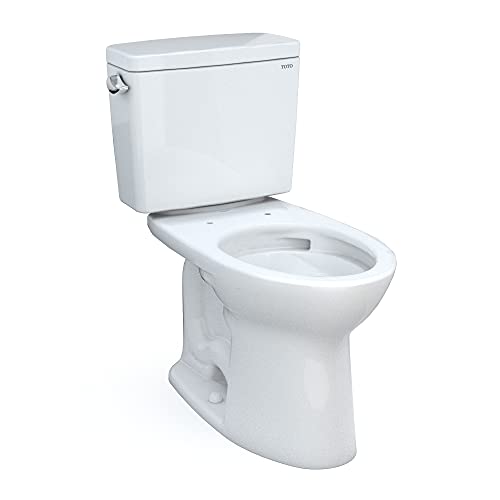
The TOTO Drake II is the floor-mounted toilet most consistently recommended for buyers who want maximum independently verified flush performance, EPA WaterSense efficiency and a straightforward two-piece installation at a price well below the wall hung category.
TOTO's Double Cyclone flush uses twin nozzles to generate a powerful rotating water flow that rinses the full bowl surface on every flush. This produces a 1,000-gram MaP result, the highest achievable rating in the Maximum Performance testing protocol, while using only 1.28 gallons per flush under EPA WaterSense certification. As a two-piece floor-mounted toilet, the Drake II separates into a bowl and tank that each weigh manageable amounts for a solo DIY install, with no wall work, no carrier framing and no concealed plumbing required.
Aggregated owner reviews consistently cite the Drake II's flush reliability as the main reason for purchase, with particular note of its performance relative to similar floor-mounted toilets in the same price range. The comfort height bowl at 16.5 inches suits most adult users and meets ADA accessibility requirements. The tank-to-bowl seam is the only cleaning concession compared to a one-piece skirted design, but for buyers who are neutral on this point the Drake II represents the strongest flush-to-cost ratio in the floor-mounted category. For further reading on how the Drake II compares against TOTO's own one-piece line, see our dedicated breakdown of the TOTO Drake vs UltraMax II.
If the floor-mounted versus wall hung decision comes down to flush performance, the Drake II settles it clearly in favor of the floor-mounted format. A 1,000-gram MaP score is the ceiling of what independent testing measures, and the Drake II delivers it on a straightforward two-piece install at a fraction of a wall hung system's total installed cost. This is the toilet to recommend when performance is the priority and the floating look is optional.

The TOTO Aquia IV wall-hung is the wall hung toilet recommended for buyers committed to the floating design, pairing a proven TOTO DuoFit in-wall carrier rated to 880 pounds with a dual Tornado flush that reaches the maximum 1,000-gram MaP score on 0.9 or 1.28 gallons.
TOTO's Tornado flush fires water through dual angled nozzles to create a swirling rinse across the full inner bowl surface on each flush, which compensates for the concealed cistern's lower drop height and allows the Aquia IV to reach the full 1,000 grams on MaP testing. The DuoFit in-wall carrier is a welded steel frame with a published load rating of 880 pounds, which is among the highest in the wall hung category and provides confidence that the structural support matches the aesthetic promise. TOTO's CeFiONtect glaze option reduces mineral and waste adhesion to the bowl interior.
Aggregated owner reviews are consistent on clean single-flush performance and the open-floor cleaning benefit. Reviews also note that accessing the cistern internals through the flush plate opening is manageable for fill valve servicing without professional help on most service calls. The DuoFit system includes an adjustable bracket for setting bowl rim height from 15 to 19 inches during rough-in, which is a genuine advantage for tall users or households installing specifically for ADA-compliant accessibility. The total system cost, counting bowl, DuoFit carrier and actuator plate, sits well above any floor-mounted alternative, which is the honest trade-off for the floating result.
The Aquia IV is the wall hung toilet to specify when the floating design is a firm requirement and quality matters. The DuoFit carrier has a credible load rating, the Tornado flush actually delivers the maximum 1,000 grams without the double-flush behavior that plagues cheaper wall hung models, and the adjustable bowl height is a real benefit you cannot get from any floor-mounted toilet. Accept the higher cost and the in-wall construction as the price of the floating look done correctly, knowing you are not giving up any flush performance to get it.
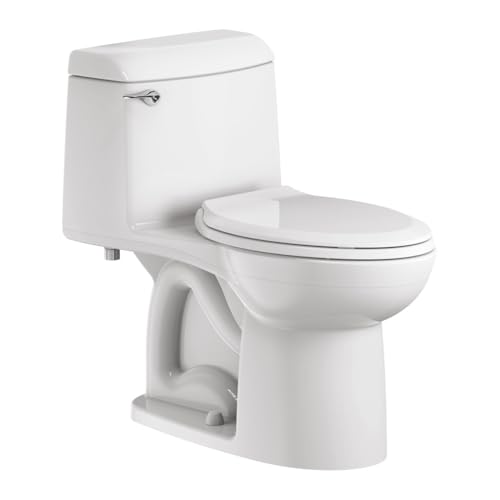
The American Standard Champion 4 is the floor-mounted toilet specified most often in high-volume and historically clog-prone bathrooms, combining a 4-inch flush valve with the widest fully glazed residential trapway available in a gravity-fed design.
The Champion 4 uses American Standard's Accelerator flush valve, a 4-inch opening that releases the full 1.6-gallon tank essentially instantaneously, creating a powerful siphon through a 2 3/8-inch fully glazed trapway. No wall hung toilet on the market offers a trapway this wide or a flush valve this large; the physics of a concealed cistern system make such dimensions impractical behind a wall. This is the design argument for floor-mounted toilets in clog-prone applications: the engineering headroom for large-bore flush systems simply does not exist in the wall hung format.
American Standard rates the Champion 4 as capable of clearing 70 percent more waste per flush than a standard toilet, and the 1,000-gram MaP score from independent testing validates the performance claim. The trade-off is water use: at 1.6 GPF, the Champion 4 consumes more water per flush than any WaterSense-certified model and is not EPA certified. For households choosing between a high-performance floor-mounted toilet and a wall hung system where the primary concern is clog prevention, the Champion 4's advantages are decisive. For a head-to-head on the two leading American Standard floor-mounted clog fighters, our review of the Champion 4 vs Cadet 3 lays out the spec differences clearly.
Recommend the Champion 4 specifically when clog elimination is the non-negotiable requirement, and the buyer accepts 1.6 GPF as the trade-off for a 4-inch valve and the widest residential trapway available. No wall hung system can match this combination. For clog-prone bathrooms, this is where the floor-mounted format's engineering headroom matters most.
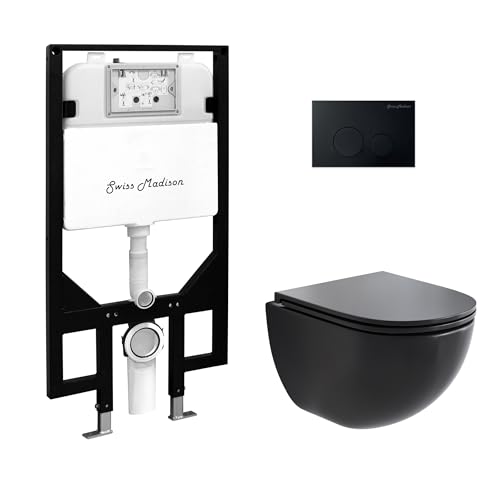
The Swiss Madison St. Tropez wall-hung brings the rimless floating bowl design to a more accessible system price point than TOTO or Kohler equivalents, making it the entry point for buyers who want the wall hung aesthetic without a premium-brand budget.
The St. Tropez wall-hung uses a rimless bowl design in which water flows around the full inner circumference of the bowl rather than through hidden rim channels, delivering a complete rinse while eliminating the rim cavity where bacteria and mineral deposits accumulate in traditional bowls. The dual-flush at 0.8 and 1.28 GPF provides genuine water savings for light-use bathrooms. Swiss Madison packages the bowl, carrier system and chrome flush plate as a kit, which simplifies purchasing compared to buying components separately from multiple suppliers.
Published MaP data for the St. Tropez wall-hung sits in the 600-gram range, which is functional for typical household use but well below the maximum 1,000-gram standard set by the TOTO Aquia IV wall-hung. For a guest bathroom or powder room that sees two to four uses per day, the difference is unlikely to result in real-world clogging issues. For a busy family bathroom with six or more daily users, the lower MaP ceiling is a meaningful consideration. Swiss Madison is a younger brand than the major names, so long-term parts availability and service support are not as deep, which is a fair trade-off at its system price point for buyers who value the aesthetic and understand the specifications.
Recommend the Swiss Madison St. Tropez wall-hung for the buyer who wants the floating look on a tighter budget and is installing it in a low-traffic guest bath or powder room. Be direct about the 600-gram MaP versus the maximum 1,000-gram Aquia IV and let the buyer decide whether the price difference is worth the performance headroom. For a busy family bathroom, spend up to the TOTO system.

The TOTO UltraMax II is the floor-mounted one-piece toilet that most closely approaches the visual cleanliness of a wall hung design while maintaining the simplicity and flush-performance ceiling that only a floor-mounted fixture can offer.
The UltraMax II uses TOTO's Double Cyclone flush, identical to the Drake II, which produces twin rotating water streams that rinse the bowl interior completely on every flush and achieve a 1,000-gram MaP score. The skirted one-piece casting removes the exposed trapway curves from the sides of the toilet and fuses the tank and bowl into a seamless vitreous china shell with no horizontal seam, no bolt caps and no tank-to-bowl gasket to clean or potentially leak. This is the closest a floor-mounted toilet comes to the visual simplicity of a floating design without requiring in-wall construction.
The key difference between the UltraMax II and a wall hung toilet is that the base still rests on the floor and must be cleaned around, even though the skirted sides make that task significantly easier than on an unskirted toilet. For buyers who are drawn to the wall hung look primarily for its cleaning advantage rather than its floating aesthetic, the UltraMax II often satisfies the requirement at a much lower total installed cost. TOTO's optional CeFiONtect glaze reduces bowl staining and extends the interval between full cleaning sessions.
The UltraMax II is the right recommendation when a buyer wants the wall hung look's cleaning benefits but is not doing a full remodel where opening the wall is already in scope. The skirted one-piece format delivers seamless cleaning, the 1,000-gram MaP ceiling and a standard floor-flange install. It does not float, but the floor area it occupies is small and the cleaning effort is genuinely minimized. Save the wall hung specification for projects where the wall is open.

The Kohler Cimarron is the floor-mounted two-piece toilet recommended for buyers who want Kohler's AquaPiston flush technology, a limited lifetime vitreous china warranty and EPA WaterSense certification at a price well below the premium one-piece category.
Kohler's AquaPiston canister flush valve opens 360 degrees rather than swinging from one side like a standard flapper, exposing the full valve opening and releasing water uniformly from all sides. This engineering choice produces the maximum 1,000-gram MaP result at 1.28 GPF WaterSense certification, matching TOTO's top-tier models, which means the Cimarron conserves water without the weak-flush behavior that early high-efficiency toilets were known for. The Cimarron's two-piece design installs with the same DIY-friendly separate-bowl-and-tank approach as the TOTO Drake, and Kohler's parts availability for the AquaPiston canister is excellent through retail and online channels.
The lifetime vitreous china warranty is the Cimarron's strongest differentiator over TOTO's equivalent two-piece models, which carry one-year limited warranties on the fixture body. Kohler's china warranty applies for as long as the original purchaser owns the toilet. In a family primary bathroom expected to serve 20 or more years, that coverage difference is meaningful. The Cimarron is available in 10-inch, 12-inch and 14-inch rough-in versions, which broadens its fit to older homes that may not have a standard 12-inch rough-in.
The Cimarron is the recommendation when a buyer wants a Kohler floor-mounted toilet and the lifetime china warranty matters to them. On strict MaP performance, the Cimarron ties TOTO's Drake II at the maximum 1,000-gram ceiling, so the decision comes down to warranty and glaze rather than flush power. The warranty edge and Kohler's extensive parts network tip the Cimarron ahead for long-term value in this tier.

The American Standard Cadet 3 is the most consistently recommended floor-mounted toilet for budget-conscious buyers who need reliable MaP performance above 800 grams, a WaterSense GPF and a limited lifetime china warranty without approaching the premium price tier.
American Standard's Cadet 3 uses a 3-inch flush valve that opens faster and wider than a standard 2-inch flapper, allowing a quicker release of the 1.28-gallon tank volume and a more forceful siphon through the trapway. The EverClean surface treatment, an antimicrobial additive bonded to the vitreous china during firing, inhibits mold, bacteria and algae growth inside the bowl between cleanings. Both of these features are unusual at the Cadet 3's price point, which is why it has maintained its position as the default budget recommendation for years.
The parts network for the Cadet 3 is one of the widest in residential plumbing: fill valves, flappers and flush valves are stocked at major hardware retailers and available online for same-day replacement. This is a meaningful advantage over wall hung concealed cistern systems, where replacement parts may need to be ordered from the manufacturer or a specialty supplier. The Cadet 3 is ADA-compliant with a comfort-height elongated bowl and fits a standard 12-inch rough-in, making it the default specification for accessible bathroom renovations at budget constraints.
For any floor-mounted toilet installation where budget is the deciding factor, the Cadet 3 is the honest recommendation. The 800-plus MaP score is genuinely good for daily household use, the EverClean surface adds real maintenance value and American Standard's parts network makes repairs a one-trip hardware store task. It is not the most modern-looking toilet, but it is one of the most dependable at its price point.

The Kohler Veil wall-hung is the premium alternative to TOTO's Aquia IV for buyers who want Kohler's design language in a floating toilet, combining a dual-flush system with an 800-gram MaP score and the option to pair with Kohler's in-wall carrier system.
The Kohler Veil uses a skirted wall-hung bowl with a clean rectangular tank profile and Kohler's dual-flush system calibrated for 0.8 GPF partial and 1.28 GPF full flushes, both within EPA WaterSense parameters. The 800-gram MaP score is strong but trails the TOTO Aquia IV wall-hung's maximum 1,000-gram score at the top of the wall hung performance range. Kohler's limited lifetime warranty on the vitreous china, which is longer than the one-year limited terms TOTO offers on wall hung bowl bodies, is a differentiating factor for buyers who intend to live with the fixture for decades.
The Veil is designed to work with Kohler's in-wall carrier and flush actuator plate systems, which simplifies the specification process for buyers working within the Kohler product ecosystem on a primary bathroom renovation. The rectangular bowl profile and the clean flush-plate installation match the design direction of a high-end wet room or spa bathroom more naturally than some rounder European wall hung designs. Kohler's service and parts network in North America is one of the deepest in the industry, which is relevant for a wall hung installation where the in-wall cistern and carrier may eventually require service.
The Kohler Veil is the wall hung toilet to specify when the project is committed to the Kohler design system and the budget supports a premium system. The 800-gram MaP is strong, just short of the TOTO Aquia IV wall-hung's maximum 1,000-gram ceiling, but the limited lifetime china warranty is the strongest in the floating toilet segment and Kohler's North American service network is the deepest you will find for a wall hung product. Pay the premium knowingly; it delivers real long-term value even without the absolute top flush score.
After comparing mounting styles, MaP scores, installation requirements and total cost of ownership across wall hung and floor-mounted toilets from TOTO, Kohler, American Standard, Woodbridge, Swiss Madison and Gerber, the pattern is clear. Floor-mounted toilets win on installation simplicity, total cost, repair ease, versatility across bathroom types and budgets, and the widest selection of models that reach the 1,000-gram MaP ceiling, though a premium wall hung model like the TOTO Aquia IV wall-hung now matches that ceiling too. Wall hung toilets win on the floating aesthetic, open-floor cleaning and adjustable bowl height in new-build or fully remodeled bathrooms. Let the project scope decide: if the wall is open, a wall hung system with a proven carrier and a quality bowl is a worthwhile investment in a primary bathroom, and you no longer have to accept a flush-power discount to get it. If the wall is finished, a skirted floor-mounted one-piece like the TOTO UltraMax II closes most of the aesthetic and cleaning gap at a fraction of the installed cost.
Four questions that guide the right mounting choice for almost every bathroom project.
This is the most decisive question. A wall hung toilet requires a steel carrier frame inside the wall cavity, which means either the wall is being opened during a remodel, or you are building new construction where the wall has not been closed yet. If you are replacing a floor-mounted toilet in a finished bathroom and the wall is not being opened for any other reason, a wall hung installation requires you to open, frame, re-plumb, tile and close a section of wall for a toilet upgrade alone. In nearly every retrofit scenario, a quality floor-mounted toilet is the practical answer. Wall hung is a new-construction or full-remodel specification, not a swap-in replacement.
The purchase price of the bowl is only the first cost in a wall hung system. Add the carrier frame (often sold separately from the bowl), the concealed cistern, the flush actuator plate, and then the labor for framing the chase wall, plumbing the in-wall supply, finishing and tiling the wall surface. In most markets this adds several hundred to over a thousand dollars in labor above a floor-mounted toilet replacement. Floor-mounted toilets require the fixture, a wax ring and supply line, plus standard plumber time. Knowing the real total cost before making the mounting decision prevents budget surprises mid-project.
A wall hung toilet frees the entire floor beneath the bowl, making mopping a single uninterrupted pass. This is a genuine daily quality-of-life benefit in a primary bathroom with tile floors. A skirted floor-mounted one-piece removes the exposed trapway curves and the seam between tank and bowl, which are the main cleaning challenges on an unskirted two-piece. If your main cleaning concern is the floor, a wall hung toilet has an advantage no floor-mounted design can match. If your main concern is cleaning the fixture body and minimizing crevices, a skirted one-piece floor-mounted toilet closes most of the gap.
A wall hung toilet's adjustable bowl height, settable during carrier rough-in from approximately 15 to 19 inches, is a genuine advantage for tall users, people with mobility limitations or households installing specifically for ADA-compliant seated height. Once the wall is closed, the height is fixed, so this advantage requires accurate planning before installation. Floor-mounted toilets are available in standard height (14 to 15 inches) and comfort height (16 to 18 inches) configurations, which cover most residential needs, but the height choice is made at purchase rather than adjusted during installation. Our complete toilet height guide covers the seat height dimensions for all major floor-mounted models with ADA compliance data.
Decision tip: If you answered "yes, the wall is open" to question one and "yes, the budget includes wall work" to question two, a wall hung toilet in a primary bathroom is a justifiable upgrade. If you answered "no" to either, a skirted floor-mounted one-piece delivers most of the aesthetic and cleaning benefits at a fraction of the installed cost. Do not open a wall just for a toilet if nothing else in the bathroom justifies it.
Two short checklists that settle the mounting decision for most bathrooms without overcomplicating the choice.
You are doing new construction or a full bathroom gut-remodel where the wall is already open and the carrier can be framed in during rough-in. The open-floor floating aesthetic is a firm design priority for a primary suite or spa-level bathroom. You want the ability to set exact bowl height for tall users or ADA-compliant accessibility before the wall is closed. You are committed to a dual-flush system with a 0.8 GPF partial flush for maximum water savings in a light-traffic bathroom. Your budget includes the carrier, cistern, flush plate and wall construction labor as part of a larger project. Best wall hung picks: TOTO Aquia IV for the best flush and carrier, Swiss Madison St. Tropez for value in light-traffic bathrooms, Kohler Veil for the Kohler-ecosystem primary bath.
You are replacing an existing toilet and the bathroom wall is finished, making a wall hung carrier install a disproportionately large scope for a toilet upgrade. Budget is a meaningful constraint and you want the best flush per dollar spent on the total installed cost, since even the strongest floor-mounted models like the TOTO Drake II and American Standard Champion 4 reach the maximum 1,000-gram MaP score for far less money than a wall hung system with an equivalent score. You want direct, easy access to the flush mechanism without tools or wall openings. You want the widest possible selection of large-bore trapway and flush valve options, such as the Champion 4's 4-inch valve, which wall hung systems cannot match. The bathroom is a rental, a secondary bath or a project where the floating aesthetic is not a design requirement. Best floor-mounted picks: TOTO Drake II for maximum MaP performance, TOTO UltraMax II for seamless one-piece cleaning, Kohler Cimarron for the lifetime china warranty, American Standard Cadet 3 for budget projects, American Standard Champion 4 for clog-prone households.
A wall hung toilet bolts a porcelain bowl to a steel carrier frame inside the wall, with the tank concealed behind the finished surface, so the fixture appears to float off the floor. A floor mounted toilet sits on the floor over a standard drain flange with its tank on top in plain view. The mounting difference drives installation complexity, total cost, cleaning access and aesthetics, but both styles flush using the same gravity or pressure mechanics.
Yes, significantly. A floor mounted toilet installs over an existing closet flange with two bolts and a supply line connection, a task most DIYers complete in an afternoon. A wall hung toilet requires anchoring a steel carrier frame inside the wall, plumbing a concealed cistern, closing and finishing the wall and then hanging the bowl, which typically requires new construction or an opened wall and professional labor.
The best ones do. The TOTO Aquia IV wall-hung reaches the full 1,000-gram MaP maximum, matching the TOTO Drake II, Drake and American Standard Champion 4 floor-mounted toilets. Mid-range wall hung models like the Kohler Veil wall-hung reach a still-excellent 800 grams. The floor-mounted category has a wider selection of 1,000-gram top performers overall because the full-size tank drop height and larger flush valve openings are easier to engineer in a non-concealed format, but the mounting style itself no longer caps the ceiling.
Yes, substantially more when you count total installed cost. A wall hung system requires a bowl, a carrier frame, a concealed cistern and a flush actuator plate, each often sold separately, plus the professional labor to build the carrier into the wall, plumb it and finish the wall surface. The total installed cost of a wall hung system is typically two to five times the cost of an equivalent quality floor-mounted toilet replacement.
Technically yes, but practically it requires a major scope increase. You would need to open the finished bathroom wall, build a chase wall or frame a new one, mount the carrier and concealed cistern, re-plumb the water supply inside the wall, close and tile the wall, and then hang the bowl. This is a full remodel scope, not a toilet replacement. In a bathroom where the wall is not already being opened, a floor-mounted replacement is almost always the practical choice.
Carrier load ratings vary by system. The TOTO DuoFit carrier is rated to 880 pounds. Geberit's Duofix carrier systems are rated to similar loads. Budget carriers from lesser-known brands may have lower or unpublished ratings. Always verify the carrier's published load rating before purchasing any wall hung system. Floor-mounted toilets transfer all weight to the floor, so there is no effective residential weight limit.
A MaP score of 600 grams is adequate for light-to-moderate use. An 800-gram score, which the Kohler Veil wall-hung achieves, is strong performance that handles typical residential loads without chronic clogging concerns. The TOTO Aquia IV wall-hung goes further, reaching the same 1,000-gram maximum that leading floor-mounted models achieve, proving that a wall hung system is not capped below the ceiling. Either score is well above the 500-gram residential functional threshold.
The floor underneath a wall hung toilet is easier to clean because the open space lets you mop freely without reaching around a pedestal or base. The bowl exterior of a wall hung toilet is also easy to access from all sides. However, the wall around the flush actuator plate can collect dust and moisture at the plate edges, which requires attention. A skirted floor-mounted one-piece toilet is comparably easy to clean on the fixture itself and eliminates the wall-junction cleaning issue entirely.
Yes, during the rough-in stage before the wall is closed. Most in-wall carrier systems, including TOTO's DuoFit and Geberit's Duofix, allow the bowl mounting height to be adjusted within a range of roughly 15 to 19 inches of rim height during installation. Once the wall is closed and tiled, the height is fixed. Floor-mounted toilets come in pre-set standard height (14 to 15 inches) and comfort height (16 to 18 inches) configurations.
A wall hung toilet can help a small bathroom feel larger because the open floor and the absence of a visible tank reduce the visual mass of the fixture. The actual floor space saved in the room's footprint is typically 3 to 6 inches of depth versus the deepest floor-mounted models. A compact floor-mounted one-piece like the Kohler Santa Rosa occupies only slightly more physical space but does not deliver the floating visual effect. If the wall is open during a remodel, a wall hung design in a small bathroom is a legitimate space-perception upgrade.
TOTO leads the North American wall hung market with the Aquia IV wall-hung, which pairs the brand's Tornado dual flush with the DuoFit carrier. Kohler's Veil wall-hung offers premium design and a limited lifetime china warranty. Geberit is the dominant carrier system supplier worldwide and pairs with many European bowl brands. Swiss Madison offers rimless wall hung designs at a lower system price point than the major brands. Woodbridge provides budget wall hung options for light-traffic applications.
TOTO leads in MaP-verified flush performance with the Drake, Drake II and UltraMax II achieving 1,000-gram scores with WaterSense certification. Kohler's Cimarron and Highline deliver strong AquaPiston performance with limited lifetime china warranties. American Standard's Champion 4 is the clog-resistance benchmark, and the Cadet 3 is the best-value budget floor-mounted pick. Gerber's Viper and Avalanche are solid mid-range performers. Woodbridge offers value one-piece skirted floor-mounted designs.
Wall hung toilets are not inherently higher maintenance, but accessing the concealed cistern for fill valve or seal service is more involved than lifting the lid of a floor-mounted tank. Most modern in-wall systems provide a flush plate that can be removed for basic service access. If the wall tile must be disturbed for a repair, the cost and complexity are significantly higher than the same repair on a floor-mounted toilet.
Wall hung toilets can be set to ADA-compliant rim heights during rough-in because the carrier allows height adjustment before the wall is closed. ADA requires a rim height between 17 and 19 inches. Most wall hung carrier systems accommodate this range. Floor-mounted comfort height toilets at 16 to 18 inches meet ADA requirements in many configurations as well. Confirm the specific model's height range against ADA standards before installation if accessibility compliance is required.
The TOTO Aquia IV wall-hung posts the highest verified MaP score in the North American wall hung category at a full 1,000 grams, the maximum the protocol measures, using TOTO's dual Tornado flush through two angled nozzles that generate a rotating rinse. The Kohler Veil wall-hung follows at a strong 800 grams. For buyers who want that same maximum score with a larger flush valve and wider trapway, a floor-mounted toilet like the American Standard Champion 4 offers more engineering headroom, but it does not out-score the Aquia IV wall-hung on the MaP gram number itself.
The vitreous china bowl of a wall hung toilet is as durable as any floor-mounted toilet and should last 20 or more years with normal use. The concealed cistern and flush mechanism are rated to similar service lives as standard tank components. The carrier frame, being structural steel, is essentially permanent. The difference in longevity between a wall hung and floor-mounted toilet is less about fixture life and more about the cost complexity of eventual concealed system repairs.
Yes, when installed with a properly engineered carrier rated for the application. Carriers from TOTO, Geberit and Kohler publish load ratings of 500 to 880 pounds, which far exceeds any residential use scenario. The carrier must be anchored to structural studs and the floor slab per the manufacturer's installation instructions. A carrier that is not anchored to structural members or that is a low-rated off-brand unit is the main structural risk in a wall hung installation.
1.28 GPF is the recommended choice for most households. It meets the EPA WaterSense standard for water efficiency and, in models with high MaP scores like the TOTO Drake II or Kohler Cimarron, delivers fully adequate flush performance for typical residential loads. The American Standard Champion 4 runs at 1.6 GPF for maximum clog resistance, sacrificing WaterSense certification for the widest available flush valve. Dual-flush floor-mounted models can average below 1.28 GPF with appropriate use of the partial flush button.
No. A wall hung toilet requires a wall with studs or structural support that can anchor the carrier frame, plus sufficient wall depth to house the carrier and concealed cistern, typically at least 6 to 8 inches behind the finished surface. Exterior walls, thin partition walls and walls without adequate structural framing may require reinforcement before a carrier can be installed. A structural assessment is part of the rough-in planning for any wall hung project.
For nearly every bathroom project, a floor-mounted toilet is the right choice. It installs on existing plumbing without wall work, costs a fraction of a wall hung system's total installed price, offers the widest selection of maximum MaP scores from the TOTO Drake II at 1,000 grams and the American Standard Champion 4 for clog-prone households, and keeps all service access open without opening the wall. The TOTO UltraMax II one-piece skirted floor-mounted toilet delivers the seamless cleaning aesthetic that most buyers cite as the wall hung's main appeal, at a far lower total installed cost. Choose a wall hung toilet, specifically the TOTO Aquia IV wall-hung with its DuoFit carrier and matching maximum 1,000-gram dual Tornado flush, when the wall is already open during a full remodel and the floating aesthetic justifies the added system investment; you no longer have to trade away flush power to get it. For buyers exploring which floor-mounted brand is right for their bathroom, our comparative review of TOTO vs Kohler covers the two leading brands in depth.
We compared the TOTO Drake and Kohler Highline two-piece toilets: both hit MaP 1000 at 1.28 GPF. See flush systems, verified specs…
Read the guideHome / Comparisons / TOTO Drake vs TOTO Drake II TOTO Drake Two-Piece Toilet vs TOTO Drake II Two-Piece Toilet: Which Should…
Read the guideA data-driven look at resale impact, long-term availability, and which color choice makes more sense for your bathroom and your budget.
Read the guide