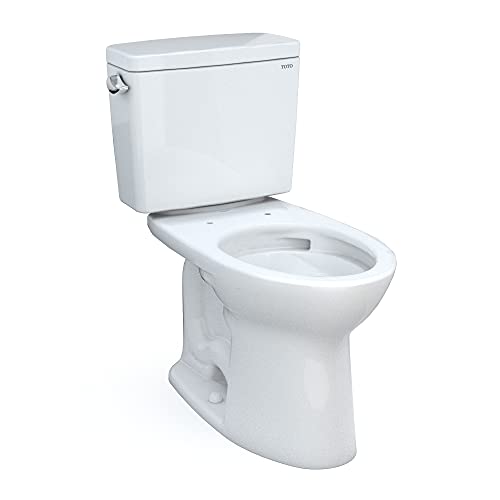
Best Mission Toilets (2026)
Toilets4.6
Mission-style toilets favor honest, simple lines and strong proportions over ornamentation, pairing naturally with Arts and Crafts bathrooms, and the strongest ones…
Read the guideWe ranked the highest-performing toilets by their MaP flush-test scores, trapway diameter, GPF rating, and aggregated owner feedback so you can find the model that actually clears waste on the first flush -- every time.
Research updated June 2026.
The TOTO Drake II and American Standard Champion 4 both achieve the maximum MaP score of 1,000 grams, making them the strongest-flushing toilets available. For a dual-flush option that still scores 1,000 g, the TOTO Aquia IV stands alone. All three use 1.28 GPF or less and carry EPA WaterSense certification.
MaP (Maximum Performance) testing is an independent flush-performance protocol that measures how many grams of solid waste a toilet can remove in a single flush. A score of 1,000 grams is the highest possible rating, meaning the toilet cleared the full test load completely. Any toilet scoring 800 g or above is considered high-performance; 1,000 g is the benchmark for the strongest-flushing models available in 2026.
Beyond raw MaP scores, flushing strength depends on trapway diameter (larger is better, with 2-3/8 inches being wide), flush valve size (3-inch valves move water faster than standard 2-inch valves), and bowl-rim design -- whether water enters from a single jet, a full-rim siphon, or a tornado-style dual-nozzle pattern. Water pressure at the supply line also affects real-world performance, so a toilet rated at 1,000 g in lab conditions may flush differently in low-pressure homes.
| Model | MaP Score | GPF | Trapway | Flush Type | WaterSense |
|---|---|---|---|---|---|
| TOTO Drake II | 1,000 g | 1.28 | 2-1/8 in | Double Cyclone | Yes |
| American Standard Champion 4 | 1,000 g | 1.6 | 2-3/8 in | Siphon Jet | No |
| TOTO UltraMax II | 1,000 g | 1.28 | 2-1/8 in | Double Cyclone | Yes |
| TOTO Aquia IV | 1,000 g | 1.28 / 0.8 | 2-1/8 in | Dual Flush Tornado | Yes |
| American Standard Cadet 3 | 1,000 g | 1.28 | 2-3/8 in | PowerWash Siphon | Yes |
| Kohler Cimarron | 1,000 g | 1.28 | 2-1/8 in | AquaPiston | Yes |
| Kohler Highline Classic | 800 g | 1.6 | 2 in | Canister Flush | No |
| Woodbridge T-0001 | 800 g | 1.28 / 0.8 | 2-1/8 in | Dual Flush Siphon | Yes |
| Gerber Viper | 1,000 g | 1.28 | 2-1/8 in | Pressure-Assist | Yes |
| Swiss Madison Sublime II | 600 g | 1.28 / 0.8 | 2 in | Dual Flush Siphon | Yes |
The TOTO Drake II earns its top position by combining the maximum MaP score of 1,000 grams with a water-efficient 1.28 GPF rating and EPA WaterSense certification -- a combination very few toilets achieve.
TOTO's Double Cyclone system uses two nozzles that spin water around the bowl rather than distributing it through rim holes, which keeps the rim cleaner and directs water with greater force toward the trapway. The fully glazed 2-1/8-inch trapway means waste moves through without friction buildup that can cause recurring clogs over time.
Owner reviews consistently highlight the Drake II's ability to clear heavy waste loads on the first flush, even in homes with lower-than-average water pressure. TOTO backs this with a one-year warranty on parts, and replacement flush valves and trip levers are stocked at major hardware chains -- an important practical detail for a toilet expected to last 20+ years.
The Drake II is the workhorse of the TOTO lineup. Its Double Cyclone nozzle design moves the same volume of water as a 1.6 GPF model but uses 20% less water per flush, thanks to better directional force. For households replacing a chronically clogging toilet, this is the straightforward fix.
American Standard built the Champion 4 around one specific problem: clogging. Its 2-3/8-inch fully glazed trapway is the largest of any toilet on this list, and its 4-inch flush valve releases water nearly twice as fast as a standard 2-inch valve -- resulting in a 1,000 g MaP score backed by an unusually strong "clog-free" warranty claim.
The Champion 4 system works differently from TOTO's nozzle approach. American Standard uses a large-diameter tower-style flush valve that drops the entire tank volume into the bowl almost simultaneously, creating a surge effect rather than a directed stream. This brute-force approach clears the trapway regardless of what is in it.
The downside is water use -- at 1.6 GPF it does not qualify for the EPA WaterSense program, which requires 1.28 GPF or less. For homeowners who experience recurring clogs and live outside a water-restricted area, the trade-off is reasonable. American Standard's 10-year limited warranty is also significantly longer than the industry standard 1-year coverage.
The 4-inch flush valve is what separates the Champion 4 from most gravity toilets. More surface area open at once means more water enters the bowl in less time, which directly translates to clearing force at the trapway. The wide trapway removes the secondary bottleneck most toilet designs still have.
The UltraMax II delivers the same 1,000 g MaP performance and Double Cyclone flushing as the Drake II but in a seamless one-piece design that is easier to clean and has a more contemporary profile suitable for bathroom remodels.
For renovation projects where aesthetics matter alongside performance, the UltraMax II is the most popular TOTO choice. The one-piece vitreous china body has no exposed bolt caps or gasket areas that can harbor bacteria, and the SoftClose seat (included on most configurations) eliminates lid-slamming noise.
The flush mechanism is identical to the Drake II, so performance characteristics carry over: the Double Cyclone distributes water evenly around the bowl, the fully glazed trapway resists staining and buildup, and the 1.28 GPF volume qualifies for rebates offered by many water utility districts in drought-prone states. See our guide to the best flushing toilets for a broader view of top-rated models across all categories.
The UltraMax II is essentially the Drake II in a one-piece shell. The performance is the same; you are paying for the cleaner aesthetic and the joint-free construction. In high-humidity bathrooms where two-piece joints can develop slow leaks over years, that premium is often justified.
The TOTO Aquia IV is the only dual-flush toilet on this list to achieve a 1,000 g MaP score on its full 1.28 GPF flush, making it the strongest dual-flush toilet available and the right choice for buyers who want maximum performance without sacrificing the water savings of a 0.8 GPF light-flush option.
TOTO's Tornado Flush technology on the Aquia IV uses two nozzles positioned at 180 degrees from each other to create a centrifugal water flow around the bowl. This covers more bowl surface area than a single-nozzle siphon jet while directing water forcefully into the trapway on the full flush cycle.
For households in California, Colorado, Texas, or other states where water districts restrict flush volume or offer rebates for WaterSense-certified toilets, the Aquia IV is among the most financially attractive options. The 0.8 GPF light flush handles liquid waste while the 1.28 GPF full flush matches the power of single-flush competitors. Read our comparison of dual-flush toilets for a deeper look at how these systems work in practice.
Getting a 1,000 g MaP score from a 1.28 GPF dual-flush toilet is genuinely difficult engineering. Most dual-flush competitors score 600-800 g because splitting the flush mechanism introduces compromises. TOTO's Tornado nozzle design sidesteps that limitation effectively.
The American Standard Cadet 3 punches above its price point: it scores 1,000 g on MaP testing, uses just 1.28 GPF, and carries EPA WaterSense certification -- a combination that is hard to beat for a widely available, competitively priced toilet.
The Cadet 3 uses American Standard's PowerWash rim, which channels water through a continuous rim outlet that scrubs the entire bowl surface on every flush. Combined with the 2-3/8-inch trapway -- the same diameter found on the more expensive Champion 4 -- it delivers a cleaning and clearing performance that owners frequently compare favorably to toilets at much higher price points.
For rental property owners, new construction on a budget, or a secondary bathroom upgrade, the Cadet 3 provides verified 1,000 g MaP performance without significant financial outlay. Its parts are standard across American Standard's lineup, which simplifies maintenance. See our water-efficient toilets guide for more models that combine power with low GPF ratings.
The Cadet 3 is the most accessible path to a genuine 1,000 g MaP score. American Standard managed to put its wide trapway into a 1.28 GPF design that meets WaterSense requirements -- that combination used to only exist in premium-tier toilets a few years ago.
The Kohler Cimarron achieves a 1,000 g MaP score using Kohler's AquaPiston canister flush valve, which opens 360 degrees for a more complete water release than flapper-style valves, combined with comfort height seating at 16.5 inches from floor to seat top.
Kohler's AquaPiston canister technology is the defining feature here. Unlike a traditional rubber flapper that pivots open and can create turbulence that reduces flushing efficiency, the AquaPiston lifts straight up, creating an unobstructed circular flow of water into the bowl from all sides simultaneously. This approach moves water faster in the opening phase of the flush cycle.
The Cimarron's comfort height seating at 16.5 inches makes it a practical choice for elderly users or those with mobility limitations. Kohler's broad parts network means canister seals and flush assemblies are stocked at most hardware and plumbing supply stores, which is relevant given that canister seals tend to require replacement more often than flapper-based systems.
The AquaPiston canister is Kohler's genuine engineering contribution to flush performance. The 360-degree opening eliminates the performance asymmetry you see with flapper valves, where only part of the valve surface clears early in the flush cycle. The Cimarron is Kohler's strongest gravity toilet for solid waste.
The Gerber Viper uses a pressure-assisted tank vessel that compresses air above the water during fill, then releases that stored pressure on flush -- producing a louder but measurably more forceful flush that scores 1,000 g on MaP and performs consistently even with supply pressure as low as 20 PSI.
Pressure-assist technology was originally developed for commercial and institutional settings -- restaurants, office buildings, high-traffic restrooms -- where gravity flushing often proves insufficient with aging supply infrastructure. Gerber's Viper brings that technology into a residential form factor at a price point that makes sense for homeowners on well systems or with older homes where supply pressure drops below 40 PSI.
The noise level is a legitimate trade-off. Pressure-assist flushes are audibly louder than gravity models -- approximately 10-15 decibels higher at peak -- which is acceptable in a basement bathroom or half bath but may be undesirable in a bedroom-adjacent master bath. For commercial applications, the Viper is a standard recommendation among plumbers who need guaranteed clearing performance. Explore more options in our pressure-assist toilets guide.
In a home with water pressure below 40 PSI, a gravity toilet rated 1,000 g in the lab may only achieve 600-700 g of real-world performance. The Viper sidesteps this issue entirely by storing energy in compressed air rather than relying solely on gravity and line pressure. For low-pressure supply situations, pressure-assist is the correct solution.
Not necessarily. Flush strength depends more on how water is delivered than on the total volume used. The TOTO Drake II flushes 1.28 GPF and scores 1,000 g on MaP -- identical to the American Standard Champion 4 at 1.6 GPF -- because TOTO's Double Cyclone nozzles direct water with more precision and force than a traditional siphon jet. Modern low-GPF toilets consistently outscore older 3.5 GPF and 5 GPF models in MaP testing because of improved bowl geometry, valve speed, and trapway design.
A fully glazed trapway of at least 2-1/8 inches is the accepted minimum for reliable clog resistance in a residential toilet. The American Standard Champion 4 and Cadet 3 feature 2-3/8-inch trapways, which are the widest available in consumer toilets and the most effective at passing large waste loads without obstruction. The glaze is equally important: unglazed ceramic inside the trapway creates friction that allows waste and mineral deposits to accumulate, while a fully glazed surface remains smooth over the toilet's lifespan.
MaP testing, conducted independently by veritec consulting and IAPMO Research and Testing, verifies flush performance without manufacturer involvement. In 2026, the brands with the most models achieving the maximum 1,000 g MaP score are TOTO, American Standard, Kohler, and Gerber. Swiss Madison and Woodbridge score lower on average (600-800 g range) despite strong reviews, primarily because their dual-flush mechanisms divide water volume between two cycles. Consumers can verify any specific toilet's MaP score by searching the public MaP database at map-testing.com.
The maximum MaP score is 1,000 grams. This indicates the toilet successfully removed 1,000 grams of solid waste in a single flush during standardized testing. Any toilet scoring 1,000 g qualifies for MaP's highest performance tier.
MaP testing is conducted by independent laboratories -- veritec consulting and IAPMO Research and Testing are the primary testing bodies. Manufacturers submit toilets for testing, but they do not control the testing process or results. Published scores are publicly available at map-testing.com.
Yes. Multiple 1.28 GPF toilets achieve 1,000 g on MaP testing, which is identical to the best 1.6 GPF models. The TOTO Drake II at 1.28 GPF and the American Standard Champion 4 at 1.6 GPF both score 1,000 g. Water volume alone does not determine flush power.
EPA WaterSense is a voluntary certification program that labels toilets using 1.28 GPF or less. WaterSense certification tells you a toilet is water-efficient, but does not directly certify flush performance. A toilet can be WaterSense certified and score 600 g on MaP, or score 1,000 g -- WaterSense only addresses water volume, not waste removal ability.
A pressure-assist toilet stores compressed air above the water in a sealed vessel inside the tank. When flushed, the compressed air forces water into the bowl with greater velocity than gravity alone can achieve. This produces a louder flush but is more consistent across varying supply-line pressure conditions, making it particularly effective in homes with water pressure below 40 PSI.
A fully glazed trapway means the interior passage that waste travels through from the bowl to the drain line is coated in the same ceramic glaze as the bowl surface. This glaze is non-porous and smooth, preventing waste and mineral scale from adhering to the trapway walls. Unglazed trapways develop buildup over time that reduces the effective diameter and increases clogging frequency.
For bowl-cleaning coverage, yes. Traditional siphon-jet flushing uses a single nozzle at the base of the bowl to create a siphon effect, which is effective for waste removal but cleans only the lower portion of the bowl. TOTO's Double Cyclone uses two nozzles positioned to spin water around the entire rim, cleaning more bowl surface on each flush while still achieving a 1,000 g MaP score.
If your primary goal is clog prevention and you are not in a water-restricted area, the Champion 4's 2-3/8-inch trapway and 4-inch flush valve make it one of the most reliable options available. However, if water efficiency matters -- for utility costs, rebates, or local restrictions -- a 1.28 GPF WaterSense model like the TOTO Drake II or American Standard Cadet 3 achieves the same MaP score while using 20% less water per flush.
Bowl height does not significantly affect flush performance. Standard height (15-16 inches) and comfort height (16.5-18 inches, sometimes called ADA height or chair height) use the same flush mechanisms and achieve equivalent MaP scores. Choose comfort height for elderly users or those with knee and hip mobility concerns; standard height is preferred by many shorter adults and children.
For flapper-based systems, replacement every 3-5 years is common as rubber degrades and allows water to run continuously into the bowl, reducing flush force. Kohler's AquaPiston canister seals typically require replacement on a similar schedule. TOTO's Fluidmaster-compatible flush valves in the Drake and UltraMax lines are among the most widely stocked and simplest to replace at the consumer level.
Yes. For gravity toilets, replacing a worn flapper with a new flush valve, adjusting the float to increase tank water level to the marked fill line, and cleaning mineral buildup from the rim holes with a wire and diluted acid cleaner can restore significant flushing power. If supply pressure has dropped, installing a water pressure booster on the supply line is a more costly but effective fix. If these steps fail, a full toilet replacement is usually the most reliable solution.
For heavy residential use -- large households, older adults, or bathrooms used frequently -- a minimum MaP score of 800 g is recommended. For maximum reliability and to minimize clogging risk entirely, choose a model that scores 1,000 g. Toilets in the 500-600 g range are generally adequate for light-use guest bathrooms but are not appropriate as primary household fixtures.
Bowl shape (elongated vs. round) does not inherently improve flush performance. MaP testing uses a standardized soybean paste analog regardless of bowl shape, and both elongated and round versions of the same toilet model typically achieve identical MaP scores. Elongated bowls are more comfortable for most adults; round bowls fit better in smaller bathrooms.
The Woodbridge T-0001 is a dual-flush one-piece toilet with a contemporary skirted trapway design that has become popular for bathroom renovations. It carries EPA WaterSense certification and achieves approximately 800 g on MaP testing. While it is a solid performer and cleaner-looking than exposed-trapway models, it does not match the 1,000 g MaP scores of the TOTO or American Standard models in this guide. It is best suited to low-to-moderate use bathrooms where aesthetics are prioritized alongside function.
Swiss Madison toilets are valued primarily for their sleek European styling and competitive pricing. Their MaP scores typically fall in the 500-700 g range, which is adequate for residential light-to-moderate use but below the 1,000 g standard set by TOTO, American Standard, Kohler, and Gerber. If flushing power is the primary purchase criterion, Swiss Madison is not the top choice; if design and budget are the priorities, their models are well-reviewed for their stated use cases.
A 1,000 g MaP score means the toilet cleared the standardized test load in laboratory conditions. Real-world performance depends on supply water pressure, the condition of the drain stack, and what is being flushed. Non-flushable items -- wipes, paper towels, feminine hygiene products -- will clog any toilet regardless of MaP score. For standard household waste, a 1,000 g MaP toilet with a fully glazed 2-inch or wider trapway eliminates the vast majority of normal clogging events.
No. The original TOTO Drake uses a G-Max single-flush system that achieves 1,000 g on MaP at 1.6 GPF. The Drake II is the updated version that uses the Double Cyclone system and achieves 1,000 g at 1.28 GPF, making it 20% more water-efficient while maintaining identical waste-removal performance. The Drake II is the version currently in production and widely available; the original Drake has been largely phased out of TOTO's primary lineup.
For the strongest flushing toilet available in 2026, the TOTO Drake II is the overall best choice: it achieves the maximum MaP score of 1,000 grams, uses just 1.28 GPF, carries EPA WaterSense certification, and is backed by one of the most reliable parts networks in the industry. If clog resistance is your single top priority and water efficiency is secondary, the American Standard Champion 4's 2-3/8-inch trapway and 4-inch flush valve make it the most mechanically aggressive gravity toilet on the market. For dual-flush buyers who refuse to compromise on power, the TOTO Aquia IV stands alone as the only dual-flush model to achieve a 1,000 g MaP score. All three earn a place in any serious conversation about maximum flushing strength.
How we rank & our data sources
We do not run physical lab tests. Rankings are built from published, verifiable data and real owner feedback, never paid placement.
Researched by Marcus Bell · Last updated June 28, 2026 · Our review method
Mission-style toilets favor honest, simple lines and strong proportions over ornamentation, pairing naturally with Arts and Crafts bathrooms, and the strongest ones…
Read the guide
Elaborate high-tank pull-chain designs and ornately scalloped silhouettes that bring genuine period drama without sacrificing a modern, reliable flush.
Read the guide
Refined, softly curved one-piece and skirted silhouettes with a polished, Parisian-elegant profile, paired with verified MaP flush scores rather than a stylist's…
Read the guide