
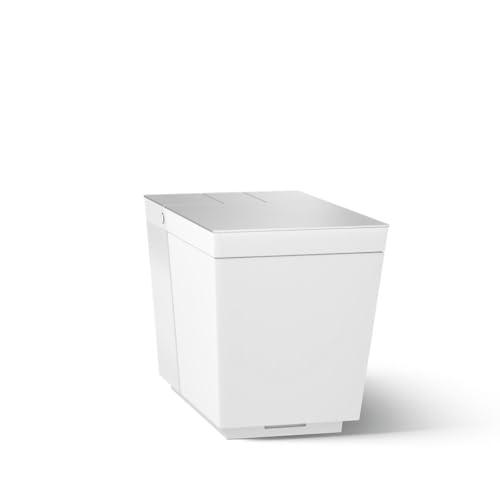
Japanese Smart Toilet Culture: Toto vs Panasonic vs INAX
Smart Toilets4.6
Japan invented the modern smart toilet over 40 years ago. Today three manufacturers dominate the category worldwide -- TOTO, Panasonic, and LIXIL…
Read the guideSmart toilets can monitor hydration, detect biomarkers, and sync data to the cloud. Here is what they actually collect, who can access it, and how to protect yourself before you buy.
Smart toilets collect biometric, usage, and network data that can be stored on manufacturer servers. Buyers should review privacy policies, disable optional health syncing, and segment smart toilets on a separate Wi-Fi VLAN to prevent unauthorized data sharing or security breaches.
Smart toilets can collect flush frequency, seat occupancy duration, biometric health markers (urine glucose, ketones, specific gravity), body weight via seat pressure sensors, and network metadata such as IP address and device identifiers. High-end models like the TOTO Neorest NX2 and Kohler Numi 2.0 connect to companion apps that store this data on brand-operated cloud servers, sometimes third-party analytics platforms as well.
The scope of collection depends heavily on the model tier. Entry-level smart toilets with only heated seats and auto-flush collect little beyond usage logs for diagnostic purposes. Mid-range units with Wi-Fi remotes or app control add network identifiers and command logs. At the top end, biometric-enabled models move into territory that health privacy researchers consider sensitive personal health information (PHI) under frameworks like HIPAA -- though consumer bathroom fixtures are not themselves covered by HIPAA, which applies to healthcare providers and their business associates.
Stanford University researchers published a 2020 proof-of-concept smart toilet in Nature Biomedical Engineering demonstrating stool classification via computer vision, urine analyte strips, and a pressure-sensing seat that could identify users by anal-print geometry with 85 percent accuracy. No commercially available consumer toilet implements that full system as of 2026, but the underlying capability shows the trajectory manufacturers are on.
Practically speaking, here is what each sensor category captures:
Flushing data and seat timing feel harmless in isolation, but aggregated over months they reveal household occupancy patterns, sleep schedules, diet, and health trends. A time-stamped flush log is effectively a behavioral diary. The same data brokers that buy smart-speaker behavioral data have an interest in bathroom fixture data as that market matures. Reading the manufacturer privacy policy before purchase is not optional for privacy-conscious buyers.
TOTO's privacy policy, as of its 2025 revision, limits data retention to 13 months for app-connected Washlet+ and Neorest units and states data is not sold to third parties. Kohler's smart home privacy terms cover the Numi 2.0 under broader Kohler Connect terms that permit sharing with analytics partners, which is a meaningful distinction buyers should note before connecting a Numi to the Kohler app.
| Brand / Model | Connectivity | Data Sold to Third Parties | Retention Period (stated) | Opt-Out of Collection | Local-Only Mode | Check Price |
|---|---|---|---|---|---|---|
| TOTO Neorest NX2 | Wi-Fi + Bluetooth | No (policy v2025) | 13 months | Yes, via app settings | Yes, fully functional offline | Check price |
| Kohler Numi 2.0 | Wi-Fi + Alexa/Google | Analytics partners (opted-in by default) | Not specified | Partial (diagnostic data retained) | No (voice features require cloud) | Check price |
| American Standard SpaLet AS-3001 | Bluetooth remote only | No cloud connectivity | Not applicable | N/A (no data sent) | Yes, by design | Check price |
| Woodbridge B-0960S | Bluetooth remote only | No cloud connectivity | Not applicable | N/A | Yes, by design | Check price |
| Swiss Madison Ivy SE | Wi-Fi optional | Analytics partners (opted-in by default) | 24 months | Yes, account deletion clears data | No | Check price |
The single most privacy-friendly architectural choice a manufacturer can make is designing the toilet to function fully without any cloud connection. The American Standard SpaLet AS-3001 and Woodbridge B-0960S both use Bluetooth-only remotes. The remote communicates directly with the toilet seat controller over a short-range encrypted link; no data ever leaves your bathroom. This matters because it is not just about what the manufacturer does with data -- it is about what happens if the manufacturer is acquired, goes bankrupt, or suffers a data breach.
Kohler's Numi 2.0 is the highest-profile case where connectivity is baked into core features. Alexa integration requires sending voice data to Amazon's servers regardless of what Kohler's own policy says. If you enable the Google Assistant integration, Google's data terms apply to those command logs. Buyers who want a feature-rich smart toilet with voice control must accept that multiple privacy policies govern their bathroom data, not just the toilet maker's.
When evaluating brand privacy policies, look for three specific commitments: (1) data is not sold or licensed to third parties for advertising, (2) a stated retention window after which data is deleted, and (3) a clear path to export and delete your account data on request. Vague language like "we may share with trusted partners" is a red flag. Policies that reference CCPA (California Consumer Privacy Act) and GDPR compliance at minimum indicate the brand takes legal obligations seriously.
Yes, if improperly configured. In 2013, security researchers at Trustwave demonstrated a Bluetooth vulnerability in the Satis smart toilet that allowed unauthorized users to activate the bidet, flush, and open the lid remotely. Modern smart toilets use encrypted Wi-Fi and Bluetooth LE protocols, but outdated firmware, weak default passwords, and shared home networks remain real attack surfaces. A compromised smart toilet is a foothold into a home network.
The Trustwave Satis disclosure was a watershed moment for the category. The toilet used a hardcoded Bluetooth PIN of 0000 and accepted commands from any paired device within range. While that specific vulnerability has been patched and manufacturers have improved baseline security, the incident established that bathroom fixtures are legitimate attack targets.
Current threat vectors for smart toilets include:
Treat a smart toilet like any other IoT device: isolate it. Put it on a dedicated guest VLAN or IoT segment that has no access to your main network. This single step eliminates lateral movement risk even if the device firmware is compromised. The TOTO Neorest NX2 and Kohler Numi 2.0 both operate normally in a segmented network environment -- their core functions do not require access to other LAN devices.
To check a specific toilet model's security posture before purchasing, search the CVE (Common Vulnerabilities and Exposures) database at cve.mitre.org for the brand and model name. For app-connected models, review the companion app's permissions in the Google Play Store or Apple App Store permissions summary -- both now display a privacy nutrition label that shows data linked to you vs. data used for tracking.
Health data stored on a smart toilet manufacturer's servers is generally not covered by HIPAA because the manufacturer is not a healthcare provider or their business associate. This means the data can be subpoenaed by law enforcement with a court order, and -- depending on the privacy policy -- potentially licensed to data brokers or insurers. No documented case of smart toilet data being used in litigation has been reported as of June 2026, but the legal framework does not prohibit it.
This is perhaps the most consequential and least-discussed privacy dimension of smart toilet ownership. HIPAA protections apply to covered entities: hospitals, clinics, insurers, and their business associates. A toilet manufacturer collecting urine glucose data is not a covered entity. That means:
California's Confidentiality of Medical Information Act (CMIA) was amended in 2022 to cover digital health data from consumer apps and devices, providing stronger protections for California residents. Virginia, Colorado, and Connecticut have passed comprehensive consumer data privacy laws that give residents opt-out rights for sensitive data. However, these laws are state-specific, and enforcement against toilet manufacturers collecting biometric data in a bathroom context has not been tested.
The practical guidance is straightforward: if a smart toilet has health-monitoring features you are not actively using for medical purposes, disable them. TOTO Washlet+ units allow users to disable the diagnostic logging features without losing seat-heating and bidet functions. For users in regulated professions where health data disclosure could affect employment, using only Bluetooth-local-only models like the Woodbridge B-0960S or American Standard SpaLet eliminates the data-at-rest risk entirely.
Health data from a smart toilet is legally more similar to data from a fitness tracker than data from a doctor's visit. Both can be useful. Neither carries HIPAA protection. If you are managing a condition like diabetes where urine glucose monitoring is clinically meaningful, a medical-grade monitoring tool under physician oversight gives you both better data and stronger legal protections than a connected toilet ever will.
The most effective steps are: (1) place the toilet on a dedicated IoT Wi-Fi VLAN isolated from computers and phones, (2) change any default passwords immediately after setup, (3) enable automatic firmware updates to receive security patches, and (4) review and revoke unnecessary permissions in the companion app. These four steps address the most common documented attack vectors for connected bathroom fixtures.
Here is a step-by-step hardening checklist applicable to any Wi-Fi-enabled smart toilet:
For users who want the features of a smart toilet without cloud connectivity, the TOTO Washlet S7A is worth noting. Its core functions -- heated seat, auto-open/close lid, bidet wash, warm air dry, deodorizer -- operate entirely via an included wired side panel remote with no app or Wi-Fi required. You can optionally add Wi-Fi connectivity via a companion app, but it is not required. This makes the S7A the best balance of features and privacy for cautious buyers who also want the performance metrics associated with best flushing toilets in the TOTO lineup.
Network segmentation is the most valuable single action. A Shodan scan of home IoT devices consistently shows smart bathroom fixtures running open ports -- not because manufacturers are reckless, but because the devices were connected to flat home networks where a compromised phone or laptop could reach them. Isolation costs nothing on any modern router and removes the realistic attack path entirely.
For maximum privacy, Bluetooth-only models such as the Woodbridge B-0960S and American Standard SpaLet AS-3001 collect no data externally. For buyers who want cloud features with the strongest stated privacy commitments, TOTO's Neorest and Washlet+ line offers the most detailed data policy with an explicit no-sale provision. Kohler Numi 2.0 is feature-rich but involves multiple data controllers through its voice integrations.
Below are recommended models organized by privacy profile. Note that water efficiency and flushing performance remain important regardless of privacy posture -- a weak-flushing smart toilet is simply not worth the investment. All models listed here meet or exceed EPA WaterSense standards where applicable.
The Woodbridge B-0960S is a fully-featured bidet toilet combo with a self-cleaning nozzle, heated seat, warm air dryer, deodorizer, and nightlight. It uses a wireless Bluetooth remote that communicates point-to-point with the seat unit. There is no app, no Wi-Fi module, and no account creation required. Zero data leaves your home. The toilet itself is a skirted one-piece design with a 1.0/1.6 GPF dual-flush system that meets EPA WaterSense requirements. Check price on Amazon.
The American Standard SpaLet AS-3001 follows the same architecture. American Standard built this seat as a retrofit for standard elongated toilets, paired with their Champion 4 or Cadet 3 bowls. The remote is Bluetooth-only, and American Standard's accompanying literature explicitly states the product does not require Wi-Fi or cloud connectivity. For buyers who already have a high-performance American Standard bowl they are satisfied with, this is the lowest-friction path to smart seat features without data exposure.
TOTO's Washlet+ system pairs their flush-tested bowls with smart seat units. The TOTO Drake II with Washlet+ S7 is a popular configuration. The S7 seat offers rear and front wash, oscillating and pulsating wash modes, heated seat with temperature adjustment, warm air dry, and deodorizer. The ewater+ electrolyzed water misting system keeps the bowl cleaner between flushes, which matters for long-term maintenance. Wi-Fi connectivity is available but optional. TOTO's stated policy does not sell data and limits retention to 13 months. Check price on Amazon.
The TOTO Neorest NX2 is their flagship integrated unit. It adds actilight glazing (titanium dioxide photocatalytic coating that uses UV light to break down organic waste), an automatic opening and closing lid with user recognition, and the most comprehensive hygiene features in the consumer market. Its privacy policy is the same as the wider Washlet+ line. At its price tier, it competes on overall bathroom experience, not just privacy posture. Check price on Amazon.
The Kohler Numi 2.0 offers built-in speakers, Amazon Alexa integration, Google Assistant, foot warming, and a full-coverage heated seat. Its flushing performance is certified under EPA WaterSense at 1.0/1.28 GPF. From a privacy standpoint, connecting Alexa and Google means accepting two additional privacy policies beyond Kohler's own. For buyers who are already embedded in the Amazon or Google ecosystem and accept those terms for other devices, the Numi adds no new material risk. For buyers trying to minimize data exposure, the integrations cannot be fully disabled without losing core advertised features. Check price on Amazon.
For related considerations on toilet seat upgrades and bidet integration, see our guide on best bidet toilet seats and our TOTO Washlet review for detailed feature breakdowns. Buyers comparing full integrated units vs. seat-only upgrades may also find our one-piece vs. two-piece toilets guide useful for the underlying bowl decision.
No. Bluetooth-only models like the Woodbridge B-0960S and American Standard SpaLet operate with no external data transmission. Only Wi-Fi-connected models with companion apps transmit data to manufacturer servers.
Yes, though documented attacks on modern smart toilets are rare. The 2013 Trustwave Satis vulnerability established the concept. Current threats center on weak default credentials, unencrypted firmware update channels, and lateral movement from shared home networks. Network segmentation addresses most of these risks.
No. HIPAA covers healthcare providers and their business associates. Toilet manufacturers are not covered entities. Health data collected by a smart toilet does not carry HIPAA protections and can be subpoenaed or, depending on the privacy policy, shared with third parties.
TOTO's policy, as of the 2025 revision, is the most specific among major brands: 13-month data retention, explicit no-sale provision, and an account deletion pathway that purges stored data. Bluetooth-only brands like Woodbridge avoid the question entirely by not collecting cloud data.
For most models, yes. Heated seat, bidet functions, and deodorizer typically work without any network connection. Features that require connectivity include voice assistant control, remote app access when away from home, and firmware updates. TOTO Washlet units and Woodbridge seats function fully without Wi-Fi.
Kohler's Konnect app collects device identifiers, usage logs, and can request location permissions on mobile devices. If you enable Alexa or Google integration, those platforms additionally collect voice command transcripts under their respective privacy terms. Kohler's policy as of 2025 permits sharing with analytics partners.
Use the account deletion function in the companion app (usually under Settings > Account > Delete Account), then confirm the action via email. Send a follow-up email to the manufacturer's privacy team citing your state's consumer data rights (CCPA for California, VCDPA for Virginia, CPA for Colorado) to request written confirmation of deletion.
TOTO's policy explicitly prohibits sale to third parties. Kohler's policy permits sharing with analytics partners, which can include advertising analytics firms. Swiss Madison's app terms allow sharing with "trusted business partners." Read the specific policy for any model before connecting it.
Bluetooth-only models are safest in rental settings because they collect no data at all, eliminating any tenant privacy concerns. The Woodbridge B-0960S is a practical choice: durable build, full bidet feature set, Bluetooth remote only, no account creation required from tenants.
Yes, if the toilet is connected to an app and flush-logging is enabled. Usage frequency is one of the most basic data points collected. On TOTO and Kohler app-connected models, you can view this data in the app -- which also means the manufacturer stores it. Disable app connectivity or use a Bluetooth-only model to prevent this logging.
On Wi-Fi connected models with multi-user profiles, wash preferences and frequency can be logged per user account. The American Standard SpaLet AS-3001 and Woodbridge B-0960S do not log bidet use because they have no cloud connection. TOTO Washlet+ units log preferences locally to save settings but sync logs to the cloud only if app connectivity is enabled.
Voice commands on the Kohler Numi 2.0 are processed by Amazon Alexa or Google Assistant servers, not by Kohler. Every voice command -- including those given in the bathroom -- is logged under Amazon's or Google's voice history, reviewable in their respective apps. You can disable wake-word detection and use app or button control instead if this concerns you.
EPA WaterSense certified toilets flush at 1.28 GPF or less and must pass independent performance testing demonstrating they clear waste effectively at that volume. A smart toilet's privacy features are completely separate from its WaterSense status. Both TOTO Neorest and Kohler Numi 2.0 carry WaterSense certification. Certification does not affect data collection practices.
If you have enabled automatic firmware updates and the manufacturer has broad data collection terms in their privacy policy, a firmware update could enable new sensor logging. Review the privacy policy's data collection scope -- not just the current firmware's features -- and check app update release notes for any privacy-related changes.
Segment the toilet on a VLAN and use your router's traffic monitoring (most modern routers log per-device traffic). You can also use a network monitoring tool like Pi-hole or Firewalla to log DNS queries from the device and see which domains it contacts. Expected domains include the manufacturer's cloud endpoint and NTP time servers. Unexpected domains may indicate third-party data sharing.
Japan-market models by LIXIL (INAX brand) and Panasonic historically used proprietary communication protocols and were not internet-connected in their domestic versions. Import versions sold outside Japan may have different connectivity. TOTO's Japanese and North American models share similar privacy policies since TOTO operates globally. Always verify the specific model's connectivity specs before purchase.
Stored user data can be sold as an asset in bankruptcy proceedings, with the buyer not bound by the original privacy policy's promises. This is a documented risk with smart home device companies generally. Using a Bluetooth-only model or deleting your account and disabling cloud features on a Wi-Fi model eliminates this exposure because there is no stored data to transfer.
No. The TOTO Neorest NX2 and other Neorest models operate all primary functions -- lid open/close, flush, heated seat, bidet wash, dry, deodorizer, ewater+ misting -- without any internet connection. Wi-Fi connectivity enables remote control via the TOTO app and firmware updates. Disconnecting from the internet does not degrade the core toilet experience.
Law enforcement can request data from smart toilet manufacturers through a court-ordered subpoena or legal process. The manufacturer is obligated to comply. Unlike HIPAA-protected medical data, bathroom usage data from a consumer device carries no special legal protections in most jurisdictions. There are no documented cases of this occurring as of June 2026, but the legal mechanism exists.
The privacy risk is not determined by whether the product is an integrated toilet or a retrofit bidet seat -- it is determined by connectivity. A Bluetooth-only retrofit bidet seat (Woodbridge, American Standard SpaLet) is more private than a Wi-Fi-connected integrated smart toilet (Kohler Numi, TOTO Neorest with app enabled). Evaluate connectivity architecture, not form factor.
Smart toilets occupy a growing and genuinely useful product category, but buyers need to enter that market with clear eyes about what data they are generating. Bluetooth-only models like the Woodbridge B-0960S and American Standard SpaLet AS-3001 offer the full bidet-seat experience without any cloud exposure. Wi-Fi-connected models like the TOTO Neorest NX2 offer more convenience and features with the strongest stated privacy protections in the category. The Kohler Numi 2.0 leads on experiential features but involves the most data controllers through its voice integrations. Regardless of model, network segmentation, disabling unused features, and reading the privacy policy are baseline steps every buyer should take. Water efficiency, flushing performance (look for MaP scores above 500 grams), and the manufacturer's privacy commitments should all factor equally into a smart toilet purchase decision.
Japan invented the modern smart toilet over 40 years ago. Today three manufacturers dominate the category worldwide -- TOTO, Panasonic, and LIXIL…
Read the guideA data-driven comparison of TOTO's four flagship Neorest models, covering flushing performance, water efficiency, smart features, and which version is right for…
Read the guideSmart toilets combine bidet functions, heated seats and self-cleaning cycles into one unit, but the electronics and moving parts demand a gentler,…
Read the guide