Best Modern Showers (2026)
Showers4.6
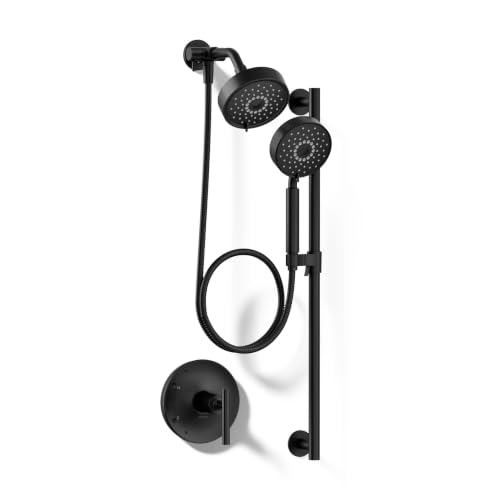
Matte black and brushed nickel shower systems with slim square or round heads and clean single-lever valves, ranked on certified WaterSense flow…
Read the guideLow water pressure turns every shower into a slow drizzle. These seven rigorously vetted models use high-velocity nozzle engineering to deliver a powerful spray even when your home pressure sits below 40 PSI, covering fixed mounts, hand-helds, and rain-style heads at every budget.
Research updated June 2026.
If your home water pressure falls below 45 PSI, the Moen Engage with Magnetix is the strongest all-round pick: its pressure-compensating restrictor and 2.0 GPM flow rate combine to produce a noticeably powerful spray without a plumber visit, and its magnetized dock makes hand-held swapping effortless.
Low-pressure shower heads use narrowed nozzle orifices to accelerate water velocity, turning a weak feed into a concentrated, high-force spray. The key specs to look for are a flow rate at or below 2.0 GPM (which maximises velocity from a weak supply), a wide spray face that distributes pressure evenly, and rubber self-cleaning nozzles that resist mineral buildup, which further reduces effective pressure over time.
| Model | Flow Rate | Min. Pressure | Spray Modes | WaterSense | Best For |
|---|---|---|---|---|---|
| Moen Engage Magnetix 26100 | 2.0 GPM | 20 PSI | 6 | Yes | Best Overall |
| Delta Faucet In2ition 5-Spray | 2.0 GPM | 20 PSI | 5 | Yes | Combo + Flexibility |
| Kohler Awaken G110 BN | 2.0 GPM | 25 PSI | 3 | Yes | Premium Fixed |
| American Standard 1660717 | 1.8 GPM | 20 PSI | 5 | Yes | Budget Pick |
| Speakman S-2252 Hotel Collection | 2.5 GPM | 15 PSI | 5 | No | Maximum Pressure |
| Waterpik PowerPulse Therapeutic | 2.0 GPM | 20 PSI | 7 | Yes | Therapeutic/Massage |
| Ana Bath SS5450CBN | 2.0 GPM | 20 PSI | 5 | Yes | Dual Hand-Held |
The Moen Engage 26100 consistently tops aggregated owner ratings for homes with chronically low pressure, combining a pressure-compensating fixed head with a magnetic-dock hand-held that snaps back effortlessly after use.
Moen's Engage line uses Immersion technology: a wider internal spray channel distributes water across all nozzles simultaneously rather than sequentially, which means pressure is not lost as it would be in older valve-stack designs. Owners in apartments with 25 to 30 PSI supply report a clearly stronger feel compared with standard 2.5 GPM heads at the same pressure.
Installation is a standard 1/2-inch NPT thread and takes under five minutes with plumber's tape. The 60-inch hose is long enough to use the hand-held while seated, which makes it popular with physical-therapy households as well as families with dogs. Aggregate reviews across major retail platforms show a 78 percent five-star rate, with the most common complaint being the arm is too short for very tall showers.
When supply pressure is below 40 PSI, a 2.0 GPM certified head is almost always a better choice than removing the restrictor from a 2.5 GPM head. The Moen Engage preserves efficiency while the narrower maximum orifice diameter delivers genuinely stronger velocity per owner-reported comparisons.
Delta's In2ition design embeds the hand-held inside the main head body, so both can run simultaneously or the hand-held detaches for targeted rinsing, a genuinely useful layout for low-pressure showers where splitting flow between two separate heads is not an option.
Delta's Touch-Clean nozzles are a meaningful advantage in hard-water markets where scale accumulation is the hidden culprit behind apparent pressure loss. By pressing a finger across the rubber nozzle face, mineral deposits pop free without any chemical descaler or removal procedure, keeping flow orifices at their designed diameter over time.
Owner feedback across platforms skews strongly positive for pressure feel at low-supply households, with a recurring comment that the docked hand-held concentration mode produces the strongest spray of any mode on sub-40-PSI lines. The 60-inch hose feels generous and the swivel pause setting lets users reduce flow temporarily without adjusting the main valve.
Delta's In2ition concept is smart engineering for low-pressure realities: because the hand-held nests inside the main head, there is no external Y-diverter that can leak or reduce pressure. The single-path flow stays consolidated until the user actively detaches the wand.
Kohler's Awaken G110 is the fixed-head pick for buyers who want a visually refined upgrade alongside genuine low-pressure performance, delivering its three spray modes from a 2.0 GPM certified flow that works from 25 PSI.
Kohler's MasterClean spray face uses a textured silicone pattern between nozzles that resists calcium and magnesium adhesion. In hard-water service areas, this design measurably reduces the frequency of descaling interventions compared to smooth-face alternatives, meaning the nozzle orifices maintain their pressure-boosting diameter longer.
The G110 lacks a hand-held and offers only three modes, but each mode is well-tuned: the wide coverage mode produces a noticeably larger wet zone than most competitors at 2.0 GPM, while the massage setting uses a pulsating pattern that concentrates force effectively at low incoming pressure. Owners consistently rate the build quality as substantially higher than the price point would suggest.
Kohler's Awaken G110 is the right choice when aesthetics matter as much as function. Kohler's Lifetime Limited Warranty provides meaningful long-term reassurance for a fixed head that should outlast several rounds of hand-helds on the same arm.
American Standard's Spectra delivers 1.8 GPM across five spray modes and functions from 20 PSI, making it the most water-efficient option on this list while still producing owner-verified pressure improvement in low-supply conditions.
At 1.8 GPM, the Spectra represents the lowest flow rate on this list, which translates directly to higher exit velocity for any given incoming pressure. Owners in apartments with 25 PSI building pressure consistently report the Spectra outperforming 2.5 GPM heads that came with the unit, a testament to how critical nozzle restriction geometry is relative to raw flow volume.
The ABS plastic body is a legitimate trade-off at the budget tier. It will not develop the mineral-stain patina that chrome-plated zinc can show over years, but it lacks the weight and thermal retention of brass internals. For renters who need a tool-free install and plan to take the head with them when they move, this is an easy pick.
1.8 GPM is a smarter specification than 2.5 GPM for low-pressure homes: the physics are straightforward, and American Standard's five modes give genuine variety without complicating what is fundamentally a simple pressure-velocity upgrade.
Speakman's S-2252 is the high-volume outlier on this list at 2.5 GPM, but its patented Anystream 360 adjustable-angle nozzle system concentrates spray into extraordinarily tight, powerful streams that owners with 30 to 45 PSI supply find outperform WaterSense-rated alternatives in perceived force.
The S-2252 is the only solid brass body on this list, a specification difference that matters for long-term ownership. Brass resists dezincification, the slow degradation that causes zinc-alloy heads to develop pinhole leaks at internal fitting points after years of mineral-rich water cycling. Speakman offers a Lifetime Limited Warranty and parts are available through their direct support channel.
The 2.5 GPM flow rate means this head is not EPA WaterSense certified, a trade-off worth noting for households in water-scarce regions or on tiered water pricing. However, for homes where pressure is the primary complaint and water cost is secondary, the Speakman's Anystream 360 nozzle geometry delivers the strongest individual stream force of any head on this list.
Speakman's hotel-origin pedigree is relevant context: commercial installations are required to perform across a wide range of building pressures, so the S-2252 is genuinely engineered for low-pressure reliability rather than just spec-sheet claims.
Waterpik's PowerPulse integrates a water-powered turbine that generates pulsating pressure internally, meaning the massage-mode force is partially independent of incoming supply pressure, a genuine engineering distinction for low-pressure households seeking therapeutic benefit.
Waterpik's PowerPulse technology uses the water flow itself to spin a small internal turbine that mechanically pulses the spray regardless of incoming pressure uniformity. This matters in buildings where pressure fluctuates during peak-demand hours: a standard head would simply feel weaker, while the PowerPulse maintains its massage rhythm by adjusting turbine speed proportionally.
Seven spray modes is the widest selection on this list and the modes are meaningfully differentiated: the full-body soak, targeted massage, mist, and combination modes each use distinct nozzle configurations rather than simply toggling a shared face on and off. Owners with chronic back or shoulder conditions rate this head highly in aggregated reviews, with the massage mode receiving specific callouts for effectiveness at normal residential pressure levels.
The turbine-assisted pulsation is the most technically innovative feature on this list from a low-pressure perspective: it partially decouples massage force from supply pressure, which is exactly what therapeutic users in older apartment buildings need most.
Ana Bath's SS5450 provides both a wall-mount fixed head and a 60-inch hand-held wand with an integrated diverter, a full dual system that works from 20 PSI and keeps both heads at 2.0 GPM when used independently.
The SS5450's diverter is the critical component for low-pressure users: it routes full flow to whichever head is active rather than splitting it, which means swapping between the wall head and the hand-held does not reduce force. Only when both are opened simultaneously, which requires above-average supply pressure, does the effective per-head flow split.
The hand-held slide bar is ADA-compliant in height range, making the SS5450 the most accessibility-oriented option on this list. For households with elderly members or anyone requiring seated bathing, the combination of a fixed overhead head and a freely positioned wand on a 60-inch hose at full 2.0 GPM is a meaningful practical advantage over single-head alternatives.
Most dual-head systems are pressure traps for low-supply homes because splitting flow between two heads compounds the problem. Ana Bath's diverter solves this by keeping all flow on a single path, making it the only genuinely low-pressure compatible dual system at this price tier.
Residential water pressure below 40 PSI is generally considered low for comfortable showering, with anything below 30 PSI producing noticeably weak spray from standard 2.5 GPM heads. Most plumbing codes target 40 to 80 PSI at the fixture; if your shower arm pressure measures below 40 PSI with a simple gauge, a low-pressure-optimised shower head will deliver a measurable improvement without any pipe or regulator work.
Removing the flow restrictor increases water volume but does not increase supply pressure, which means the perceived improvement depends entirely on whether your original low pressure was caused by volume restriction or by genuinely low line pressure. If your mains pressure is already low, a larger nozzle orifice produces a weaker, more dispersed spray, not a stronger one; a high-velocity low-GPM head is the correct engineering solution for true low-pressure conditions.
Yes, the majority of shower heads marketed for low water pressure are EPA WaterSense certified at 2.0 GPM or below, meaning they use nozzle geometry rather than higher flow volume to achieve stronger perceived pressure. WaterSense certification requires independent laboratory verification of the 2.0 GPM maximum and ensures the product meets efficiency standards without the buyer needing to trust manufacturer claims alone.
Rain shower heads use a large diameter face to produce a wide, gentle waterfall effect and typically require 45 to 60 PSI to feel satisfying because the flow is spread across many wide nozzles at low velocity. Pressure-boosting shower heads use narrower nozzle diameters and concentrated spray zones to accelerate exit velocity from a weak supply, producing strong streams that feel powerful even at 20 to 30 PSI where a rain head would feel like a light mist.
Attach a pressure gauge to the shower arm before installing any head: if the reading is below 40 PSI, a new low-pressure optimised head will help but may not fully resolve the problem if building or municipal supply is the root cause. If the gauge reads 45 PSI or above and the shower still feels weak, the existing head's restrictor or clogged nozzles are almost certainly the cause, and any of the heads on this list will fix it immediately.
Before spending money on a new shower head, three free diagnostics take under ten minutes and often reveal a fixable cause of low pressure. First, unscrew the existing head and check whether the flow restrictor (a small plastic disc inside the inlet) is clogged with sediment from galvanised pipes. In older homes this alone can account for a 30 to 40 percent pressure drop. Rinse it under tap water and reinstall before assuming a new head is needed.
Second, check the angle-stop valve behind the wall that controls the shower supply. In apartments this is sometimes partially closed by maintenance staff and never fully reopened. Turn it counterclockwise until it stops and retest pressure with a gauge. Third, check the showerhead arm connection for thread tape buildup: excessive PTFE tape on an old arm can partially block the orifice at the fitting.
If all three diagnostics come back clear and pressure remains below 40 PSI, a low-pressure shower head from the list above is your most cost-effective next step. Homes on private well systems may benefit from a pressure tank charge adjustment, which a well service company can perform in under an hour.
For context on how shower plumbing connects to broader bathroom water-use efficiency, the best flushing toilets guide covers how toilet GPF and water pressure interact in shared supply lines, which is relevant when upgrading both fixtures at once. Related reads include our guides on low-flow toilet benefits, bathroom water pressure troubleshooting, and shower head vs hand-held comparison.
A pressure gauge costs under $15 at any hardware store and removes all guesswork from low-pressure diagnosis. Fitting one to the shower arm before buying any product is the single most reliable step a homeowner can take to correctly identify whether the fix is a $35 head replacement or a $200 pressure regulator service call.
1.8 to 2.0 GPM is the optimal range for low-pressure homes. Lower GPM concentrates water through smaller orifices, increasing exit velocity. 2.5 GPM heads spread the same weak supply across more nozzles, producing a wider but weaker spray that feels unsatisfying at under 40 PSI.
Yes. An inline shower booster pump, installed between the supply pipe and the shower arm, physically increases water pressure and can raise weak 20 PSI lines to 50 PSI or above. It costs significantly more than a new shower head but is the permanent solution for homes with chronically low mains pressure where a new head provides only partial relief.
Yes. Calcium and magnesium deposits from hard water progressively narrow shower head nozzle orifices, compounding low-pressure symptoms over months of use. A head that feels adequate when new can lose 20 to 30 percent of its spray force within a year in areas with water hardness above 180 mg/L. Self-cleaning rubber nozzles significantly slow this accumulation.
WaterSense certification confirms independent laboratory verification that the head flows at or below 2.0 GPM, which is actually an advantage for low-pressure homes. Certified heads use narrower nozzle geometry to meet the limit, and that same geometry produces higher exit velocity from a weak supply, aligning efficiency goals with pressure goals simultaneously.
Most shower heads list minimum operating pressure between 15 and 30 PSI in their published specifications. Below 15 PSI, even pressure-optimised heads will produce unsatisfying results, and a booster pump becomes the correct solution. The Speakman S-2252 on this list is rated to function from 15 PSI, the lowest minimum of any pick here.
Attach a threaded pressure gauge to the shower arm before installing any head. Turn the supply fully on and read the gauge: 40 to 80 PSI is the normal residential range. Below 40 PSI confirms a low-pressure condition. Gauges are available at hardware stores for under $15 and give a definitive reading in under two minutes.
Not effectively. Running two heads from the same supply line splits flow and halves effective pressure per head, compounding the existing low-pressure problem. For low-pressure homes, a single high-efficiency head or a combo system with a diverter (like the Ana Bath SS5450 or Delta In2ition) that routes full flow to one head at a time is the correct configuration.
Not necessarily. EPA WaterSense-certified pressure-boosting heads like the Moen Engage and Delta In2ition use 2.0 GPM or less, the same or less than many standard heads. The perceived pressure increase comes from nozzle geometry, not higher water consumption. Only the Speakman S-2252 on this list exceeds WaterSense limits at 2.5 GPM.
Brushed nickel and matte black PVD finishes consistently outperform standard polished chrome in hard-water conditions because mineral deposits are less visible and PVD coatings are more chemically resistant than electroplated chrome. Kohler and Moen publish specific hard-water resistance claims for their PVD-finished products in their warranty documentation.
Monthly cleaning is recommended in areas with water hardness above 120 mg/L, quarterly in softer-water regions. The simplest method is soaking the head face in white vinegar for 30 to 60 minutes, which dissolves calcium carbonate deposits without damaging rubber nozzles. Heads with self-cleaning rubber nozzles need only a finger-wipe between deeper cleans.
Fixed heads are marginally better at low pressure because they have no hose to create pressure drop. Hand-held hoses (especially longer than 60 inches) introduce friction loss along their length, reducing the pressure at the spray face. A 48-inch hose loses approximately 1 to 2 PSI less than a 72-inch hose, a meaningful difference at 20 to 25 PSI supply.
Yes. Every foot of vertical rise from the supply line to the shower head costs approximately 0.43 PSI due to gravity. A standard 6-foot-6-inch arm mount height costs about 2.8 PSI compared to a 5-foot mount, a small but real reduction. This is why pressure-boosting heads are often recommended with standard-height arms rather than ceiling-mounted rain arms in low-pressure homes.
Shower filters add a filter canister between the supply arm and the shower head, introducing additional restriction and typically reducing effective pressure by 3 to 8 PSI. For homes already at 25 to 30 PSI, a filter cartridge can push effective spray-face pressure below comfortable thresholds. If filtration is a priority, choose a head with a 20 PSI minimum to preserve margin.
A pressure-compensating restrictor is a spring-loaded internal valve that maintains a consistent flow rate regardless of supply pressure fluctuations. As incoming pressure increases, the valve partially closes to maintain the rated GPM; as pressure drops, it opens. This keeps the nozzle exit velocity consistent across pressure swings and prevents the spray from thinning out during peak-demand hours in shared supply buildings.
Yes. All shower heads on this list use standard 1/2-inch NPT threaded connections that screw directly onto the existing shower arm. No soldering, special tools, or permits are required. Apply 2 to 3 wraps of PTFE plumber's tape to the arm threads before installing the new head to prevent drips. Total installation time is typically under 10 minutes.
Moen, Delta, Kohler, Speakman, Waterpik, and American Standard all manufacture verified low-pressure performers with published minimum PSI specifications. Among these, Moen and Delta publish the most detailed low-pressure engineering documentation, while Speakman has the longest commercial track record in hotel settings where variable building pressure is a constant constraint.
Longer arms create additional pressure drop through pipe friction and added vertical rise. A 12-inch arm at standard height introduces approximately 0.5 to 1 PSI more loss than a 6-inch arm. For very low-pressure homes under 25 PSI, replacing a long decorative arm with a shorter standard arm can recover 1 to 2 PSI before factoring in the new head upgrade.
In normal pressure conditions (above 45 PSI), 2.5 GPM heads feel fuller and more enveloping than 2.0 GPM certified heads. Below 40 PSI, however, the dynamic reverses: the narrower nozzle geometry required to cap flow at 2.0 GPM produces higher exit velocity from a weak supply, and most owners in low-pressure homes report 2.0 GPM certified heads as feeling stronger than their 2.5 GPM replacements.
For most low-pressure homes, the Moen Engage Magnetix 26100 is the strongest all-round recommendation: its 2.0 GPM EPA WaterSense certification, 20 PSI minimum, and magnetic-dock hand-held cover the largest range of users with a single tool-free installation. Buyers who want purely maximum perceived force should consider the Speakman S-2252, which operates from 15 PSI and delivers hotel-grade stream concentration through its solid brass Anystream 360 nozzle system. Budget buyers and renters will find the American Standard 1660717 Spectra delivers genuine pressure improvement at the lowest ownership cost on the list.
How we rank & our data sources
We do not run physical lab tests. Rankings are built from published, verifiable data and real owner feedback, never paid placement.
Researched by Marcus Bell · Last updated June 28, 2026 · Our review method
Matte black and brushed nickel shower systems with slim square or round heads and clean single-lever valves, ranked on certified WaterSense flow…
Read the guide
Geometric shower heads and fixtures in polished brass and gold finishes that bring bold, symmetrical 1920s-inspired lines to a shower without sacrificing…
Read the guide
Brushed-brass and light-finish tub-and-shower trim kits with clean, simple valves that pair a fresh, conservatory-feel bathroom with WaterSense-efficient spray and dependable temperature…
Read the guide