
TOTO Drake Two-Piece Toilet vs Kohler Highline Two-Piece Toilet: Which Should You Buy?
Comparisons4.6
We compared the TOTO Drake and Kohler Highline two-piece toilets: both hit MaP 1000 at 1.28 GPF. See flush systems, verified specs…
Read the guideA data-driven breakdown of design, flushing performance, water efficiency, cleaning, installation, and long-term cost so you can pick the right toilet for your bathroom.
One-piece toilets cost more upfront but are easier to clean and look sleeker. Two-piece toilets cost less, ship lighter, and let you replace the tank alone if it cracks. For most bathrooms, a quality two-piece like the TOTO Drake or Kohler Highline delivers equal or superior flushing at a lower price.
The one-piece vs two-piece debate comes up in nearly every toilet buying decision. Walk into any showroom and you will see both styles side by side, often with surprisingly similar flush ratings but very different price tags. This guide pulls together published manufacturer specifications, independent MaP flush-test data, EPA WaterSense certification records, and aggregated owner reviews to give you a genuinely useful comparison rather than a list of marketing claims.
Before diving into head-to-head data, it helps to understand exactly what the terms mean. A one-piece toilet is a single molded vitreous china unit where the tank and bowl are fused together at the factory. A two-piece toilet has a separate tank that bolts onto the bowl at the time of installation. That physical difference ripples through every aspect of ownership: shipping weight, cleaning, parts availability, installation difficulty, and total cost of ownership over a decade.
| Factor | One-Piece | Two-Piece | Winner |
|---|---|---|---|
| Upfront cost range | $300 to $1,200+ | $120 to $700 | Two-Piece |
| Average shipping weight | 90 to 130 lbs | 55 to 90 lbs (split into two boxes) | Two-Piece |
| MaP score availability | Many models 800 to 1,000g | Many models 800 to 1,000g | Tie |
| GPF options (WaterSense) | 1.0, 1.28 GPF common | 1.0, 1.28, 1.6 GPF common | Two-Piece (more options) |
| Ease of cleaning | No seam between tank/bowl; fewer crevices | Seam at tank-bowl junction collects grime | One-Piece |
| Installation difficulty | Heavier; awkward single lift | Lighter; two manageable pieces | Two-Piece |
| Parts replacement | Tank not individually replaceable | Tank or bowl replaced independently | Two-Piece |
| Aesthetic profile | Sleek, modern, low-profile | Traditional; tank-on-bowl look | One-Piece (for modern baths) |
| Risk of tank-bowl leaks | None (no junction) | Gasket can fail over time | One-Piece |
| Warranty coverage | Lifetime china; 1-5 yr parts typical | Lifetime china; 1-5 yr parts typical | Tie |
There is no inherent flushing advantage to either design. MaP (Maximum Performance) flush testing, which drops compacted soybean paste in gram increments to find a toilet's waste-removal ceiling, awards maximum 1,000g scores to both one-piece and two-piece models. The TOTO Drake II (two-piece) scores 1,000g at 1.28 GPF; the TOTO UltraMax II (one-piece equivalent) also scores 1,000g at 1.28 GPF. Flush performance is determined by the flush valve diameter, trapway size, and water surface area, not by whether the tank is molded to the bowl.
That said, flush engineering varies significantly within each category. A budget two-piece with a 2-inch flush valve will underperform a premium one-piece with a 3-inch valve. The table below lists published MaP scores for common models across both categories to illustrate the range.
| Model | Type | GPF | MaP Score | Flush Valve | WaterSense | Check Price |
|---|---|---|---|---|---|---|
| TOTO Drake II | Two-piece | 1.28 | 1,000g | 3-inch | Yes | Check price |
| TOTO UltraMax II | One-piece | 1.28 | 1,000g | 3-inch | Yes | Check price |
| Kohler Highline Classic | Two-piece | 1.28 | 1,000g | 3-inch | Yes | Check price |
| American Standard Champion 4 | Two-piece | 1.6 | 1,000g | 4-inch | No (1.6 GPF) | Check price |
| American Standard Cadet 3 | Two-piece | 1.28 | 800g | 3-inch | Yes | Check price |
| Woodbridge T-0001 | One-piece | 1.28 / 0.8 dual | 800g | 3-inch | Yes | Check price |
| Kohler Cimarron | Two-piece | 1.28 | 1,000g | 3-inch | Yes | Check price |
| Gerber Viper | Two-piece | 1.28 | 1,000g | 3-inch | Yes | Check price |
| Swiss Madison Sublime II | One-piece | 1.28 / 0.8 dual | 500g (est.) | 3-inch | Yes | Check price |
| TOTO Aquia IV | One-piece | 1.0 / 0.8 dual | 600g | 3-inch | Yes | Check price |
Published MaP data makes it clear: the 1,000g ceiling is achievable in both formats. If maximum clog resistance is your priority, filter by MaP score first, then choose between one-piece and two-piece based on budget and aesthetics. A 1,000g two-piece at 1.28 GPF is as capable as any 1,000g one-piece and typically costs significantly less.
Yes, with one important qualification. One-piece toilets eliminate the seam where the tank meets the bowl, removing the most grime-collecting crevice in a standard toilet. There is no tank-bowl gasket to clean around and no bolts to scrub under. However, one-piece models are heavier and harder to move, so cleaning behind and underneath takes more effort. The net advantage to one-piece is real but less dramatic than marketing language implies.
The seam on a two-piece toilet sits at floor level where the tank overhangs the bowl. In most bathrooms, this joint traps mineral deposits, mold, and dust within weeks of installation. Owners in hard-water areas report this junction as the single most tedious cleaning task. One-piece designs sidestep the problem entirely. The trade-off is that the heavier unit is harder to tilt or move for floor cleaning underneath.
For households where cleaning simplicity is the deciding factor, a skirted one-piece takes the argument further still. Skirted designs from TOTO (the UltraMax II Skirted) and Swiss Madison cover the trapway with a smooth ceramic panel, eliminating the exterior ridges and curves that catch dust and cleaning cloths.
If your household cleans toilets weekly and dislikes scrubbing crevices, the cleaning advantage of a one-piece is genuine. For households where deep cleaning happens monthly, the seam on a quality two-piece takes only a few extra seconds with a flexible brush and the cost savings may matter more.
Neither design is inherently more water efficient. EPA WaterSense certification, which requires 1.28 GPF or less at a minimum MaP score of 350g, is available across both categories. The TOTO Aquia IV (one-piece) offers dual flush at 1.0/0.8 GPF, while the Kohler Highline (two-piece) achieves 1.28 GPF WaterSense. The lowest GPF options currently marketed, dual-flush units at 0.8 GPF full and 0.6 GPF partial, appear in both one-piece and two-piece formats.
Water use per flush is set by the fill valve, flush valve, and tank volume, not by whether the tank is attached to the bowl. EPA WaterSense standards apply equally to both types. As of 2026, WaterSense-certified toilets must use no more than 1.28 gallons per full flush and must pass a minimum MaP flush test threshold.
Dual-flush toilets, which offer a reduced volume for liquid waste, are common in both categories. The Woodbridge T-0001 (one-piece) uses 1.28/0.8 GPF. Gerber's Avalanche (two-piece) offers 1.28/0.8 GPF as well. Over a 10-year lifespan with average household use (around 2,500 flushes per year per person), switching from an older 3.5 GPF toilet to a 1.28 GPF WaterSense model saves roughly 57,000 gallons per person per decade, regardless of whether the replacement is one-piece or two-piece.
Generally yes. A one-piece toilet ships as a single unit typically weighing 90 to 130 pounds, requiring two people for a safe installation. Two-piece toilets separate into a bowl (40 to 60 lbs) and a tank (20 to 30 lbs), each manageable by a single installer. Plumbers charge the same labor rate for either type since the actual floor-bolt and supply-line work is identical, but the handling risk is higher for one-piece units.
Installation steps are otherwise the same: set the wax ring, lower the bowl over the floor bolts, tighten the nuts, connect the water supply, and set the seat. For two-piece models, you add one step: mount the tank onto the bowl using the included tank bolts and rubber gasket. This takes roughly 10 minutes and is straightforward for any competent DIYer.
The weight issue is more significant than it sounds. Dropping a one-piece toilet during installation shatters the china. Given that one-piece models often cost two to three times more than comparable two-piece units, that risk is a real consideration. For second-floor bathrooms with narrow hallways, the two-piece wins on logistics alone.
Professional plumbers typically charge the same flat rate to install either type. The one-piece's heavier single-piece profile does add handling complexity, which is worth considering if you are a DIY installer or if the bathroom is on an upper floor with tight corners. For contractor installs, this is a non-factor on labor cost.
On a two-piece toilet, a cracked tank is a straightforward parts replacement. Many manufacturers sell replacement tanks individually, and universal tanks exist for common bowl footprints. On a one-piece toilet, a cracked tank means replacing the entire unit since the tank is fused to the bowl. This can turn a minor damage event into a full toilet replacement costing several hundred dollars or more.
Tank cracks are not common, but they occur from hard freezes, accidental impacts, and thermal shock (pouring very hot water into a cold tank). In climates where pipes can freeze, this risk is relevant. Two-piece construction provides meaningful resilience: the bowl, which almost never cracks under normal use, can outlast multiple tanks.
Parts availability varies by brand and model age. TOTO, Kohler, American Standard, and Gerber all maintain reasonably good replacement parts pipelines for their current two-piece lines. For older or discontinued models, universal tank lids and fill valves are widely available from Fluidmaster and Korky. One-piece owners have no equivalent fallback when the tank is structurally compromised.
Total cost of ownership over a typical 15-20 year toilet lifespan depends on upfront cost, installation labor, repair parts, water use, and the probability of needing a full replacement.
Upfront cost: Entry-level two-piece toilets with solid MaP scores start around $120 to $200 (Kohler Highline, American Standard Cadet 3). Equivalent one-piece models with similar flush ratings start at $300 to $400 (TOTO UltraMax II, Woodbridge T-0001 at the lower end). Premium designer one-piece models from TOTO and Kohler reach $800 to $1,200+.
Installation labor: Plumbers charge $150 to $350 in most U.S. markets for standard toilet installation, with no consistent premium for one-piece vs two-piece. The charge is for the service call and the floor work, not the number of pieces.
Repair parts: Fill valves, flush valves, flappers, and trip levers wear out in any toilet design. These parts cost $10 to $50 and are identical in difficulty to replace whether the tank is attached or separate. On a one-piece, the tank lid is a single thicker ceramic piece that can be harder and more expensive to replace if broken.
Water cost: Both types offer WaterSense-certified options at 1.28 GPF. At national average water rates of roughly $0.004 per gallon, the difference between a 1.28 GPF WaterSense model and a 1.6 GPF model is about $13 per person per year. This math is the same regardless of one-piece or two-piece construction.
Over 15 years, the cost differential narrows but rarely closes. A two-piece Kohler Highline at $200 installed for $250 labor totals $450. A comparable one-piece TOTO UltraMax II at $500 installed for the same $250 totals $750. Both will deliver equivalent flushing performance, both carry lifetime china warranties, and both will need routine internal parts over 15 years. The two-piece buyer pockets $300 upfront that the one-piece buyer pays for aesthetic preference and easier cleaning.
For bathrooms that get heavy daily use and require frequent deep cleaning, a one-piece pays back some of its premium in convenience. For secondary or guest bathrooms where cleaning is less frequent, the two-piece is the rational choice. Neither design has a material quality or reliability advantage when you compare models at equivalent price points from the same manufacturer.
One-piece toilets tend to read as more contemporary. The absence of a visible tank-bowl seam creates a cleaner silhouette that fits well in minimalist and transitional bathrooms. Low-profile one-piece designs, particularly skirted models, sit noticeably lower and sleeker than standard two-piece units.
Two-piece toilets cover a wider aesthetic range than many buyers realize. Traditional high-tank pull-chain designs are two-piece by definition, as are classic vitreous china designs that have anchored American bathrooms for decades. Transitional two-piece models from Kohler (Cimarron, Highline Arc) and American Standard (Edgemere, Studio) have modern silhouettes that hold up well in updated bathrooms without carrying a one-piece price.
Rough-in dimension matters for either style. Standard U.S. rough-in is 12 inches from the finished wall to the center of the floor drain. Most models assume this measurement. Older homes sometimes have 10-inch or 14-inch rough-ins; checking this before purchasing prevents installation problems with either format. For tight spaces, compact elongated bowls (shorter than standard elongated) are available in both one-piece and two-piece designs from TOTO, Kohler, and American Standard.
Color matching is a practical aesthetic concern. Both types are produced in biscuit, almond, bone, and white finishes by major manufacturers. White is the most widely available and the easiest to match with other fixtures. If a toilet must match existing china in a non-white color, stock availability is significantly better in two-piece format.
The following models represent strong options across both designs, based on MaP scores, WaterSense certification, owner review aggregates, and brand service support. For a full ranked list, see our best flushing toilets guide.
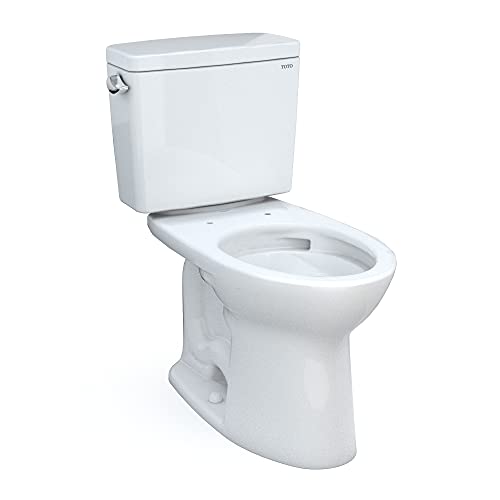
TOTO Drake II (CST454CEFG): A 1.28 GPF WaterSense-certified two-piece with a 1,000g MaP score. Uses TOTO's Double Cyclone flushing system with two nozzles instead of a rim channel for even bowl coverage. The tank has a CEFIONTECT glaze option that reduces waste adhesion. This is one of the most consistently recommended two-piece toilets in plumbing professional circles. Check price on Amazon.
Kohler Highline Classic (K-3493): A reliable 1.28 GPF WaterSense model with a 3-inch flush valve and Class Five flushing technology. Scores 1,000g on MaP testing. Wide availability of replacement parts through Kohler's service network. The Highline's simple lines hold up in transitional and traditional bathrooms equally well. Check price on Amazon.
American Standard Champion 4 (2034.014): The 4-inch flush valve is a genuine differentiator. At 1.6 GPF it is not WaterSense certified but produces industry-leading waste removal. The right choice for households with documented clogging history or older, smaller-diameter drain lines. See our full American Standard Champion 4 review for details. Check price on Amazon.
Gerber Viper (21-302): Less prominent in consumer marketing but consistently scores 1,000g on MaP at 1.28 GPF. Gerber's commercial plumbing heritage means durable internal components. Good option for buyers who want MaP-verified performance without premium brand pricing. Check price on Amazon.
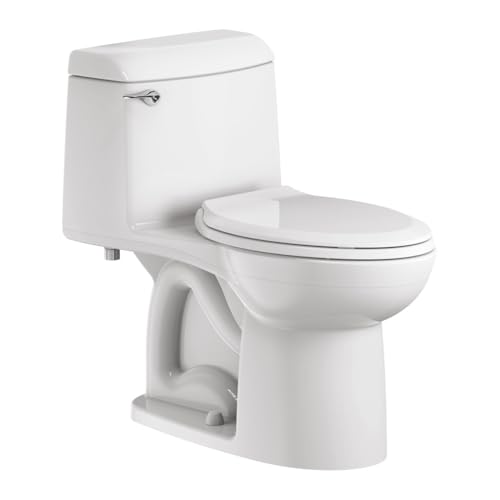
TOTO UltraMax II (MS604114CEFG): The one-piece companion to the Drake II. Same 1,000g MaP score and 1.28 GPF WaterSense performance in a seamless elongated design with CEFIONTECT glaze. The most frequently cited one-piece recommendation by plumbing professionals based on owner review aggregates and service call frequency. Check price on Amazon.
Woodbridge T-0001: A dual-flush one-piece at 1.28/0.8 GPF that delivers clean modern styling at a price point well below TOTO's one-piece line. MaP score is estimated around 800g, adequate for most households. The skirted design simplifies cleaning. Popular in bathroom remodel contexts where visual impact matters. Read more in our Woodbridge T-0001 review. Check price on Amazon.
TOTO Aquia IV (MS446124CEMFG): A dual-flush one-piece at 1.0/0.8 GPF with TOTO's Tornado Flush. Among the most water-efficient gravity-flush one-piece toilets available. MaP score of 600g at 1.0 GPF means it is suited to households with normal waste loads, not heavy-duty clog-prone situations. Check price on Amazon.
Swiss Madison Sublime II: A wall-facing skirted one-piece with a modern low-profile appearance. Dual-flush at 1.28/0.8 GPF with WaterSense certification. Aesthetic-forward; MaP data is less consistently published than for TOTO or Kohler. Best suited to guest bathrooms or primary baths where aesthetics take priority over heavy-duty performance. Check price on Amazon.
After reviewing performance data, cost structures, and owner feedback, the decision typically narrows to three scenarios:
Choose a one-piece if: Your bathroom is a primary or master bath that is cleaned frequently and visible to guests. The seamless look matters to you and fits your renovation budget. You are not doing a DIY installation. The bathroom has standard door clearance and no sharp turns between the exterior door and the bathroom.
Choose a two-piece if: Budget is a primary consideration and you want the best MaP-verified flushing performance per dollar. The toilet is for a secondary, basement, or children's bathroom. You are doing a DIY installation and prefer to carry the bowl and tank separately. You want maximum replacement-parts availability for long-term ownership. You live in a climate where pipes could freeze and tank cracks are a real risk.
Either works equally well if: Flushing performance is your top priority (both achieve 1,000g MaP), water efficiency is the goal (WaterSense options in both), or the toilet goes in an accessible design context (ADA-compliant chair-height models exist in both formats). For accessible bathroom planning, see our ADA toilet guide.
One comparison that does not get enough attention: the trapway. Fully glazed, larger-diameter trapways resist clogs better than partially glazed or smaller ones, regardless of one-piece vs two-piece format. TOTO's SanaGloss and American Standard's EverClean surface treatments apply to both formats and materially affect long-term cleaning ease and clog resistance. For more on flush technology, see our guide to toilet flushing systems.
No. Flush performance is determined by flush valve size, trapway diameter, and tank volume, not by whether the tank is attached to the bowl. Both formats achieve 1,000g MaP scores, which is the highest rating available from independent flush testing.
In some respects, yes. One-piece toilets eliminate the tank-bowl gasket that can wear and cause slow leaks in two-piece models. However, two-piece toilets allow individual replacement of the tank or bowl if one component is damaged, which can extend service life.
A typical one-piece toilet weighs 90 to 130 pounds as a single unit. A two-piece toilet's combined weight is often similar but is split between a 40 to 60 pound bowl and a 20 to 30 pound tank, making each piece manageable by one person.
Yes, but it is strongly recommended to have a second person assist. The single-piece weight and the need to lower the entire unit precisely onto the wax ring without chipping the china makes solo installation risky. Two-piece toilets are generally easier for DIY installation.
Both score 1,000g MaP at 1.28 GPF and use the same Double Cyclone flush system. The UltraMax II is one-piece and costs significantly more. If cleaner aesthetics and easier seam cleaning justify the premium for your bathroom, yes. If performance-per-dollar is the goal, the Drake II two-piece delivers the same flush at lower cost.
EPA WaterSense is a certification program that requires toilets to use 1.28 GPF or less and pass a minimum MaP flush test of 350g. Certified toilets are independently tested and verified. Both one-piece and two-piece models qualify across major brands including TOTO, Kohler, American Standard, and Gerber.
Routine internal repairs (fill valves, flush valves, flappers) cost the same regardless of format since the tank internals are identical in design. The one scenario where a one-piece is dramatically more expensive to repair is a cracked tank, which requires full unit replacement since the tank cannot be sourced separately.
MaP (Maximum Performance) testing drops measured amounts of compacted soybean paste into a toilet to determine the maximum waste load it can clear in a single flush. Scores range from 250g to 1,000g. A 1,000g score indicates the toilet can handle virtually any residential waste load without clogging. MaP data is publicly available at map-testing.com.
One-piece toilets often have a lower profile and shorter footprint than comparable two-piece models, which can help in smaller bathrooms. However, the difference is typically 1 to 3 inches in depth. Compact elongated designs are available in both formats for tight spaces.
Not inherently. Water use per flush is set by the tank volume and flush valve, not by the design format. Both one-piece and two-piece toilets are available in WaterSense-certified 1.28 GPF and dual-flush 1.28/0.8 GPF configurations. Choose by certification, not by piece count.
The Woodbridge T-0001 earns solid marks for aesthetics and value. Its dual-flush mechanism at 1.28/0.8 GPF is WaterSense certified. MaP scores are estimated around 800g, adequate for most households. It competes well on price against TOTO and Kohler one-piece models with comparable clean lines.
The china bowl and tank of a quality toilet can last 50 years or more. The internal components (fill valve, flapper, flush valve seat) typically need replacement every 5 to 10 years. Tank-bowl gaskets on two-piece toilets may need replacement every 10 to 20 years. One-piece and two-piece toilets have comparable service lifespans when maintained.
The standard U.S. rough-in is 12 inches, measured from the finished wall to the center of the floor drain. Older homes may have 10-inch or 14-inch rough-ins. Verify your rough-in before purchasing any toilet, as most models are manufactured for 12-inch rough-ins only.
Often yes, but compatibility matters. Many manufacturers sell replacement tanks for current model lines. Universal replacement tanks exist for some bowl footprints. The safest approach is to source the replacement tank from the same manufacturer and model line as the existing bowl to ensure proper bolt spacing and gasket fit.
American Standard offers the Champion 4 Max as a one-piece version of the Champion 4 platform. It retains the 4-inch flush valve and produces the same high-clearance flush at 1.6 GPF. Like the two-piece Champion 4, it is not WaterSense certified due to the higher GPF but delivers maximum clog resistance.
A skirted toilet has a smooth ceramic panel covering the exterior of the trapway, eliminating the ridges and curves visible on standard designs. Skirted models exist in both one-piece and two-piece formats. TOTO's Drake Washlet+ series includes a skirted two-piece option; most Swiss Madison designs are skirted one-piece.
TOTO, Kohler, American Standard, and Gerber all offer lifetime limited warranties on china for residential use. Parts warranties vary: TOTO offers 1 year on parts, Kohler offers 1 year on electronics and 1 year on non-china parts for most models. Warranty coverage is broadly equivalent across brands and does not differ between one-piece and two-piece designs.
No. Clog resistance is a function of trapway size, flush valve diameter, and flush volume, none of which are determined by whether the toilet is one-piece or two-piece. A 1,000g MaP-rated two-piece toilet is equally clog-resistant as a 1,000g one-piece at identical GPF.
For most homeowners, a high-quality two-piece toilet such as the TOTO Drake II or Kohler Highline delivers identical flushing performance to its one-piece counterpart at a meaningfully lower cost, with easier installation and better parts availability over the long term. One-piece toilets earn their premium in primary bathrooms where seamless aesthetics and simplified cleaning around the tank-bowl junction genuinely matter day to day. Match your choice to your bathroom's actual use frequency, cleaning habits, and budget rather than marketing claims about flushing superiority, since published MaP data shows both formats reach the same 1,000g ceiling.
We compared the TOTO Drake and Kohler Highline two-piece toilets: both hit MaP 1000 at 1.28 GPF. See flush systems, verified specs…
Read the guideHome / Comparisons / TOTO Drake vs TOTO Drake II TOTO Drake Two-Piece Toilet vs TOTO Drake II Two-Piece Toilet: Which Should…
Read the guideA data-driven look at resale impact, long-term availability, and which color choice makes more sense for your bathroom and your budget.
Read the guide